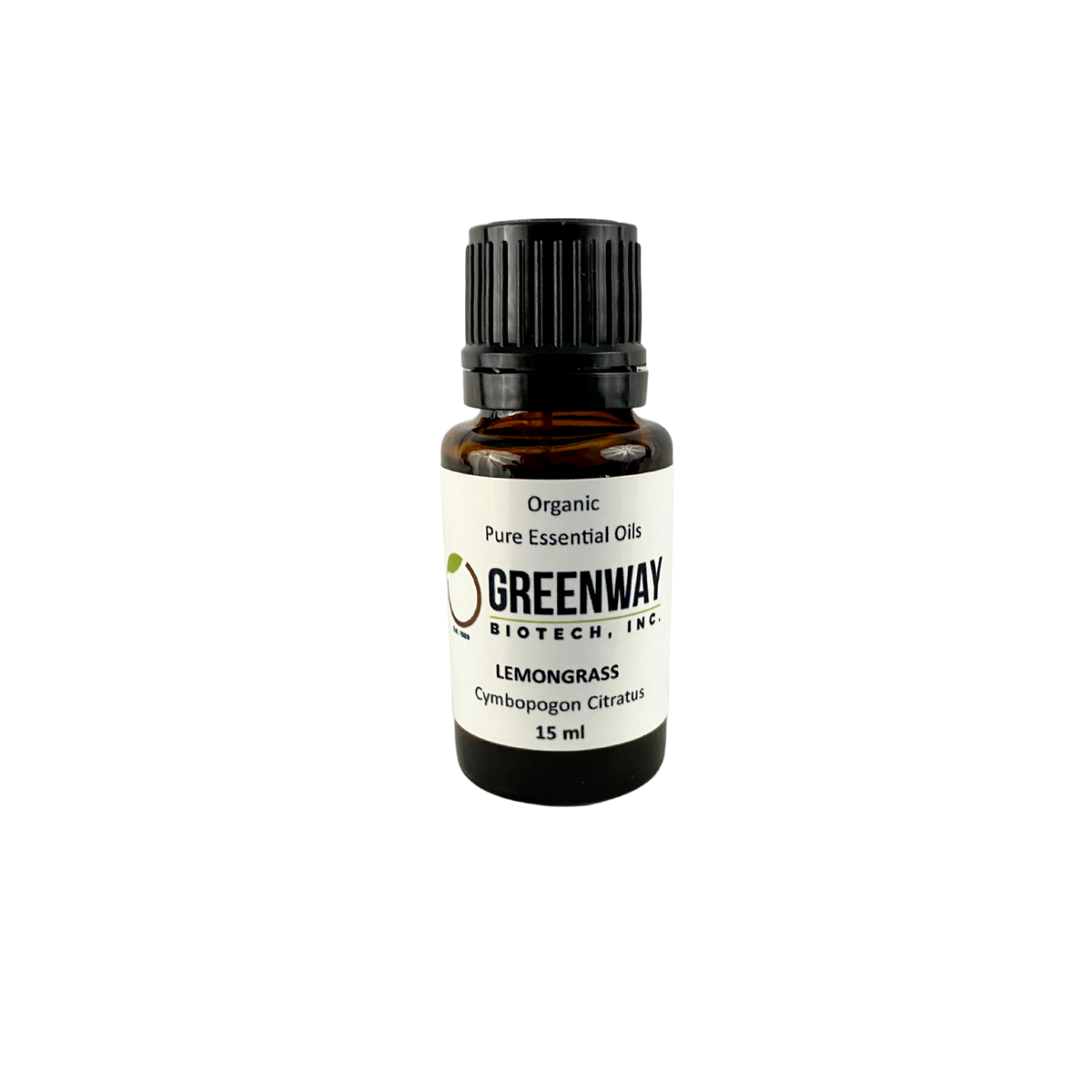
Lemongrass essential oil is dominated by a single compound — or more precisely, a single isomer pair: citral, a 50/50 mixture of two stereoisomeric monoterpene aldehydes (geranial, the trans isomer, and neral, the cis isomer). Together they make up 65-85% of the oil by weight. Citral is the compound responsible for the unmistakable "lemon" aroma that shows up in many otherwise unrelated plants — lemon balm, lemon myrtle, and cold-pressed lemon peel oil all owe their characteristic scent to citral, just in much lower concentrations than lemongrass.
The supporting cast rounds out the body. Geraniol (3-7%) adds a soft rose-floral undertone — the same compound found in geranium and rose oils. Myrcene (10-20%) contributes a slightly herbal-resinous balsamic character. Limonene (1-5%) adds a faint citrus background. Linalool (trace) brings a soft floral note. Together these supporting compounds give lemongrass its complexity beyond the citral headline — distinguishing it from a pure citral isolate or from synthetic "lemongrass fragrance."
Two practical implications follow from this chemistry. First, lemongrass is a documented contact sensitizer due to its high citral content — IFRA sets the maximum topical dilution at 0.7%, the lowest in the Greenway citrus and citrus-adjacent line. Patch testing is more important here than for most essential oils. Second, the oil stores meaningfully better than cold-pressed citrus oils — steam distillation produces a more stable product, and a 2-3 year shelf life sealed in dark amber glass is realistic. The trade-off: lemongrass is a top note but with less of cold-pressed citrus's bright, sparkling immediacy — its character is heavier and more herbaceous.
Constituent ranges below reflect typical batch profiles for steam-distilled Sri Lankan Cymbopogon citratus oil. The current-batch GC/MS report is available on request.
Citral — Geranial + Neral (65-85%)
The dominant aldehyde pair. Carries the unmistakable lemony aroma and the well-documented natural-cleaning reputation that makes lemongrass popular in DIY surface sprays. Also the compound responsible for the strict 0.7% topical dilution limit.
Myrcene (10-20%)
A monoterpene with a slight herbal-resinous, balsamic character. Also a major component in hops, bay laurel, and lavender. Adds aromatic depth that distinguishes lemongrass from a citral isolate.
Geraniol (3-7%)
A monoterpene alcohol with a soft rose-floral character — also dominant in geranium, rose, and palmarosa oils. Contributes to the slightly sweet floral undertone in the lemongrass aromatic profile.
Limonene (1-5%)
The dominant compound in expressed citrus oils, present here in supporting amounts. Adds a faint citrus background to the citral headline.
Linalool (trace)
A soft floral terpene alcohol, the same compound that dominates lavender. Contributes a delicate floral background to the herbal-citrus profile.
No Furanocoumarins
Unlike cold-pressed citrus peel oils, steam distillation does not capture the trace furanocoumarins (bergapten, bergamottin) responsible for phototoxicity. Lemongrass is non-phototoxic at any topical concentration within the 0.7% maximum.