Continental US, Standard shipping: free on orders of $100 or more, $9.99 on orders under $50, and $14.99 from $50 up to $100.
UPS and FedEx options are also offered at checkout, at their own rates.
Orders placed by 11 AM Pacific on a business day ship the same day.
Alaska, Hawaii, US territories, APO/FPO and international addresses: the cost is shown at checkout, and 2-day delivery isn’t available to Alaska, Hawaii or P.O. boxes.
Water-soluble fertilizer for cucurbits · 8-16-36 · chelated micronutrients
About Cucumber Fertilizer 8-16-36
Cucumber Fertilizer 8-16-36 is a water-soluble fertilizer for cucumbers, squash, watermelon, cantaloupe, and the other vine crops named on its label. It supplies 36% soluble potash (K₂O), 16% available phosphate (P₂O₅), and 8% nitrogen, with EDTA-chelated iron, manganese, zinc, and copper plus boron and molybdenum. The label rate is 2.8 grams per plant every 4 to 6 weeks. With a soil test you can size a bed by the potash the test calls for, and in hydroponics you dose it to a potassium target.
It is a potash-rich supplement, not a complete program. It contains no calcium or magnesium, and it supplies 4.5 parts potash for every part nitrogen, so most of a cucurbit crop’s nitrogen has to come from another fertilizer. Keep its concentrate separate from calcium concentrates.
36% K₂O Each pound supplies 163 g of potash, 73 g of available phosphate, and 36 g of nitrogen
2.8 g per plant The label’s soil rate, every 4 to 6 weeks. A 1 lb bag holds about 160 of these doses
No Ca or Mg Supply calcium and magnesium separately. See companion products
Product facts & composition
Guaranteed analysis and product specifications, Greenway Biotech Cucumber Fertilizer 8-16-36 (package label dated March 25, 2025)
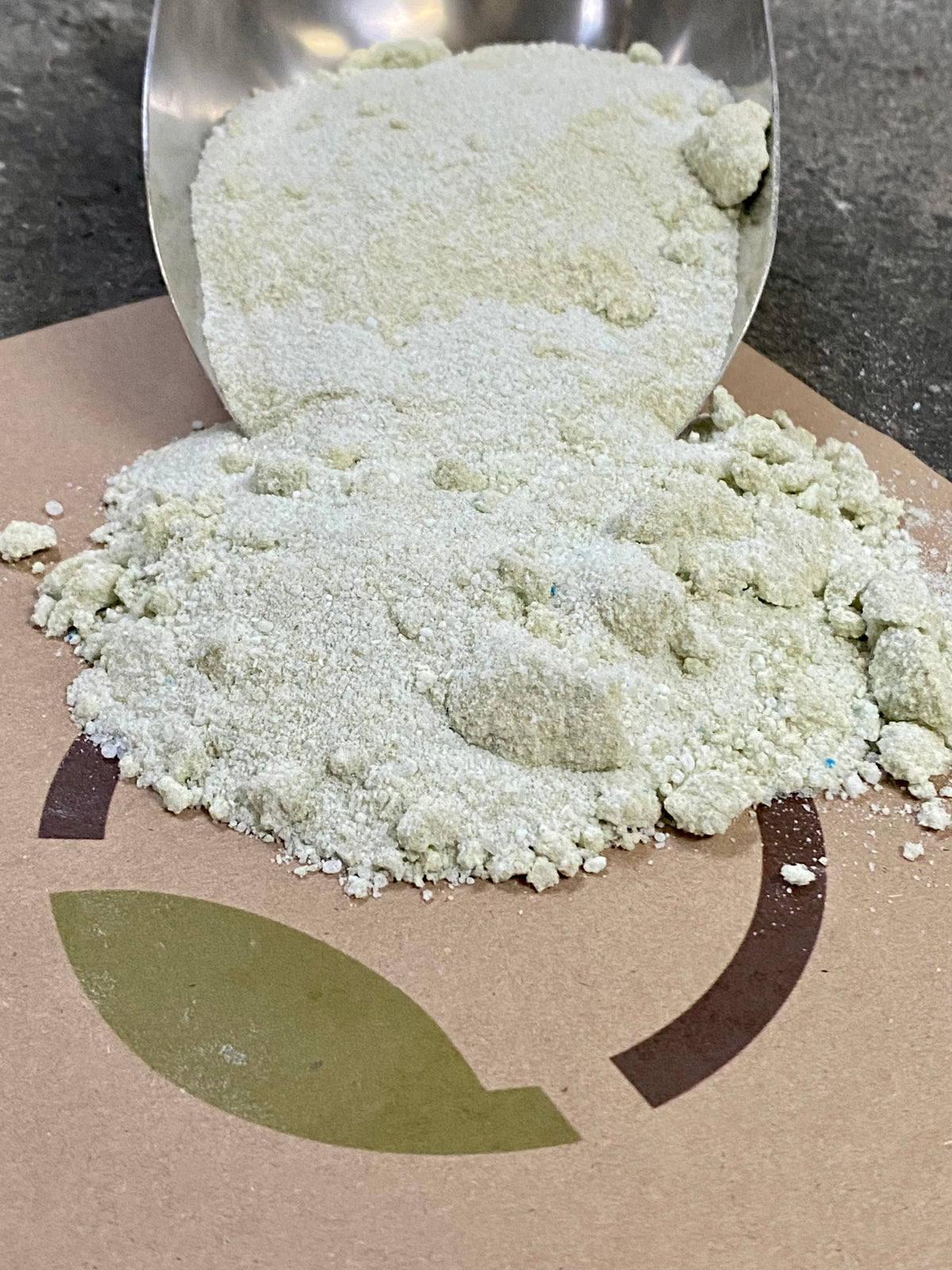
White to off-white powder or fine granules. The Safety Data Sheet describes it as fully soluble at recommended use rates
In solution
1 g of product per liter adds 80 ppm nitrogen (65 nitrate N, 15 ammoniacal N), 70 ppm phosphorus, 299 ppm potassium, 5 ppm iron, 3 ppm zinc, 2 ppm manganese, 1 ppm boron, 0.5 ppm copper, and 0.01 ppm molybdenum. 1 g per US gallon adds 21 ppm N, 18 ppm P, and 79 ppm K
Heavy-metal test
One independent laboratory report is on file for this product (AgroLab/Matrix Sciences; sample received December 16, 2024; reported December 20, 2024): arsenic 0.36, cadmium 0.36, lead 1.02, nickel 1.10 mg/kg, mercury not detected. See Product documents
Hazards
Harmful if swallowed. Avoid contact with eyes, open cuts, or sores, and avoid breathing dust. See Handling, storage & limitations
Package sizes
1, 2, 5, 10, and 25 lb
Percentages are by weight of product. One pound supplies 163 g (0.36 lb) of potash (K₂O), 73 g (0.16 lb) of available phosphate (P₂O₅), and 36 g (0.08 lb) of nitrogen, of which about four-fifths is nitrate nitrogen. Labels state phosphorus and potassium as oxides; the solution figures above convert them to elements with P = P₂O₅ × 0.436 and K = K₂O × 0.830, because hydroponic recipes are written in elemental ppm. The potassium sulfate and ammonium sulfate also supply some sulfur, but the label guarantees none. The iron, zinc, manganese, and copper come from EDTA chelates; the boron and molybdenum come from boric acid and sodium molybdate. Weigh the product: this page assumes no weight for a spoonful.
Best uses & benefits
Choose it when a cucurbit crop needs potash and some phosphate, and you have another source of nitrogen, calcium, and magnesium.
The cucurbits on its label
The label names cucumbers and squash, including zucchini, winter squash, mirliton (chayote), pumpkin, gourd, cucuzzi, cushaw, and luffa, plus watermelon and cantaloupe. Because it contains boron, keep to those crops: the label warns that boron-containing fertilizers used on other crops can cause serious injury.
A potash source for fruiting vine crops
North Carolina State Extension estimates that a 10-ton cucumber harvest removes about 174 lb of potash (K₂O), 90 lb of nitrogen, and 28 lb of phosphate per acre. Clemson Extension warns that too much nitrogen on cucumbers encourages vines and reduces fruit, and this product carries little nitrogen for its potash.
Hydroponic and fertigation recipes
University of Florida IFAS hydroponic recipes put a potash-and-phosphate premix in one stock tank and calcium nitrate in another. Dosed to a potassium target, this product can fill the premix role in a cucumber solution; calcium, magnesium, and most of the nitrogen come from the other tank and ingredients. See the hydroponic formula.
Garden plants without a soil test
The label’s per-plant soil rate, 2.8 g every 4 to 6 weeks, lets you feed cucurbits in garden soil by plant count. A soil test lets you size a whole bed by its potash need instead.
Where it is a poor fit
Soils that test high in potassium. University of Florida IFAS recommends no potash for cucurbits on soils testing high, and the Mid-Atlantic recommendations none on soils testing very high.
Soils already high in phosphorus. Every pound of potash from this product brings 0.44 lb of phosphate. For potash alone, Potassium Sulfate 0-0-53 adds none.
A nitrogen feed. It supplies 8% nitrogen against 36% potash. Plan nitrogen separately; see Application rates.
Crops not on the label, and forage. Boron can injure crops the label does not list, and molybdenum can build up in forage to levels toxic to cattle, sheep, and goats.
Foliar feeding. This page gives no foliar rate; see Application rates.
Application rates & directions
Use one of three bases: the label’s per-plant rate, a soil test’s potash recommendation for a bed or field, or a potassium target for a nutrient solution. Weigh the product. If the directions printed on your package differ from this page, contact us before applying.
Test first. Clemson Extension puts the best soil pH for cucumbers at 6.0 to 6.5 and calls a soil test the best guide to a crop’s fertilizer needs. For nutrient solutions, test your water for potassium, calcium, and magnesium before you mix.
Per plant: the label rate
Per-plant soil rate from the Cucumber Fertilizer 8-16-36 package label, for cucurbits in garden soil
Plants
Product per application
Supplies per application
How often
1 plant
2.8 g
1.0 g potash (K₂O), 0.45 g phosphate (P₂O₅), 0.22 g nitrogen
Every 4 to 6 weeks
5 plants
14 g
5.0 g K₂O, 2.2 g P₂O₅, 1.1 g N
Every 4 to 6 weeks
12 plants
33.6 g
12.1 g K₂O, 5.4 g P₂O₅, 2.7 g N
Every 4 to 6 weeks
The label gives the amount as “2.8 grams or ½ teaspoon” per plant. This page uses the weight, because the weight of a teaspoon of this product has not been measured; a kitchen scale that reads to 0.1 g is enough. The label gives no rate for plants in containers of potting mix; email us before using it there.
Placement. Clemson Extension advises placing sidedress fertilizer 4 to 6 inches from the plants to avoid burning the roots. Water it in afterward. Because this product dissolves, you can instead dissolve the weighed dose in a full watering can and pour it around the plant on moist soil. Keep it off the leaves and stems.
Beds and fields: size it by a soil test
Formula. Pounds of product = pounds of potash (K₂O) your soil test recommends ÷ 0.36. Multiply by 453.6 for grams. Extension applies potash before planting, broadcast and worked into the soil. On drip-irrigated beds under plastic, North Carolina State Extension works about 30% of the potassium into the bed before laying the plastic and injects the rest through the season.
University Extension potash (K₂O) recommendations for cucumbers by soil-test potassium level, for a whole season, with the equivalent weight of this 36% K₂O product
Source and soil-test potassium
K₂O recommended per acre
This product per acre
This product per 100 sq ft
UF/IFAS, cucurbits: low
100–120 lb
278–333 lb
289–347 g (0.64–0.77 lb)
UF/IFAS, cucurbits: medium
80 lb
222 lb
231 g (0.51 lb)
UF/IFAS, cucurbits: high
None
None
None
Mid-Atlantic, cucumbers: low
200 lb
556 lb
579 g (1.28 lb)
Mid-Atlantic, cucumbers: medium
150 lb
417 lb
434 g (0.96 lb)
Mid-Atlantic, cucumbers: high
100 lb
278 lb
289 g (0.64 lb)
Mid-Atlantic, cucumbers: very high
None
None
None
UF/IFAS figures are from its Florida fertilizer-management chapter (CV296, Mehlich-3 soil test); Mid-Atlantic figures are the season totals in the 2026/2027 Mid-Atlantic Commercial Vegetable Production Recommendations. Soil-test labs define low, medium, and high differently, so use the recommendation printed on your own report. Each pound of potash from this product also brings 0.44 lb of phosphate and 0.22 lb of nitrogen; on soils high in phosphorus, a potash-only source avoids adding phosphate the soil does not need.
What the label prints for beds and fields
For soil beds the label prints 1 to 1.5 lb per 100 sq ft, or 260 to 580 lb per acre, and says the acre rate assumes 40,000 to 90,000 plants per acre. That is about 90 to 210 plants per 100 sq ft, the density of machine-harvested pickling cucumbers (North Carolina State Extension: 50,000 to 70,000 plants per acre). Garden cucurbits stand far wider, from about 2 plants per 100 sq ft for watermelon to about 44 for trellised cucumbers (Clemson Extension spacing). The label’s bed rate supplies 157 to 235 lb of potash per acre and its field rate 94 to 209 lb; the Extension recommendations above give 100 to 200 lb for a whole season on soil low in potassium, and less or none on soil that tests higher. Because the label does not say how often to repeat the bed or field rate, and one application already supplies about as much potash as Extension recommends for a whole season on low-potassium soil, this page sizes beds by a soil test instead. If you want to use the bed or field rate on your package, email us your soil test first.
Nitrogen and calcium come from other fertilizers
At the label’s per-plant rate, this product supplies only 0.22 g of nitrogen per plant. For home-garden cucumbers, Clemson Extension sidedresses calcium nitrate at 2 lb per 100 ft of row before the vines develop, and for cantaloupe and watermelon again after bloom, when fruit is developing. Commercial recommendations run 80 to 150 lb of nitrogen per acre for cucumbers (Mid-Atlantic), with at least half of it as nitrate. Clemson warns not to overfertilize cucumbers with nitrogen, because it encourages vine growth and reduces fruit. For calcium in soil, lime to the pH your soil test calls for, or use gypsum where calcium is low and pH is already on target, and keep the soil evenly moist.
Hydroponic solutions
Formula. Grams of product = (potassium target in ppm − potassium already in your water in ppm) × liters of final solution ÷ 299. Multiply US gallons by 3.785 to get liters. Dose it to the potassium target; calcium, magnesium, and most of the nitrogen come from other ingredients in a separate stock.
The University of Florida IFAS cucumber formula (Formula 2 in CV265) targets 150 ppm potassium and 62 ppm phosphorus at every stage, 133 ppm nitrogen and 130 ppm calcium from seeding to first fruit, and 240 ppm nitrogen and 260 ppm calcium from first fruit to the end of the crop, with 50 ppm magnesium. Dosed to 150 ppm potassium, this product supplies the following:
This product at 0.50 g per liter of final solution (150 ppm potassium), compared with the University of Florida IFAS cucumber formula, in ppm (mg/L)
Nutrient
From this product at 0.50 g/L
UF/IFAS cucumber formula
Supply the difference with
Potassium (K)
150
150
Nothing further
Phosphorus (P)
35
62
A phosphorus source without potassium, if you want the full 62; monopotassium phosphate would also raise potassium
Nitrogen (N)
40 (33 nitrate, 7.5 ammoniacal)
133, then 240
Calcium nitrate, in its own stock
Calcium (Ca)
0
130, then 260
Calcium nitrate, in its own stock
Magnesium (Mg)
0
50
Magnesium sulfate (Epsom salt)
Iron (Fe)
2.5
2.5
Nothing further
Manganese (Mn)
1.0
0.62
None; more than the formula
Zinc (Zn)
1.5
0.09
None; about 17 times the formula
Boron (B)
0.50
0.44
Nothing further
Copper (Cu)
0.25
0.05
None; 5 times the formula
Molybdenum (Mo)
0.005
0.03
Molybdenum alone, if you follow the full formula
Calcium and nitrogen. Calcium nitrate 15.5-0-0 adds 190 ppm calcium and 155 ppm nitrogen for each gram per liter. To reach 130 ppm calcium from water with none, add 0.68 g per liter, which brings total nitrogen to about 146 ppm; for 260 ppm calcium, 1.37 g per liter brings it to about 252 ppm. UF/IFAS adds magnesium sulfate at 50 g per 100 liters (0.5 g per liter) for 50 ppm magnesium, in the same stock as the potash and phosphate, away from the calcium nitrate.
Micronutrients. At this dose the product supplies about as much iron and boron as the UF/IFAS cucumber formula, but more zinc, copper, and manganese (zinc about 17 times as much) and about one-sixth of the molybdenum. Do not add a complete micronutrient mix on top of it; add molybdenum alone if your recipe calls for it, and anything else only if a water or plant tissue test calls for it.
Potassium and calcium balance. UF/IFAS cautions that premixed fertilizers carry large amounts of potassium, and that excess potassium with low calcium in the water can bring on early blossom-end rot, because potassium interferes with calcium uptake. Dose to your recipe’s potassium target rather than above it, and supply the calcium.
Stock strength. The UF/IFAS tomato recipe dissolves 16 lb of a 4-18-38 premix in a 30-gallon stock tank, about 64 g per liter, for injection at 1:100. If your stock needs much more than that, dissolve the product in warm water and check that nothing settles out; if it does, use a larger tank or a smaller dilution ratio, such as 1:100 instead of 1:200.
pH, EC, and solution changes. UF/IFAS gives a target pH of 5.5 to 6.0 for greenhouse cucumber solutions (CV268), and Oklahoma State lists an EC of 1.7 to 2.0 mS/cm for hydroponic cucumbers (HLA-6722). Oklahoma State advises checking pH and EC daily and replacing the solution completely every two weeks; UF/IFAS recommends flushing the sump tank of recirculating systems once per week and mixing new solution. These are greenhouse recipe figures, not the only correct recipe for every system.
Foliar sprays
This page gives no foliar rate. The label’s foliar directions do not state how much water to use per plant and assume a planting far denser than garden cucurbits, so this page does not restate them while they are under review. None of the university sources used for this page gives a foliar rate for a fertilizer of this kind on cucurbits. If you plan to spray, email questions@greenwaybiotech.com with your crop and sprayer volume first.
How to use Cucumber Fertilizer 8-16-36
Test and plan. Get a soil test for beds and fields, or a water test for nutrient solutions. Lime to pH 6.0 to 6.5 for cucumbers if the test calls for it, and plan nitrogen and calcium from other fertilizers.
Pick one basis and weigh the dose. Use 2.8 g per plant, your soil test’s potash recommendation divided by 0.36, or your solution’s potassium target. The calculator below does the arithmetic.
Apply it. Per plant: place it 4 to 6 inches from the stem and water it in, or dissolve it in a full watering can and pour it around the plant. Beds: broadcast it and work it in before planting. Solutions: dissolve it on its own and keep its concentrate in a different stock tank from calcium nitrate or Cal-Mag.
Add nitrogen and calcium separately. Sidedress calcium nitrate before the vines develop, or add it to the calcium stock of your solution, and keep the soil evenly moist.
Repeat only as the basis says. Per plant: every 4 to 6 weeks. Soil-test amounts: once per season, then retest. Solutions: check pH and EC daily and replace the solution every one to two weeks.
Calculator & choosing a size
Formulas. Per plant: grams of product = number of plants × 2.8. Beds by soil test: pounds of product = pounds of potash (K₂O) recommended for the area ÷ 0.36. Solutions: grams of product = (potassium target − potassium in your water, in ppm) × liters of final solution ÷ 299. Multiply pounds by 453.6 for grams.
Worked examples. 12 cucumber plants at the label rate: 12 × 2.8 = 33.6 g per application, supplying 12.1 g of potash and 2.7 g of nitrogen; a 1 lb bag covers it and about 13 applications like it. A 200 sq ft bed whose soil test recommends 3 lb of potash per 1,000 sq ft: 0.2 × 3 = 0.6 lb of K₂O, ÷ 0.36 = 1.67 lb (756 g) of product, supplying 121 g of phosphate and 60.5 g of nitrogen; a 2 lb bag covers it. A 50-gallon fresh batch of cucumber solution at the UF/IFAS 150 ppm potassium target, from water with no potassium: 150 × 189.3 L ÷ 299 = 95.0 g of product, adding 40 ppm nitrogen and 35 ppm phosphorus; a 1 lb bag covers it, and calcium nitrate for 130 ppm calcium from water with 30 ppm is 99.6 g in the separate stock. A 30-gallon injector stock at 1:100 (3,000 gallons of final solution) at 150 ppm potassium, from water with 5 ppm: 12.15 lb (5,510 g) in the stock tank, 184 g per gallon of stock; a 25 lb bag covers it, or a 10 lb and a 5 lb bag together.
How many 2.8 g per-plant label doses each bag size holds
Bag size
Per-plant doses of 2.8 g
1 lb (454 g)
About 160
2 lb (907 g)
About 320
5 lb (2.27 kg)
About 810
10 lb (4.54 kg)
About 1,620
25 lb (11.3 kg)
About 4,050
The calculator below asks how many plants you are feeding, how large your bed is and what potash your soil test recommends, or the volume and potassium target of your nutrient solution. It applies the label’s per-plant rate or your test result, states the nutrients supplied, and recommends the smallest single bag that covers one application or batch, plus a lower-price bag combination when one exists. Prices, tax, and shipping are confirmed at checkout, and availability is confirmed when you add to cart.
The calculator needs JavaScript. If it does not appear, use the rate tables and formulas above to choose a size.
How Cucumber Fertilizer 8-16-36 works
Potassium is the nutrient this product supplies most of. University of Minnesota Extension explains that potassium helps regulate the opening and closing of leaf stomata, which controls water loss and gas exchange, maintains cell turgor, and enhances the movement of sugars and starch in the plant. Fruit is a large potassium sink: North Carolina State Extension estimates that a 10-ton cucumber harvest removes about 174 lb of potash per acre against 90 lb of nitrogen, roughly two parts potash to one of nitrogen. This product supplies 4.5 parts potash to one of nitrogen, which is why the nitrogen plan comes from another fertilizer.
About four-fifths of its nitrogen (6.5% of its 8%) is nitrate. The Mid-Atlantic recommendations advise that at least half of the nitrogen for cucumbers be in nitrate form, and North Carolina State Extension says the same to reduce the chance of leaf burn and blossom-end rot. Clemson Extension warns that too much nitrogen on cucumbers and melons encourages vine growth and reduces fruit.
Its phosphate comes from monopotassium phosphate. In concentrated form, calcium reacts with phosphate to form calcium phosphate, and with sulfate to form calcium sulfate, both insoluble; that is why UF/IFAS keeps calcium nitrate in its own stock tank, and why this product and calcium sources are dissolved separately. Once each is diluted into the final solution they can be used together.
Two common cucurbit problems are not fertilizer problems alone. Blossom-end rot on squash, cucumbers, and watermelon comes from calcium failing to reach the developing fruit; Clemson Extension reports that foliar calcium sprays are not effective and that uniform soil moisture is the most effective prevention. In cucumbers, bitterness comes from cucurbitacins; Alabama Extension says their occurrence is genetically controlled but usually triggered by stress such as low or uneven soil moisture, low fertility, and low pH, and Nebraska Extension adds high temperatures and wide temperature swings. Nebraska Extension notes that extreme bitterness in zucchini and summer squash is set by a single gene, not by growing conditions, and that such fruit should be discarded, not eaten. This describes plant nutrition in general; it is not a trial of this finished product.
Compare your options
Match the product to your crop and your soil or water test. Analyses are each product’s guarantee as shown on its page.
Cucumber Fertilizer 8-16-36 compared with other Greenway water-soluble potash sources
Option
N–P₂O₅–K₂O
Potash per part nitrogen
Choose it when
Cucumber Fertilizer 8-16-36, this product
8-16-36, chelated micronutrients
4.5
You grow the cucurbits on its label and need potash and some phosphate
You build a solution from single salts and need phosphorus and potassium without nitrogen
None of these contains calcium or magnesium. Follow each product’s label for the crops it names.
Related products & compatibility
These supply what Cucumber Fertilizer 8-16-36 lacks. Use them in the same program, as your soil or water test calls for; they are not all required.
Calcium Nitrate 15.5-0-0: nitrogen and calcium. Clemson Extension sidedresses cucumbers with it at 2 lb per 100 ft of row, and UF/IFAS uses it as the calcium source in its cucumber solution. In solutions it goes in its own stock tank.
Cal-Mag Plus 2-0-0 Concentrate: calcium and magnesium with little nitrogen. Follow the directions on its page, and keep it apart from this product until both are diluted.
Epsom Salt (Magnesium Sulfate): magnesium and sulfur. UF/IFAS puts magnesium sulfate in the same stock as the potash and phosphate, away from calcium nitrate.
Gypsum (Calcium Sulfate): calcium for soil without raising pH, where a soil test shows calcium is low and pH is already on target. It is for soil, not for stock solutions.
Same program, separate concentrates. Dissolve this product and any calcium source separately. In concentrated form, calcium reacts with the phosphate and sulfate in this product and settles out, which can clog emitters. Dilute each into the final solution, where they can be used together, and check the final solution for cloudiness, EC, and pH. In the garden, apply this product and a calcium nitrate sidedress as separate applications.
Handling, storage & limitations
Label caution. Keep out of reach of children. Harmful if swallowed. Avoid contact with eyes, open cuts, or sores. Avoid breathing dust. Wash thoroughly after handling.
Protective equipment. The Safety Data Sheet recommends nitrile gloves and safety glasses with side shields, and chemical splash goggles when mixing concentrated solutions. Avoid raising dust, and do not eat, drink, or smoke while handling it.
Crop limits. The label warns that boron-containing fertilizers used on crops other than those recommended can cause serious injury, and that molybdenum can make forage toxic to cattle, sheep, and goats. Use it only on the crops the label lists, and not on forage or pasture.
Storage. Keep it in the original container, sealed, in a cool, dry, well-ventilated place between 40 and 95°F. It absorbs moisture from the air; clumping is physical and does not indicate a chemical change. Store it away from heat, flames, combustible and organic materials, acids, lime, food, feed, and drinking water, and out of reach of children and animals. It contains potassium nitrate, so keep it away from fire.
Spills and disposal. Sweep up spills without raising dust and keep the product out of drains and waterways, where nitrate and phosphate feed algae. Use leftover product as fertilizer according to the label. Triple-rinse empty containers, use the rinse water as fertilizer, and dispose of the containers as local rules require.
Use limits. Weigh every application, and follow one basis at a time: per plant, soil test, or solution target. It is not a complete fertilizer and not a nitrogen, calcium, or magnesium source.
First aid. Eyes: flush with clean running water for at least 15 minutes, lifting the eyelids, and remove contact lenses if easy to do; get medical attention if irritation persists. Skin: brush off dry material, wash with soap and water for at least 15 minutes, and get medical attention if irritation persists. Inhaled: move to fresh air; get medical attention if coughing or irritation persists. Swallowed: do not induce vomiting; rinse the mouth, give one to two glasses of water if the person is conscious and alert, and contact Poison Control or a doctor immediately.
It guarantees 8% nitrogen (6.5% nitrate, 1.5% ammoniacal), 16% available phosphate (P₂O₅), and 36% soluble potash (K₂O), plus 0.5% iron, 0.3% zinc, 0.2% manganese, and 0.05% copper, all chelated with EDTA, and 0.1% boron and 0.001% molybdenum. It contains no calcium or magnesium. Each pound supplies 163 g of potash, 73 g of phosphate, and 36 g of nitrogen.
How much should I use per plant?
The label’s soil rate is 2.8 grams per plant every 4 to 6 weeks. For 12 plants that is 33.6 g per application. Place it 4 to 6 inches from the stem and water it in, or dissolve it in a full watering can and pour it around the plant on moist soil. The label also prints this as half a teaspoon; this page uses the weight because the weight of a teaspoon of this product has not been measured. The label gives no rate for plants in containers of potting mix, so email us before using it there.
How much should I use on a garden bed or field?
Size it by a soil test: pounds of product equal the pounds of potash (K₂O) your test recommends, divided by 0.36, applied before planting and worked in. For example, 3 lb of potash per 1,000 sq ft on a 200 sq ft bed is 1.67 lb of product. Mid-Atlantic commercial recommendations call for up to 200 lb of potash per acre on low-potassium soil and University of Florida IFAS up to 120 lb, less as the soil tests higher and none on the highest-testing soils; use the figure on your own report. The label’s bed rate, 1 to 1.5 lb per 100 sq ft, does not say how often to repeat it, and one application already supplies about a season’s potash for low-potassium soil, so email us your soil test before using it.
Do I still need a nitrogen fertilizer?
Yes. It supplies only 0.22 g of nitrogen per plant at the label rate. For home-garden cucumbers, Clemson Extension sidedresses calcium nitrate at 2 lb per 100 feet of row before the vines develop, and for cantaloupe and watermelon again after bloom. Do not overdo nitrogen: Clemson warns that too much encourages vine growth and reduces fruit.
How do I use it in a hydroponic system?
Dose it to your solution’s potassium target: grams = (target ppm K minus the K in your water) × liters of final solution ÷ 299. At the University of Florida IFAS cucumber target of 150 ppm potassium that is 0.50 g per liter, which also adds 40 ppm nitrogen and 35 ppm phosphorus. Supply calcium and most of the nitrogen with calcium nitrate in a separate stock tank, and magnesium with magnesium sulfate. UF/IFAS targets a solution pH of 5.5 to 6.0 for greenhouse cucumbers. At this dose the product supplies more zinc and copper than the UF/IFAS formula, so do not add a complete micronutrient mix unless a test calls for it.
Can I mix it with Cal-Mag or calcium nitrate?
Not as concentrates. Calcium reacts with the phosphate and sulfate in this product to form insoluble calcium phosphate and calcium sulfate, which settle out and can clog emitters. Dissolve each product separately, keep them in different stock tanks, and dilute each into the final solution, where they can be used together. Then check the final solution for cloudiness, EC, and pH.
Can I spray it on the leaves?
This page gives no foliar rate. The label’s foliar directions do not state how much water to use per plant and assume a planting far denser than garden cucurbits, so this page does not restate them while they are under review. None of the university sources used for this page gives a foliar rate for a fertilizer like this on cucurbits. If you plan to spray, email questions@greenwaybiotech.com with your crop and sprayer volume first.
Will it prevent bitter cucumbers or blossom-end rot?
No fertilizer can promise that. In cucumbers, bitterness comes from cucurbitacins, which are genetically controlled and usually triggered by stress such as uneven watering, heat, low fertility, or low pH, according to Alabama and Nebraska Extension; Nebraska Extension adds that extreme bitterness in zucchini and summer squash is genetic, and such fruit should be discarded. Blossom-end rot on squash, cucumbers, and watermelon comes from calcium failing to reach the fruit; Clemson Extension says uniform soil moisture is the most effective prevention and that foliar calcium sprays are not effective. Good nutrition is one part; steady watering matters as much.
Which crops can I use it on?
The label names cucumbers and squash, including zucchini, winter squash, mirliton (chayote), pumpkin, gourd, cucuzzi, cushaw, and luffa, plus watermelon and cantaloupe. Because it contains boron, the label warns that use on other crops can cause serious injury, and because it contains molybdenum, do not use it on forage or pasture. For a crop not on that list, email us first.
How should I store and handle it?
Keep it sealed in its original container in a cool, dry place, away from heat, combustible materials, acids, and lime, and out of reach of children and animals. It absorbs moisture from the air, and clumping does not indicate a chemical change. It is harmful if swallowed, so wear gloves and eye protection, avoid breathing dust, and wash after handling.
Sulfate vs. Chelated Fertilizers: how chelated and sulfate forms of iron, zinc, manganese, and copper differ, and how soil pH affects them.
Articles give background. For this product, use the rates and documents on this page.
Product documents & sources
Product label (PDF): the guaranteed analysis, crop list, cautions, and directions for this product, dated March 25, 2025. How this page uses its bed, field, and foliar directions is explained in Application rates.
Safety Data Sheet (PDF): handling, storage, first aid, and emergency numbers. Version 1.0, issued April 2026.
Heavy-metal analysis (PDF): one independent laboratory test of this product by AgroLab/Matrix Sciences, sample received December 16, 2024, reported December 20, 2024. It reports the tested sample only.
Where the rates and statements on this page come from
The per-plant rate, crop list, and cautions come from the product label; the hazard, storage, and first-aid statements come from the Safety Data Sheet; the soil-test, nitrogen, spacing, hydroponic, and plant-nutrition statements come from the university publications below. They are listed for growers, advisors, and anyone who wants to check them. The university sources explain crop nutrition; they do not evaluate or endorse this product.
Not sure whether to feed per plant or by soil test, or how to fit this product into a nutrient recipe? Email your crop, growing method, and soil or water test results to questions@greenwaybiotech.com, or call (562) 351-5168, Monday to Friday, 9 AM to 3 PM Pacific, and we will work through it with you.
Every order carries a 90-day satisfaction guarantee, and we pack and ship from Madera, California. You can also choose a package weight from the size selector at the top of this page.
Greenway Biotech, Inc. is a family-owned fertilizer company based in Madera, California, blending and packaging specialty fertilizers and soil amendments in California since 1989.
5 stars: 7 (50%)
4 stars: 1 (7%)
3 stars: 2 (14%)
2 stars: 1 (7%)
1 star: 3 (21%)
R
Ron Hummel
Cucumbers
Works great been using this for a number of years now. Seems to increase growth and production. I grow with trellis only. Be careful not to overdue the amounts of fertilizer used. I closely watch the condition of plants and go from there.. You will notice when they need more fertilizer when production slacks off. Works for honeydew and watermelon also.
G
George Waterhouse
Opinion Neutral
We have only had the product for a short time (~ 1 month), so it is a bit early to provide a substantive review. At this point, it is unclear if there is any beneficial effect on our trellised cucumbers. Therefore, we are neutral on performance. We will continue to evaluate, and update the review as appropriate. BTW Greenway Biotech: Why are you asking for a review of fertilizers when we have only just received them? If you want a performance review, which we hope you do, try asking customers a couple of months after they received the product. At least by then they may have had a chance to see how the product works.
R
Russell Giobbie
It killed all my cucumber plants. What the hell do you put in this crap?
T
Tirsa Myler
Great product
This is great stuff! It has enabled us to grow cucumbers in Alaska
J
Joshua Borchers
Looking forward to my harvest of cucumbers
SO FAR SO GOOD... have used. Greenway biotech products for a decade. First go with. This. MIX. ALL OTHERS. HAVE worked great
J
Jennifer Galletti
Cucumber fertilizer
I Can’t use it because it has no directions.
J
Jennifer Galletti
Cucumber fertilizer
I Can’t use it because it has no directions.
k
karl kriegel
potassium cloride
Great Product! fast Shipping what else can you ask for!
B
Barbara Stakes
Purchasing cuke fertilizer
Not so good. There were no instructions on the package or with the package.
Not even ratio to water or frequency of application!
Please advise
j
julie gaynor
Waiting to see
Service and delivery was very fast. Didn’t give a 5 rating because an email reply with questions about some of products in order wasn’t answered. However, when I called I got all my questions answered. Prepping raises garden boxes today. First year using these products so am anxious to see how well
my veggies grow this year.
My MSM is decreasing my osteoarthritis pain, especially in my hands
My product arrived intact. I started taking it as soon as I went into the kitchen. I mixed it with my daily Metamucil, but there was no discernible taste. I am working on making it a habit each morning. The pain from my osteoarthritis, especially in my hands, is decreasing. I expect it to continue to improve. Thank you for my MSM.
You did not send me MSM Powder, you sent me Magnesium Chloride powder. I tried contacting you 3 times, by email & phone and you didn't have the courage & honesty to return my messages & rectify the situation. I even offered to text you a photo of the mag chloride.