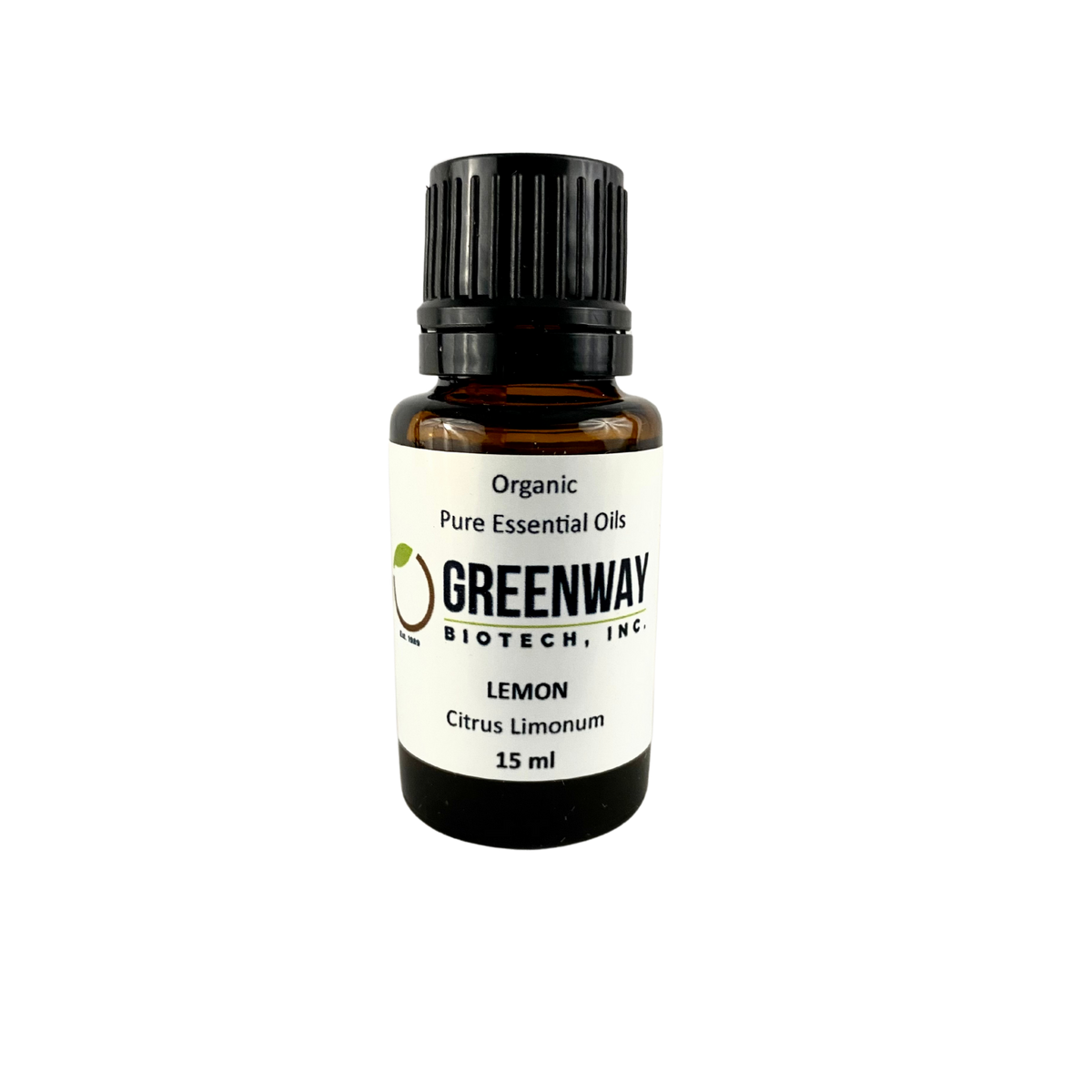
Lemon essential oil is dominated by (R)-(+)-limonene, a monoterpene that makes up 60-70% of the oil. Limonene is the bright, fresh citrus note you smell across every expressed citrus oil — orange, grapefruit, lime, bergamot, lemon all share it as their dominant compound. Limonene is also the compound primarily responsible for the well-documented natural solvent and degreasing activity of citrus oils — the reason cold-pressed citrus oils show up in so many DIY cleaning sprays.
What gives lemon its distinct, sharper character — different from sweet orange's warmth or pink grapefruit's bitter-sweet — is the supporting cast. Citral (a mixture of two stereoisomeric aldehydes, geranial and neral) at trace levels carries the unmistakably "lemon" signature; this is the same compound that defines lemongrass oil's character. γ-Terpinene (10-15%) adds a slightly herbal-piney background. β-Pinene (5-15%) contributes a fresh, woody-resinous undertone. α-Pinene rounds out the lower-volatility tail.
Two practical implications follow. First, the oil is phototoxic — cold-pressed citrus peel oils contain trace furanocoumarins (notably bergapten) that bind to skin and cause UV-sensitized reactions. Lemon's furanocoumarin content is higher than orange's, which is why its IFRA topical maximum is lower. Second, that limonene- and citral-rich composition means the oil oxidizes quickly in the presence of air, light, and heat — and oxidized citral can sensitize skin. Both are real, both are manageable, and both are why this page repeats the 12-hour UV window and the refrigerate-after-3-months guidance more than once.
Constituent ranges below reflect typical batch profiles for cold-pressed Italian Citrus limonum peel oil. The current-batch GC/MS report is available on request.
Limonene (60-70%)
The dominant monoterpene of all expressed citrus oils. Responsible for the bright citrus character and the practical solvent and degreasing activity. Lemon's limonene content is lower than grapefruit's (88-95%) but higher than most non-citrus oils.
γ-Terpinene (10-15%)
A monoterpene with a slightly herbal-piney character. Contributes to lemon's "sharper than orange" reputation; significantly more prominent here than in sweet orange (where it's a trace component).
β-Pinene (5-15%)
A monoterpene with a fresh, woody-resinous undertone — also found in pine and rosemary. Adds aromatic depth that distinguishes lemon from purely sweet citrus oils.
Citral (geranial + neral, trace-3%)
A mixture of two stereoisomeric monoterpene aldehydes. Present in trace amounts but carries a disproportionate share of the aromatic identity — citral is the compound primarily responsible for the unmistakably "lemon" smell across many other plants (lemongrass, lemon myrtle, lemon balm).
α-Pinene (trace-2%)
A monoterpene found across many conifers and herbs. Rounds out the lower-volatility tail of lemon's aromatic profile with a faint pine-forest undertone.
Furanocoumarins (trace)
Including bergapten and other related compounds. These trace coumarin derivatives are responsible for lemon's phototoxicity profile — they bind to skin proteins and create UV-sensitized reactions. Cold-pressed peel extraction captures them; steam-distilled lemon oil would not.