Hydroponic tomato nutrients · three parts · Starter and Season sizes
About the Complete Tomato Feeding Kit
The Complete Tomato Feeding Kit holds the three Greenway fertilizers a hydroponic or container tomato crop needs, in amounts that run out at about the same time: Tomato Fertilizer 4-18-38 for phosphorus, potassium and chelated micronutrients, Calcium Nitrate 15.5-0-0 for calcium and most of the nitrogen, and Epsom Salt for Plants for magnesium and sulfur.
The feeding chart on this page follows the University of Florida IFAS hydroponic tomato formula built on a 4-18-38 premix, recalculated from Greenway’s guaranteed analyses and checked by two separate calculations. You weigh each product per gallon of water by growth stage, and dissolve the Calcium Nitrate on its own before it meets the other two.
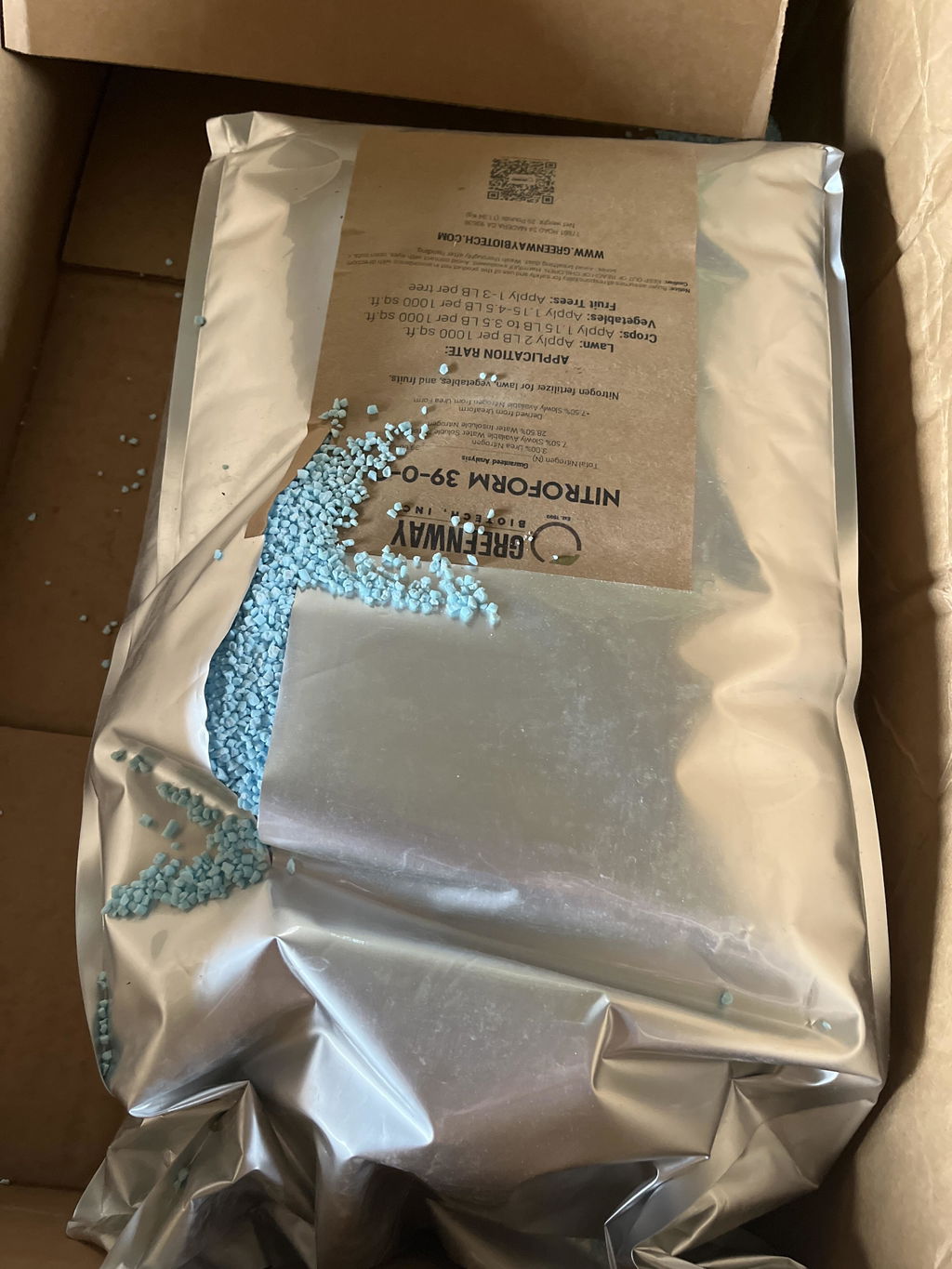
3 products Tomato Fertilizer 4-18-38, Calcium Nitrate 15.5-0-0 and Epsom Salt for Plants, in separate bags
5 stages The grams per gallon step up with each new flower cluster, from transplant to the end of the crop
11–27¢ a gallon Fertilizer cost per gallon of finished feed, depending on kit size and growth stage
What’s in the kit
Complete Tomato Feeding Kit sizes, contents and yield
Size
Tomato Fertilizer 4-18-38
Calcium Nitrate 15.5-0-0
Epsom Salt for Plants
Makes about
Fertilizer cost per gallon
Starter
2 lb
2 lb
1 lb
250 to 300 gallons
22 to 27¢
Season
5 lb
5 lb
3 lb
730 to 900 gallons
11 to 14¢
Gallons are for the Standard recipe. The lower figure is at full late-season strength (stage 5); the higher one is at stages 1 to 3, where the Epsom Salt runs out first. Cost per gallon is the kit price divided by those gallons, before water, pH adjustment and shipping. On its own, the Season kit reaches the $100 free-shipping threshold for the continental US.
The chart has two recipes, and the calcium in your water decides which one to use. Test your water once, or ask your water utility for its report, for calcium, magnesium, potassium, pH and alkalinity (bicarbonate).
Choosing the Standard or Soft water recipe
Your water
Use
Calcium 50 ppm or more (most well water, hard tap water)
Standard, the UF/IFAS formula as published. It counts on 40 to 60 ppm calcium from the water.
Calcium under 50 ppm (reverse osmosis, rain, soft tap water)
Soft water. It uses less Tomato Fertilizer in stages 1 to 4 and a little more Calcium Nitrate in stages 1 to 3. UF/IFAS warns that high potassium with water under 50 ppm calcium can bring early blossom-end rot, and names lower potassium as the better fix.
Calculate your batch
Choose your water, growth stage and batch size to get the grams of each product, how far each kit size goes, and a mixing card to download. The amounts come from the feeding chart below.
The calculator needs JavaScript. If it does not appear, use the feeding chart below.
Feeding chart
Grams per US gallon of finished solution. Multiply by the gallons in your batch and weigh each product separately; for batches under 5 gallons, use a scale that reads to 0.01 g. Move to the next stage when the plants reach the next flower cluster, not by the calendar.
Standard recipe, grams per US gallon
Stage
From
Tomato Fertilizer
Calcium Nitrate
Epsom Salt
1
Transplant to first flower cluster
2.42
1.13
1.51
2
First to second cluster
2.42
1.44
1.51
3
Second to third cluster
2.42
1.81
1.51
4
Third to fifth cluster
2.42
2.49
1.81
5
Fifth cluster to end of crop
2.42
3.10
1.81
Soft water recipe (water under 50 ppm calcium), grams per US gallon
Stage
From
Tomato Fertilizer
Calcium Nitrate
Epsom Salt
1
Transplant to first flower cluster
1.44
1.34
1.51
2
First to second cluster
1.44
1.58
1.51
3
Second to third cluster
1.80
1.98
1.51
4
Third to fifth cluster
1.80
2.49
1.81
5
Fifth cluster to end of crop
2.42
3.10
1.81
Stock-tank amounts for a fertilizer injector
The same recipe as two 30-gallon stock tanks, each injected at 1:100 (1 gallon of each stock per 100 gallons of finished solution). Tank A holds Tomato Fertilizer and Epsom Salt; tank B holds Calcium Nitrate only. These amounts are larger than the kit, so buy the products in their larger sizes.
Pounds per 30-gallon stock tank, injected at 1:100
Stage
Standard: tank A
Standard: tank B
Soft water: tank A
Soft water: tank B
1
16 lb Tomato + 10 lb Epsom
7.5 lb Calcium Nitrate
9.5 lb Tomato + 10 lb Epsom
9 lb Calcium Nitrate
2
16 lb Tomato + 10 lb Epsom
9.5 lb Calcium Nitrate
9.5 lb Tomato + 10 lb Epsom
10.5 lb Calcium Nitrate
3
16 lb Tomato + 10 lb Epsom
12 lb Calcium Nitrate
12 lb Tomato + 10 lb Epsom
13 lb Calcium Nitrate
4
16 lb Tomato + 12 lb Epsom
16.5 lb Calcium Nitrate
12 lb Tomato + 12 lb Epsom
16.5 lb Calcium Nitrate
5
16 lb Tomato + 12 lb Epsom
20.5 lb Calcium Nitrate
16 lb Tomato + 12 lb Epsom
20.5 lb Calcium Nitrate
Fill each tank about two-thirds with water, dissolve the products (Tomato Fertilizer before Epsom Salt in tank A), and top off to 30 gallons. Inject both at the same time so they meet only after dilution, and remake both tanks when the crop moves to the next stage. If two 1:100 injectors run side by side on one water line, UF/IFAS doubles the stock amounts.
How to mix a batch
Fill the reservoir. Add the full batch of water at room temperature.
Weigh each product on its own. Example: 5 gallons of Standard, stage 1, is 12.1 g Tomato Fertilizer, 5.7 g Calcium Nitrate and 7.6 g Epsom Salt.
Add the Epsom Salt, then the Tomato Fertilizer. Stir each into the reservoir until the water is clear.
Dissolve the Calcium Nitrate separately. Use a clean container with about 1 quart of water per 5 gallons of batch, then pour it slowly into the reservoir while stirring.
Check pH and EC. Bring the solution to pH 5.8 to 6.2 with a pH-down product, and write down the EC with the date and stage.
Keep it fresh. Check pH and EC daily and replace the solution every two weeks, as Oklahoma State University Extension advises.
Why the Calcium Nitrate goes in separately. In concentrated form, calcium reacts with phosphate and sulfate and settles out, which can clog drip emitters. Once each product is diluted in the reservoir, they can be used together.
Adjusting for what’s in your water
Adjustments for minerals already in your water
In your water
Adjustment
Magnesium
Use 0.039 g less Epsom Salt per gallon for each ppm. For example, 20 ppm magnesium means 0.77 g per gallon less.
Potassium
Use 0.012 g less Tomato Fertilizer per gallon for each ppm. This also lowers phosphorus in the same proportion.
pH above 6.5 or high alkalinity
Bring the finished solution to pH 5.8 to 6.2, the UF/IFAS target, with an acid pH-down product.
Calcium
Do not cut the Calcium Nitrate. UF/IFAS warns that cutting it too far can bring blossom-end rot unless the water supplies the calcium; the calcium in your water adds to the recipe rather than replacing it.
What the solution supplies
Standard recipe, ppm in the finished solution from the fertilizer alone (UF/IFAS target in brackets)
Stage
Nitrogen
Phosphorus
Potassium
Calcium
Magnesium
Sulfur
1
72 (70)
50 (50)
202 (120)
57 (150)
39 (40)
52 (50)
2
85 (80)
50 (50)
202 (120)
72 (150)
39 (40)
52 (50)
3
100 (100)
50 (50)
202 (150)
91 (150)
39 (40)
52 (50)
4
128 (120)
50 (50)
202 (150)
125 (150)
47 (50)
62 (60)
5
153 (150)
50 (50)
202 (200)
156 (150)
47 (50)
62 (60)
Phosphorus and potassium are elemental, as UF/IFAS states them. Calcium from the fertilizer alone stays under the 150 ppm target until stage 5. The UF/IFAS formula counts on 40 to 60 ppm calcium from the water to close part of that gap, and more Calcium Nitrate would push nitrogen over its targets. Potassium runs above target until stage 5 because the 4-18-38 carries phosphorus and potassium in a fixed ratio; the Soft water recipe brings potassium to target and runs phosphorus a little lower (30 to 37 ppm in stages 1 to 4).
Micronutrients come from the Tomato Fertilizer’s EDTA-chelated iron, manganese, zinc and copper, plus boron and molybdenum. Molybdenum comes out at about a tenth of the UF/IFAS target. Growers who want to make up the difference can add Sodium Molybdate, sold separately, at the amount on its label.
The fertilizer adds an estimated 1.0 to 1.7 dS/m of EC across the stages, and your water adds its own. Measure the finished solution rather than relying on these figures.
Handling & storage
Keep the Calcium Nitrate concentrate apart from the Tomato Fertilizer and Epsom Salt concentrates. They meet only once diluted.
Store each bag closed, in a cool, dry place, away from children and pets.
Tomato Fertilizer contains boron and molybdenum, so use the solution only on the crops its label names and never on forage or pasture.
Read each product’s label and Safety Data Sheet before use (see Product documents).
Frequently asked questions
What is in the Complete Tomato Feeding Kit?
Three separate bags: Tomato Fertilizer 4-18-38, Calcium Nitrate 15.5-0-0 and Epsom Salt for Plants. The Starter kit has 2 lb, 2 lb and 1 lb; the Season kit has 5 lb, 5 lb and 3 lb. Together they supply nitrogen, phosphorus, potassium, calcium, magnesium, sulfur and chelated micronutrients for a hydroponic or container tomato solution.
How much feed does each kit make?
With the Standard recipe, the Starter kit makes about 250 gallons of finished solution at full late-season strength and about 300 gallons at stages 1 to 3. The Season kit makes about 730 and 900 gallons, and its three bags run out at about the same time.
Which recipe should I use?
Standard if your water has 50 ppm calcium or more, as most well water and hard tap water do. Soft water if it has less, as reverse osmosis, rain and soft tap water do. If you don’t know, test your water or ask your water utility for its report.
Can I mix all three products together in one container?
Not as concentrates. Dissolve the Epsom Salt and Tomato Fertilizer in the reservoir, and the Calcium Nitrate in a separate container of water, then pour it in. Concentrated calcium reacts with phosphate and sulfate and settles out, which can clog emitters. Once diluted in the full batch, they can be used together.
When do I move to the next stage?
When the plants reach the next flower cluster: stage 2 starts at the first cluster, stage 3 at the second, stage 4 at the third, and stage 5 at the fifth, which runs to the end of the crop. Go by the plants, not the calendar.
Is it a 2:2:1 mix by weight?
The Starter bags are 2:2:1 by weight, but the feeding chart is not a fixed ratio. Tomato Fertilizer stays at 2.42 g per gallon in the Standard recipe, while Calcium Nitrate rises from 1.13 to 3.10 g and Epsom Salt from 1.51 to 1.81 g as the crop grows, following the UF/IFAS stage targets.
Can I use the kit in garden soil?
The feeding chart is for nutrient solutions in hydroponic and container systems. In a garden bed, size Tomato Fertilizer by a soil test and use Calcium Nitrate as a sidedress, as each product’s own page describes.
What else do I need?
A scale that reads to 0.01 g for batches under 5 gallons, a pH meter or test kit with a pH-down product, and ideally an EC meter. Sodium Molybdate is optional, for growers who want to bring molybdenum to the UF/IFAS target.
Where the recipe and statements on this page come from
The amounts were calculated from Greenway’s guaranteed analyses: Tomato Fertilizer 4-18-38 (4% nitrogen, 18% available phosphate, 38% soluble potash), Calcium Nitrate 15.5-0-0 (19% calcium) and Epsom Salt for Plants (magnesium sulfate). The stage targets, water guidance and mixing practice come from the publications below, which explain crop nutrition but do not evaluate or endorse this product.
Questions about your water or setup? Email your water test and growing system to questions@greenwaybiotech.com, or call (562) 351-5168, Monday to Friday, 7 AM to 5 PM Pacific. Every order carries a 90-day satisfaction guarantee, and we pack and ship from Madera, California.
You did not send me MSM Powder, you sent me Magnesium Chloride powder. I tried contacting you 3 times, by email & phone and you didn't have the courage & honesty to return my messages & rectify the situation. I even offered to text you a photo of the mag chloride.
an effective supplement for severe arthritis. and this optMSM form/brand is superior, imho, to the widely available brands of MSM available. i know, i have taken many of them.