Sodium Molybdate
- Regular Price
- $ 89.99
- Sale Price
- $ 89.99
- Regular Price
Sold Out
- Unit Price
- per
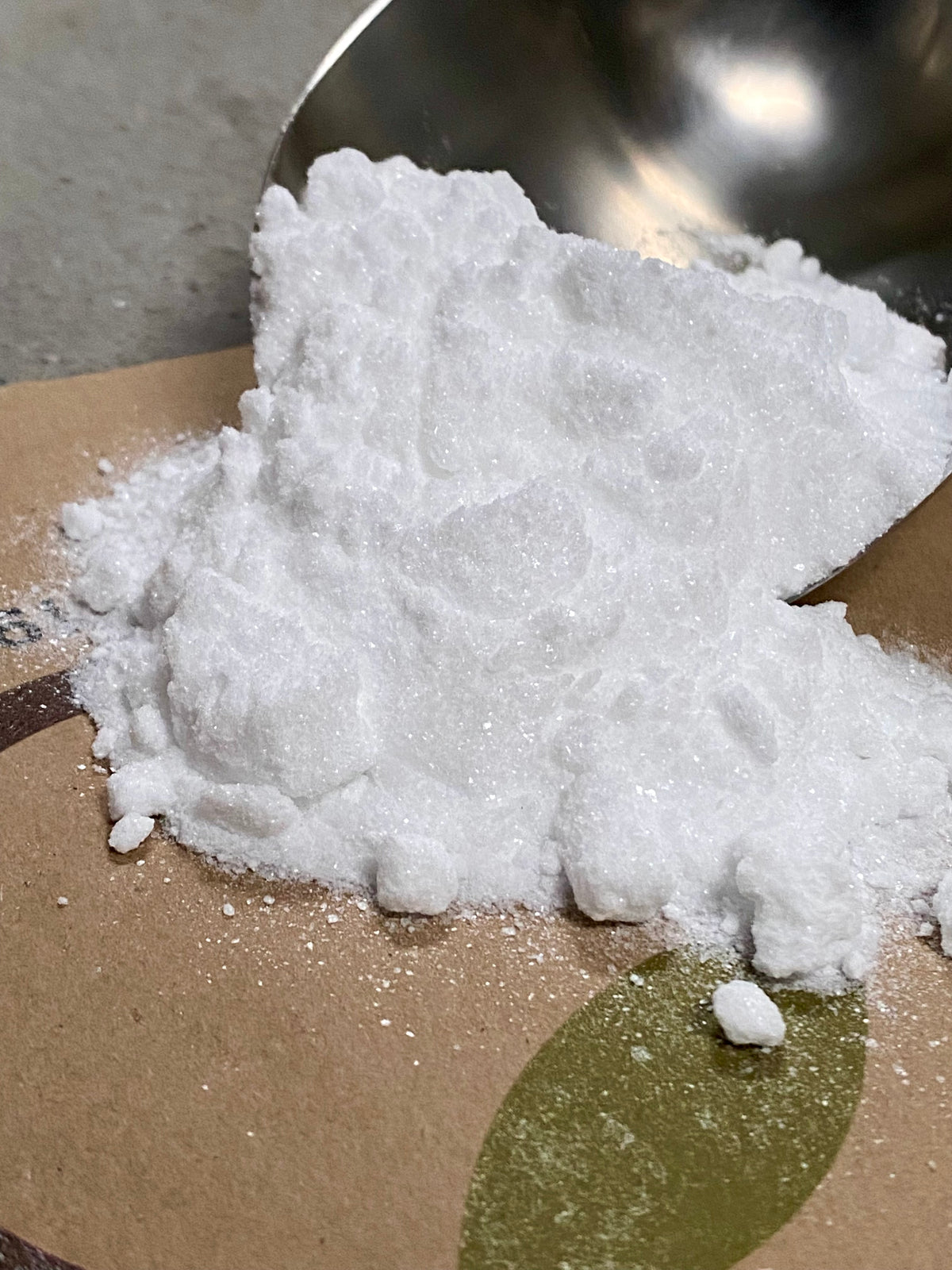
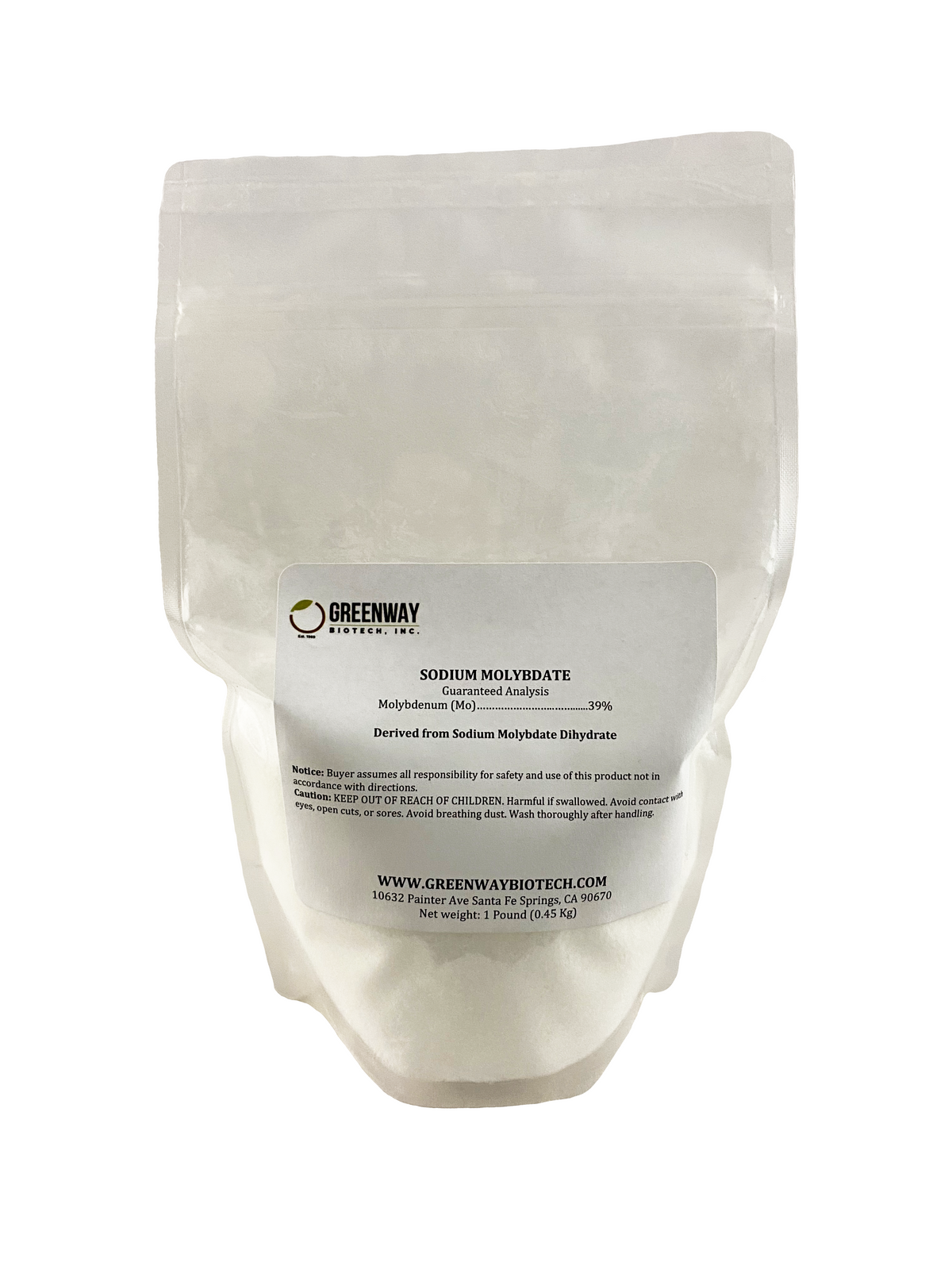
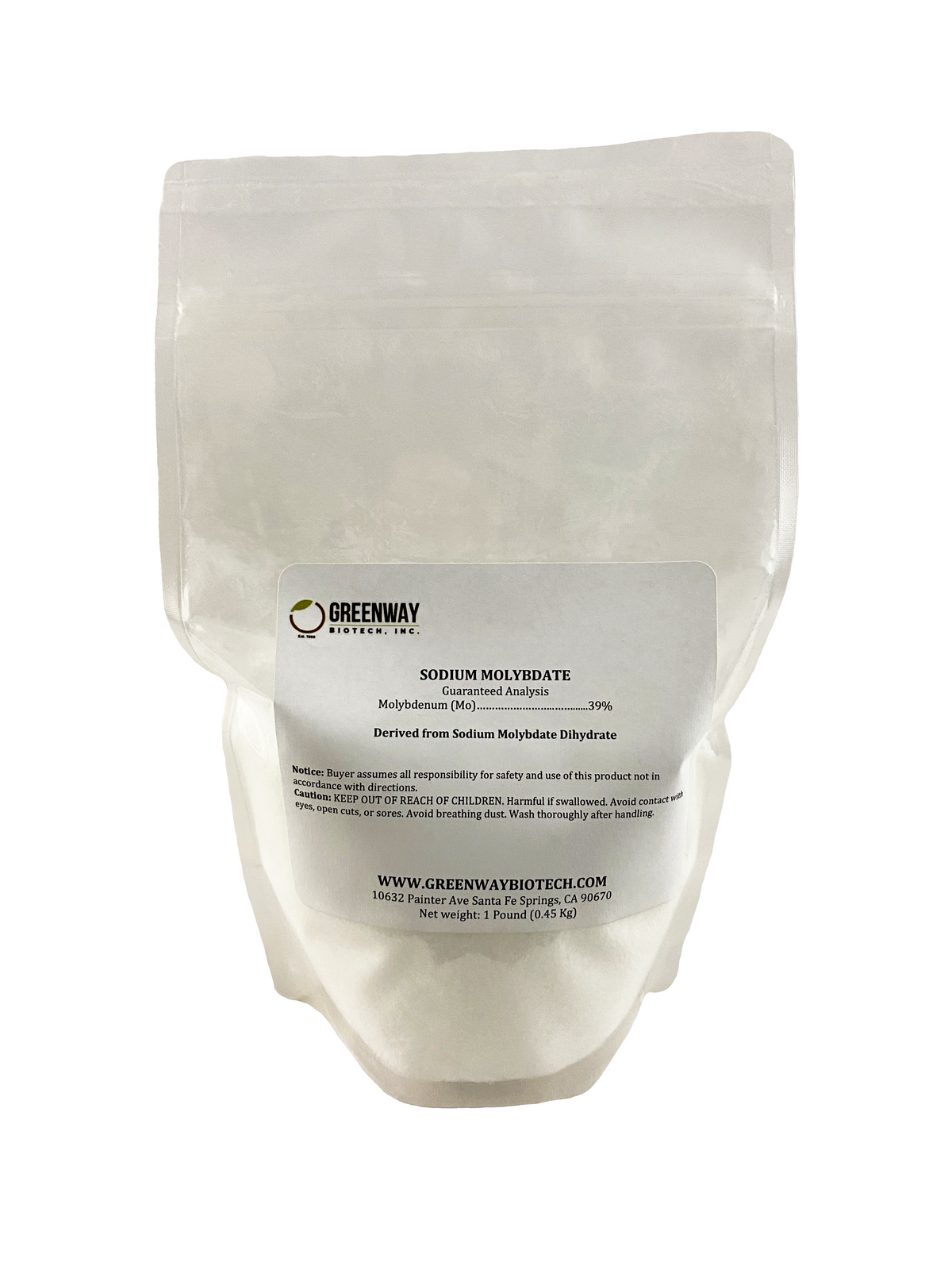
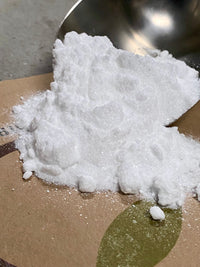
A single-ingredient micronutrient fertilizer delivering 39% molybdenum — the cofactor plants need to convert nitrate into proteins and the enzyme that lets legumes fix atmospheric nitrogen. 100% water-soluble for seed treatment, foliar spray, soil banding, and hydroponics. CDFA registered and independently lab tested for heavy metals.
Find your size → Calculate how much I need39%
Molybdenum by weight — ounces per acre is all you need
100%
Water-soluble — seed, foliar, soil, hydro
100x
Mo availability shift per pH unit — the trace element that hates acid soil
35+yrs
Family-owned fertilizer company in California
Molybdenum is required in smaller quantities than any other essential plant nutrient — a single pound covers many acres. Coverage figures below are general references; actual rates depend on soil test results and crop. See the Application Rates section for crop-by-crop guidance.
| Bag Size | Seed Treatment Coverage | Field Crop Coverage | Best For |
|---|---|---|---|
| 1 lb | ~400–1,600 lbs of legume seed | ~4–16 acres at typical foliar/soil rates | Most popular |
Molybdenum is rarely the first deficiency a grower thinks of — but in the crops and soil conditions below, it can make the difference between a stalled crop and a productive one.
The most efficient method: 1–2 oz per 100 lb of seed places Mo exactly where bacteria will need it for nitrogen fixation. One application supports a full season.
Brassicas are the most sensitive to Mo deficiency — the classic "whiptail" symptom (narrow, strap-like leaves) is hard to mistake. Foliar at the 4–6 leaf stage.
Legume crops with poor nodulation despite quality inoculant may be Mo-limited. Mo is part of the nitrogenase enzyme that fixes atmospheric N.
Below pH 6.0, soil Mo becomes increasingly unavailable. Either supplement Mo directly or raise pH with lime — both can correct the underlying lockout.
0.02–0.05 ppm Mo in solution covers most crops. Most pre-blended micro packages already contain Mo — check first to avoid double-dosing.
Mo can accumulate in forage and induce copper deficiency (molybdenosis) in cattle and sheep above 5–10 ppm in tissue. Test before treating any grazed acreage.
Plants need less Mo than any other essential nutrient — but when it's missing, two of the most important enzyme systems in plant biology shut down. Here's what 39% Mo delivers.
At 39% Mo by weight, ounces per acre is all most situations require. That makes Mo correction one of the lowest cost-per-acre fertilizer inputs in any program — especially when the alternative is buying more synthetic nitrogen to compensate for inefficient uptake.
Nitrate reductase is the gateway enzyme that converts nitrate (NO₃⁻) to nitrite in every plant. Nitrogenase is the enzyme that converts atmospheric N₂ gas into ammonium inside legume root nodules. Mo sits at the active site of both. Research suggests that without adequate Mo, plants accumulate nitrate without metabolizing it — producing symptoms that mimic nitrogen deficiency even when N is abundant.
Dissolves completely with no residue or clogging. Use it as a seed coating slurry, a foliar tank-mix, a soil drench, a fertigation injection, or a hydroponic micro supplement — the same product works across every delivery system.
Because plant Mo requirements are so small, a single soil broadcast at 4–8 oz/acre typically supports correction for 3–5 years before reapplication is needed. Seed treatment provides full-season protection from a single application at planting.
Registered with the California Department of Food and Agriculture as a specialty fertilizer. Independently lab tested with heavy metal results consistently well below required limits. Packed in our family-owned facility in Madera, California.
39% Mo
Sodium molybdate dihydrate — Na₂MoO₄·2H₂O
Molybdenum is required by plants in smaller quantities than any other essential nutrient — healthy crops typically contain less than 1 ppm Mo in dry tissue. That tiny requirement makes Mo easy to overlook in a fertility program. But it also makes Mo one of the highest-leverage inputs in agriculture: the difference between zero and adequate is measured in ounces per acre, and the response can be the difference between a stalled legume crop and a productive one.
Mo's importance comes from its role as a metal cofactor in two enzymes that control nitrogen metabolism. Nitrate reductase is the gateway enzyme present in every higher plant. It converts nitrate ions (NO₃⁻) into nitrite, the first step in transforming soil nitrogen into amino acids and proteins. Without adequate Mo, this conversion slows or stops — nitrate accumulates in leaves, and the plant shows the classic symptoms of nitrogen deficiency despite having plenty of N in the soil. Nitrogenase is the second Mo-dependent enzyme, found in the Rhizobium bacteria that inhabit legume root nodules. Nitrogenase splits the triple bond in atmospheric N₂ gas, producing plant-available ammonium. Without Mo at its active site, biological nitrogen fixation halts — nodules turn from healthy pink to non-functional green or white.
Soil pH is the single biggest factor determining whether native soil Mo is available to plants. Unlike most micronutrients, which become more available in acid conditions, molybdenum does the opposite: each one-unit drop in pH reduces Mo availability by roughly 100-fold. Below pH 6.0, even soils with adequate total Mo behave as deficient. That gives growers two correction paths: apply Mo directly via seed, foliar, or soil application, or raise pH through liming so that native Mo becomes plant-available. In moderately acid soils, liming to pH 6.2–6.5 often resolves the deficiency without any direct Mo input.
For deeper coverage of micronutrient function, see Essential Micronutrients for Healthier Plants and our guide to the function of nitrogen in plants.
Mo is needed in such small amounts that measurement accuracy matters more than for any other fertilizer. Always confirm deficiency through soil or tissue testing before applying — and never exceed recommended rates, particularly on pasture or forage crops where excess Mo can harm grazing livestock.
Quick answer: 1–2 oz per 100 lb of legume seed, applied as a slurry with inoculant. One treatment can support a full season for annual crops.
| Crop | Rate per 100 lb seed | Method |
|---|---|---|
| Soybeans, Peas | 1–2 oz | Slurry with inoculant |
| Dry & Snap Beans | 1–2 oz | Slurry with inoculant |
| Peanuts | 2–3 oz | Treat before planting |
| Alfalfa, Clover | 2–4 oz | Mix with seed coating material |
Note: Dissolve in a small volume of water, coat seed evenly by tumbling, and allow to dry before planting. Plant treated seed within 24 hours for best inoculant viability. Seed treatment is preferred over foliar or soil application whenever the crop is a legume.
Quick answer: 1–4 oz per acre dissolved in 20–30 gallons of water. Apply at the 4–6 true leaf stage before deficiency symptoms appear.
| Crop | Rate per Acre | Timing |
|---|---|---|
| Cauliflower / Broccoli | 2–4 oz | 4–6 true leaves |
| Soybeans | 1–2 oz | V3–V5 stage |
| Canola | 1–3 oz | 4–6 leaf stage |
| Sugar Beets | 2–3 oz | 4–8 leaf stage |
Foliar safety check: At 1–4 oz per acre dissolved in 20–30 gallons of water, the working concentration lands within the typical 1–4 g/gallon foliar range. Test on a small area first, spray in early morning or late afternoon, avoid temperatures above 85°F, and ensure good coverage on both leaf surfaces.
Quick answer: 4–8 oz per acre broadcast, or 2–4 oz per acre banded with starter fertilizer. A single application can correct deficiency for 3–5 years.
| Method | Rate per Acre | Notes |
|---|---|---|
| Broadcast | 4–8 oz | Most effective on acid soils (pH < 6.0) |
| Banded with starter | 2–4 oz | More efficient than broadcast at half the rate |
| Fertigation | 1–3 oz | Through drip or sprinkler injection |
📋 Field & acreage rates: The per-acre figures above are general references for medium-testing soils at typical yield goals. Actual rates should be based on a current soil test (target soil Mo above 0.1 ppm) and local nutrient removal estimates. In acid soils, raising pH to 6.2–6.5 with lime can release enough native Mo to correct deficiency without direct application. Consult your local extension service for site-specific recommendations.
Quick answer: Target 0.02–0.05 ppm Mo in the working nutrient solution. Many pre-blended micro packages already include Mo — verify before adding more.
| System | Concentration | Notes |
|---|---|---|
| General hydroponic solution | 0.02–0.05 ppm Mo | Working nutrient solution |
| Stock solution | ~1 oz per 100 gallons | Dilute to working concentration as needed |
Note: Add sodium molybdate after the base nutrients have dissolved and pH is adjusted. Monitor Mo levels through tissue analysis monthly. Reduce or eliminate supplementation if your base fertilizer or pre-blended micro mix already contains molybdenum — over-application can be wasteful and, in field grow operations using nutrient solution as foliar runoff, can elevate Mo in any forage grown nearby.
Because Mo is needed in such tiny quantities and can be harmful in excess to grazing livestock, the workflow matters more than the math. Confirm deficiency first, then measure carefully.
Test soil (target Mo above 0.1 ppm) or send a tissue sample to your local extension lab. Mo deficiency often looks like nitrogen deficiency — see our guide to 8 reasons leaves turn yellow for help differentiating causes.
If pH is below 6.0, liming to 6.2–6.5 with Dolomite Lime often releases enough native Mo to correct the deficiency without direct application. Each pH unit increase can shift Mo availability roughly 100-fold.
For legumes, seed treatment is by far the most efficient. For acute deficiency in standing crops, foliar spray gives the fastest correction. For long-term programs, soil broadcast can last 3–5 years from a single application.
Use the calculator on the right to convert per-acre or per-gallon rates into measured weights. Mo above 5–10 ppm in forage tissue can induce copper deficiency (molybdenosis) in grazing cattle and sheep — do not apply to pasture without baseline forage testing.
Most growers don't pick between Mo products — they pick between sodium molybdate, raising pH with lime to unlock native Mo, or using a pre-blended micro package that already contains Mo. Here's where each fits.
| Source | Mo Content | Form | Best For | Notes |
|---|---|---|---|---|
| Sodium Molybdate 39% Mo (this product) | 39% | Water-soluble crystal | Direct correction of confirmed Mo deficiency — seed, foliar, soil, hydro | Highest concentration available; ounces-per-acre rates |
| Dolomite Lime | None directly | Mined limestone, slow-acting | Acid soils (pH < 6.0) where native Mo is locked out | Raises pH and supplies Ca + Mg; releases native Mo over months |
| Micro Green 2-0-3 | Trace, blended | Chelated micro blend | Hydroponic systems needing a complete micro package | Already contains Mo — avoids double-dosing |
| Foliar "complete micro" blends | Trace, varies | Multi-micro foliar | Multi-deficient soils needing several micros at once | Mo rate may not be high enough for correction; check label |
Mo correction is high-leverage when the deficiency is real — and wasteful when it isn't. Use this split to decide before ordering.
The same soil conditions that drive Mo deficiency — acidity, low organic matter, sandy textures — often coincide with other micronutrient limitations. Build a complete program with these companions.
Boron supports nitrogen fixation, pollination, and cell wall formation in legumes alongside molybdenum — the two micros are often deficient together.
Co-deficient microIron chlorosis often co-occurs with Mo deficiency in acid soils. EDTA chelation keeps iron plant-available across a wide pH range.
Common companionZinc deficiency is common in the same acidic and sandy soils where Mo is limited. Useful for a complete micro correction program.
Root cause fixIn acid soils, liming to pH 6.2–6.5 may release enough native Mo to correct the deficiency without direct supplementation.
Molybdenum is required in tiny quantities and is similarly harmful in excess — especially to grazing livestock. The safety rules below matter more for Mo than for almost any other fertilizer.
If your question isn't here, contact our team at questions@greenwaybiotech.com or by phone Mon–Fri 7AM–5PM PST.
Sodium molybdate (Na₂MoO₄·2H₂O) is a water-soluble crystalline fertilizer containing 39% molybdenum by weight. Mo is an essential micronutrient that serves as the metal cofactor for two key enzymes: nitrate reductase, which converts nitrate to nitrite as the first step in protein synthesis in all plants, and nitrogenase, which converts atmospheric N₂ to plant-available ammonium inside legume root nodules. Without adequate Mo, plants accumulate nitrate without metabolizing it — producing symptoms that mimic nitrogen deficiency even when N is abundant. For more on micronutrient roles, see our guide to Essential Micronutrients for Healthier Plants.
Symptoms vary by crop. Brassicas (cauliflower, broccoli) show the classic "whiptail" pattern — narrow, strap-like, distorted leaves with ragged edges. Legumes show poor nodulation: healthy active nodules are pink or red inside (from leghemoglobin); Mo-deficient nodules turn green or white with little to no nitrogen fixation. Most other crops show pale green to yellow leaves resembling nitrogen deficiency, sometimes with upward leaf cupping or scorched margins on older leaves.
Mo deficiency is most common in acid soils (pH below 6.0), sandy soils with low organic matter, and after heavy rainfall events that leach molybdate ions. Because Mo deficiency often looks like nitrogen deficiency, see our guide to 8 reasons leaves turn yellow for help differentiating causes — soil or tissue testing is the most reliable confirmation.
It depends on the crop and the situation. Seed treatment (1–2 oz per 100 lb of seed) is the most efficient method overall — it places Mo exactly where Rhizobium bacteria need it for nitrogen fixation and supports the full season for legume annual crops. Foliar spray (1–4 oz per acre in 20–30 gallons of water) gives the fastest correction in standing crops, best applied at the 4–6 leaf stage before symptoms appear. Soil broadcast (4–8 oz per acre) is less efficient per application but can support correction for 3–5 years from a single treatment. As an alternative, liming acidic soils to pH 6.2–6.5 often releases enough native Mo to correct the deficiency without direct application.
Critical: never exceed recommended rates. Mo above 5–10 ppm in forage tissue can cause copper deficiency (molybdenosis) in grazing livestock.
Mo deficiency is a common but often overlooked cause of poor nitrogen fixation in legumes. The nitrogenase enzyme that splits atmospheric N₂ requires Mo as a cofactor — without adequate Mo, even well-inoculated legumes cannot fix nitrogen effectively. Check nodule color first: healthy active nodules are pink or red inside; Mo-deficient nodules turn green or white. Seed treatment with 1–2 oz of sodium molybdate per 100 lb of seed at planting usually addresses this for the entire season.
Also check soil pH — acidic conditions below pH 6.0 severely limit Mo availability, and the deficiency may resolve with liming alone. For broader nitrogen-source guidance, see our article on the best nitrogen fertilizer for your situation.
Unlike most micronutrients, Mo becomes less available as soil pH drops. Each one-unit decrease in pH reduces plant-available Mo by roughly 100-fold — so a soil at pH 5.5 can behave as severely deficient even if total Mo content is adequate. This is the opposite of iron, manganese, and zinc, which all become more available in acid conditions.
This gives growers two correction paths: apply Mo directly (seed, foliar, or soil), or raise pH through liming with Dolomite Lime to 6.2–6.5 so native Mo becomes plant-available. In moderately acid soils with adequate total Mo, liming alone often resolves the deficiency.
Several important interactions. Mo is essential for nitrogen metabolism — without adequate Mo, plants can't convert nitrate to amino acids even when nitrogen is abundant. Sulfate ions compete with molybdate for plant uptake, so high-sulfur fertility programs can induce Mo deficiency even in soils with adequate total Mo — if you're applying significant sulfur, monitor Mo more closely.
There's also an antagonistic relationship with copper: high tissue Mo can induce copper deficiency in grazing livestock (molybdenosis), which is why forage Mo above 5–10 ppm is unsafe for cattle and sheep. For background on nutrient interactions and how toxicity can mimic deficiency, see Fertilizer Toxicity vs. Nutrient Deficiency.
Sodium molybdate is generally permitted in organic systems as a remedial input when a documented deficiency exists, but always verify with your certifying agency before application. Typical requirements include: soil or tissue tests confirming Mo deficiency, documentation of deficiency and application rates, and applying only the amount necessary to correct the deficiency — not as a routine input. The tiny quantities needed (often less than 0.1 lb of actual Mo per acre) make Mo correction both environmentally low-impact and economical for organic production.
Duration depends on the method. Seed treatment supports the full season for annual legume crops — one application at planting is typically enough. Foliar correction addresses the current season but may need repeating in subsequent years if the underlying soil deficiency isn't resolved. Soil broadcast applications generally support correction for 3–5 years before reapplication is needed, making them the most efficient long-term investment for chronic Mo-deficient soils. In hydroponic systems, maintain continuous low levels of 0.02–0.05 ppm in the working solution and monitor monthly.
Yes — sodium molybdate is compatible with most fertilizers and can be tank-mixed for convenience with nitrogen sources, micronutrient blends, and foliar sprays. Avoid mixing with highly acidic solutions, which can reduce Mo availability. When banding with starter fertilizer, placement efficiency improves significantly compared to broadcast at the same rate.
As with any fertilizer combination, jar-test unfamiliar mixtures before tank-mixing at scale to check for precipitation or compatibility issues.
This is the single most important safety consideration for Mo. While plants need Mo to function, grazing cattle and sheep are sensitive to molybdenum in forage tissue. When forage Mo exceeds approximately 5–10 ppm, it can induce copper deficiency in the animal — a condition called molybdenosis that causes scouring, weight loss, and reduced productivity. The effect is worse when forage copper is also low.
For pasture and forage crops, never apply Mo without first establishing a baseline through forage tissue testing. If you must correct a confirmed deficiency in grazed acreage, use the lowest effective rate (seed treatment is preferable to soil broadcast) and retest forage tissue before resuming grazing.
Sodium molybdate is one of the smallest, highest-leverage inputs you can make in any program where Mo deficiency is documented. A single pound covers many acres, ships free on orders over $100 in the continental US, and is backed by our 90-day money-back guarantee.
Choose your size →