Strawberry Fertilizer 8-12-32 | Chelated Micronutrients | Hydroponics, Soil & Foliar Application
- Regular Price
- $ 24.99
- Sale Price
- $ 24.99
- Regular Price
- $ 24.99
Sold Out
- Unit Price
- per


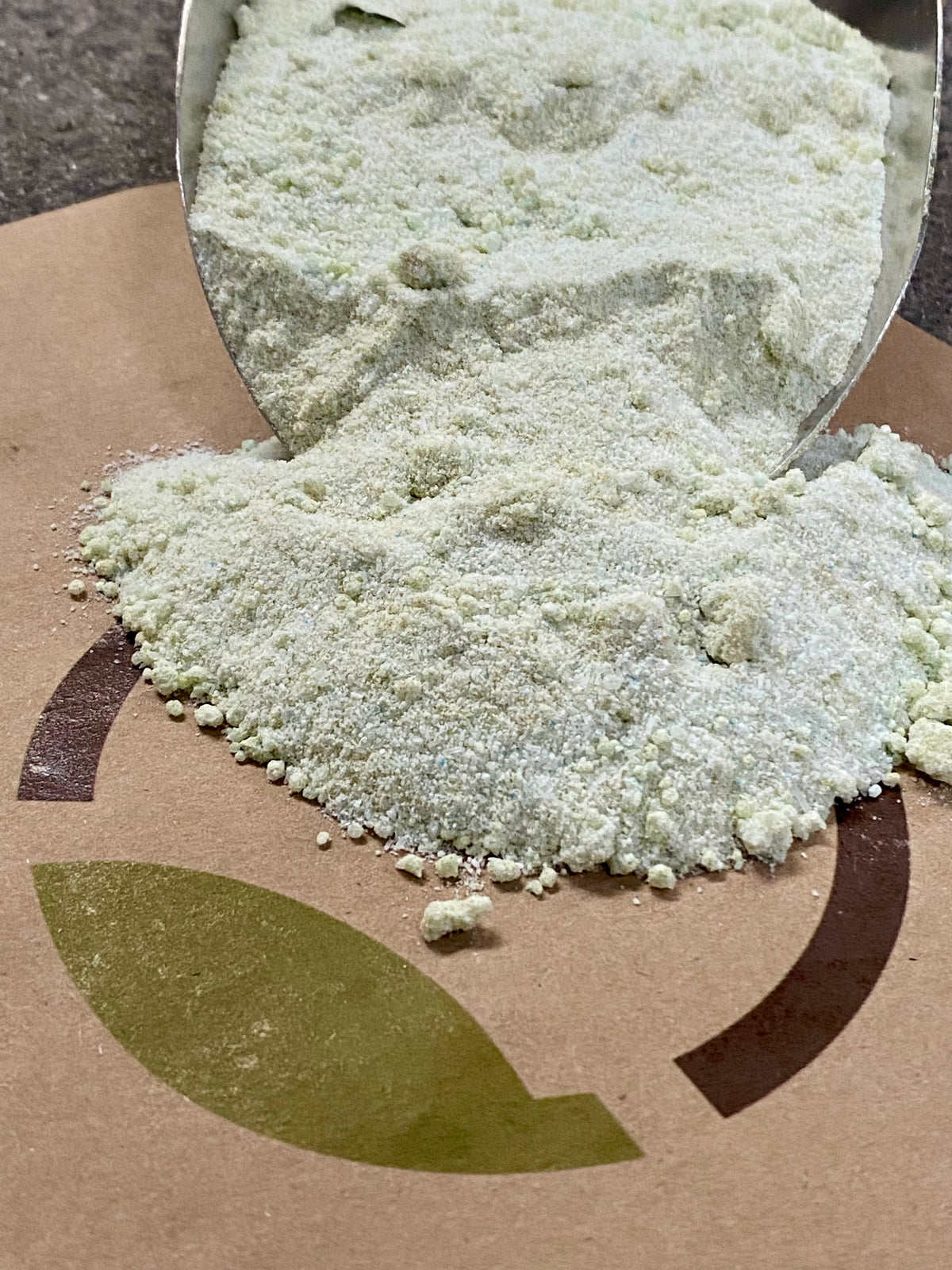


A water-soluble 8-12-32 formula engineered for strawberries and other berry crops. Very high potassium supports fruit sweetness, firmness, and shelf life; moderate nitrogen keeps plants productive without pushing runners at the expense of fruit; EDTA-chelated micronutrients in every bag. 100% water-soluble. CDFA registered. Independently lab tested.
Find your size → Calculate how much I need32%
Soluble potash (K₂O) — sweetness, firmness, shelf life
12%
Available phosphate (P₂O₅) for crown establishment and flowering
8%
Moderate nitrogen — fruit over runners
100%
Water soluble — drip, towers, NFT, Dutch buckets, foliar
Plant coverage assumes 2.5 g per plant across eight applications in a season. Hydroponic coverage is figured at the fruiting rate. Actual use varies with variety, season length, and feeding frequency.
Complete berry program: 8-12-32 supplies NPK plus chelated micronutrients — it contains no calcium by design (calcium and phosphate precipitate together in concentrated solution). Pair it with a separate calcium source: Cal-Mag Plus or Calcium Nitrate for hydro, containers, and RO water; Gypsum for raised beds and in-ground soil. Never mix calcium and 8-12-32 as concentrated stock.
| Bag Size | Plants per Season | Hydroponic Solution | Best For |
|---|---|---|---|
| 1 lb | ~22 plants | ~180 gal at fruiting rate | A hanging basket or two, or a trial run |
| 2 lb | ~45 plants | ~360 gal at fruiting rate | Patio containers, a small bed |
| 5 lb | ~115 plants | ~900 gal at fruiting rate | Most popular — home strawberry patch |
| 10 lb | ~225 plants | ~1,800 gal at fruiting rate | Large beds, vertical towers, small hoop house |
| 25 lb | ~565 plants | ~4,500 gal at fruiting rate | Best value — market gardens |
| 50 lb | ~1,130 plants | ~9,000 gal at fruiting rate | Commercial greenhouses and field production |
Berry crops share a nutritional shape — heavy potassium demand during fruit fill, steady phosphorus for crown and flower development, and controlled nitrogen so energy goes to fruit rather than foliage and runners.
June-bearing, everbearing, and day-neutral varieties. The flagship crop — the ratio is built around strawberry fruit physiology.
Highbush, lowbush, and rabbiteye. Pair with an acidifier where soil pH runs above 5.5 — blueberries want acid soil.
Summer-bearing and primocane types. High potassium supports drupelet fill and post-harvest firmness.
Vertical towers, NFT, Dutch buckets, drip, and DWC. 100% water-soluble with no residue when pre-dissolved.
Hanging baskets, strawberry pots, grow bags, and patio planters. Use the container rates and flush monthly.
Traditional in-ground beds and commercial plasticulture. Feed by area and confirm against a current soil test.
Strawberries are salt-sensitive and fruit over a long window. They need sustained potassium without the EC load a balanced formula would impose to deliver it.
Potassium activates the enzyme systems that move sugars from leaf to fruit, and it drives the water relations behind firmness and shelf life. In berries, that sugar-loading step is what separates a flat berry from a sweet one. Calcium — supplied separately — remains the nutrient behind cell-wall integrity and firmness, which is why this formula pairs with a dedicated calcium source.
Excess nitrogen in strawberries produces lush foliage and aggressive runnering at the expense of fruit, and soft berries that don't hold. The 8% here keeps leaves productive without pushing vegetative growth; the 32% K₂O carries fruit quality. The 4:1 ratio sits between our vegetative and heavy-fruiting formulas by design.
Phosphorus drives ATP synthesis, root extension, and flower initiation — all critical at transplant and through repeat flowering in day-neutral varieties. In soil, apply phosphorus to soil-test need; many established beds already hold enough.
Iron, manganese, zinc, and copper are EDTA-chelated to stay plant-available across a wider pH range than sulfate forms. Boron and molybdenum round out the trace package — supporting pollination, fruit set, and nitrogen metabolism.
Strawberries burn at EC levels many crops tolerate easily. A high-K formula that requires heavy dosing to deliver potassium would push EC past what berries can take. 32% K₂O delivers the potassium at a concentration that keeps the reservoir under the 1.8 EC ceiling.
Registered with the California Department of Food and Agriculture. Independently lab tested for heavy metal content — results consistently well below required limits. Blended and bagged in Madera, California by a family-owned operation since 1989.
K+
The ionic form plants absorb — freely soluble and mobile in solution
Unlike nitrogen, potassium isn't a structural component of plant tissue at all. It acts as an ionic regulator — opening and closing guard cells, activating dozens of enzyme systems, and keeping water and sugars moving through the vascular system. In fruiting crops, adequate potassium is closely associated with fruit size, sugar transport, firmness, flavor, and post-harvest shelf life.
Strawberries make that relationship unusually visible. The berry is both a sugar sink and a potassium sink: sugars produced in the leaves get loaded into the phloem and shipped to the fruit, and that loading is potassium-driven. K-deficient plants accumulate sugars in leaves instead of partitioning them to harvestable fruit — which shows up as pale, flat-tasting berries even on a plant that looks healthy.
The tension in berry nutrition is salt sensitivity. Strawberries show leaf-margin burn and reduced fruit set at EC levels tomatoes shrug off — which is why the fruiting reservoir target here tops out around 1.4–1.6 EC, roughly half what a fruiting tomato takes. Delivering enough potassium inside that constraint requires a formula that's potassium-dense relative to its total salt load, which is what the 8-12-32 ratio is for.
For a deeper read, see What's the Function of Potassium in Plants? and What's the Function of Phosphorus in Plants?
Rates for strawberries, blueberries, raspberries, and blackberries. Select the tab for your growing method — soil & container, hydroponic reservoirs, foliar spraying, or field-scale commercial.
🪴 Quick start (containers): Mix into 1 gallon of water per plant — 2 g at transplant, 2.5 g (½ tsp) through runners, 3 g once flowers set. Feed every 2 weeks, and water in with plain water right after. Add your calcium source separately.
Quick answer: Containers are fed per plant. In-ground beds are fed per area (per 100 sq ft), so plant count doesn't change the amount. Never let fertilizer sit against the crown.
How to read this — worked examples:
Containers (per plant). 12 plants at fruiting: 12 × 3 g = 36 g of 8-12-32 total, dissolved in 12 × 1 gal = 12 gallons of water, every 2 weeks. Water in with plain water right after.
In the ground (per area, not per plant). A 100 sq ft bed: 0.25 lb (~113 g) per 100 sq ft, side-dressed (banded 3–4" from the crown, never on it), at first flower then every 3–4 weeks. Because this is set by area, 12 plants or 30 plants in that same 100 sq ft get the same 0.25 lb — just split it evenly and water in.
| Stage | 8-12-32 (per plant) | Water (per plant) | How Often |
|---|---|---|---|
| Establishment / Transplant | 2 g | 1 gal | Every 2 weeks |
| Vegetative / Runner | 2.5 g (½ tsp) | 1 gal | Every 2 weeks |
| Flowering / Fruiting | 3 g | 1 gal | Every 2 weeks |
Container feeding: Container amounts are per plant — multiply by your plant count. One gallon of water per plant at every stage; only the fertilizer amount steps up. Apply to already-moist media and water in with plain water right after. Pair with Cal-Mag Plus at about 5 ml per plant between feedings. Flush containers with plain water once monthly to reset salt levels — strawberries are salt-sensitive and containers concentrate salts fast.
| Application | Rate (per 100 sq ft) | Timing |
|---|---|---|
| Pre-plant incorporation | 1 lb + 2 lbs gypsum | Worked into the top 4–6" with compost before setting crowns |
| Side-dress | 0.25 lb (~113 g) | At first flower, then every 3–4 weeks through fruiting |
| Renovation (June-bearing) | 0.25 lb (~113 g) | After the last harvest, following mowing and thinning |
| Drip fertigation | 0.5 lb / 100 gal of irrigation water | Every 10–14 days during fruiting |
📋 Soil test first: Rates above are general guidelines for medium-testing soils. Confirm against a current soil test and your local cooperative extension. Blueberries are the exception in this crop group — they want soil pH 4.5–5.5, so pair this formula with an acidifier such as elemental sulfur where your soil runs above 5.5.
Quick answer: Everything is per plant. Multiply each column by your plant count, mix into the reservoir, then top up water until it reads the target EC. Never exceed 1.8 EC.
Every amount below is per plant — multiply the whole row by your plant count. The water column is roughly how much your reservoir holds per plant; top up to hit the EC target, since water volume only sets concentration, not the nutrient a plant needs. The EC column is the final measured value after all nutrients are mixed. Calcium Nitrate is for RO or soft water only. Cal-Mag Plus values are ml of prepared stock (the full 5 lb bag dissolved in 2 gallons of water).
| Growth Stage | 8-12-32 (per plant) | Cal-Mag Plus (per plant) | Calcium Nitrate (per plant, RO/soft) | Water per Plant | Final EC | pH |
|---|---|---|---|---|---|---|
| Establishment / Transplant | 0.9 g | 3 ml | — | 0.7–0.9 gal | 0.8–1.0 EC | 5.8–6.2 |
| Vegetative / Runner | 1.8 g | 7 ml | 0.4–0.8 g | 0.8–1.0 gal | 1.2–1.4 EC | 5.6–6.0 |
| Flowering / Fruiting | 2.5 g (½ tsp) | 12 ml | 0.7–1.4 g | 0.9–1.1 gal | 1.4–1.6 EC max | 5.6–6.0 |
How to read this — worked example: 24 plants at fruiting, on RO water:
⚠️ The 1.8 EC ceiling is real. Strawberries show leaf-margin burn and reduced fruit set well before other fruiting crops do. Treat 1.6 EC as the fruiting target and 1.8 as a hard ceiling, not a goal. Use the low end of each band in heat, low humidity, or when your source water already carries measurable EC.
Mixing sequence: Fill to full water volume → dissolve Calcium Nitrate fully (RO/soft water) → add Cal-Mag Plus → add 8-12-32 last → adjust pH and verify final EC. Never combine concentrated calcium products directly with concentrated phosphate or sulfate fertilizers.
Hard tap water: water above roughly 30 ppm calcium already carries part of what Cal-Mag supplies — start low and add only what a water test shows you need, rather than the full RO-water dose.
Vertical towers: towers dry unevenly top to bottom. Check EC and moisture at both ends of the tower, not just the reservoir — the top plants see a different environment than the bottom ones.
Quick answer: ~2.3 g of 8-12-32 per gallon of finished spray (~½ tsp/gal) is the maintenance rate. Foliar is mixed per gallon of spray, not per plant. Never exceed 4.5 g/gal, and stop 7 days before harvest.
| Purpose | 8-12-32 (per gallon) | Cal-Mag stock | Frequency / Notes |
|---|---|---|---|
| Maintenance / general | ~2.3 g (~½ tsp) | — | Every 10–14 days during active growth |
| Pre-bloom push | ~2.3 g (~½ tsp) | 5 ml/gal in tank | Once, 7–10 days before first flowers; never on open blooms |
| Deficiency correction (MAX) | ~3.4 g (~¾ tsp) | — | Every 5–7 days, max 3 sprays — then address root-zone nutrition |
How to read this — worked example: 2 gallons of maintenance spray: 2 × 2.3 g = 4.6 g of 8-12-32. Spray until leaves just glisten — tops and undersides — every 10–14 days. Keep the finished spray at or below 4.5 g per gallon, and stop 7 days before harvest.
Foliar best practices: spray to glistening, not runoff, and cover leaf undersides. Do not spray drought-stressed, wilted, or heat-stressed plants, in high wind, on open blooms, or on developing fruit. Do not tank-mix with pesticides, oils, sulfur, or copper unless compatibility has been tested. Do not combine Cal-Mag Plus concentrate with 8-12-32 concentrate — pre-dissolve each separately into the diluted tank. Foliar feeding supplements root feeding — it does not replace it.
Quick answer: Field-scale strawberry programs typically apply 200–500 lbs of 8-12-32 per acre per season, split across the fruiting window. Always confirm with a current soil test and crop removal estimate.
| Soil Test / Crop Demand | 8-12-32 / Acre / Season | Split |
|---|---|---|
| Light (high baseline soil P and K) | 200–275 lbs | Side-dress at first flower, repeat 3–4 weeks later |
| Standard (medium-testing soil) | 275–400 lbs | 3–4 splits across fruiting |
| Heavy (high-yield with drip) | 400–500 lbs | Continuous fertigation through fruit fill |
At 340 lb/acre (the standard midpoint), 8-12-32 supplies roughly 27 lb N, 41 lb P₂O₅, and 109 lb K₂O per acre — and no calcium. Supplement calcium separately (gypsum pre-plant or Calcium Nitrate via fertigation). Always base rates on a current soil test and in-season tissue test — the ranges above are starting points for medium-testing soils, not prescriptions. Contact questions@greenwaybiotech.com for program-level guidance and bulk pricing.
8-12-32 dissolves cleanly in cold water. Whether you're feeding a hanging basket or running a vertical tower farm, the steps are the same — pre-dissolve, add the calcium source separately, apply, water in. The calculator handles the math for your method.
Always pre-dissolve each fertilizer in a separate small container of water before adding to the reservoir or watering can. Calcium sources and high-phosphate fertilizers must never be combined in concentrated form — doing so causes calcium phosphate precipitation and locks up both nutrients.
Fill your reservoir or container with fresh water (RO or rainwater for production hydroponics). Add Calcium Nitrate solution first (if using), stir thoroughly. Add Cal-Mag Plus stock next. Add dissolved 8-12-32 last, stir until fully dispersed.
Adjust pH to 5.8–6.2 at establishment and 5.6–6.0 through vegetative and fruiting. For soil growing, aim for 5.8–6.5 (4.5–5.5 for blueberries). Never exceed 1.8 EC — strawberries are salt-sensitive and burn well before other fruiting crops do.
Band fertilizer around the plant, never against the crown — crown rot is the most common way to lose a strawberry plant. Replace hydroponic solution every 7–14 days. Flush containers with plain water monthly. Stop foliar feeding 7 days before harvest and rinse fruit.
Greenway makes several specialty crop fertilizers. They look similar on paper but solve different problems. Here's how 8-12-32 stacks up against its closest siblings.
| Product | NPK | K₂O:N Ratio | Best Fit | When to Pick This Instead |
|---|---|---|---|---|
| Strawberry Fertilizer 8-12-32 (this product) | 8-12-32 | 4:1 | Strawberries, blueberries, raspberries, blackberries — all berry crops | — |
| Tomato Fertilizer 4-18-38 | 4-18-38 | 9.5:1 | Tomatoes, peppers, eggplants — fruiting nightshades | Nightshades, which tolerate far higher EC than berries do |
| Cucumber Fertilizer 8-16-36 | 8-16-36 | 4.5:1 | Cucumbers, melons, squash, all cucurbits | Vine crops with long continuous fruit-set windows |
| Pepper & Herb 11-11-40 | 11-11-40 | 3.6:1 | Peppers, woody Mediterranean herbs | Crops needing sustained nitrogen with very high potash |
| Lettuce Fertilizer 8-15-36 | 8-15-36 | 4.5:1 | Lettuce, leafy greens, soft herbs | Foliage crops where the leaf is the product |
| Grow Green 4-2-6 | 4-2-6 | 1.5:1 | Vegetative-stage hydroponic feeding for any crop | Early vegetative growth before flowering begins |
A simple yes/no read. If most of the left column matches your situation, 8-12-32 is the right call. If you're nodding along to the right column, take a look at the alternative linked there instead.
8-12-32 covers NPK and the chelated micronutrient package. To build a complete berry program, add calcium (always separately from this formula) and magnesium where your water source is short.
Calcium, magnesium, and chelated iron in one bag. The default calcium pairing for hydroponic growers and container gardeners on RO water.
Hydro alternative15.5% N + 19% Ca. Water-soluble calcium with a small nitrogen contribution. Always add to the reservoir first, before any phosphate source.
Soil calcium23% Ca + 18% S. Pre-plant soil amendment that builds calcium without raising pH. The right pick for raised-bed and matted-row berry beds.
BlueberriesLowers soil pH into the 4.5–5.5 range blueberries need. Apply well ahead of planting — sulfur takes months to work.
Concentrated fertilizer salts need the same care you'd give any soluble plant nutrient. The five rules below cover most of what goes wrong in practice.
The questions we hear most often by phone and email. If yours isn't here, reach out at questions@greenwaybiotech.com.
Hydroponics and containers are measured per plant, so multiply by your plant count. In containers: 1 gallon of water per plant at every stage, with 2 g at transplant, 2.5 g (½ tsp) through runners, and 3 g once flowers set — every 2 weeks. In hydroponics: about 0.9 g per plant at establishment, 1.8 g at vegetative, and 2.5 g at fruiting, then top up water to hit your target EC. In-ground beds are the exception — they're fed by area (1 lb per 100 sq ft pre-plant, 0.25 lb side-dress), so plant count doesn't change the amount. The calculator above will size it exactly for your grow.
Strawberries are genuinely salt-sensitive. Where a fruiting tomato runs comfortably at 2.6–3.2 EC, strawberries show leaf-margin burn, reduced fruit set, and stunted runners well before 2.0. Treat 1.4–1.6 EC as the fruiting target and 1.8 as a hard ceiling, not a goal. Use the low end of each band in heat, low humidity, or when your source water already carries measurable EC. This is also why the formula is 32% K₂O rather than 38–40% — delivering potassium at a concentration berries can actually take.
The two most common causes are crown contact and EC. Fertilizer sitting against the crown — the thick central stem where leaves emerge — causes crown rot, and it's the fastest way to lose a plant. Always band fertilizer in a ring around the plant, 3–4 inches out, and water it in. The second cause is EC drift: strawberries burn at levels other crops tolerate, so check EC with a calibrated meter rather than trusting a table, and flush containers with plain water monthly.
Adequate potassium supports the sugar-loading process that moves sugars from leaves into fruit, so meeting potassium demand helps plants reach their genetic sweetness potential. But sweetness is also driven by variety, light levels, water management, and harvest maturity — a berry picked before it's fully ripe won't be sweet regardless of nutrition. For best results, feed consistently through fruit development, avoid over-watering during ripening, and pick berries fully red.
Yes, with one important caveat: blueberries need acidic soil, pH 4.5–5.5, and this formula won't acidify anything. If your soil runs above 5.5, pair 8-12-32 with elemental sulfur applied well ahead of planting — sulfur takes months to work through the soil. Once pH is in range, the 8-12-32 nutrient profile fits blueberries well. In containers, use an acidic potting mix and monitor runoff pH.
Calcium and phosphate should not be mixed in concentrated stock solution — combining them directly can form insoluble calcium phosphate that becomes unavailable to plants. Since this formula contains 12% available phosphate (P₂O₅), calcium is best applied separately. Berries need consistent calcium for firm fruit and good shelf life — use Cal-Mag Plus 2-0-0 or Calcium Nitrate 15.5-0-0 as a companion, added to the reservoir first.
Both are high-potash formulas for fruiting crops, but they're built for very different plants. Tomato Fertilizer 4-18-38 runs a 9.5:1 K:N ratio with heavy phosphate, and tomatoes tolerate reservoir EC up to 3.2. Strawberries are salt-sensitive and cap around 1.6–1.8 EC, so 8-12-32 delivers its potassium at a lower total salt load with a 4:1 ratio and moderate nitrogen to keep plants productive without pushing runners. Using the tomato formula on berries risks EC burn; using the strawberry formula on tomatoes underfeeds them at fruiting.
June-bearing varieties fruit in one concentrated window, so feed through establishment and vegetative growth, then side-dress at first flower and once more during fruiting. After the last harvest, mow and thin the bed, then apply a renovation feed (~0.25 lb per 100 sq ft) to build next year's crown. Day-neutral and everbearing varieties fruit continuously, so run a steady program every 2–3 weeks through the season rather than timing to a single flush.
Yes — 8-12-32 is 100% water-soluble and well suited to towers, NFT, Dutch buckets, drip, and DWC. One tower-specific caution: towers dry unevenly top to bottom, and the plants at the top see a different environment than the ones at the bottom. Check EC and moisture at both ends, not just at the reservoir, and don't assume a reservoir reading represents what every plant is actually getting.
8-12-32 is hygroscopic, meaning it absorbs moisture from the air. Keep the bag sealed tight between uses and store in a cool, dry place out of direct sunlight. If it clumps from moisture exposure, simply break it up — efficacy isn't affected. Keep out of reach of children and pets.
8-12-32 is a synthetic blended fertilizer — not OMRI listed. If you're certified organic or growing strictly to organic standards, use mineral-based amendments instead: bone meal for phosphate and K-Mag for potassium and magnesium. For home gardens that aren't strictly organic, 8-12-32 is independently lab tested for heavy metals with results consistently well below required limits, and CDFA registered.
The guaranteed analysis at a glance, plus the documents you may want for your records, your buyer, or your certifier.
| Nutrient | Guaranteed Analysis |
|---|---|
| Total Nitrogen (N) | 8% |
| Available Phosphate (P₂O₅) | 12% |
| Soluble Potash (K₂O) | 32% |
| Micronutrients | Fe, Mn, Zn, Cu (EDTA-chelated); B, Mo (mineral) |
1 lb for a basket. 2 lb for the patio. 5 lb for the home patch. 10 lb for a tower or a big bed. 25 lb for the market garden. 50 lb for commercial production. Same 8-12-32 formula in every bag, dissolved in cold water, clean to the last drop. Free shipping in the continental US on orders over $100, backed by our 90-day guarantee.
Choose your size →