Sulfate of Potash Magnesia 0-0-22
- Regular Price
- $ 17.99
- Sale Price
- $ 17.99
- Regular Price
- $ 17.99
Sold Out
- Unit Price
- per
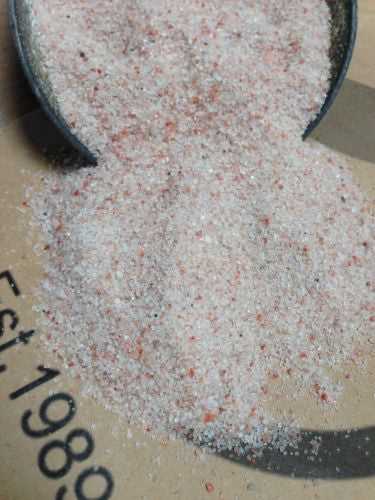
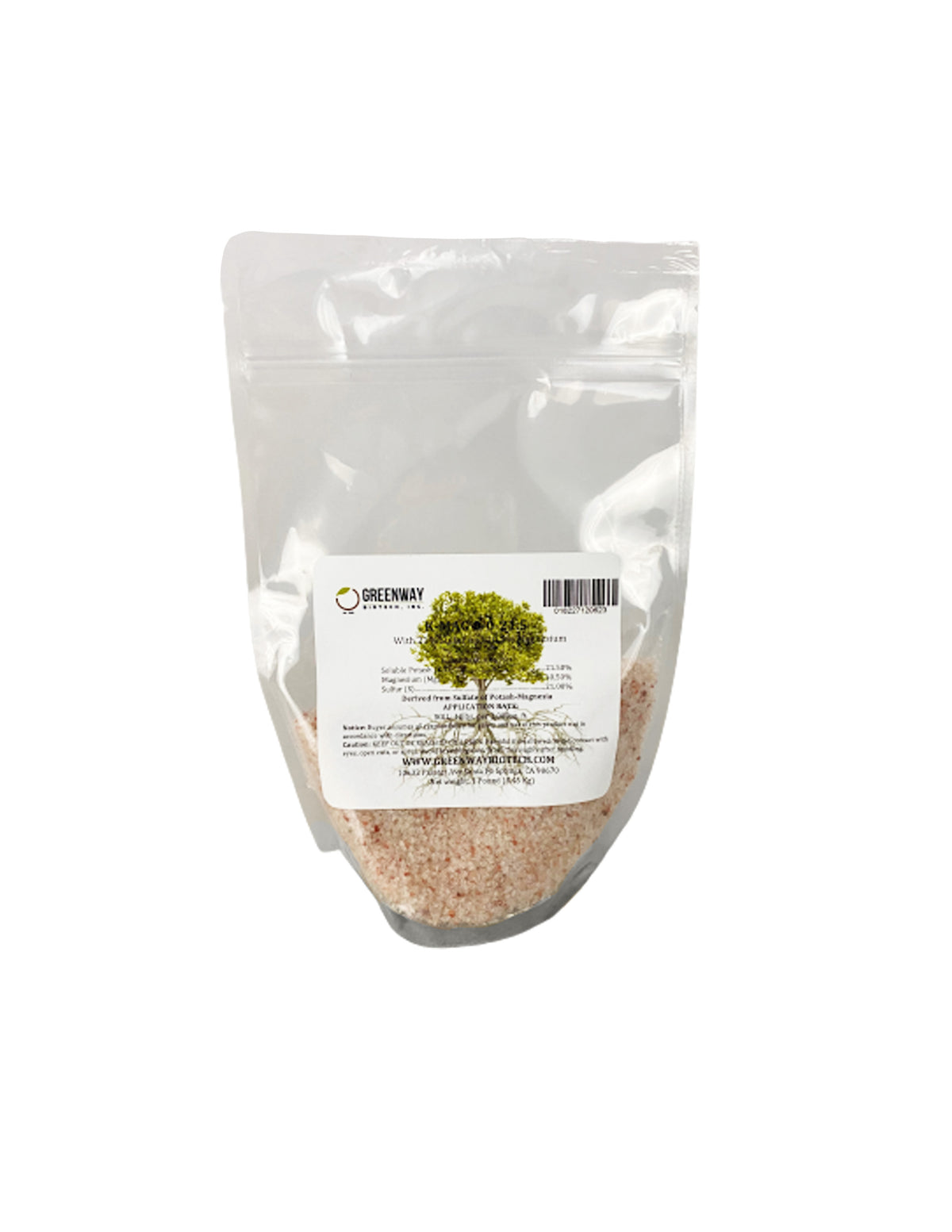
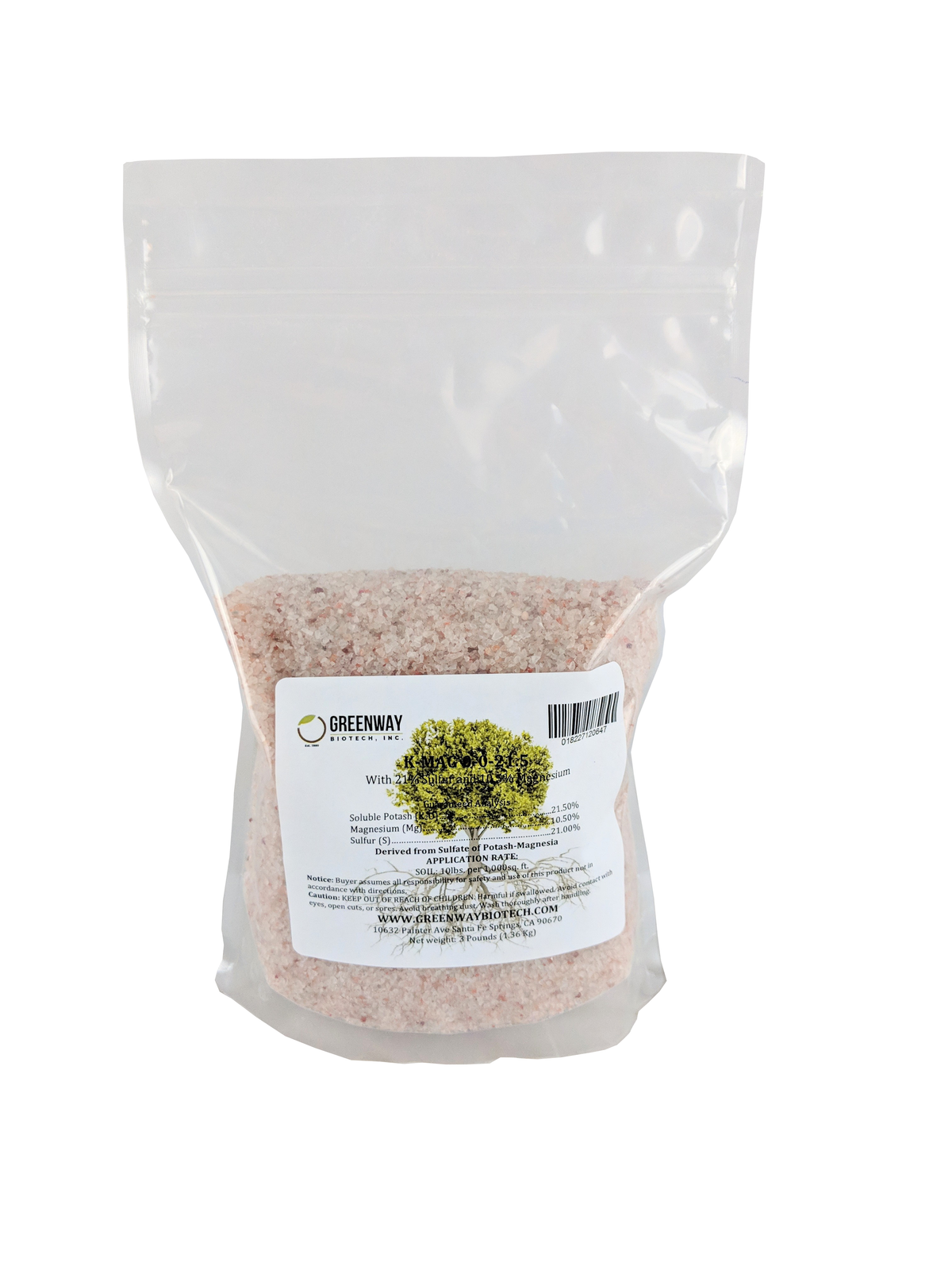
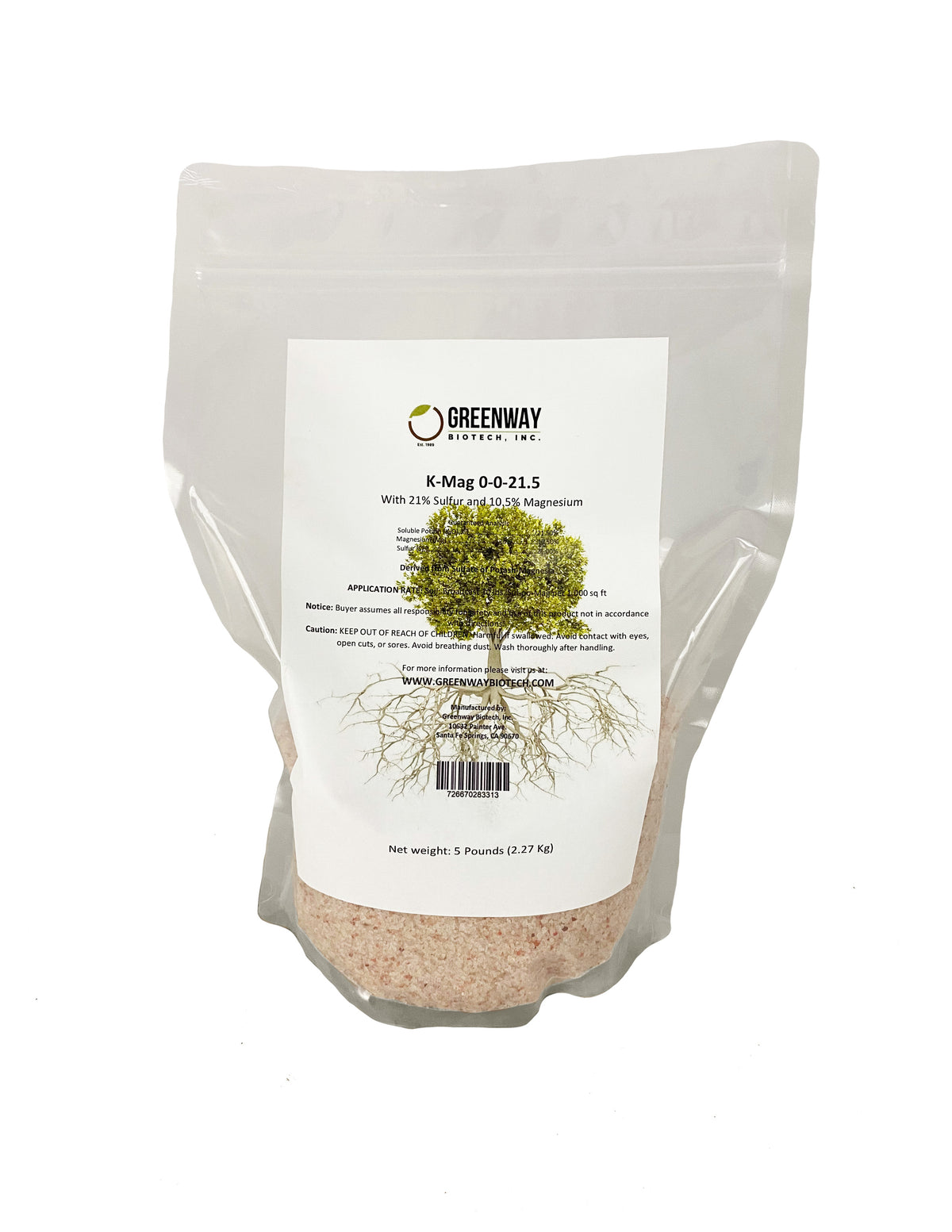
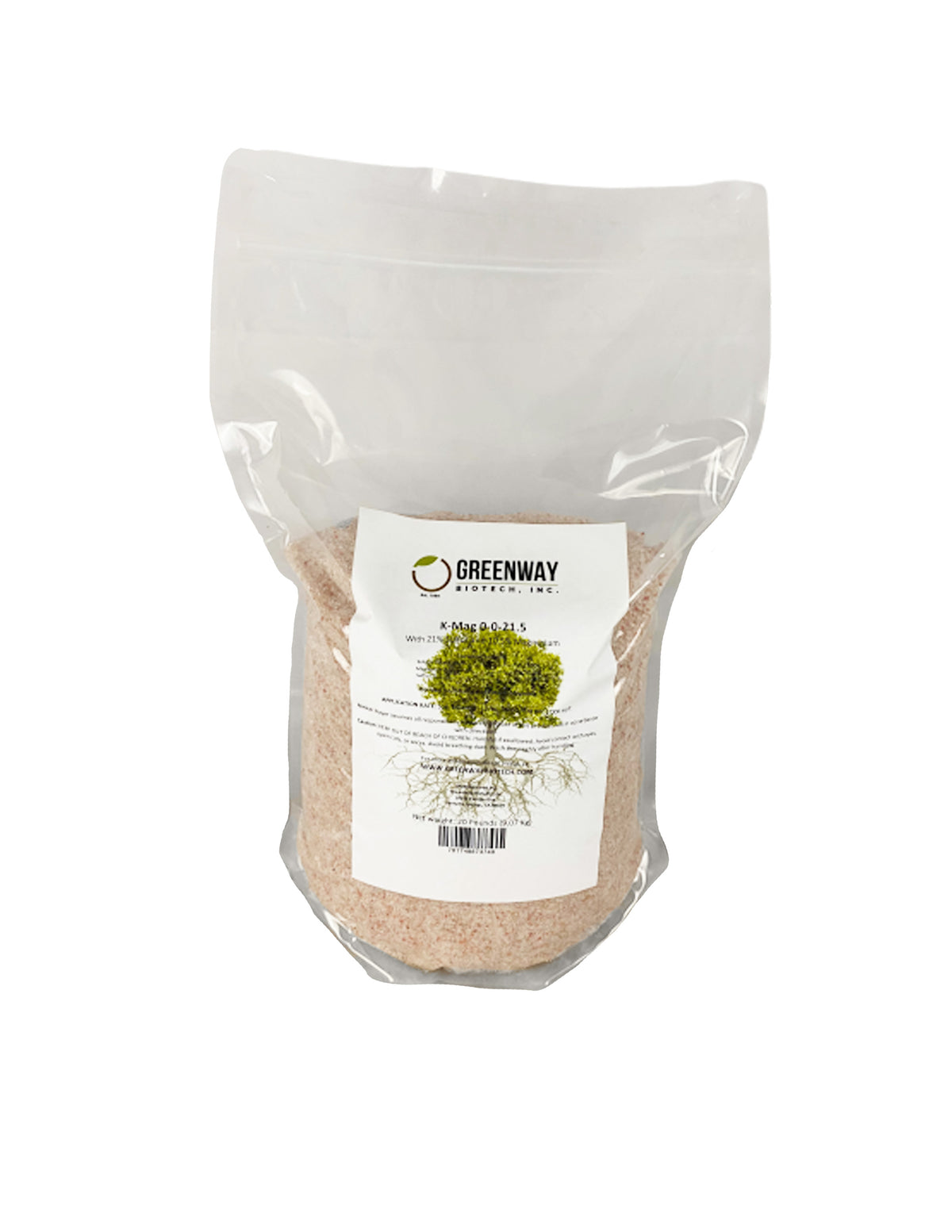
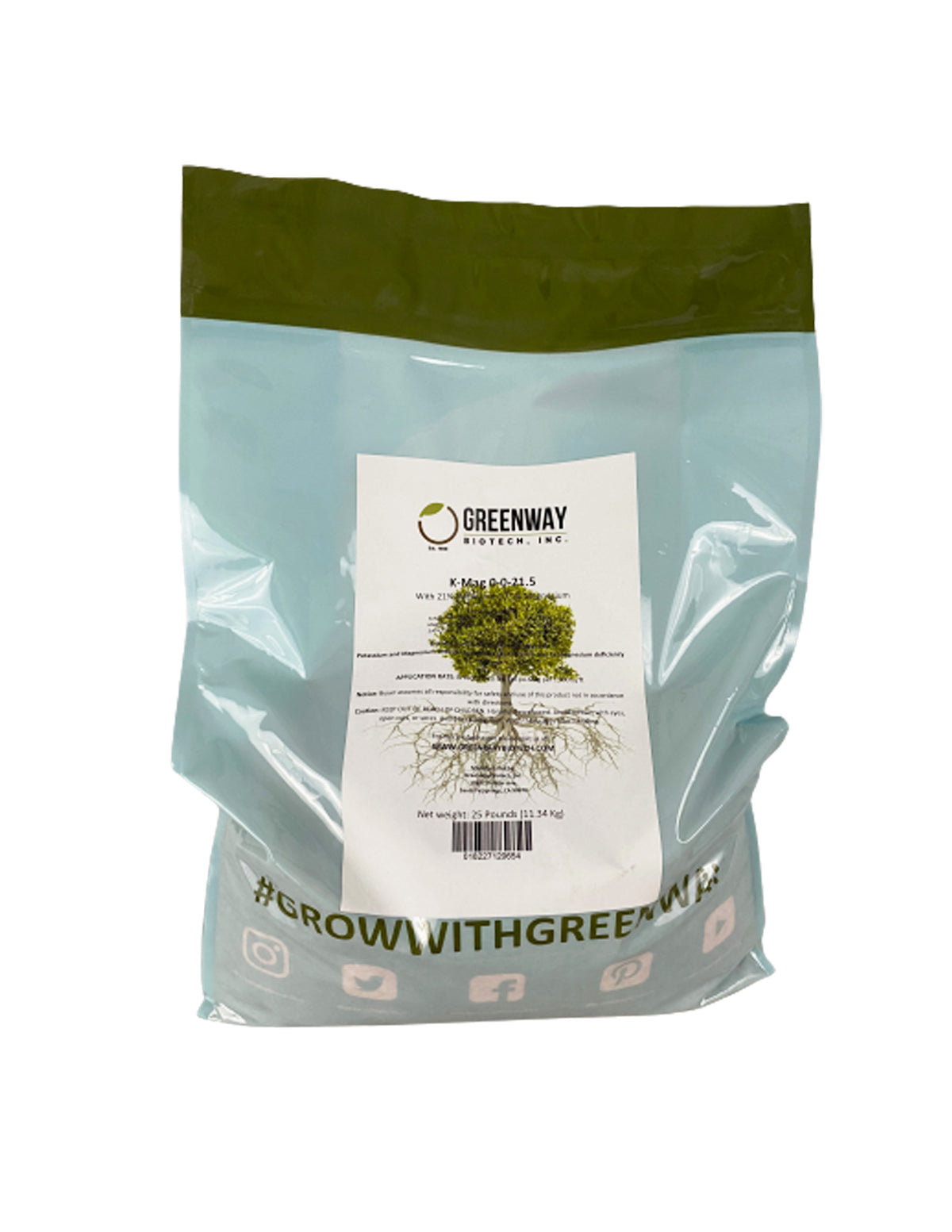
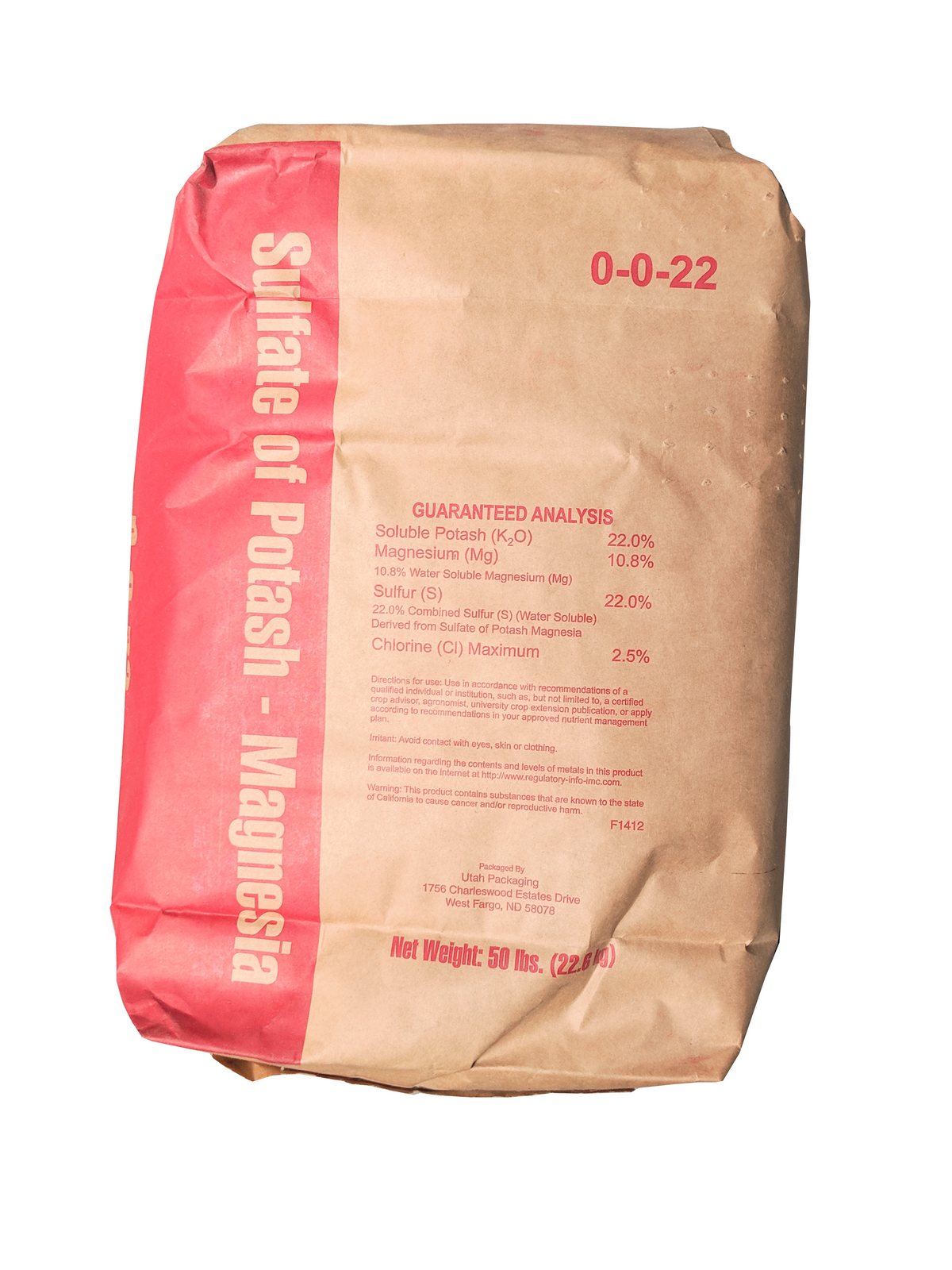
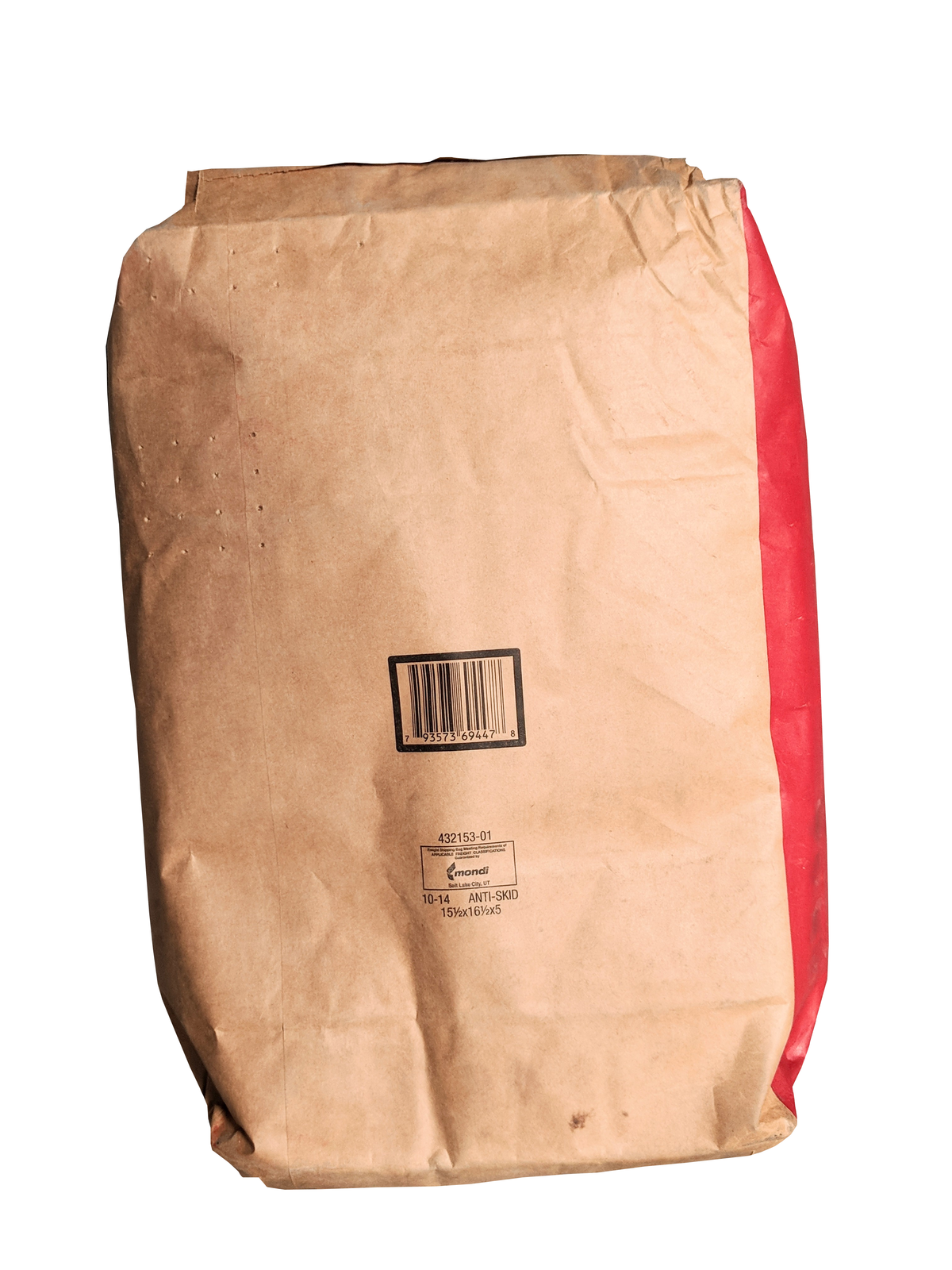
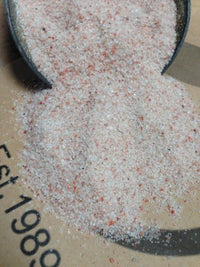
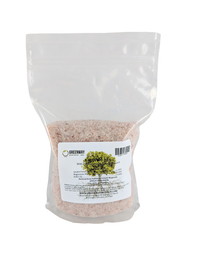
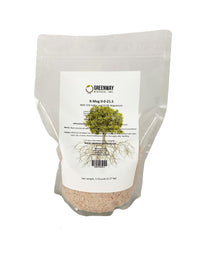
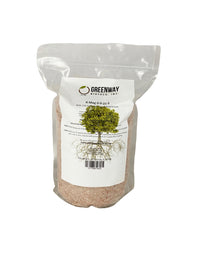
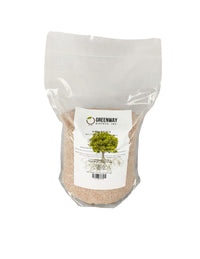
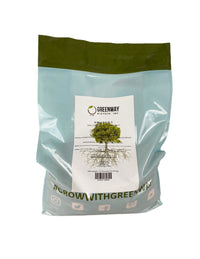
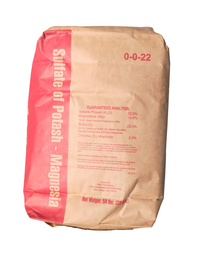
Greenway Biotech K-Mag 0-0-22 (sulfate of potash magnesia, also called langbeinite) is a naturally mined mineral fertilizer for soil application across vegetables, fruit trees, berries, pastures, and chloride-sensitive field crops. Each pound delivers 22% potassium (K₂O), 11% magnesium (Mg), and 22% sulfur (S) — with less than 2.5% chloride and no nitrogen.
Find your size → Calculate how much I need22%
Soluble potash (K₂O) — drives fruit size, sugar, and stress tolerance
11%
Magnesium (Mg) — the central atom in every chlorophyll molecule
22%
Sulfur (S) — required for protein synthesis, enzyme function, and crop quality
2.5%
Maximum chloride (Cl) — well below muriate of potash for chloride-sensitive crops
K-Mag is available in seven bag sizes from 1 lb (single tree or small bed) to 50 lb (large garden, orchard, or split field applications). Coverage estimates use a planning rate of approximately 10 lbs per 1,000 sq ft for vegetable beds. Actual rates vary by crop, soil test, and seasonal nutrient targets — see the Application Rates section below for crop-specific rates.
| Bag Size | Garden Coverage (Planning Rate) | Tree / Orchard Coverage | Best For |
|---|---|---|---|
| 1 lb | ~100 sq ft veg bed | ~1 young tree (annual) | Single tree, small raised bed, test run |
| 2 lb | ~200 sq ft veg bed | 1-2 trees | Backyard berry patch, small garden |
| 5 lb | ~500 sq ft veg bed | 3-5 trees | Most popular |
| 10 lb | ~1,000 sq ft veg bed | 5-10 trees | Average home garden, small orchard |
| 20 lb | ~2,000 sq ft veg bed | 10-20 trees | Large garden, hobby orchard |
| 25 lb | ~2,500 sq ft veg bed | Small vineyard / berry block | Small farm operation |
| 50 lb | ~5,000 sq ft veg bed | Acre-scale split application | Best value |
K-Mag works wherever you need soil-applied potassium plus magnesium and sulfur — without nitrogen and without chloride stress. Each application has its own rate; the calculator below figures it for you.
Chloride-sensitive — K-Mag is the preferred potassium source. Apply at planting and at hilling. May help improve tuber quality and storage.
Late-season potassium without driving foliage growth. Supports fruit size, color, and shelf life through ripening.
Strawberry, raspberry, blueberry, and vineyard crops. Low chloride profile is well suited to sensitive berry root systems.
Spring and fall applications under the drip line. Delivers K, Mg, and S in one pass — no separate magnesium correction needed.
Alfalfa, hay, corn, soybean, tobacco. Soil-test driven; chloride-sensitive crops benefit most from the low-chloride profile.
Helps address magnesium-deficient forage where grass tetany risk is present in livestock. Pair with soil test and veterinary guidance.
The case for K-Mag over other potassium fertilizers comes down to its triple-nutrient profile, low chloride content, gradual nutrient availability, and absence of nitrogen during fruiting and ripening.
K-Mag delivers potassium, magnesium, and sulfur from one naturally mined source. Compared with applying potassium sulfate plus Epsom Salt separately, K-Mag simplifies blending and balances nutrient delivery in a single pass.
Less than 2.5% chloride — well below muriate of potash (~47% chloride). Helps reduce chloride-related stress on tobacco, potatoes, tomatoes, peppers, and berries where higher-chloride sources may cause problems.
K-Mag contains no nitrogen, so late-season applications can build potassium and magnesium reserves without driving unwanted vegetative growth during fruit development and ripening. Pair with a separate nitrogen source earlier in the season for full NPK coverage.
Langbeinite is less soluble than highly water-soluble potassium salts, providing more gradual nutrient availability — which can help reduce the risk of excessive salt concentration at the root zone and may help support more even uptake across the growing season.
Registered with the California Department of Food and Agriculture. Independently tested for heavy metals — results consistently well below required limits. Packaged in Madera, California by a family-owned company, in business since 1989.
If you're not satisfied with your results, return the unused portion within 90 days for a full refund. No questions asked. Every Greenway product carries the same guarantee.
22%
Soluble Potash (K₂O) from Langbeinite — K₂Mg₂(SO₄)₃
Among the secondary plant nutrients, potassium is the one most closely tied to crop quality. It regulates water uptake and stomatal function, drives sugar translocation into developing fruit, and supports the enzymatic pathways that determine fruit size, color, sweetness, and shelf life. Adequate potassium can also help plants better manage drought, cold, and pathogen pressure — particularly where soil tests indicate low K levels.
Magnesium sits at the center of every chlorophyll molecule. Without adequate magnesium, photosynthesis declines, phosphorus utilization drops, and interveinal chlorosis appears on older leaves first. Sulfur, in turn, is required for protein synthesis, enzyme activation, and nitrogen metabolism — it supports crop flavor and aroma development, and may contribute to vitamin content in high-value crops.
K-Mag (sulfate of potash magnesia, also called langbeinite) is a naturally mined mineral with the chemical formula K₂Mg₂(SO₄)₃. Because it is less soluble than highly water-soluble potassium salts like potassium sulfate or potassium chloride, K-Mag dissolves gradually as soil moisture moves through the root zone — providing nutrient availability over weeks rather than days, and reducing the risk of excessive salt concentration at the roots.
The low chloride content (less than 2.5%) is what sets K-Mag apart from muriate of potash (~47% chloride). For chloride-sensitive crops — tobacco, potatoes, tomatoes, peppers, berries — this matters: chloride at high levels can interfere with crop quality, leaf health, and storage performance.
For deeper coverage of how plants use these nutrients, see our guides on What's the Function of Potassium in Plants?, What's the Function of Magnesium in Plants?, and What is the Best Potassium Fertilizer?
Four distinct rate tables for the most common K-Mag applications. Click a tab to switch — quick-answer summaries above each table for the most common case, full table below for everything else. K-Mag is a soil-applied fertilizer and is not intended for foliar use or hydroponic recirculation.
Quick answer: For most vegetable beds, broadcast 10 lbs per 1,000 sq ft before planting and incorporate into the top 4-6 inches of soil. For potatoes, increase to 15-20 lbs per 1,000 sq ft and apply at planting plus hill formation.
| Crop | Rate per 1,000 sq ft | Application Timing |
|---|---|---|
| Potatoes | 15-20 lbs | At planting + hill formation |
| Tomatoes / peppers / eggplant | 10-15 lbs | Pre-plant + at first fruit set |
| Cole crops (broccoli, cabbage, cauliflower) | 8-12 lbs | 3 weeks after transplant |
| Root vegetables (carrot, beet, turnip) | 10-15 lbs | Pre-plant incorporation |
| Leafy greens (lettuce, spinach, kale) | 6-10 lbs | Pre-plant + half rate mid-season |
| Cucurbits (cucumber, squash, melon) | 10-12 lbs | Pre-plant + at first vine run |
| Sweet corn | 10-15 lbs | Pre-plant + at knee-high |
Note: Final rates should be adjusted based on a current soil test. For chloride-tolerant crops with no Mg deficiency, lower-cost muriate of potash may be more economical.
Quick answer: Annual K-Mag ranges from about 1 lb per young tree to 4 lbs per mature citrus. Apply at bud break in spring and again in late summer or early fall. For berries, broadcast 8-10 lbs per 1,000 sq ft pre-plant and again after harvest.
Broadcast evenly under the drip line (outer edge of canopy) for trees. For berries and vineyards, broadcast across the bed or row and incorporate lightly. Water thoroughly after application.
| Crop | Young (1-3 yr) | Bearing (4-8 yr) | Mature (9+ yr) |
|---|---|---|---|
| Apple / Pear / Cherry | 0.5-1 lb / tree | 1-2 lbs / tree | 2-3 lbs / tree |
| Peach / Plum / Apricot | 0.5-1 lb / tree | 1-2 lbs / tree | 2-3 lbs / tree |
| Citrus (orange, lemon, lime) | 0.5-1 lb / tree | 1.5-3 lbs / tree | 2-4 lbs / tree |
| Avocado | 0.5-1 lb / tree | 1-2 lbs / tree | 2-3 lbs / tree |
| Olive / Fig / Pomegranate | 0.5-1 lb / tree | 1-2 lbs / tree | 1.5-3 lbs / tree |
| Strawberries | 8-10 lbs / 1,000 sq ft pre-plant + same rate after harvest | ||
| Raspberries / blackberries | 5-8 lbs / 1,000 sq ft pre-plant + half rate post-harvest | ||
| Blueberries | 3-5 lbs / 1,000 sq ft (acid-loving — also consider sulfur amendment) | ||
| Grapes (vineyard) | 200-300 lbs / acre early spring | ||
Citrus timing: For citrus, split annual rate between spring (bud break) and late summer or early fall. Avoid late-fall applications in regions where new flush may not harden before frost.
Quick answer: Field crop K-Mag rates range from about 100 lbs per acre for soybeans to 400 lbs per acre for high-removal alfalfa programs. Always confirm with a current soil test, crop nutrient removal estimates, and local extension recommendations.
📋 Field & Acreage Rates: The per-acre figures below are general references for medium-testing soils at typical yield goals. Actual rates should be based on a current soil test and local nutrient removal estimates. Consult your local extension service for site-specific recommendations.
| Crop | Typical Rate (lbs / acre) | Application Notes |
|---|---|---|
| Alfalfa / Hay | 200-400 | Split: pre-establishment + after each cutting |
| Tobacco (chloride-sensitive) | 200-300 | Pre-plant — K-Mag preferred over muriate of potash |
| Corn (grain or silage) | 100-200 | Pre-plant or early-season banded |
| Soybeans | 100-150 | Pre-plant broadcast |
| Cotton | 100-150 | Pre-plant + side-dress at squaring |
| Wheat / barley / oats | 100-150 | Pre-plant — Mg-deficient soils benefit most |
| Sugar beet / sugarcane | 150-250 | Pre-plant broadcast |
Quick answer: For actively grazed or hayed pastures on medium-test soils, apply 200-300 lbs per acre annually, split into early-spring and post-grazing or post-cutting applications. Reduce on lower-removal pastures or where soil tests show high K. In regions where grass tetany has been a concern, K-Mag can help raise forage magnesium when soil and tissue tests indicate Mg shortfall.
| Forage System | Annual Rate (lbs / acre) | Timing |
|---|---|---|
| Cool-season pasture (fescue, ryegrass, orchard) | 200-300 | Early spring + after each grazing rotation |
| Warm-season pasture (bermuda, bahia) | 200-300 | Spring green-up + mid-summer |
| Alfalfa hay | 250-400 | After each cutting |
| Grass hay (timothy, brome, orchardgrass) | 200-300 | Spring + after first cutting |
| Mixed hay (grass + legume) | 200-300 | Spring + after first cutting |
Grass tetany note: Grass tetany (hypomagnesemia) in grazing livestock is a multi-factor condition influenced by forage Mg, K, and N, plus animal management. K-Mag may help raise forage magnesium where soil and tissue tests indicate a shortfall, but should be used alongside veterinary guidance and an overall mineral program — not as a sole intervention.
Four application methods cover everything K-Mag is good for. The calculator on the right does the math for whichever you pick.
Spread the calculated amount evenly over the planting area at the recommended rate. Incorporate into the top 4-6 inches of soil using a tiller or rake. Water thoroughly after incorporation to begin nutrient availability. Best for establishing beds, gardens, and field operations before seeding or transplanting.
Apply 1-2 lbs per 100 sq ft around the base of established plants. Keep product 2-3 inches away from direct contact with stems and foliage. Lightly work into the top 1-2 inches of soil if possible. Water thoroughly to move nutrients into the root zone.
Apply 1-2 lbs per 100 linear feet in a band alongside crop rows. Place the band 4-6 inches from plant stems to avoid root contact. Cover lightly with soil to reduce runoff. Irrigate after application for best nutrient uptake.
K-Mag is not fully water-soluble and is not intended for foliar sprays or recirculating hydroponic reservoirs. For fully water-soluble potassium, use MKP 0-52-34 or Potassium Sulfate 0-0-53 instead.
K-Mag is one of several potassium fertilizers in our catalog. Use this side-by-side comparison to choose the right source for your situation. For a deeper dive, see our Best Potassium Fertilizer guide.
| Product | Nutrients | Chloride | Best For | Notes |
|---|---|---|---|---|
| K-Mag 0-0-22 (this product) | 22% K₂O + 11% Mg + 22% S | Low (<2.5%) | Chloride-sensitive crops, Mg-deficient soils, late-season feeding | Triple-nutrient mineral with gradual nutrient availability — no nitrogen |
| Potassium Sulfate 0-0-53 | 53% K₂O + 17% S | Low | Higher K concentration when Mg is not needed | 100% water-soluble; suitable for fertigation and foliar use |
| Muriate of Potash 0-0-62 | 62% K₂O | High (~47%) | Chloride-tolerant field crops, lowest cost per lb K₂O | Most concentrated potassium source — NOT for chloride-sensitive crops |
| MKP 0-52-34 | 52% P₂O₅ + 34% K₂O | None | Bloom and fruit stage, fertigation, foliar | Adds phosphate alongside potassium — 100% water-soluble |
| Epsom Salt (Magnesium Sulfate) | 10% Mg + 13% S | None | Magnesium correction only — no potassium | Fully water-soluble; suitable for foliar or soil drench |
K-Mag is the go-to for chloride-sensitive crops and soils that need K plus Mg in one pass. For some specific use cases, a different product is a better match — see the right column.
K-Mag delivers potassium, magnesium, and sulfur. For a complete soil fertility program, pair it with these complementary products.
High-concentration nitrogen for early-season vegetative growth. Pair with K-Mag for full NPK coverage across the season.
Calcium + NitrogenWater-soluble calcium and nitrogen for cell wall strength and BER risk reduction in fruiting crops.
Phosphate + PotassiumWater-soluble phosphate and potash for bloom and fruit set. Complements K-Mag's gradual soil-applied profile.
Calcium + Mg + FeWater-soluble calcium and magnesium for fruiting crops and transplants where rapid Ca correction is needed.
K-Mag is safe when used as directed. These five rules cover the most common mistakes.
If your question isn't here, contact our team. We'd rather over-explain on the front end than disappoint on the back end.
K-Mag (sulfate of potash magnesia, also called langbeinite fertilizer or potassium magnesium sulfate) is a naturally mined mineral fertilizer with a guaranteed analysis of 22% potassium (K₂O), 11% magnesium (Mg), and 22% sulfur (S). Its triple-nutrient profile is unique because it delivers potassium without nitrogen — ideal during fruit development and ripening. The low chloride content (less than 2.5%) makes it a preferred low-chloride potassium source for chloride-sensitive crops like tobacco, potatoes, tomatoes, and berries, where higher-chloride sources like muriate of potash may cause chloride-related stress.
Choose K-Mag when growing chloride-sensitive crops (tobacco, potatoes, tomatoes, peppers, berries), when magnesium is also needed, for late-season soil fertilization when nitrogen isn't desired, or on sandy and acidic soils that tend to be low in both magnesium and sulfur. K-Mag can also help raise forage magnesium in pastures where grass tetany has been a concern. For a deeper look at how potassium benefits your crops, see our guide on What's the Function of Potassium (K) in Plants?
K-Mag works through three complementary nutrient pathways. Potassium (22% K₂O) regulates water uptake, can support drought tolerance, and may enhance fruit size and plant resilience under stress. Magnesium (11% Mg) is the central component of chlorophyll and supports phosphorus utilization — deficiency shows first as interveinal chlorosis on older leaves. Sulfur (22% S) is required for protein synthesis, supports nitrogen efficiency, and may contribute to crop flavor and aroma. In potassium- or magnesium-deficient soils, correcting these nutrients with K-Mag can help improve yield and tuber quality, including reduced internal brown spot in potatoes.
Potassium deficiency typically appears as yellowing or browning of leaf edges (marginal chlorosis), weak stems, poor fruit quality, and increased susceptibility to stress. Magnesium deficiency shows as interveinal chlorosis on older leaves first, with reduced photosynthesis and poor fruit set. Sulfur deficiency causes uniform yellowing of younger leaves (unlike nitrogen deficiency, which affects older leaves first), stunted growth, and delayed maturity. Soil-test critical levels vary by lab methodology, soil type, and crop — consult your soil test report and local extension guidance to determine whether K and Mg levels warrant application. For more on magnesium deficiency, see What's the Function of Magnesium (Mg) in Plants?
No. K-Mag is not 100% water-soluble and is not intended for foliar sprays or recirculating hydroponic reservoirs. It is a soil-applied fertilizer — broadcast, top-dress, or side-dress, then water in. For fully water-soluble potassium needs (fertigation, foliar feeding, or hydroponics), consider MKP 0-52-34 or Potassium Sulfate 0-0-53 instead.
K-Mag is compatible with most dry fertilizers, including urea, ammonium sulfate, DAP, MAP, and most micronutrient sources. Avoid blending with calcium nitrate or high-calcium fertilizers unless compatibility has been confirmed; sulfate plus calcium can form insoluble gypsum in blended or solution applications. K-Mag is primarily intended for soil application — not fertigation.
Manganese activates enzymes involved in carbohydrate metabolism and root health, which supports a plant's capacity to absorb potassium. When manganese levels are adequate, plants tend to develop more efficient root systems. This relationship is particularly relevant for high-carbohydrate crops like potatoes and corn that have elevated potassium demand. For a detailed look at this nutrient interaction, see Why High-Carb Crops Demand Plenty of Potassium (and How Manganese Can Help).
Langbeinite is a naturally mined mineral input that may be allowed in organic production depending on certification rules. Always verify with your certifying body — such as OMRI or your local organic certification program — before use, as requirements can vary by program and region.
From a 1 lb test run to a 50 lb season supply, we've shipped K-Mag from Madera, California to growers in all 50 states. Free shipping on orders over $100. 90-day money-back guarantee on every order.
Choose your size →