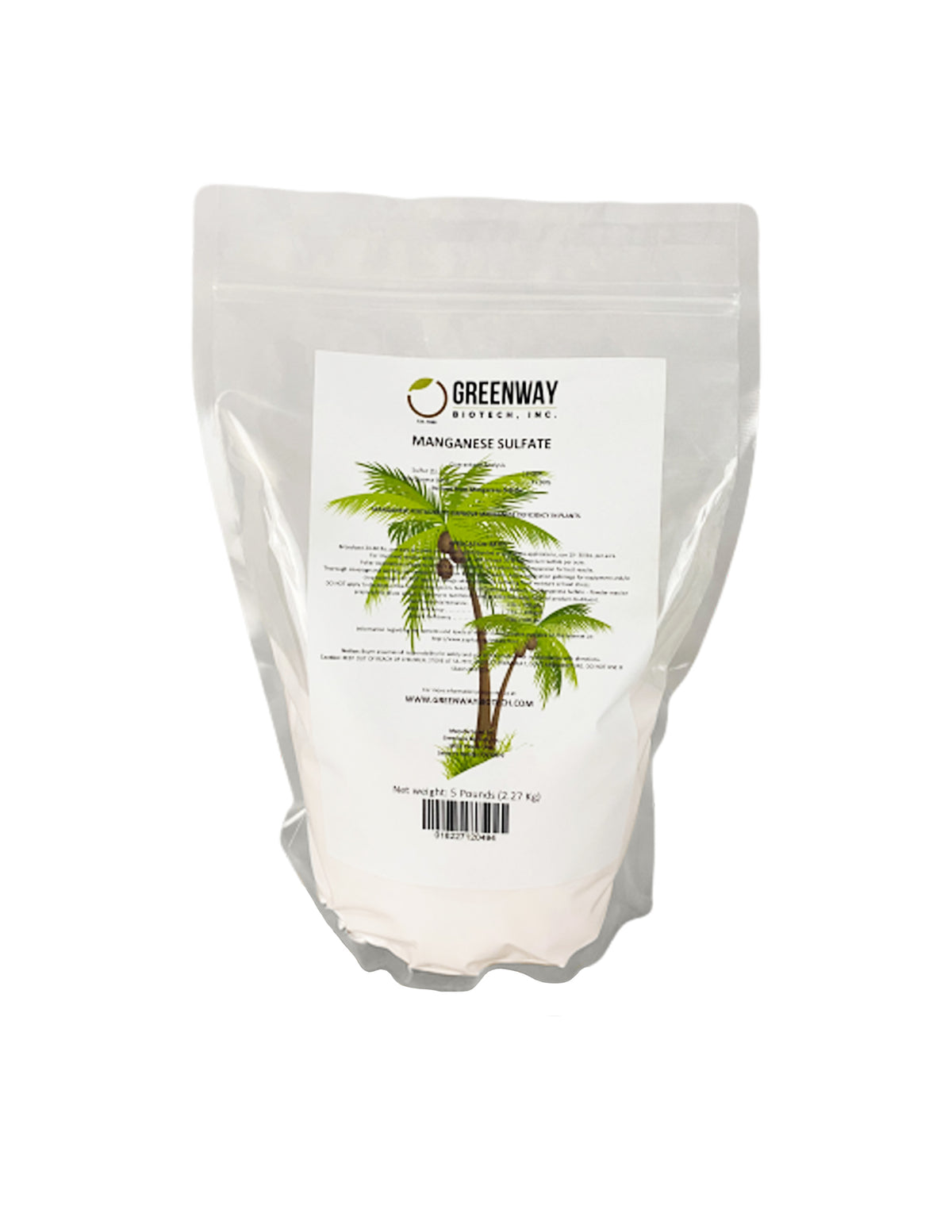
Continental US, Standard shipping: free on orders of $100 or more, $9.99 on orders under $50, and $14.99 from $50 up to $100.
UPS and FedEx options are also offered at checkout, at their own rates.
Orders placed by 11 AM Pacific on a business day ship the same day.
Alaska, Hawaii, US territories, APO/FPO and international addresses: the cost is shown at checkout, and 2-day delivery isn’t available to Alaska, Hawaii or P.O. boxes.
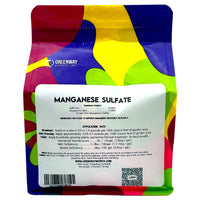
Manganese and sulfur micronutrient · 31% Mn · 18% S · manganese sulfate monohydrate
About Manganese Sulfate 31% Mn
Manganese sulfate monohydrate (MnSO₄·H₂O) is a water-soluble micronutrient that supplies 31% manganese and 18% sulfur. It corrects manganese deficiency, which shows as yellowing between the veins of new leaves and as frizzletop in palms, as a foliar spray, a band beside the row, a treatment under a palm’s canopy, or a trace addition to a hydroponic solution.
Soil pH decides how it works. Deficiency is most common above about pH 6.5, where manganese spread over the soil is tied up quickly, so spray it on the leaves or band it rather than broadcasting it. On acid soil below about pH 5.5, manganese can reach toxic levels, so add it only where a deficiency is confirmed. It looks like iron and zinc deficiency, it must not be tank-mixed with glyphosate, and the powder can cause serious eye damage, so wear goggles.
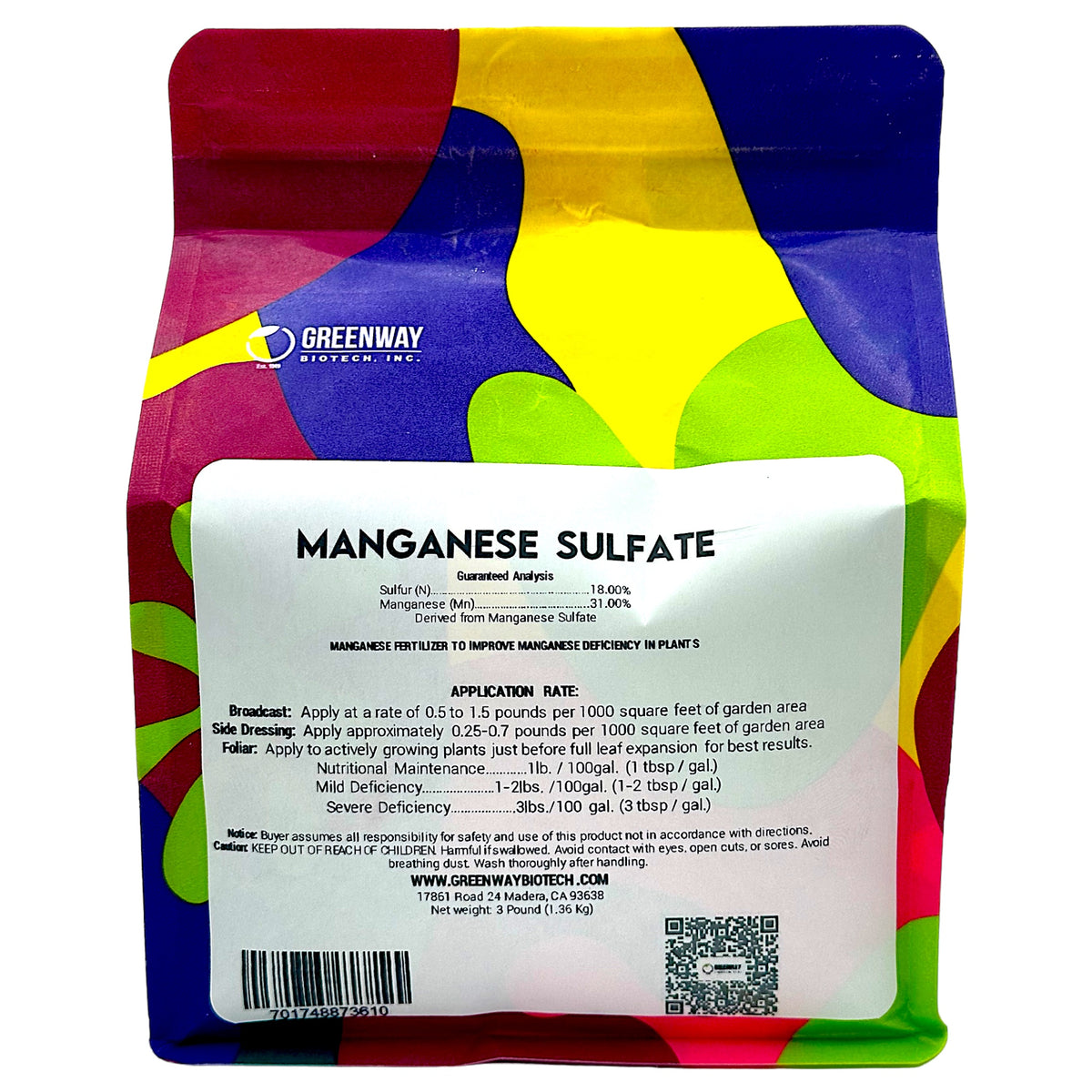
31% Mn · 18% S Guaranteed manganese and sulfur from manganese sulfate monohydrate
Above pH 6.5 Where deficiency is most common; spray or band it there rather than broadcasting
1–50 lb bags Seven sizes; the calculator turns your palms, beds, lawn, spray, or reservoir into an amount and a bag size
Manganese sulfate monohydrate (MnSO₄·H₂O), CAS 10034-96-5
Nitrogen, phosphate, potash
None. This is a manganese and sulfur source, not a complete fertilizer.
Physical form
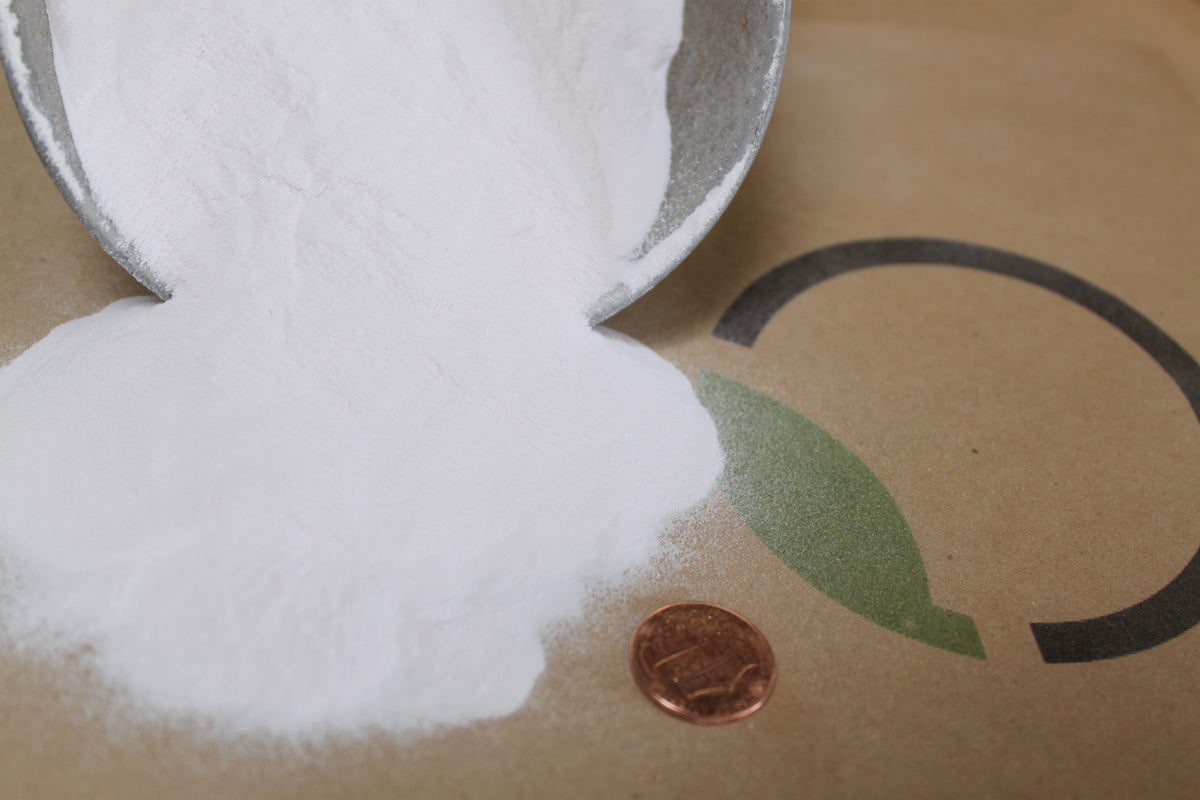
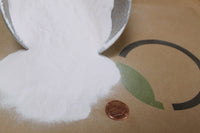
Light pink powder; bulk density 70–74 lb per cubic foot (safety data sheet)
Solubility
Water-soluble; dissolves for foliar sprays, drip, and nutrient solutions (University of Wisconsin A2526 describes manganese sulfate as very soluble)
Hazard classification (SDS)
Signal word Danger. Causes serious eye damage; may cause damage to organs through prolonged or repeated exposure; toxic to aquatic life with long-lasting effects.
Registration
CDFA-registered fertilizer
Package sizes
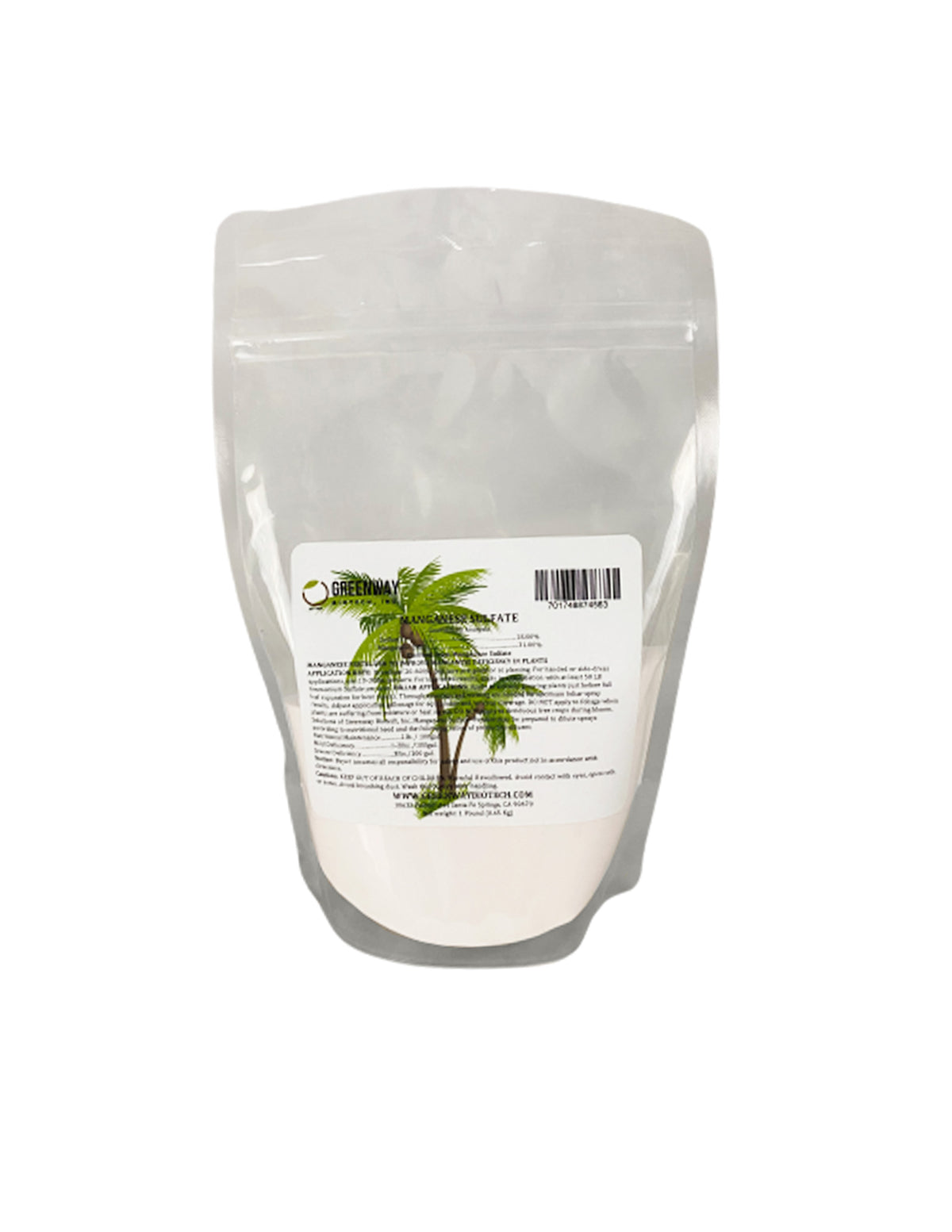
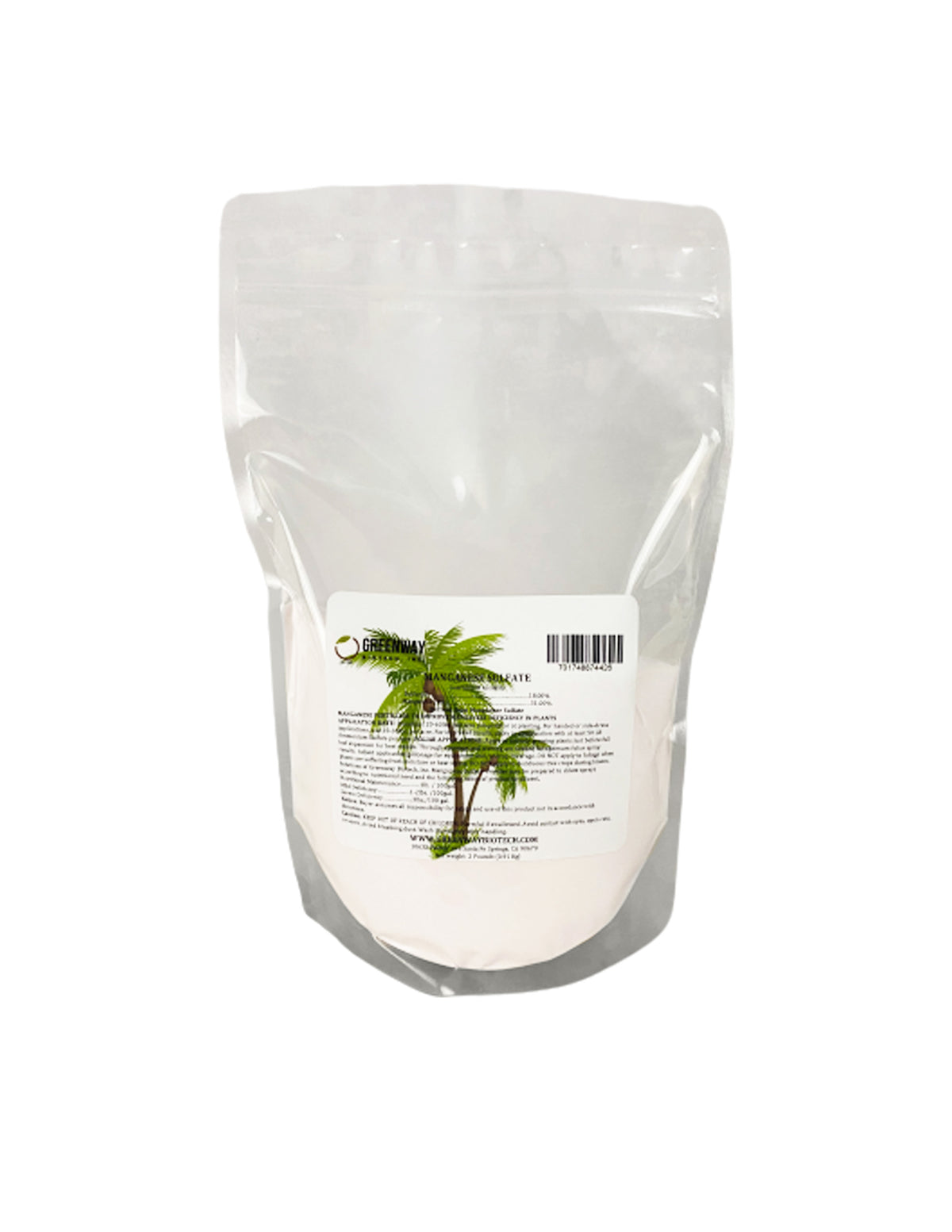
1, 2, 3, 5, 10, 25, and 50 lb (the 50 lb size may ship as two 25 lb bags)
Packed by
Greenway Biotech, Inc., Madera, California
Percentages are by weight of product: 1 lb contains 0.31 lb (141 g) of manganese and 0.18 lb (82 g) of sulfur, and a 25 lb bag contains 7.75 lb of manganese. Every rate on this page is product weight unless it says “of manganese” or “Mn”: pounds of product = pounds of manganese ÷ 0.31.
Best uses & benefits
Choose it when new leaves show the symptoms and the soil pH explains them. Manganese deficiency yellows the tissue between the veins of the youngest leaves; eight common causes of yellow leaves are worth ruling out first, and a tissue test settles doubtful cases.
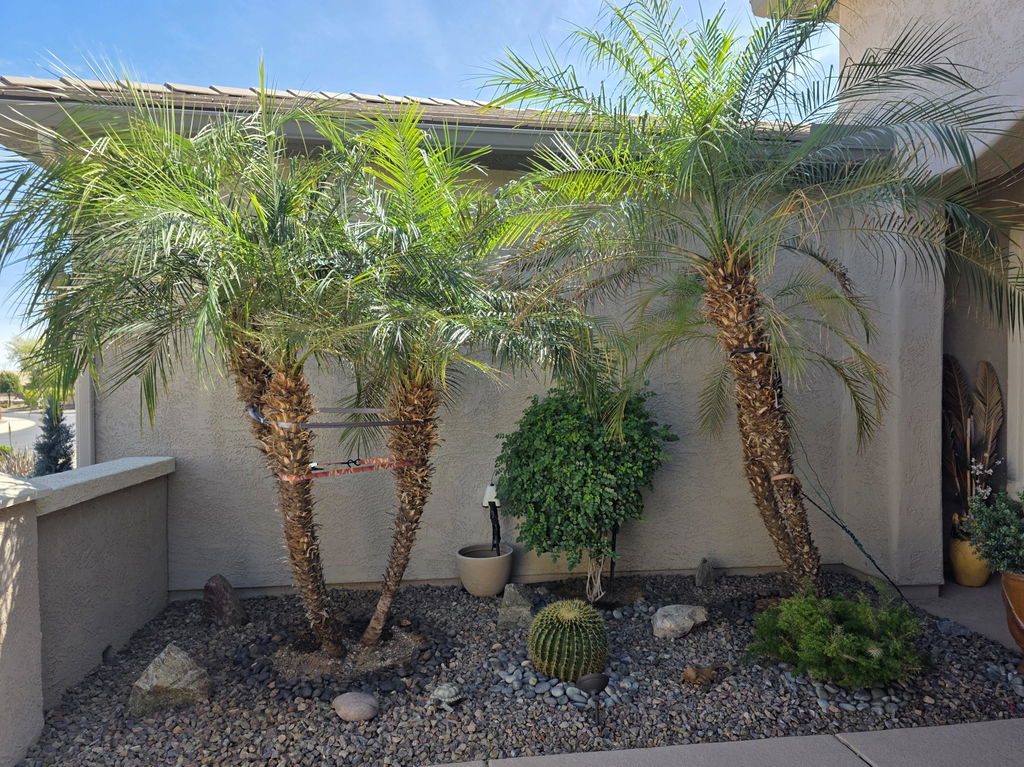
Palms with frizzletop
University of Florida IFAS describes new palm leaves that emerge yellow, streaked, and withered, with leaflets curled around the stem. Queen, royal, paurotis, and pygmy date palms are the most susceptible. Manganese sulfate spread under the canopy every 2 to 3 months is the treatment, with a foliar spray for a faster, short-term response.
Vegetables and flowers on alkaline soil
Beans, lettuce, onions, radish, spinach, and raspberries have a high manganese requirement (University of Wisconsin). On neutral to alkaline, limed, or high-organic soil, a foliar spray is the fastest fix, and a second or third spray may be needed.
Citrus and fruit trees
Citrus shows manganese deficiency as a green band along the midrib and main veins with paler tissue between, on leaves of normal size and shape (UF/IFAS). UF/IFAS and the BC Tree Fruit Production Guide treat it with foliar sprays timed to newly expanded leaves.
Lawns on high-pH soil
North Dakota State University recommends a light foliar manganese sulfate spray for turf on alkaline soil, where deficiency can yellow the grass.
Field and vegetable crops on a soil test
University of Wisconsin treats soil testing below 10 ppm manganese, or soil over 6% organic matter above pH 7.0, with weighed soil and foliar rates by crop. Banding it with an ammonium nitrogen fertilizer improves availability.
Hydroponic and nutrient solutions
The classic Hoagland solution carries 0.5 ppm manganese, and Penn State’s herb solution 0.25 ppm. Manganese sulfate dissolves for a stock solution where a recipe calls for it.
Where it is a poor fit
Acid soil, or no deficiency. University of Wisconsin reports manganese toxicity on acid soils below pH 5.5, especially when wet; asparagus, forage legumes, mint, and peas are susceptible. UF/IFAS notes that excess manganese induces iron deficiency in palms.
Broadcasting on high-pH, high-organic soil. Wisconsin does not recommend it, because those soils fix manganese quickly. Spray the leaves or band it.
Yellowing that has not been diagnosed. Iron and zinc deficiency, and citrus greening (HLB), look similar on young leaves; yellowing that starts on older leaves points to nitrogen or magnesium.
A tank mix with glyphosate. Purdue Extension advises against mixing them, because each reduces the other’s effectiveness.
Our complete hydroponic formulas. The crop formulas and Micro Green 2-0-3 already carry chelated manganese; do not add more on top.
A complete fertilizer. It supplies manganese and sulfur only.
Application rates & directions
Every rate below is product weight and names its source, a university Extension service or government agriculture department listed in section 13. A soil or tissue test gives the best rate. Without one, use the starting amounts below only where new leaves show the symptoms and the soil is neutral to alkaline, never on soil below about pH 5.5.
Weigh it. The density of this product in a spoon has not been measured, so no spoon or cup measure is given. Use a kitchen scale that reads grams for sprays and small beds, and convert a manganese rate with pounds of product = pounds of manganese ÷ 0.31.
Without a soil test: starting amounts for plants with symptoms
Manganese sulfate starting amounts where new leaves show deficiency on neutral to alkaline soil, one application unless noted
Plant
Amount
How and when
Source
Palms, soil
8 oz per small palm or any palm on acid sand, up to 8 lb per large palm on limestone soil
Spread evenly over the soil under the canopy and water in; repeat every 2–3 months; new growth may take 3–6 months to respond
UF/IFAS ENH1015
Palms, foliar
3 lb per 100 gal of water: 13.6 g (0.48 oz) per gallon
Spray the leaves for a faster, short-term response, in addition to the soil treatment, not instead of it
UF/IFAS ENH1015
Vegetables and flowers, foliar
1.3 oz (37 g) per 1,000 sq ft, or 3.7 g per 100 sq ft, in about 1.2 gal of water per 1,000 sq ft (30 g per gallon)
Spray the leaves with a wetting agent while plants are young; a second or third spray may be needed
Western Australia DPIRD
Lawns, foliar
1.3 oz (37 g) per 1,000 sq ft
Dissolve in 1–3 gal of water per 1,000 sq ft and spray evenly
NDSU H1824
Apple, pear, and stone-fruit trees, foliar
200 g per 100 L of water: 7.6 g (0.27 oz) per gallon
Spray to wet the leaves as soon as they are well developed; once a year
BC Tree Fruit Production Guide
Test a spray on a few leaves first and spray in the cool part of the day. Judge the result on the leaves that grow after treatment; leaves already yellow may not green up. For citrus in a home landscape, a complete citrus fertilizer that contains manganese, such as Citrus & Avocado Fertilizer 14-4-14, is the simplest way to keep it supplied; the grove rates are below.
From a soil test: vegetables and field crops
University of Wisconsin manganese rates (A2526) where soil tests below 10 ppm Mn, or above pH 7.0 on soil over 6% organic matter, converted to this product
3 lb Mn per acre: 9.7 lb per acre, or 3.6 oz (101 g) per 1,000 sq ft
0.75 lb Mn per acre: 2.4 lb per acre, or 0.89 oz (25 g) per 1,000 sq ft
Other crops
None
None
Wisconsin does not recommend broadcasting on high-pH, high-organic soils; band it beside the row, with ammonium nitrogen in the band to improve availability, or spray it, and expect two or three foliar passes for the best response. NC State Extension, for vegetables where the soil Mn availability index is below 25, gives 20–25 lb of manganese sulfate per acre broadcast (7.3–9.2 oz per 1,000 sq ft) or 1–2 lb per acre as a foliar spray. Western Australia’s vegetable rates are 50 kg per hectare broadcast (45 lb per acre), 10–20 kg per hectare in the furrow or band (9–18 lb per acre), or 4 kg per hectare as a 0.8% foliar spray (3.6 lb per acre in about 54 gal of water).
Palms
UF/IFAS bases palm rates on species, soil type, and severity: as little as 8 oz of manganese sulfate for a small palm or one on acid sand, up to 8 lb for a large palm on limestone soil, broadcast under the canopy every 2 to 3 months, plus a 3 lb per 100 gal foliar spray for a faster but short-lived response. Severely affected palms stop growing and new leaves emerge as dead stubs, so treat at the first yellow, streaked new leaves. Keep composted sewage sludge and manure products away from palms; UF/IFAS notes they bind manganese strongly.
Citrus groves
UF/IFAS (SS423) recommends a foliar spray with 2–3 lb of manganese per acre (6.5–9.7 lb of this product) on spring or summer flush leaves that are two-thirds to fully expanded, and notes that 7–10 lb per acre of low-biuret urea in the spray increases uptake. For trees affected by citrus greening, the 2026–2029 Florida Citrus Production Guide uses three foliar applications a year after the March, May, and September flushes, totaling 15 lb of manganese per acre (16.1 lb of product per application), and limits soil applications of 20 lb of manganese per acre (64.5 lb of product) to soils that are not calcareous. Optimum leaf manganese is 25–100 ppm, and below 18 ppm is deficient.
Fruit trees
The BC Tree Fruit Production Guide treats manganese deficiency in apple, pear, and stone-fruit trees with one spray a year as soon as the leaves are well developed: 200 g of manganese sulfate per 100 L of water, or 3.6 kg per acre (7.9 lb per acre). It notes that deficiency occurs on alkaline and high-organic soils, not on acid or neutral soils.
Hydroponics and nutrient solutions
Manganese sulfate needed for a manganese target in the final nutrient solution
Target
Per 100 US gal
Per 1,000 L
Source
0.25 ppm Mn (herbs)
0.31 g
0.81 g
Penn State Extension, modified Sonneveld solution
0.5 ppm Mn
0.61 g
1.61 g
Hoagland and Arnon, Circular 347
These amounts are too small to weigh accurately on a kitchen scale, so dissolve a weighed amount in a concentrate and dose from it. Hold the solution between pH 5.5 and 6.5, where UF/IFAS reports most elements are absorbed best. Greenway’s crop formulas and Micro Green already supply chelated manganese; do not add more to them.
Glyphosate
Do not tank-mix manganese sulfate with glyphosate. Purdue Extension advises against it because each reduces the other’s effectiveness, and recommends a foliar manganese spray 7 to 10 days after the glyphosate application.
Eyes, soil, and water. The powder can cause serious eye damage: wear goggles and gloves when weighing and mixing. Do not exceed these rates or apply it to acid soil without a confirmed deficiency, and keep spray, spills, and rinse water out of storm drains, ponds, and streams; it is toxic to aquatic life.
How to use manganese sulfate
Check the need. Look for yellowing between the veins of the youngest leaves, or frizzled new palm fronds, and measure soil pH. Deficiency is most likely above about pH 6.5; below 5.5, do not add manganese without a test. A tissue test separates manganese from iron and zinc.
Pick the method and rate. Spray the leaves for the fastest response; band it beside the row on a soil test; spread it under the canopy for palms; dose a stock solution for hydroponics. Use the matching row in section 4.
Measure, then weigh. Measure the area, count the palms or trees, or measure the spray or reservoir volume, and weigh the product in grams. Wear goggles and gloves.
Dissolve and apply. Dissolve it fully in water before spraying, test on a few leaves, and spray in the cool part of the day. Water soil treatments in. Keep glyphosate at least 7 to 10 days apart.
Judge the new growth. Look at the leaves that grow after treatment, repeat sprays only as the row allows, and retest soil or leaves before treating again. Palms may take 3 to 6 months to show recovery.
Calculator & choosing a size
Formulas. From a manganese rate: product (lb) = lb of Mn ÷ 0.31. Area rates: product = rate per 1,000 sq ft × square feet ÷ 1,000, or rate per acre × acres. Sprays: product = grams per gallon × gallons. Palms: rate per palm × number of palms. Nutrient solutions: grams of product = ppm × liters ÷ 310.
Worked examples. Tomatoes on a 200 sq ft bed with symptoms on alkaline soil: 3.7 g × 2 = 7.4 g in about 0.25 gal of water; a 1 lb bag. Three small palms on sandy soil at 8 oz each: 1.5 lb per round, every 2 to 3 months; a 2 lb bag covers one round. A 2,000 sq ft lawn: 2.6 oz (73 g) in 2 to 6 gal of water; a 1 lb bag. An acre of soybeans on a soil test below 10 ppm, banded: 16.1 lb; a 25 lb bag. A 100 gal reservoir at 0.5 ppm: 0.61 g.
What each bag covers at four of the rates on this page
Bag
Lawn or vegetable foliar spray, 1.3 oz per 1,000 sq ft
Small palms at 8 oz each, one round
Fruit-tree spray at 7.6 g per gallon
High-requirement crops banded at 16.1 lb per acre
1 lb
12,400 sq ft
2 palms
60 gal
2,700 sq ft
2 lb
24,800 sq ft
4 palms
120 gal
5,400 sq ft
3 lb
37,200 sq ft
6 palms
180 gal
8,100 sq ft
5 lb
62,000 sq ft
10 palms
300 gal
0.31 acre
10 lb
124,000 sq ft
20 palms
600 gal
0.62 acre
25 lb
310,000 sq ft
50 palms
1,500 gal
1.55 acres
50 lb
620,000 sq ft
100 palms
3,000 gal
3.1 acres
About the calculator. Choose the job: palms by size and soil, a palm spray, a foliar spray for vegetables, flowers, or a lawn, a fruit-tree spray, crops on a soil test (University of Wisconsin), citrus groves (UF/IFAS), or a nutrient solution. It applies the rate from section 4, starting at the low end of a range, shows the manganese supplied and, for sprays, the water to mix it in, and recommends a bag for one application. It works in weights only. Bag suggestions use the current price and stock of all seven sizes, 1 to 50 lb, and the 50 lb size counts as 50 lb. Tax and shipping are added at checkout.
The calculator needs JavaScript. If it does not appear, use the formulas, examples, and table above to choose a size.
How manganese sulfate works
Manganese is part of the water-splitting step of photosynthesis and activates many plant enzymes. It barely moves once it is in a leaf, so a shortage shows first on the newest growth: yellow tissue between green veins, gray or brown specks in some crops, and, in palms, withered new fronds. Manganese sulfate dissolves into manganese and sulfate ions, so the manganese is in the plant-available form as soon as it dissolves, and the sulfate supplies sulfur without lowering soil pH.
In soil, availability follows pH and air. NC State Extension notes that acid soils below pH 6.0 and waterlogged soils keep manganese soluble, while well-drained soils above pH 7.5 hold it as oxides that roots cannot use. That is why University of Wisconsin sees deficiency above pH 6.5 and on high-organic soils, and toxicity on acid, wet soils below 5.5. Broadcast manganese meets a lot of soil and is fixed quickly; banding limits that contact, and ammonium nitrogen in the band acidifies it as it converts to nitrate. A foliar spray skips the soil, which is why it works fastest, though it greens only the leaves it reaches.
Chelated manganese behaves differently. Wisconsin found chelates less effective than manganese sulfate when applied to soil, because the chelate can swap its manganese for soil iron, and reports a soybean trial where a soil-applied chelate made the deficiency worse. Both forms work as foliar sprays, and a chelate holds manganese in solution better at higher pH. The evidence on this page concerns manganese sulfate as an ingredient; it is not a trial of this finished product.
Compare your options
Pick by the nutrient a test names and by where it goes: soil, leaves, or a nutrient solution. Analyses are each product’s label guarantee.
Manganese Sulfate 31% Mn compared with other manganese and micronutrient options
Option
Supplies
Choose it when
Limitation
Manganese Sulfate 31% Mn, this product
31% Mn, 18% S
Foliar sprays, soil bands, palms, and stock solutions for confirmed manganese deficiency
Fixed quickly when broadcast on high-pH soil; toxic in excess on acid soil
Same program is not the same tank. Never tank-mix it with glyphosate. The BC Tree Fruit Production Guide notes that manganese sprays may be combined with boron, zinc chelate, magnesium, or urea, and UF/IFAS adds urea to citrus manganese sprays to increase uptake. Keep it out of concentrated stock solutions with phosphate fertilizers, where manganese can precipitate, dissolve each product separately, and jar-test any new mix at spray strength; a clear jar does not prove crop safety.
Handling, storage & limitations
Classification (SDS). Danger: causes serious eye damage; may cause damage to organs through prolonged or repeated exposure; toxic to aquatic life with long-lasting effects.
Protective equipment. Tight-fitting goggles, chemical-resistant gloves, and protective clothing; a NIOSH-approved respirator when dust may exceed exposure limits. Weigh and mix it without raising dust, and do not clear dust with compressed air.
Storage. Sealed original container in a cool, dry, well-ventilated place, away from strong oxidizers, and out of reach of children and pets.
Water. Keep product, spray drift, and rinse water out of storm drains, ponds, and streams.
Application limits. Only where a deficiency is confirmed or symptoms appear on neutral to alkaline soil; not on acid soil below about pH 5.5 without a test. Never tank-mixed with glyphosate. Test sprays on a few leaves first.
First aid (from the safety data sheet). Eyes: flush with plenty of water for at least 15 minutes, removing contact lenses if easy, and get medical attention immediately. Skin: wash with soap and water. Inhaled: move to fresh air and call a physician if symptoms develop or persist. Swallowed: rinse the mouth and get medical attention if symptoms occur. Poison Control: 1-800-222-1222.
Disposal. Dispose of unused product and containers according to local, state, and federal rules.
California Proposition 65 (from the safety data sheet): this product contains a chemical known to the State of California to cause cancer. For more information go to www.P65Warnings.ca.gov.
Frequently asked questions
What is manganese sulfate used for?
Manganese sulfate monohydrate supplies 31% manganese and 18% sulfur. Gardeners and growers use it to correct manganese deficiency, which shows as yellowing between the veins of new leaves, as a foliar spray, a band beside the row, a treatment under palms with frizzletop, or a trace addition to hydroponic solutions. It is most useful on neutral to alkaline soil, where manganese is less available.
How much manganese sulfate should I use on a palm tree?
University of Florida IFAS gives as little as 8 oz for a small palm or one on acid sand, up to 8 lb for a large palm on limestone soil, spread evenly under the canopy and watered in every 2 to 3 months. A foliar spray of 3 lb per 100 gallons of water, about 13.6 g per gallon, gives a faster but short-lived response alongside the soil treatment. New growth can take 3 to 6 months to recover.
How do I spray manganese sulfate on vegetables, flowers, or a lawn?
Where new leaves show deficiency on neutral to alkaline soil, use about 1.3 oz (37 g) per 1,000 sq ft. For vegetables, Western Australia’s agriculture department dissolves that in about 1.2 gallons of water with a wetting agent, and a second or third spray may be needed. For lawns, North Dakota State University mixes it in 1 to 3 gallons of water per 1,000 sq ft. Test on a few leaves first and spray in the cool part of the day.
How do I tell manganese deficiency from iron deficiency?
Both yellow the tissue between the veins of young leaves, and high soil pH can cause both at once. In citrus, UF/IFAS describes manganese deficiency as a green band along the midrib and main veins, with leaves of normal size and shape, while iron-deficient leaves turn pale yellow to white and become small and thin in severe cases. A tissue test is the reliable way to tell them apart.
Will it work on alkaline soil?
As a foliar spray or a soil band, yes. Spread over alkaline or high-organic soil it is tied up quickly, and University of Wisconsin does not recommend broadcasting it there. Band it with an ammonium nitrogen fertilizer to improve availability, or spray the leaves. For nutrient solutions that run above pH 6.5, a chelate holds manganese in solution better.
Can too much manganese hurt plants?
Yes. University of Wisconsin reports manganese toxicity on acid soils below pH 5.5, especially when they are wet, with distorted leaves and dark specks; asparagus, forage legumes, mint, and peas are susceptible. UF/IFAS notes that excess manganese induces iron deficiency in palms. Do not add manganese to acid soil without a confirmed deficiency, and stay within the rates on this page.
Should I use manganese sulfate or chelated manganese?
For soil applications, manganese sulfate: University of Wisconsin found chelates less effective in soil because they can swap their manganese for soil iron. Both work as foliar sprays. Chelated Manganese EDTA is the better choice for nutrient solutions and sprays that run above pH 6.5, where it holds manganese in solution.
Can I mix manganese sulfate with glyphosate?
No. Purdue Extension advises against tank-mixing manganese with glyphosate, because each reduces the other’s effectiveness. Apply the manganese spray 7 to 10 days after the glyphosate application.
Can I use it in organic production?
Our 50 lb size is repackaged from material that is OMRI Listed; the other sizes are not. Greenway Biotech’s own product is not OMRI Listed, so check with your certifier before using any size on certified ground, and keep a record of the deficiency, which certifiers usually require for micronutrients.
How much do I add to a hydroponic reservoir?
The classic Hoagland solution carries 0.5 ppm manganese, which takes 0.61 g of this product per 100 gallons; Penn State’s herb solution uses 0.25 ppm. Dissolve a weighed amount in a concentrate rather than weighing a fraction of a gram, and hold the solution between pH 5.5 and 6.5. Greenway’s crop formulas and Micro Green already contain manganese, so do not add more to them.
Articles give background. For this product, use the directions and documents on this page.
Product documents & sources
Product label, Safety Data Sheet, and heavy-metal test results: available on request. Email questions@greenwaybiotech.com with the product name and we will send the current documents.
Where the rates and statements on this page come from
The rates come from the university Extension and government agriculture publications below, converted to this product’s 31% manganese guarantee; they explain plant nutrition and do not certify or endorse this product.
Not sure whether the yellowing is manganese, iron, or zinc, or which rate fits your plants? Email a photo of the leaves, your soil pH, and what you are growing to questions@greenwaybiotech.com or call (562) 351-5168, Monday to Friday, 9 AM to 3 PM Pacific, and we will work through it with you. Every order carries a 90-day satisfaction guarantee, and Standard shipping is free on orders over $100 to the continental US.
Greenway Biotech, Inc. has been a family-owned fertilizer company in California since 1989. This product is packed at our facility in Madera, California, and is a CDFA-registered fertilizer.
5 stars: 20 (95%)
4 stars: 0 (0%)
3 stars: 0 (0%)
2 stars: 0 (0%)
1 star: 1 (5%)
J
John C in Arizona
I live in AZ and several years ago my palm trees were not doing so well
I live in AZ and several years ago my palm trees were not doing so well. During a discussion with a friend in Florida, she told me that I needed manganese sulfate fertilizer. I immediately did an internet search and found Greenway Biotech and have been using it ever since. My palm trees are healthy and looking great!
M
Mark
Great product
The product seems good quality. If you buy a bulk amount, you'll want to be prepared to put it in a new container, though, since it doesn't come in a resealable zipper bag; it comes in a paper bag (kind of like the ones you buy flour in). I think I got 10 pounds of it, and it filled most of a gallon (I put it in two half-gallon jars with unsealed canning jar lids and bands, or such; they still close tight; you don't need them sealed and microbe-free like you do with food). My watermelons, peppers, tomatoes, and mustard seem to appreciate foliar sprays of it (we seem to have alkaline soil; so, I wanted to try it out that way, since manganese is less available in alkaline soil, and I like the results). As a word of caution, I do /not/ recommend spraying both manganese sulfate and monopotassium phosphate in conjunction with each other (I tried that long before this purchase, and it seemed to kill foliage). On its own or with other sulfates I've tried, manganese sulfate doesn't seem to burn plants particularly easily. Also, be sure to cover your nose/mouth and eyes while spraying, because it can irritate them (even if you're spraying a low concentration). I like to wear safety goggles and put a bandana over my nose/mouth.
B
Beverly Jennings
Good stuff
Been using it for years on my sego palms!
R
Robert Kravetz
Greenway Biotech, Inc, You're The Best
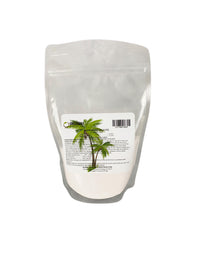
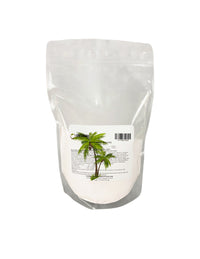
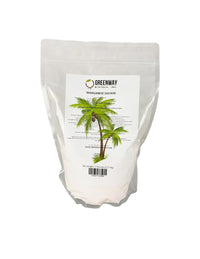
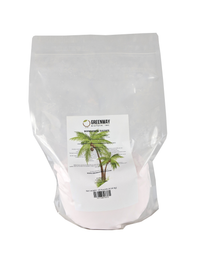
Easy to use, diluted very smoothly. It's hard to read the text on the bag through the palm trees. Maybe a lighter green palm?
R
Rose Singer
New product
I have 4 palm trees that need some nutrition but I understand I should feed them in the center where the growth comes up or is it better to feed at the base of the tree, What would the ratio be for each tree and do I mix it with only water, If you can supply the answer I would gratefully appreciate it, Thank you so much for your assistance Sincerely Rose Singer
R
Robert Kravetz
You are one of the few that offers various non-common ingredients for trees and shrubs. It arrived as promised and intact. Since it’s powder it dissolved very easily.
D
Derek Ruthruff
Prompt timely shipping
Weighs what it's supposed to and the bag doesn't leak. No clumps or other issues. I'm using this as a soil amendment so I assume it is what it's supposed to be. I had issues with a previous order that was rectified immediately so I recommend this company.
N
Nelson Swartley
You folks are always on it. Prompt delivery of any/all orders I have placed . THANKS !
G
George Slavin
Item not received!
Item not received!
M
Mark Lemley
Palm tree
Works great to keep our palm tree healthy and growing
C
Charles Murray
Above and Beyond
Customer service at Greenway Biotech is way above average. They will do whatever it takes to make assure customer satisfaction.
K
Ken Mettler
Manganese
Just started, but seem to be getting positive results.
W
Walter Brodie
I wish that it was
I wish that it was not so fine because it gets airborne so easily that it is a health hazard.
I have no idea if it is effective. My soil scientist recommended I apply 0.05 pounds per 100 foot row of vegetables. I am doing so.
S
Scott G.
Very Fast Delivery
This is the second time we have purchased Manganese Sulfate from Greenway Biotech. Both times our order arrived sooner than expected and in very good condition. I highly recommend Greenway Biotech.
B
Brian M.
Maganese
Haven’t used it yet. Too cold in northern Michigan still
M
Matthew H.
Queen Palms
To Early to Tell. Added Product, (As Directed) Just Waiting for Results......
L
Linda W.
Service
Can’t rate products as I just applied to my vegetable garden, but should not be an issue. I give the company itself 5 stars for valve vs price; free shipping; timely arrival all the way across the country; and excellent follow-up
J
Juanita H.
Why haven't I heard of this before
The two indoor house-palms we purchased YEARS ago (from a big-box store that rhymes with "owes") have grown and multiplied more than we expected. I live in Zone 7, the Plains Zone 7, with a lot of south winds in the summer. Spring, summer, and most of fall, the palms enjoy a shady spot on the sunny porch. This is the first year I've had where they didn't propagate, and some of the fronds turned yellow or had brown spots - even with steady watering. Did an Internet search. Found the Manganese Sulfate; ordered; it shipped; it arrived. The next day, I used some of this, and then went on vacation. Came back, and the palms have perked up, and are greener. Who knew? Yes, I highly recommend this for your palms.
B
Beverly J.
Excellent product and service
Good product and I appreciated the suggestion of a second product to support what I was buying. It arrived promptly
s
sharon h.
magananese
I HAVE USED IT BEFORE--IT IT I AN EXCELLENT PRODUCT..I WILL USE IT AGAIN!!
My MSM is decreasing my osteoarthritis pain, especially in my hands
My product arrived intact. I started taking it as soon as I went into the kitchen. I mixed it with my daily Metamucil, but there was no discernible taste. I am working on making it a habit each morning. The pain from my osteoarthritis, especially in my hands, is decreasing. I expect it to continue to improve. Thank you for my MSM.
You did not send me MSM Powder, you sent me Magnesium Chloride powder. I tried contacting you 3 times, by email & phone and you didn't have the courage & honesty to return my messages & rectify the situation. I even offered to text you a photo of the mag chloride.