Organic Ferrous Sulfate (Iron Sulfate) | 20% Iron (Fe)
- Regular Price
- $ 19.99
- Sale Price
- $ 19.99
- Regular Price
- $ 18.99
Sold Out
- Unit Price
- per


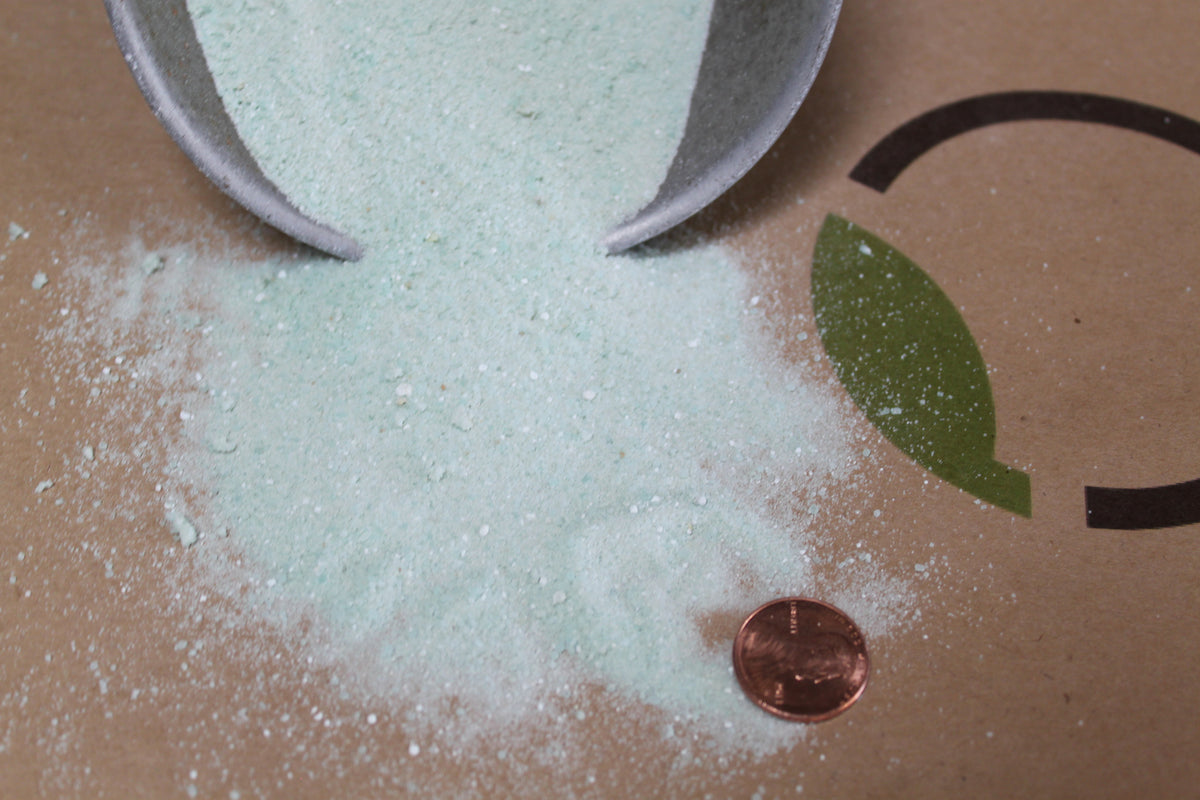



High-purity ferrous sulfate heptahydrate (FeSO₄·7H₂O) supplying 20% soluble iron and 12% sulfur. The fast-acting, low-cost iron source for correcting interveinal chlorosis, supporting soil pH reduction in alkaline ground, and managing lawn moss. Independently lab-tested in Madera, California.
Find your size → Calculate how much I need20%
Soluble iron as Fe²⁺
12%
Sulfur as sulfate (SO₄²⁻)
5–10days
Typical foliar green-up response
100%
Water-soluble, no inert fillers
Coverage figures below assume a typical chlorosis-correction soil rate of ½–1 lb per 100 sq ft for trees and shrubs. Rates for moss control, foliar spray, and pH adjustment differ — see the Application Rates section for details.
| Bag Size | Garden / Bed Coverage | Trees & Shrubs | Best For |
|---|---|---|---|
| 2 lb | ~400–800 sq ft | 2–4 small shrubs | First-time foliar trial |
| 5 lb | ~1,000–2,000 sq ft | 3–5 trees (avg) | Most popular |
| 10 lb | ~2,000–4,000 sq ft | Whole yard chlorosis correction | Mixed landscape |
| 25 lb | ~5,000–10,000 sq ft | Acre-scale orchard support | Commercial / acreage |
| 50 lb | ~10,000–20,000 sq ft | Multi-season soil pH program | Best value |
Ferrous sulfate is one of the most versatile single-ingredient soil amendments in horticulture — supplying iron, supplying sulfur, helping lower pH, and managing moss with one CDFA-registered material.
Foliar spray at 1–1.5 tbsp per gallon produces visible greening in new growth within days. Best paired with soil pH management for lasting results.
Broadcast at ¼–1 lb per 100 sq ft for flowers, vegetables, and ornamentals showing iron deficiency in alkaline soils.
Apply ½ cup per inch of trunk diameter under the drip line. Pair with elemental sulfur in drilled holes for longer-lasting correction in calcareous soils.
Faster-acting than elemental sulfur for lowering alkaline soil pH. In strongly calcareous ground, repeat seasonal applications may be needed for durable change.
Broadcast at 5 lbs per 1,000 sq ft — moss typically blackens within 7–10 days. Address underlying shade, drainage, and pH for lasting control.
Blueberries, azaleas, camellias, and gardenias in marginal soils. Works alongside ammonium sulfate or elemental sulfur for a full pH-management program.
Among the most economical, fastest-responding, and most versatile iron sources for outdoor plants in soils with pH at or below 7.0. Below the surface, here is what is working.
Most soil iron sits locked up as insoluble Fe³⁺ (ferric) compounds, especially above pH 6.5. Plant roots have to reduce Fe³⁺ to Fe²⁺ at the root surface before any uptake can occur. Ferrous sulfate skips that step — it supplies iron already in the Fe²⁺ form, which is why foliar applications can produce a visible green-up response in new growth within days.
Dissolves completely for foliar spray, soil drench, or careful fertigation. Always jar-test before injecting into irrigation lines — ferrous sulfate is incompatible with phosphate-containing fertilizers and highly alkaline water in concentrated stock tanks. Use separate stock tanks for incompatible inputs.
Supplies 20% iron and 12% sulfur. Sulfur is delivered as sulfate (SO₄²⁻) — directly available to plants without the microbial oxidation step that elemental sulfur requires. The soil-acidifying effect after application comes from the iron oxidation chemistry that follows, not from sulfate itself.
Elemental sulfur depends on soil bacteria to oxidize it — a slow process that stalls below 55°F. Ferrous sulfate begins acidifying on contact as Fe²⁺ oxidizes and releases hydrogen ions: 4FeSO₄ + O₂ + 10H₂O → 4Fe(OH)₃ + 4H₂SO₄. The sulfuric acid produced lowers pH within weeks rather than months. In strongly calcareous soils, repeated seasonal applications are typically needed for durable change.
Independently tested by third-party laboratory for iron concentration and screened for heavy metals — results consistently well below required limits. Packaged at our facility in Madera, California by the family that started Greenway Biotech in 1989. Backed by our 90-day money-back guarantee.
For acid-to-neutral soils (pH below 6.5–7.0), ferrous sulfate is typically the most economical way to deliver iron. In persistently alkaline soils above pH 7.0, Chelated Iron EDTA or Chelated Iron DTPA often deliver more reliable results because the chelate protects iron from re-oxidation. Match the source to the soil, not the price tag.
7.0pH threshold
FeSO₄·7H₂O — iron(II) sulfate heptahydrate
Iron is the fourth most abundant element in the Earth's crust — yet interveinal chlorosis is one of the most common plant nutrient disorders in the western United States, the Mediterranean climate zone, and any region with limestone-influenced or arid soils. The problem is rarely a lack of iron in the soil. The problem is solubility.
Above pH 7.0, soluble Fe²⁺ oxidizes rapidly to ferric hydroxide, Fe(OH)₃, which is essentially insoluble — root systems cannot pull it across the cell membrane no matter how much sits in the soil. High-bicarbonate irrigation water further raises root-zone pH and recreates the problem after every watering. The lockup mechanism is what extension specialists call "lime-induced chlorosis," and it is why iron-sensitive plants like blueberries, azaleas, gardenias, citrus, and many landscape ornamentals struggle in calcareous soils.
Ferrous sulfate addresses both halves of the problem in one application. The Fe²⁺ cation is the form plants absorb directly — especially through leaf tissue, where a foliar spray can produce green-up in new growth within a week. At the same time, the oxidation chemistry that follows soil application releases hydrogen ions and gradually lowers root-zone pH, which keeps subsequent iron more available. For deeper coverage of how iron functions inside the plant, see What Are the Effects of Iron on Plant Growth? For a comparison of when sulfate iron outperforms chelated iron (and vice versa), see Sulfate vs. Chelated Fertilizers.
One important caveat: in soils with significant free lime (those that fizz when vinegar is applied), ferrous sulfate alone may not produce a durable pH shift — the carbonates buffer the acid faster than a single application can lower pH. In those soils, a combination program of ferrous sulfate plus elemental sulfur in drilled holes, or a switch to chelated iron, is typically the more reliable approach. Match the tool to the soil chemistry.
Five distinct uses, five rate tables. Iron deficiency presents as interveinal chlorosis — yellow tissue between green veins — beginning on the youngest leaves. Confirm deficiency before treating; excess iron can antagonize manganese and zinc uptake.
Quick answer: Broadcast ¼–1 lb per 100 sq ft depending on plant type, then water in thoroughly.
| Plant Type | Rate per 100 sq ft | Approx. Measure |
|---|---|---|
| Flowers & Vegetables | ¼–½ lb | ½–1 cup |
| Trees & Shrubs | ½–1 lb | 1–2 cups |
| Large Trees | ½ cup per inch trunk diameter | Apply under drip line |
| Acid-loving plants (blueberries, azaleas, camellias) | ½–1 lb | 1–2 cups — pair with elemental sulfur for sustained pH |
⚠️ Staining warning: Ferrous sulfate stains concrete, brick, stone, and light-colored surfaces rust-brown on contact. Sweep dry granules off all hardscape immediately. Rinse any spray drift from sidewalks and driveways before it dries.
Quick answer: 1–1.5 tbsp per gallon for active correction. Start at the lower rate and increase only after a small-area test.
| Deficiency Level | Rate per Gallon | Frequency |
|---|---|---|
| Preventive | 0.5–1 tbsp | Monthly |
| Mild | 1 tbsp | Every 2–3 weeks |
| Moderate | 1–1.5 tbsp | Every 2 weeks |
| Severe | 1.5 tbsp — repeat after observing plant response | Weekly until corrected |
Foliar safety check: Ferrous sulfate foliar rates run higher than chelated iron foliar rates because Fe²⁺ is rapidly tied up in the spray solution at neutral pH — the higher concentration compensates for in-solution losses. Even so, ferrous sulfate has a moderate salt index. Always test on a small area first, spray in early morning or late afternoon, and never spray in temperatures above 85°F. Add a few drops of liquid soap or a non-ionic surfactant for better leaf adhesion. Rinse foliage if wilting or scorch appears within 24 hours.
Quick answer: Work in stages — do not attempt to change pH more than 0.5–1.0 units per application. Test pH before and 4–6 weeks after.
| Current pH | Target pH | Sandy Soil | Loam Soil | Clay Soil |
|---|---|---|---|---|
| 8.5 | 6.5–6.8 | 230 lbs | 285 lbs | 345 lbs |
| 8.0 | 6.5–6.8 | 140 lbs | 170 lbs | 230 lbs |
| 7.5 | 6.5–6.8 | 55 lbs | 90 lbs | 115 lbs |
| 7.0 | 6.5–6.8 | 10 lbs | 20 lbs | 35 lbs |
Important: These figures are general estimates for average soil buffering capacity. Free-lime calcareous soils (those that fizz when vinegar is applied) often resist pH reduction regardless of rate — consider Elemental Sulfur Powder in combination, or consult your local cooperative extension service. For large pH changes, work in stages over multiple seasons.
Quick answer: Lawn moss — 5 lbs per 1,000 sq ft, broadcast dry. Structure moss — 3 oz per gallon of water, spray.
| Use | Rate | Method |
|---|---|---|
| Lawn Moss — Broadcast Dry | 5 lbs / 1,000 sq ft | Broadcast dry; water in lightly; follow all label directions |
| Lawn Moss — Liquid Spray | 5 lbs / 1,000 sq ft total, dissolved in sprayer carrier water | Dissolve fully; spray evenly at chosen carrier volume |
| Structure Moss (roofs, walks) | 3 oz / gallon water | Spray; allow 24-hour contact; rinse afterward to prevent staining |
Set expectations honestly: Moss typically blackens within 7–10 days after iron treatment, but chemical kill is only temporary. Moss returns wherever the underlying conditions remain — shade, compaction, poor drainage, low soil pH, or thin turf. For lasting control, address the underlying cause alongside treatment. At moss-control rates, turfgrass also temporarily darkens or thins; recovery is typical within 2–3 weeks.
Quick answer: Not preferred. Use Chelated Iron DTPA 11% or Chelated Iron EDTA 13% instead.
⚠️ Why ferrous sulfate is not preferred for hydroponics: Fe²⁺ is unstable in solution. Above pH 5.5–6.0, it rapidly oxidizes to insoluble Fe³⁺ and precipitates out of nutrient solution, often clogging drip emitters, filters, and reservoir lines over time. Most recirculating systems operate at pH 5.8–6.5, exactly where ferrous sulfate falls out of solution fastest.
For hydroponic and soilless applications, choose a chelated iron source instead:
For deeper coverage of choosing between sulfate and chelated iron forms, see Sulfate vs. Chelated Fertilizers.
The same four habits apply across every use case. Get the rate right, protect the hardscape from staining, and time it for cool conditions.
Iron chlorosis presents as yellow tissue between green veins on the youngest leaves — not the older ones. If yellowing starts on lower, older leaves, suspect nitrogen or magnesium instead, not iron. Use a soil or tissue test for ambiguous cases.
Use warm water (not hot) for faster dissolution. Stir until the solution is uniformly green-tinged with no undissolved crystals. Mix only what you will use that day — once dissolved, Fe²⁺ begins oxidizing and loses efficacy within hours.
For foliar: spray in early morning or late afternoon. Never spray in temperatures above 85°F — leaf scorch risk rises sharply. For soil applications, water in thoroughly after broadcasting to move iron into the root zone and start the acidification chemistry.
Sweep dry granules off concrete, brick, stone, and pavers immediately. Rinse spray drift from sidewalks and driveways before it dries. Once iron stains oxidize and set into porous surfaces, they are very difficult to remove.
Recirculating hydroponic systems — use Chelated Iron DTPA 11%. Persistently alkaline or calcareous soils (pH above 7.5, free lime present) — pair ferrous sulfate with Elemental Sulfur Powder in drilled holes, or switch to chelated iron, for durable correction.
Ferrous sulfate is the right tool for acidic-to-neutral soils, moss control, and pH reduction. For higher pH or hydroponics, chelated iron is the more reliable choice. Full breakdown in Sulfate vs. Chelated Fertilizers.
| Product | Best Soil pH | Hydroponics | Best For | Relative Cost |
|---|---|---|---|---|
| Ferrous Sulfate 20% Fe (this product) | Below 7.0 | ⚠️ Not preferred | Lawn moss, pH reduction, fast foliar correction | Lowest |
| Chelated Iron EDTA 13% | 4.0–7.0 | Stable to pH 6.5 | Mixed gardens at moderate pH where chelation matters | Higher |
| Chelated Iron DTPA 11% | 4.0–7.5 | ✅ Preferred (stable to pH 7.0) | Hydroponics, aquaponics, high-pH raised beds | Higher |
| Manganese Sulfate 31% Mn | Below 6.5 | Limited (similar lockout) | When chlorosis is manganese, not iron — pair with iron when both deficient | Lower |
Five conditions where ferrous sulfate excels — and four where another product is the better call.
In alkaline-soil regions, iron deficiency rarely travels alone — manganese, zinc, and sulfur often need attention at the same time. Build a complete program rather than chasing each deficiency in isolation.
For durable pH reduction in calcareous soils. Combine in drilled holes for trees, or broadcast for long-term acidification. Slower-acting than ferrous sulfate but longer-lasting.
Acidifying NAmong the most acidifying nitrogen sources available. Pairs with ferrous sulfate for a sustained multi-season pH-reduction program on lawns, blueberries, and acid-loving ornamentals.
Co-deficientManganese deficiency presents almost identically to iron chlorosis — and the two are often co-deficient in alkaline soils above pH 7.5. Correct both when symptoms are ambiguous.
High-pH TrioZinc availability declines at high pH right alongside iron and manganese. In calcareous soils, all three of these micronutrients commonly need support at the same time.
Ferrous sulfate is a stable mineral salt with low acute toxicity, but it stains everything porous on contact and has real handling considerations.
If your question isn't here, contact our team at questions@greenwaybiotech.com.
Iron chlorosis occurs when plants cannot access sufficient Fe²⁺ for chlorophyll synthesis, producing the characteristic yellow tissue between green veins on young leaves. The most common cause is not a lack of iron in the soil — it is high soil pH (above 7.0) that converts soluble Fe²⁺ into insoluble Fe(OH)₃ that roots cannot absorb. Other contributing factors include waterlogged soils, high phosphorus levels, and soils high in bicarbonate from irrigation water. Ferrous sulfate addresses both the iron deficiency and the underlying pH condition. For a deeper look at how iron functions in plant growth, see What Are the Effects of Iron on Plant Growth? For other causes of leaf yellowing, see 8 Reasons Why Your Plant Leaves Are Turning Yellow.
Foliar applications typically show a visible greening response in new growth within 5–10 days as iron becomes available directly through the leaf surface. Existing chlorotic leaves will not fully green back — improvement is most obvious in new growth that emerges after treatment. Soil applications work more gradually, acidifying the root zone over 2–6 weeks as the product oxidizes and reacts with soil minerals. For severe or persistent chlorosis, combining a foliar spray for immediate response with a soil application for long-term correction generally gives the best outcome.
Yes — this is one of the most important handling precautions. Ferrous sulfate causes rust-brown stains on concrete, stone, brick, pavers, and painted surfaces that are very difficult to remove once the iron oxidizes and sets into the material. Always sweep dry granules off hardscape immediately after application before watering. Rinse foliar spray off sidewalks and driveways right away. If staining does occur, oxalic-acid-based rust removers can reduce (though rarely fully eliminate) discoloration.
Ferrous sulfate is not recommended for hydroponic or soilless nutrient solutions. Fe²⁺ is unstable in solution and rapidly oxidizes to Fe³⁺ (insoluble) at pH levels above 5.5–6.0, precipitating out of solution and risking clogging in drip emitters and membrane filters. For hydroponic and container applications, Chelated Iron DTPA 11% (stable to pH 7.0) or Chelated Iron EDTA 13% (stable to pH 6.5) are more suitable choices. For more on choosing between sulfate and chelated iron forms, see Sulfate vs. Chelated Fertilizers.
Ferrous sulfate is commonly used as part of lawn moss management programs. Iron at the rates labeled for moss control damages moss tissue on contact — moss is a non-vascular plant without the protective structures of grasses, so it is more sensitive at iron rates that established turfgrass generally tolerates. At 5 lbs per 1,000 sq ft, moss typically blackens within 7–10 days. Rake out the dead moss thoroughly before overseeding bare areas. For lasting results, address the underlying conditions that favor moss — shade, compaction, poor drainage, and low soil pH. Follow all label directions for your specific product packaging.
Once watered in and dry, ferrous sulfate at normal fertilizer rates poses minimal risk to pets walking on treated areas. Direct ingestion of dry product, however, can cause gastrointestinal upset in dogs and cats — keep pets off treated areas until the product has been thoroughly watered in and the soil surface is dry. Do not allow product to wash into water features or natural ponds where fish are present, as iron toxicity can affect aquatic life at elevated concentrations.
Ferrous sulfate supplies iron as the free Fe²⁺ ion — effective and economical in acid-to-neutral soils (pH below 6.5–7.0), but rapidly converts to insoluble Fe³⁺ in alkaline conditions. Chelated iron (EDTA or DTPA) binds iron inside an organic molecule that protects it from reacting with soil pH, keeping it plant-available across a broader pH range. For most alkaline garden soils, starting with ferrous sulfate and monitoring pH response is a practical first approach. If pH stays above 7.0 long-term, switching to chelated iron typically delivers more reliable results. For a complete comparison, see Sulfate vs. Chelated Fertilizers.
Ferrous sulfate supplies 12% sulfur as sulfate (SO₄²⁻) — directly available to plants without microbial conversion. The soil-acidifying effect after application does not come from sulfate itself, however; it comes from the oxidation chemistry that follows: 4FeSO₄ + O₂ + 10H₂O → 4Fe(OH)₃ + 4H₂SO₄. The sulfuric acid produced releases hydrogen ions and gradually lowers soil pH. The reaction is faster than elemental sulfur (which requires bacterial oxidation), but in strongly calcareous soils with free lime, repeated seasonal applications are typically needed for durable pH change.
Avoid tank-mixing ferrous sulfate with phosphate-containing fertilizers (MAP, MKP, bone meal slurries), calcium fertilizers (calcium nitrate, gypsum suspensions), strongly alkaline materials (lime, wood ash), or highly alkaline irrigation water. These combinations form precipitates that clog injectors and lock up nutrients. Use separate stock tanks for incompatible inputs, dilute each independently before combining in the main line, and jar-test any unfamiliar combination before injecting into irrigation lines.
Available from 2 lb trial sizes up to 50 lb professional bags. Free shipping on orders $100 and up. 90-day money-back guarantee on every product we make — including this one.
Choose your size →