Continental US, Standard shipping: free on orders of $100 or more, $9.99 on orders under $50, and $14.99 from $50 up to $100.
UPS and FedEx options are also offered at checkout, at their own rates.
Orders placed by 11 AM Pacific on a business day ship the same day.
Alaska, Hawaii, US territories, APO/FPO and international addresses: the cost is shown at checkout, and 2-day delivery isn’t available to Alaska, Hawaii or P.O. boxes.
Soil acidifier · elemental sulfur · at least 98% S
About Elemental Sulfur Powder
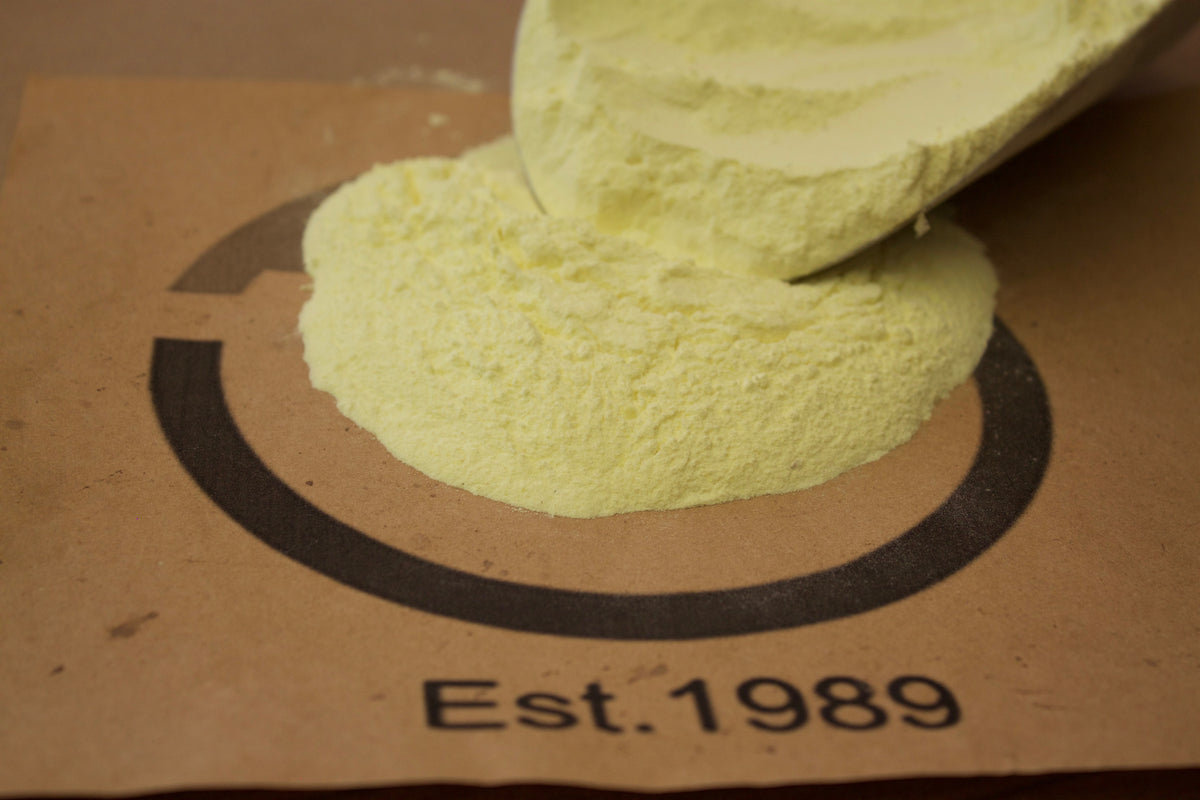
Elemental Sulfur Powder is a yellow powder that is at least 98% sulfur (S). Soil bacteria slowly turn it into sulfuric acid, which lowers soil pH, so it is the material university guides use to bring garden soil down to the acid range that blueberries, azaleas, rhododendrons, and other acid-loving plants need. Mix it into the soil before planting, or spread it around established plants, then retest pH before you add more.
Expect months, not days: Colorado State University says the change can take several months to a year. It cannot practically acidify soil that contains free lime (soil that fizzes when you pour vinegar on it), and it is sold as a soil amendment, not as a pesticide.
98% S At least 98% elemental sulfur by weight, according to the Safety Data Sheet
2 lb per 100 sq ft Clemson University’s estimate for each full pH unit you lower loam soil; less on sand, more on clay
1 to 50 lb Seven bag sizes. The calculator sizes one application for a bed, shrubs, a lawn, or your soil test
1, 2, 3, 5, 10, 20, and 50 lb (the 50 lb size may ship as two 25 lb bags)
The university guides on this page give their rates as pounds of elemental sulfur. At 98% sulfur, this page treats each pound of this product as a pound of elemental sulfur; the 2% difference is far smaller than the differences between soils. Weigh it on a postal or platform scale you keep for garden products. This page gives no cup or spoon conversions.
Best uses & benefits
Choose it when a soil test shows your pH is above your plants’ target, your soil does not fizz with vinegar, and you can wait months for the change.
Blueberries
Oregon State University says blueberries need a soil pH of 4.5 to 5.5 and recommends elemental sulfur when pH is above 5.7. Test and amend the bed about a year before planting. See Application rates.
Azaleas, rhododendrons, and other acid-loving shrubs
Oregon State gives the same 4.5 to 5.5 target for azaleas and rhododendrons, and a weighed method for top-dressing around established shrubs.
Garden beds and new lawns before planting
Mixed into the soil, sulfur works where roots will grow. Clemson University’s table gives the amount for your starting and target pH, and Purdue University notes that sulfur can be tilled in at much higher rates before turf is planted than an established lawn can take.
Blue flowers on bigleaf hydrangeas
UMass Extension says only bigleaf and mountain hydrangeas can turn blue, and that most bigleaf hydrangeas bloom blue in soil below pH 5.5, where aluminum is available to the plant, and pink above pH 6.5. Some cultivars do not change color.
Where it is a poor fit
Soil that fizzes with vinegar. The fizz means free lime, which neutralizes the acid as fast as the sulfur makes it. Colorado State calls lowering pH in these soils difficult to impossible and impractical. Grow acid-loving plants in a raised bed or container of acidic mix instead.
A quick fix this season. The change takes months. Oregon State recommends foliar iron sprays for severely yellowed acid-loving plants when acidifying the soil is expected to take more than two years; for an iron product, see Chelated Iron DTPA Fertilizer 11% Fe.
Sulfur deficiency in this season’s crop. The University of Minnesota notes that plants take up only sulfate and that soil microbes must first convert elemental sulfur, at a rate set by soil temperature, moisture, and particle size. Use a sulfate source such as Ammonium Sulfate 21-0-0, Gypsum, or Potassium Sulfate 0-0-53.
Established lawns on well-buffered soil. Purdue University concludes that sulfur is not effective for lowering the pH of established turf on calcium-buffered soils: at the amounts a lawn can take without burning, it would take many years, and Purdue suggests adjusting the lawn’s fertilizer program instead.
Containers, potting mixes, hydroponics, and sprays. This page gives no rate for them, and the powder does not dissolve in water.
Pests and plant diseases. This product is sold as a soil amendment and fertilizer. It is not registered as a pesticide, so we give no directions for controlling insects, mites, fungal diseases, snakes, or other pests.
Certified organic production. We do not hold an OMRI listing or a California Organic Input Material registration for this product, so we do not sell it for certified organic production. Your certifier decides which inputs you may use.
Application rates & directions
Every amount below is product weight. The rates come from the university guides named in each table; they differ from region to region because soils differ, so start with one application and retest. Test your soil pH first, and pour a little vinegar on a spoonful of dry soil: if it fizzes, stop here and read Where it is a poor fit. This page gives university rates and does not restate the directions printed on your package; if they differ, email questions@greenwaybiotech.com before applying.
Before planting: garden beds and new lawns
Clemson University’s table for loam soil adds 0.1 lb per 10 sq ft for every half unit of pH you want to remove, which is 2 lb per 100 sq ft for each full unit. Clemson reduces the rate by one-third for sandy soils and increases it by one-half for clayey soils. Its table covers starting pH 6.0 to 8.0 and target pH 4.5 to 6.5.
Elemental sulfur to lower soil pH before planting, from Clemson University’s table (HGIC 1650), mixed into the soil
Soil
Per full pH unit, per 100 sq ft
Per full pH unit, per 1,000 sq ft
Example: pH 7.0 to 5.5, per 100 sq ft
Sandy
1.33 lb (605 g)
13.3 lb
2 lb
Loam
2 lb
20 lb
3 lb
Clay
3 lb
30 lb
4.5 lb, in two applications
Split large amounts. Penn State’s soil testing lab divides any amount of 4 lb or more per 100 sq ft into two equal applications six months apart, and Oregon State University advises acidifying gradually: two small applications a year apart are better than one large one. Applying too much sulfur can lower pH so far that some soil elements become toxic to plants. If even half the amount is 4 lb or more per 100 sq ft, get a lab soil test and email us before applying.
Mix it in and wait. Oregon State says the sulfur must be mixed into the soil, and that a logical approach is to apply it in the fall and test the soil pH in the spring. Colorado State notes that clay soils and soils above pH 7.3 are likely to need more sulfur than its general guideline of about 650 lb per acre (14.9 lb per 1,000 sq ft) for each pH unit.
Blueberry beds. Oregon State University’s blueberry guide brings soil at pH 5.7 to 6.5 down to 5.5 with 2 to 5 lb of elemental sulfur per 100 sq ft on clay loam (2 lb from 5.7, 5 lb from 6.5) and about 1 to 3 lb on sandy soil, and notes that heavier soils may need more. Between pH 5.5 and 5.7 it adds no sulfur, because the plants’ fertilizer will lower the pH gradually. Its figures run higher than Clemson’s for the same change, which is one more reason to apply once, retest, and let the next test decide.
Around established shrubs
Spread it on the soil surface and water it in well, following Oregon State University’s per-plant amounts.
Azaleas, rhododendrons, and other acid-loving shrubs
Only when soil pH is above 5.5 and not above 7.5. Oregon State top-dresses 151 g (⅓ lb) per plant and waters it in well, beginning in a cold, wet season such as winter or early spring. It repeats monthly, testing pH before each further application, up to 1½ lb (680 g) per plant in total. Its EC 1560 adds that the reactions can take a year or more, so a test a month later may not yet show the earlier applications; if in doubt, wait longer before repeating. Above pH 7.5, Oregon State suggests choosing plants suited to alkaline soil. For small or newly planted shrubs, email us before using the full amount.
Blueberries
Only when soil pH is 5.8 or higher. Oregon State uses no more than 85 g (3 oz) per plant, once, in early autumn, on top of any sawdust mulch, then retests the next autumn and repeats only if pH is still too high. Do not exceed it: Oregon State warns that excess sulfur may burn or kill blueberry plants.
Oregon State notes that a response may not show until the following spring or summer. Keep the powder off the leaves and water it into the soil. For established hydrangeas, email us.
Established lawns
The University of Georgia limits elemental sulfur on mature turf to 5 lb per 1,000 sq ft per application, warns that even that rate can burn and discolor grass, and suggests lower rates, such as 2 lb per 1,000 sq ft every 8 to 10 weeks, to help prevent injury. Water 0.3 to 0.5 inch right after spreading to wash the sulfur off the grass, and test the soil again after the second application. Purdue University gives the same 5 lb per application and a limit of 10 lb per 1,000 sq ft per year for lawns mowed at 2 inches or higher, with lower limits for close-mowed turf. Purdue concludes that, at these rates, sulfur is not effective for lowering the pH of established turf on calcium-buffered soils; it says turf soil pH should fall between 6.0 and 7.5 and suggests adjusting the fertilizer program instead. Use sulfur on a lawn only where a soil test calls for a lower pH, and before seeding a new lawn, mix it into the soil at the bed rates instead.
From a soil test report
Formula. Pounds of this product = pounds of elemental sulfur your soil test calls for. If the report gives pounds per acre, divide by 43.56 for pounds per 1,000 sq ft. Mix it into the soil before planting, and where the amount is 4 lb or more per 100 sq ft (40 lb per 1,000 sq ft), split it into two applications six months apart, as Penn State’s lab does, unless your report says otherwise. On an established lawn, apply no more than 5 lb per 1,000 sq ft at a time, whatever your report’s total (University of Georgia), and follow the lawn directions above; around established shrubs and blueberries, follow the per-plant directions above.
Sulfur as a plant nutrient
This page gives no sulfur-nutrition rate. Elemental sulfur feeds plants only after soil microbes convert it to sulfate, and Colorado State says that conversion can take several months to a year. For a sulfur shortage in this season’s crop, use a sulfate fertilizer.
Uses with no rate on this page
This page gives no rate for containers, potting mixes, seed-starting media, houseplants, compost, hydroponics, or sprays, and the powder does not dissolve in water. Do not dust it on plants. For any of these, email questions@greenwaybiotech.com with your plants and growing method.
How to use Elemental Sulfur Powder
Test pH, and check for free lime. Get a soil pH test. Pour a little vinegar on a spoonful of dry soil: if it fizzes, the soil contains free lime and sulfur will not practically lower its pH.
Weigh the amount. Use the tables or the calculator below and a postal or platform scale. Split large amounts as described above.
Spread it evenly on a still day. Keep it off leaves and avoid raising dust. Wear safety glasses and gloves.
Mix it in or water it in. Before planting, work it into the soil where the roots will grow. Around established plants and on lawns, spread it on the surface and water it in well.
Wait, then retest. Let several months pass, ideally from fall to spring, and retest pH before you add any more.
Calculator & choosing a size
Formulas. Bed before planting: pH units to remove × 2 lb per 100 sq ft for loam (× ⅔ for sand, × 1½ for clay), from Clemson’s table; at 4 lb or more per 100 sq ft, apply half now and half after retesting. Azaleas, rhododendrons, and similar shrubs: 151 g (⅓ lb) per plant for the first application. Established blueberries: no more than 85 g (3 oz) per plant, once in early autumn. Lawns: 2 lb per 1,000 sq ft per application. Soil test: the pounds of elemental sulfur your report calls for. Multiply pounds by 453.6 for grams.
Worked examples. A 4 × 8 ft raised bed (32 sq ft) of loam from pH 7.0 to 5.5: 435 g (0.96 lb); a 1 lb bag covers it. A 100 sq ft loam bed from pH 7.0 to 5.5 for blueberries: 3 lb; a 3 lb bag covers it. A 100 sq ft clay bed from pH 7.0 to 5.5: 4.5 lb in all, so 2.25 lb now and the rest after retesting; a 3 lb bag covers the first application. Four established azaleas at pH 6.5: 1.33 lb (605 g); a 2 lb bag covers it. Six established blueberries at pH 6.0: 1.13 lb (510 g); a 2 lb bag covers it. A 1,000 sq ft lawn whose soil test calls for a lower pH: 2 lb; a 2 lb bag covers it. A soil test calling for 20 lb of elemental sulfur per 1,000 sq ft on a 500 sq ft garden: 10 lb; a 10 lb bag covers it.
What each bag covers in one application: a loam bed lowered by one pH unit (2 lb per 100 sq ft), a lawn (2 lb per 1,000 sq ft), or azaleas and rhododendrons (⅓ lb per plant)
Bag size
Loam bed, one pH unit
Lawn
Azaleas or rhododendrons
1 lb (454 g)
50 sq ft
500 sq ft
3 plants
2 lb (907 g)
100 sq ft
1,000 sq ft
6 plants
3 lb (1.36 kg)
150 sq ft
1,500 sq ft
9 plants
5 lb (2.27 kg)
250 sq ft
2,500 sq ft
15 plants
10 lb (4.54 kg)
500 sq ft
5,000 sq ft
30 plants
20 lb (9.07 kg)
1,000 sq ft
10,000 sq ft
60 plants
50 lb (22.7 kg)
2,500 sq ft
25,000 sq ft
150 plants
The calculator below asks what you are treating and, depending on your answer, the area, your soil pH, target pH, and texture, whether the soil fizzes with vinegar, how many shrubs, whether a soil test calls for a lower pH on your lawn and how short you mow it, or what your soil test calls for and where you will apply it. It applies the rate from the tables above, sizes the first application, and recommends the smallest bag that covers it, plus a lower-price combination of bags when one exists. Prices, tax, and shipping are confirmed at checkout, and availability is confirmed when you add to cart.
The calculator needs JavaScript. If it does not appear, use the rate tables and formulas above to choose a size.
How elemental sulfur lowers soil pH
Elemental sulfur is not acidic as it comes from the bag. Oregon State University explains that soil bacteria (Thiobacillus) oxidize it, producing sulfuric acid, and that acid is what lowers the pH. Colorado State University adds that the conversion needs oxygen, water, and soil microorganisms, depends on soil moisture, temperature, and microbial activity, and may take several months to a year. Clemson University notes that finely ground sulfur reacts faster. Oregon State says that for the process to work properly, the sulfur must be mixed with the soil.
Free lime is the limit. Calcium carbonate in the soil neutralizes the acid as it forms. Colorado State gives the example of a soil with 2% lime in the top 6 inches, which holds about 20 tons of lime per acre and would need about 6.5 tons of elemental sulfur per acre to neutralize, and that only in the top 6 inches. That is why it calls acidifying lime-rich soil impractical, and why the vinegar test comes first.
The sulfate left behind is the form of sulfur plants take up. The University of Minnesota notes that only sulfate can be taken up by plants and that how quickly elemental sulfur oxidizes depends on soil temperature, moisture, and particle size, so elemental sulfur is a slow source of plant sulfur, not a quick one.
This describes elemental sulfur as a material; it is not a trial of this finished product.
Compare your options
Many products contain sulfur, but only some lower pH. Match the product to the job.
Elemental Sulfur Powder compared with other Greenway products that contain sulfur or change soil pH
Option
Effect on soil pH
Choose it when
Elemental Sulfur Powder, this product
Lowers it slowly, as soil bacteria convert the sulfur to acid
You need a lasting pH drop in soil without free lime and can wait months
Lowers it gradually as the ammonium nitrogen is used. Oregon State reports that Willamette Valley lawns fed about 3.5 lb of nitrogen per 1,000 sq ft a year as ammonium sulfate dropped 0.1 to 0.2 pH units a year
The plants need nitrogen and you want to hold pH down while you feed
Sulfur changes pH; it does not feed plants for the season. These products can be used in the same program, meaning the same bed in the same season, when your plants and soil test call for them. They are not all required.
Ammonium Sulfate 21-0-0 with 24% Sulfur: nitrogen for acid-loving plants that also holds pH down. Oregon State lists it as the most acidifying of the common nitrogen fertilizers.
Mixing. Spread each product separately at its own rate; do not mix them in one container. Store this product away from strong oxidizers, which the Safety Data Sheet lists as incompatible; nitrate fertilizers such as calcium nitrate and potassium nitrate are oxidizers. Do not lime, or add wood ash to, the same soil you are acidifying, because lime raises pH.
Handling, storage & limitations
Warning: flammable solid. Keep away from heat, sparks, and open flames, and do not smoke while handling it. The Safety Data Sheet warns that sulfur dust may ignite and that burning sulfur gives off toxic sulfur dioxide.
Hazards. Classified as a flammable solid (Category 2) and an eye irritant (Category 2B). It causes eye irritation. Avoid breathing the dust.
Protective equipment. Wear protective gloves and eye protection (safety glasses or goggles) and long sleeves. Avoid breathing dust; use a NIOSH-approved respirator if dust exceeds exposure limits. Wash your hands after use.
Applying it. Avoid raising dust, and spread it on a still day. Keep it off leaves, and wash or water any powder off foliage right away. Keep children and pets away until it is watered in.
Storage. Keep it in a cool, dry, ventilated place away from heat and ignition sources, strong oxidizers (including nitrate fertilizers), and halogens. Keep the bag closed. Ground equipment when transferring large amounts. Keep it out of reach of children and pets.
Spills. Eliminate ignition sources, avoid breathing the dust, and sweep up carefully. Do not let it enter drains or waterways.
Use limits. Weigh every application, stay within the rates on this page, and retest pH before applying more. Too much sulfur can lower pH far enough to harm plants.
First aid. Eyes: rinse with water for 15 to 20 minutes, removing contact lenses if present; get medical attention if irritation persists. Skin: wash with water and remove contaminated clothing. Inhaled: move to fresh air; get medical attention if symptoms persist. Swallowed: rinse the mouth, do not induce vomiting, and call Poison Control at 1-800-222-1222.
Emergency number from the Safety Data Sheet. CHEMTREC 1-800-424-9300, 24 hours.
Frequently asked questions
How long does elemental sulfur take to lower soil pH?
Several months to a year. Soil bacteria have to convert the sulfur to sulfuric acid first, and Colorado State University says that depends on soil moisture, temperature, and microbial activity. Oregon State University suggests applying it in the fall and testing pH in the spring, and for blueberries it advises testing and amending the bed about a year before planting.
How much sulfur do I need to lower my soil pH?
It depends on your soil, so a soil test gives the best number. Clemson University’s table works out to 2 lb per 100 sq ft for each full pH unit in loam, one-third less in sandy soil and one-half more in clay. Oregon State’s blueberry guide uses 2 to 5 lb per 100 sq ft on clay loam to bring pH 5.7 to 6.5 down to 5.5. Split 4 lb or more per 100 sq ft into two applications, and retest before adding more.
My soil fizzes when I pour vinegar on it. Will sulfur work?
Not practically. The fizz means free lime, which neutralizes the acid the sulfur produces. Colorado State University calculates that a soil with 2% lime in the top 6 inches would need about 6.5 tons of sulfur per acre just to neutralize that layer. Grow acid-loving plants in a raised bed or large container of acidic mix instead, as Oregon State suggests where pH keeps rising.
How do I use it around established azaleas, rhododendrons, or blueberries?
Spread it on the soil surface and water it in. For azaleas, rhododendrons, and similar shrubs, Oregon State University top-dresses 151 g (⅓ lb) per plant and repeats monthly only after testing, up to 1½ lb per plant in total, noting that the reactions can take a year or more. For blueberries it uses no more than 85 g (3 oz) per plant in early autumn, only when pH is 5.8 or higher, and warns that excess sulfur may burn or kill the plants.
Can I use sulfur to lower the pH of my lawn?
Only where a soil test calls for it, and slowly. The University of Georgia limits mature turf to 5 lb per 1,000 sq ft per application, suggests 2 lb every 8 to 10 weeks to help prevent burn, and says to water 0.3 to 0.5 inch right after spreading. Purdue University limits lawns mowed at 2 inches or higher to 10 lb per 1,000 sq ft per year and concludes that, at these rates, sulfur is not effective for lowering the pH of established turf on calcium-buffered soils. Before seeding a new lawn, sulfur can be mixed into the soil at the bed rates instead.
Will sulfur turn my hydrangeas blue?
It can help on bigleaf and mountain hydrangeas, the only kinds UMass Extension says can turn blue. Most bigleaf hydrangeas bloom blue in soil below pH 5.5, where aluminum is available to the plant, and pink above pH 6.5, and some cultivars do not change. High-phosphorus fertilizer works against blue flowers. Expect the change to take time, because the soil pH changes slowly.
Is elemental sulfur a good fertilizer for sulfur deficiency?
Not for this season’s crop. Plants take up sulfur only as sulfate, the University of Minnesota notes that soil microbes must first convert elemental sulfur, and Colorado State says that conversion can take several months to a year. For a current shortage, use a sulfate fertilizer such as Ammonium Sulfate 21-0-0, Gypsum, or Potassium Sulfate 0-0-53.
Can I use it to control pests, plant diseases, or snakes?
No. Controlling insects, mites, fungal diseases, snakes, or other pests is a pesticide use, and this product is sold only as a soil amendment and fertilizer; it is not registered as a pesticide. For those jobs, buy a product registered with the EPA and your state for that use, and follow its label.
Is sulfur powder flammable?
Yes. The Safety Data Sheet classifies it as a flammable solid and warns that sulfur dust may ignite and that burning sulfur gives off toxic sulfur dioxide. Store it in a cool, dry, ventilated place away from heat, sparks, flames, and strong oxidizers such as nitrate fertilizers, and avoid raising dust.
Can I use it on pets, livestock, or people?
No. This is a soil amendment. It is not a supplement, a feed, or a treatment for people or animals. Keep pets and children away until it has been watered in, and call Poison Control or your veterinarian if any is swallowed.
Can I use it in certified organic production?
We do not hold an OMRI listing or a California Organic Input Material registration for this product, so we do not sell it for certified organic production. California requires fertilizing materials intended for organic crop production to be registered as Organic Input Materials. If you farm under organic certification, your certifier decides which inputs you may use.
Articles give background. For this product, use the rates and documents on this page.
Product documents & sources
Safety Data Sheet (PDF): composition, hazards, handling, storage, first aid, and emergency number.
Where the rates and statements on this page come from
The composition, hazard, storage, and first-aid statements come from the Safety Data Sheet. The rates, timing, and cautions come from the university publications below, which describe elemental sulfur and soil pH in general and do not evaluate or endorse this product.
Not sure whether your soil can be acidified, or how much it needs? Email your plants, area, soil test, and the result of the vinegar test to questions@greenwaybiotech.com, or call (562) 351-5168, Monday to Friday, 7 AM to 5 PM Pacific, and we will work through it with you.
Every order carries a 90-day satisfaction guarantee, and we pack and ship from Madera, California. You can also choose a package weight from the size selector at the top of this page.
Greenway Biotech, Inc. is a family-owned company that has blended and packaged specialty fertilizers and soil amendments in California since 1989, today from Madera.
5 stars: 56 (82%)
4 stars: 3 (4%)
3 stars: 1 (1%)
2 stars: 5 (7%)
1 star: 3 (4%)
A
Anonymous
Don’t know yet trying to bring ph down for blueberry plants
Don’t know yet trying to bring ph down for blueberry plants.
H
Herve Bonin
Order, shipping are all good. Post-Sales service is absent.
No response to asking for CofA and lot number.
E
Edwina Neubauer
As Advertised
Arrived well packaged. Very easy to use.
D
Deborah Harris
Good Stuff
I have found it difficult now to obtain good sulphur powder, so I am most appreciative. Insect repellant, killer of mange, this stuff can't be beat.
T
Tom Gibson
Expensive
It was way more expensive than my last order. Why? Has the price of sulfur gone up that much?
T
Tenny Anderson
Sulfur powder
Good I’m very happy so far
M
Mary McFadden
Wonderful
Exactly what I needed.
J
John Picha
Sulfur Powder
Order was filled correctly and shipped promptly.
D
Derek Takerer
Feedback for good experience
Good tracking info and communication. Excellent international shipping. Recommend.
T
Tree El
Great!
Haven't had the chance to add it to my garden just yet but just by the smell I know it's the real deal 😆 Thanks Greenway
M
Meredith Walters
As promised
The sulfur arrived quickly and was easy to use. I'm still waiting to see if it took care of the mites, but it arrived exactly as promised.
B
Brian Sherrill
Good Service
Great communication and package arrived in a timely manner. Product is good quality.
D
Daniel Weinless
Sulfur powder
I use sulfur as an additive for various tasks for lubricants and as a soil acidifier. This product's purity is important and meets the requirements I need. This is a good product.
L
Lisa Hassen
Love it!
Works great! Thank you! Yes, I would by again. 😊
L
Leslie London
Satisfied customer
Product was packaged properly for transit. Will definitely buy from Greenway Biotech again
D
Douglas Walker
Prompt Service
Good communication and fast shipping. Product performed as advertised.
M
Mario Rodas
Sulfur powder
Has a high purity , does what is supposed to do
L
Linda Tanner
Sulfur for Goats
Excellent. I carefully dust it on backs, sides, and backbone of goats who have various skin conditions. It seems to repel certain skin pests and the goats readily sit still for their "treatment".
R
Richard Policht
package was damaged & leaking powder everywhere.
R
Robert Harvey
. good product, generous amount for the price
I have not used this product yet, but I have total confidence that it will effectively help me with my spider mite control regimen.
S
Stephen Orey
Didn’t combat high ph in pots
Couldn’t combat high ph
R
Randolph Wood
Nice product
Used to provide needed acid to my garden. Worked great. Very fast shipping.
B
Brian Huebner
3# of powdered sulfur
That is what I ordered, that is what I got. Good price and oh baby it sure is 48 ounces of powdered sulfur for my blueberries.
W
Will Owsley
What powder it still hasn’t arrive!
Cant experience something you don’t have.
L
Lance Ford
Excellent product
This product is a very good product to use . Keeps the mite population down in my chicken coop and I mix it in some dirt for them to dust bath to keep mite off them
J
James Brown
50lb Sulfur
My biggest issue is that in the sulfur FAQ it is stated that the sulfur is 99% where as the bag I received has a tag on it with analysis of 98%. This is my first try creating a liquid sulfur garden product and as such I can't be sure if the 1% difference will affect the product quality/success. It is stated in the directions I am following to use 99% sulfur in the process.
I've bought from Greenway Biotech before (Located in Canada) and am very happy about shipping times.
A
Amy Wilson
never arrived
so far nothing! please respond
K
Kenya Johnson
Sulfur powder
Product is great and delivery was timely
Z
Zuzana Bridgman
No complaints
Strong and no fuss packaging.
Quick to arrive.
Very fine powder.
Happy customer.
L
Lee Roberts
Quick and easy
Quick and easy!
K
Kevin Townsend
Glad to have found you
I use your product on dog's mix into a dab and put in woonds the dogs naturally lick the sav and it helps from the inside Also 😁
S
Shirley Hambrick
Sulfur Powder
Wonderful, I received my purchase early
J
Janice Dime
I appreciated the fast response to my order.
K
King Brett
Don’t sulfer thru the summer without this!
Used it for years to keep chiggers and ticks off. Dust your socks, sleeves, and waist. You’ll be glad you got this from Greenway Biotech!
You did not send me MSM Powder, you sent me Magnesium Chloride powder. I tried contacting you 3 times, by email & phone and you didn't have the courage & honesty to return my messages & rectify the situation. I even offered to text you a photo of the mag chloride.
an effective supplement for severe arthritis. and this optMSM form/brand is superior, imho, to the widely available brands of MSM available. i know, i have taken many of them.