Magnesium Nitrate Fertilizer 11-0-0
- Regular Price
- $ 26.99
- Sale Price
- $ 26.99
- Regular Price
- $ 22.99
Sold Out
- Unit Price
- per
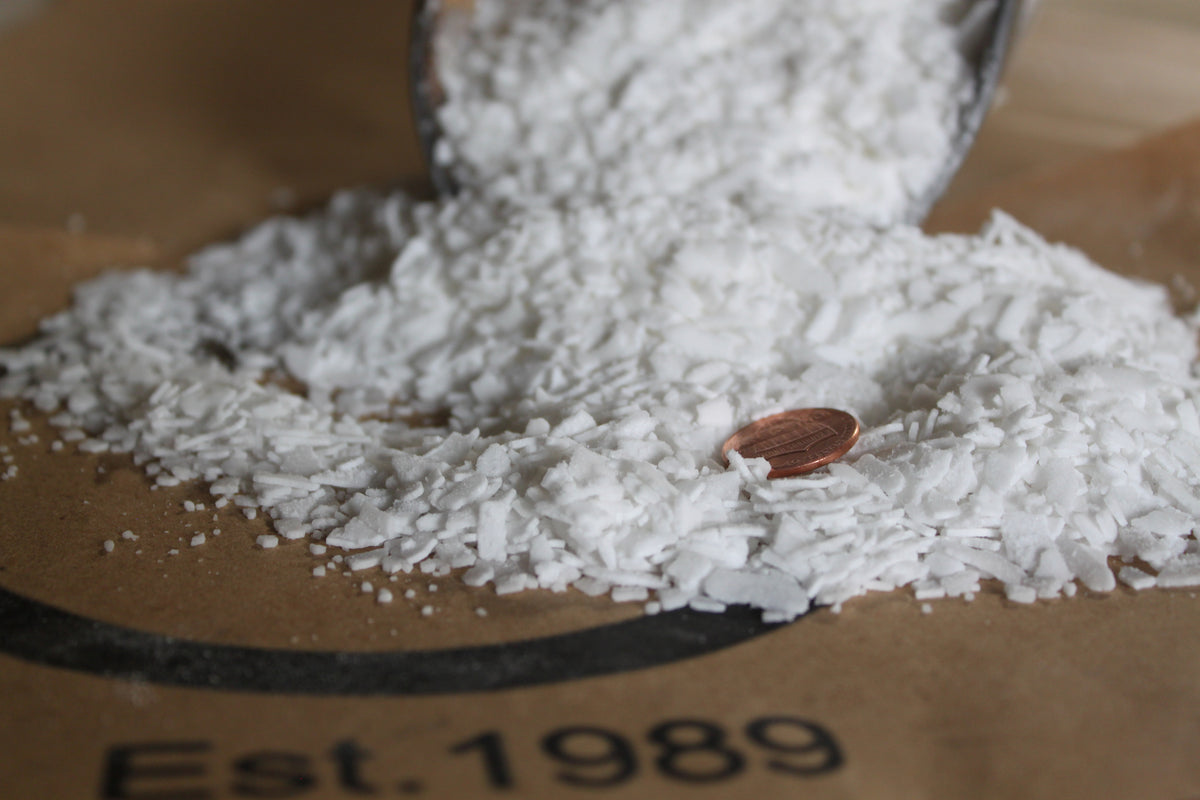
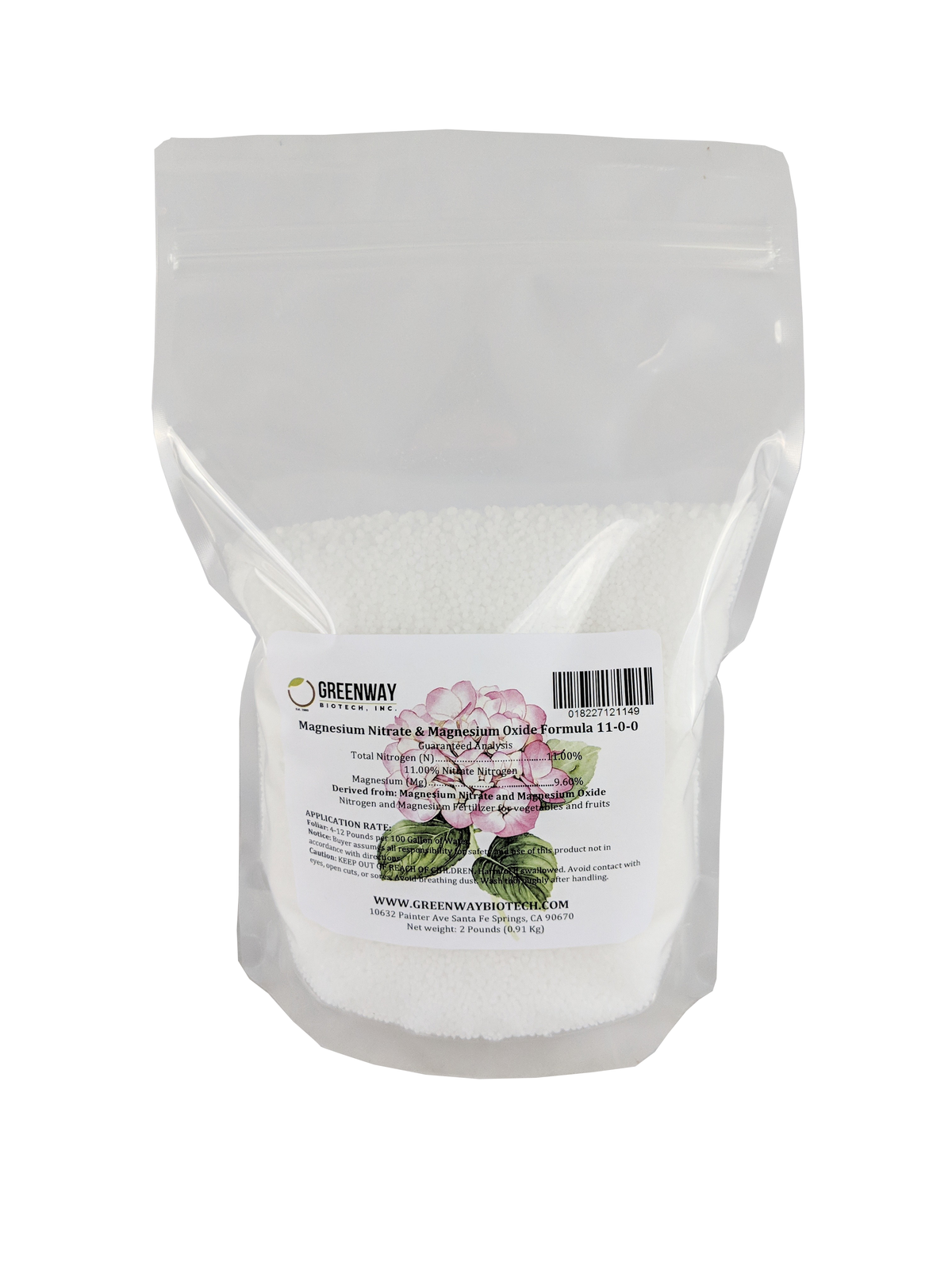
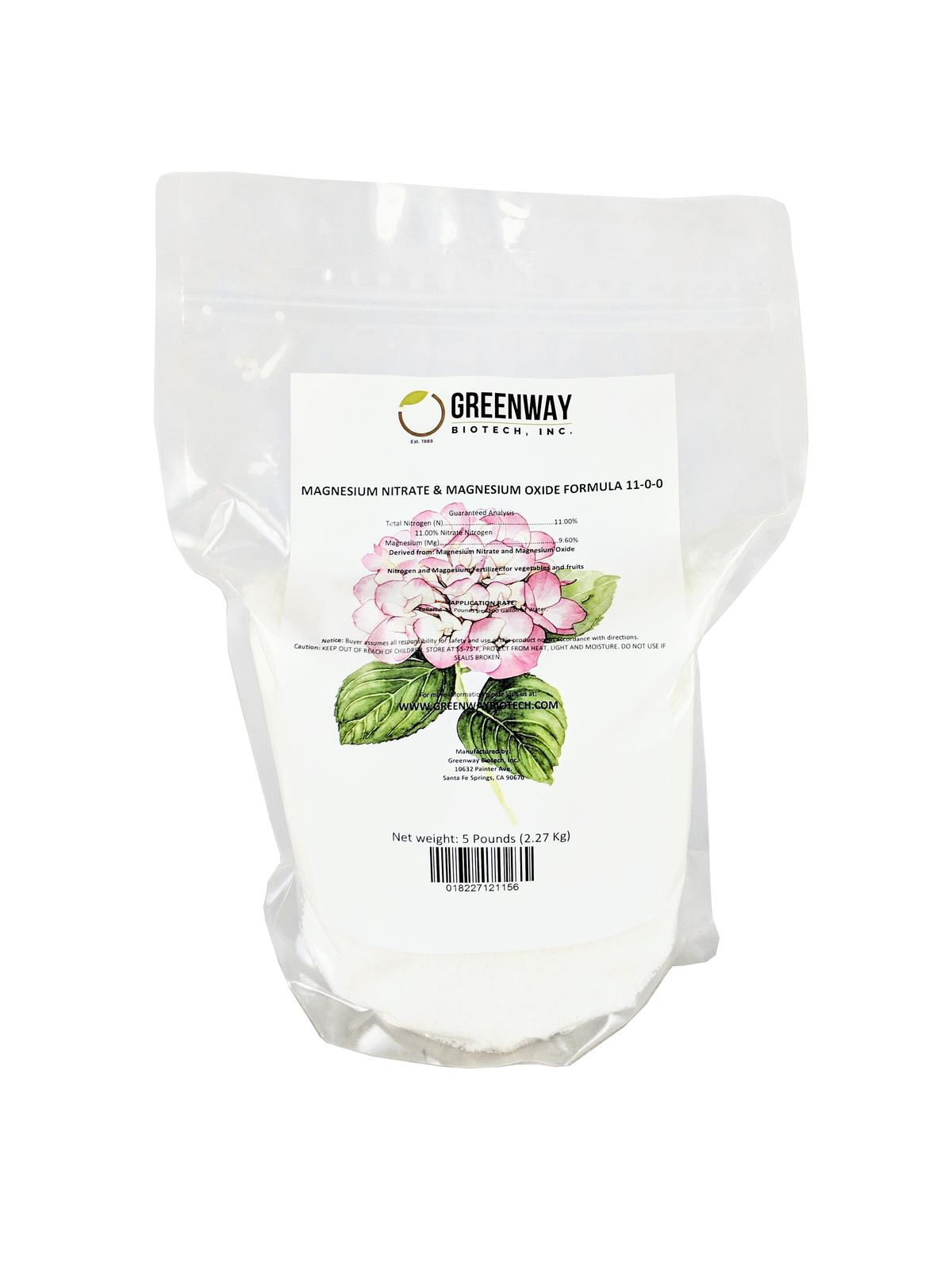
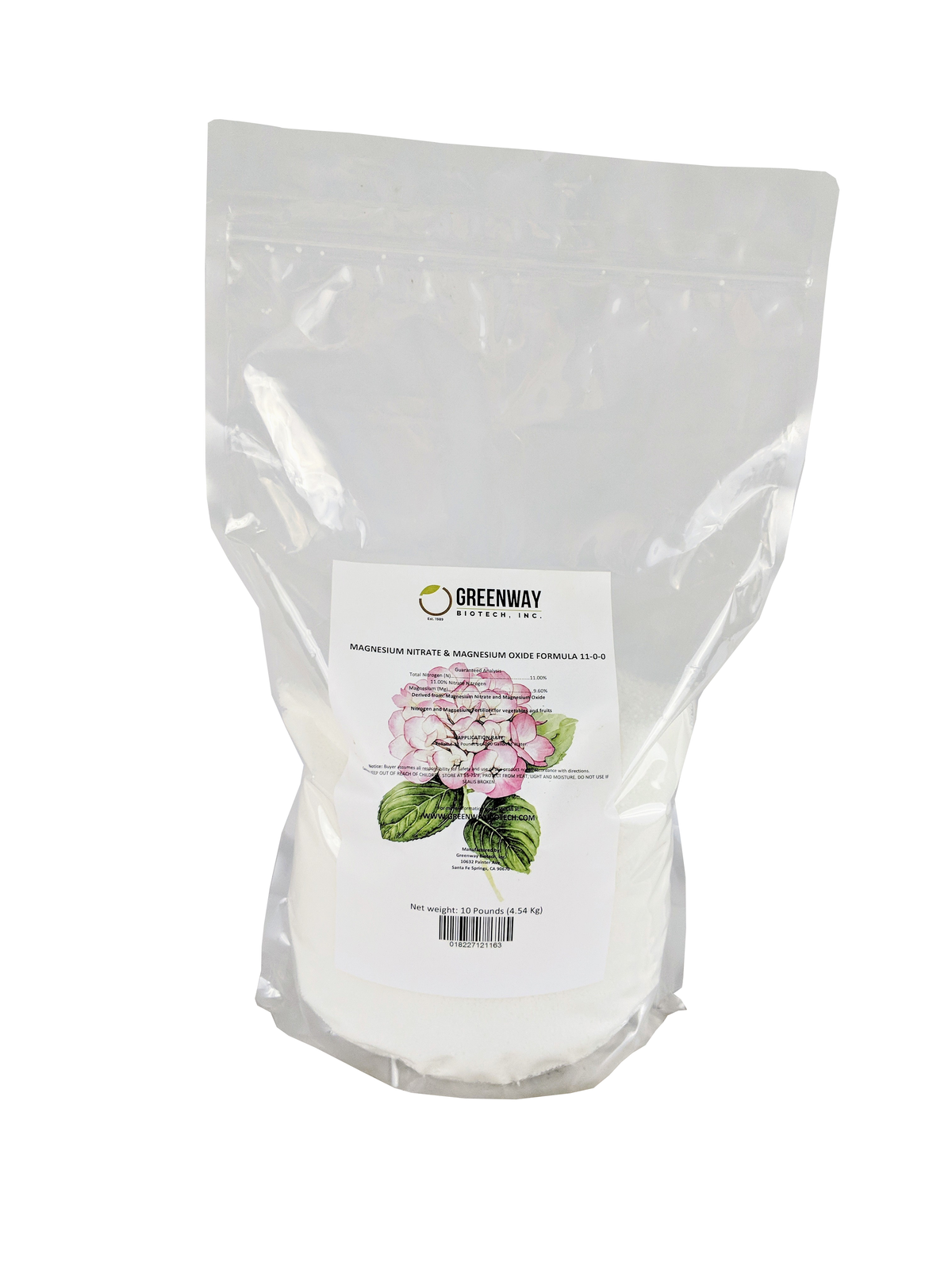
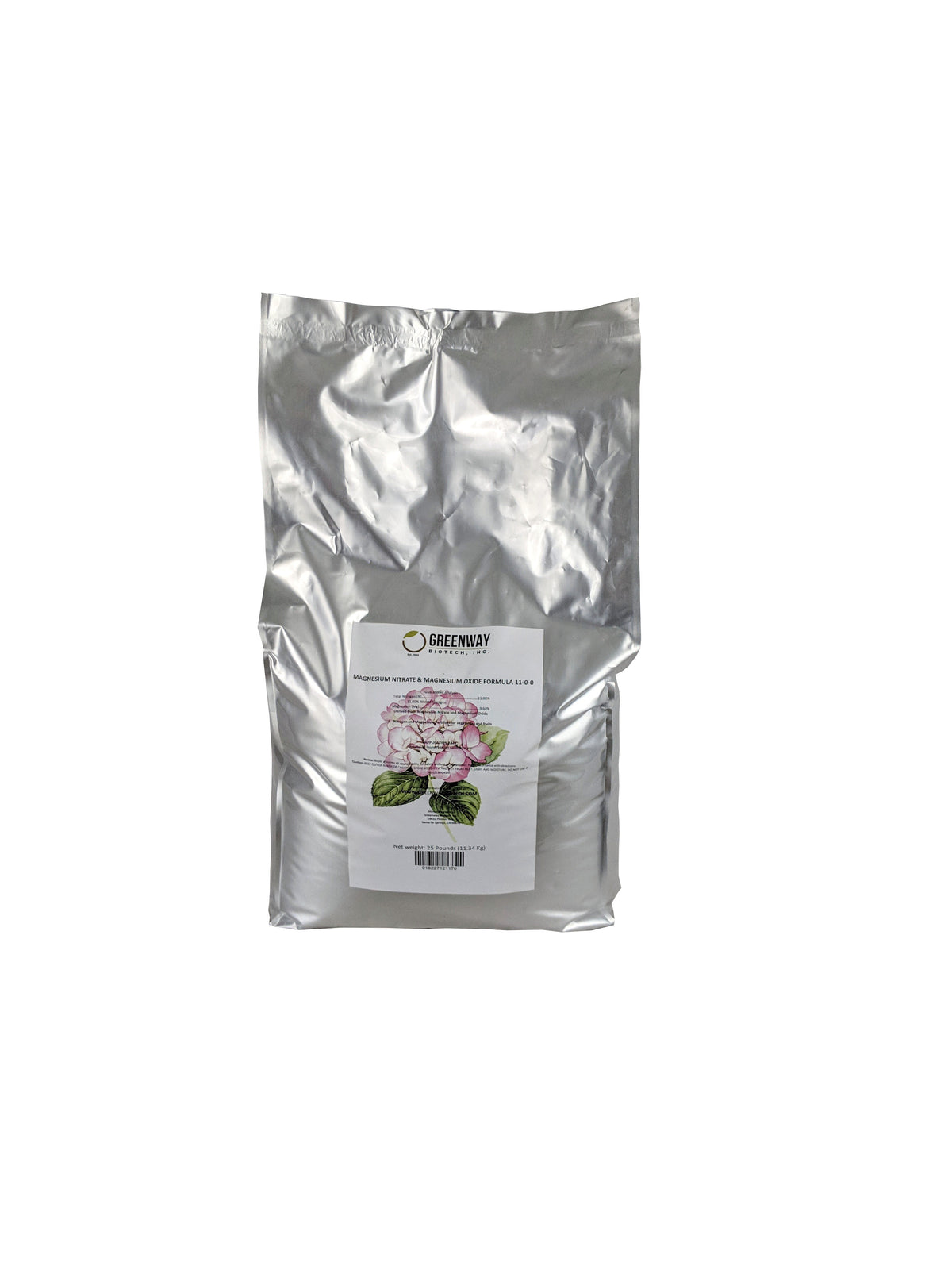

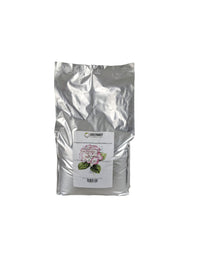
A CDFA-registered, 100% water-soluble fertilizer that delivers 11% nitrate nitrogen and 9.6% magnesium in a single pH-neutral application. Built for hydroponic Tank A programs, fertigation, foliar correction, and cool-season crops where ammonium-based nitrogen stalls. Independently lab tested for heavy metals — results consistently well below regulatory limits.
Find your size → Calculate how much I need11%
Nitrate nitrogen — immediately plant-available
9.6%
Magnesium — the central atom of every chlorophyll molecule
100%
Water soluble — no residue, no clogged emitters
35+yrs
Family-owned, California-based since 1989
Coverage is calculated at a mid-range planning rate of 1.5 tsp (~8 g) per gallon of water for soil drench, and ~5–10 lbs per 100 gallons for hydroponic Tank A makeup. Hydroponic reservoir coverage depends on your target Mg ppm and source-water analysis.
| Bag Size | Soil Drench (gal of solution) | Hydroponic Reservoirs | Best For |
|---|---|---|---|
| 2 lb | ~110 gal | ~9–18 batches of 50-gal reservoir refresh | Home gardeners & small hydroponic setups |
| 5 lb | ~275 gal | ~22–45 batches of 50-gal reservoir refresh | Most popular |
| 25 lb | ~1,375 gal | Commercial greenhouse season supply | Best value |
What ties these uses together: any time both nitrogen and magnesium are needed in plant-available form, in a pH-neutral, fully soluble carrier — from cool-season field crops to recirculating hydroponics.
Mixes with Calcium Nitrate and chelated iron in concentrated Tank A stock without precipitation. Maintain 30–50 ppm Mg in the working nutrient solution depending on crop.
Foliar sprays at 1–2% solution (about 4–8 g/gal) typically show visible recovery in new growth within 3–7 days. Always test a small area first.
Apply to moist soil at the root zone for vegetative growth and early flowering, when crops need both N and Mg in pH-neutral form.
Apply through calibrated injectors during active growth. Compatible with most fertigation programs — jar-test unfamiliar combinations before injecting.
Nitrate nitrogen uptake doesn't depend on soil microbial activity. When soils drop below 50°F and ammonium nitrification slows, nitrate stays fully available.
Greenhouse tomatoes, peppers, cucumbers, leafy greens, and citrus block fertigation programs that need both N and Mg without acidifying the rhizosphere.
A growing program built on single-nutrient salts forces compromises. Magnesium Nitrate is the rare salt that pairs two essential nutrients in plant-available form — and does it without acidifying the rhizosphere or fighting your other Tank A inputs.
All nitrogen is supplied as nitrate (NO₃⁻) — immediately plant-available with no soil microbial conversion required. Unlike ammonium, it doesn't acidify the root zone, and uptake doesn't stall in cool soils.
Magnesium sits at the center of every chlorophyll molecule and activates RuBisCO, ATP synthase, and RNA polymerase. Deficiency first appears as interveinal chlorosis on older, lower leaves — a pattern Magnesium Nitrate can correct at the source.
Unlike ammonium sulfate or Epsom salt, Magnesium Nitrate will not significantly acidify the growing medium. In hydroponic reservoirs it allows you to dial in pH without fighting drift from the nitrogen source.
Mixes safely in concentrated Tank A stock with Calcium Nitrate, Potassium Nitrate, and chelated iron. Keep phosphates (MAP, MKP) and sulfates (Epsom Salt) in Tank B — never combine Mg Nitrate with concentrated phosphate stocks.
Registered with the California Department of Food and Agriculture. Every batch is independently tested for heavy metals — results are consistently well below regulatory limits, with documentation available on request.
4N atoms
bonded to one Mg atom at the heart of every chlorophyll porphyrin ring
Magnesium sits at the geometric and functional center of the chlorophyll molecule — bonded to four nitrogen atoms in a porphyrin ring that captures light energy and drives the entire photosynthetic apparatus. Without adequate Mg, the chlorophyll molecule degrades; without adequate N, the plant cannot synthesize the porphyrin precursors or the proteins (RuBisCO, light-harvesting complexes) that surround it. The two nutrients are not just useful together — they are structurally interdependent at the molecular level.
Magnesium Nitrate hexahydrate (Mg(NO₃)₂·6H₂O) dissolves to give the magnesium cation (Mg²⁺) and two nitrate anions (NO₃⁻) in solution — both immediately taken up by root active transport. There is no microbial conversion step (unlike ammonium nitrogen), no chelate buffer to maintain (unlike Mg-EDTA), and no sulfate counter-ion to acidify the rhizosphere (unlike Epsom salt). For growers running tight pH windows and short uptake timelines, that combination is hard to replicate with two single-nutrient salts.
The practical implication: when you see interveinal chlorosis on older leaves and the plant is still building biomass, Magnesium Nitrate corrects both deficiencies in one application without making you choose between Mg and N. Foliar applications typically show visible recovery in new growth within 3–7 days; soil drenches generally take 1–2 weeks for visible response as the magnesium moves into the root zone and is translocated upward.
For deeper coverage, see What's the Function of Magnesium in Plants? and What's the Function of Nitrogen in Plants?
Rates below are drawn from university extension publications and the Greenway Biotech CDFA-registered product label. Always calibrate against a current soil or water test and your local extension service.
Quick answer: 1–2 tsp (5–10 g) per gallon of water, applied to moist soil at the root zone every 2–4 weeks during active growth.
| Crop / Use | Rate | Frequency | Source | Notes |
|---|---|---|---|---|
| General maintenance | 1–2 tsp/gal (5–10 g/gal) | Every 2–4 weeks | Greenway Biotech label; UMass Amherst | Apply to moist soil |
| Tomatoes, peppers, cucumbers | ~2 tsp/gal (10 g/gal) | Every 2 weeks | UMass Amherst; UF/IFAS | Throughout vegetative & early flowering |
| Leafy greens | ~1.5 tsp/gal (7–8 g/gal) | Every 2–3 weeks | UMass Amherst | Throughout growing season |
| Citrus (under drip line) | ~3 tsp/gal (15 g/gal) | Spring & fall | UF/IFAS Extension | Apply where soil Mg is low; pair with soil test |
📋 Soil Test First: Soil drench rates above are general guidelines. Actual rates should be confirmed by a current soil test and consultation with your local cooperative extension service, as needs vary significantly by soil type, crop, and regional conditions. For citrus specifically, UF/IFAS recommends applying Mg fertilizer at a rate equal to ~20% of the N rate when soil Mg is low — total seasonal need is typically split across applications.
Sources: University of Massachusetts Amherst Center for Agriculture, Food & Environment; University of Florida IFAS Extension (citrus nutrition); Greenway Biotech CDFA-registered product label.
Quick answer: ~0.5 tsp (2–3 g) per gallon for prevention, up to ~0.75 tsp (3–4 g) per gallon for active deficiency correction — staying within the safe 1–4 g/gallon foliar window for hand-spray use.
| Use | Rate | Frequency | Source | Notes |
|---|---|---|---|---|
| Deficiency prevention | ~0.5 tsp/gal (2–3 g/gal) | Every 7–14 days | UMass Amherst; UC IPM | Apply before visible symptoms appear |
| Active deficiency correction | ~0.75 tsp/gal (3–4 g/gal) | Every 5–7 days until recovery | UMass Amherst; UC IPM | Results visible in 3–7 days on new growth |
| Leafy greens (sensitive) | ~0.25–0.5 tsp/gal (1–2 g/gal) | Every 7 days | UMass Amherst | Light application; avoid leaf burn |
| Commercial citrus, spring/summer flush | ~20 lb/100 gal water, ground-rig coverage | 1–2 applications per flush | UF/IFAS Extension | Apply when leaves are 2/3 to fully expanded, not hardened off. Commercial rate — not for hand spray. |
| Commercial vegetable, foliar (Mg basis) | 0.5–2 lbs actual Mg/acre = 5–21 lbs of 11-0-0/acre in 30–100 gal water | As needed per tissue test | Univ. Missouri IPM; Univ. Delaware Ext. | Commercial ground-rig rate; jar-test before broader use |
Foliar safety check: Foliar rates should be well below soil rates — typically 1–4 g/gallon (or 2–6 g/liter) for hand-spray and small-plot use. Commercial ground-rig rates can go higher because of better atomization and rapid leaf drying, but always test on a small area first. Apply in early morning or late afternoon below 85°F, cover leaf undersides, and avoid spraying in direct midday sun.
Sources: University of Massachusetts Amherst Center for Agriculture, Food & Environment; UC Statewide IPM; University of Missouri IPM publications; University of Delaware Cooperative Extension; University of Florida IFAS Extension (citrus).
Quick answer: Target 30–50 ppm Mg in the working nutrient solution depending on crop. Leafy greens trend toward 30 ppm; heavy-feeding fruiting crops (tomato, cucumber, pepper) toward 50 ppm.
| System / Crop | Mg Target (ppm) | Approx. Rate | Source | Notes |
|---|---|---|---|---|
| Leafy greens (NFT / DWC) | ~30 ppm Mg | ~0.5 g/gal (~0.1 g/L) | UMass; UF Extension research-based | Add to Tank A; adjust for source water |
| Tomato, cucumber, pepper | ~50 ppm Mg | ~0.8 g/gal (~0.2 g/L) | UMass; UF Extension research-based | Heavy feeders — monitor with EC |
| General greenhouse range | 20–60 ppm Mg (50–70 ppm MgO) | 0.3–1 g/gal | UMass Extension Greenhouse Crops | Confirm against a water analysis |
💡 Hydroponic notes: Use separate stock tanks for calcium fertilizers and other concentrated fertilizer salts. Always dilute each independently before combining in the main tank, and jar-test unfamiliar combinations before injecting. As a quick reference: 1 gram of Magnesium Nitrate per gallon of water yields approximately 29 ppm nitrate-N and 25 ppm Mg in the working solution. Maintain working-solution pH between 5.5 and 6.5 for optimal uptake.
Sources: University of Massachusetts Amherst Extension; University of Florida IFAS Extension.
Quick answer: Per the Greenway Biotech CDFA-registered label, apply 4–12 lbs per 100 gallons of water through calibrated injectors, calibrated against soil test and crop uptake.
| Use Case | Rate | Source | Notes |
|---|---|---|---|
| General fertigation (label) | 4–12 lbs per 100 gal water | Greenway Biotech CDFA-registered label | Calibrate injector ratio against target ppm |
| Vegetable crops, foliar (Mg basis) | 0.5–2 lbs actual Mg/acre = ~5–21 lbs of 11-0-0/acre | Univ. Missouri IPM; Univ. Delaware Ext. | Typically applied in 30–100 gallons of water per acre |
| Field crops, broadcast (non-acid soils) | 50–100 lbs actual Mg/acre = ~520–1,040 lbs of 11-0-0/acre | Michigan State University Extension | Dolomite or K-Mag typically used at this scale; Mg Nitrate preferred when nitrate-N is also wanted |
| Field crops, banded at planting | 10–20 lbs actual Mg/acre = ~105–210 lbs of 11-0-0/acre | Michigan State University Extension | Band rather than broadcast for efficiency on row crops |
| Citrus (when soil Mg is low) | Mg at ~20% of the N rate (e.g., ~310 lbs 11-0-0/acre/season at 150 lb N/acre target) | UF/IFAS Extension | Split across multiple applications per season |
📋 Soil Test First: Field crop application rates above are general guidelines based on typical soil test levels and crop removal estimates. Actual rates should be confirmed by a current soil test and consultation with your local cooperative extension service, as needs vary significantly by soil type, crop variety, and regional conditions. Magnesium Nitrate is preferred over MgSO₄ or dolomite when nitrate-N is also wanted, when sulfate levels are already high in irrigation water, or when calcareous soils restrict uptake.
Sources: Greenway Biotech CDFA-registered product label; University of Missouri IPM publications; University of Delaware Cooperative Extension; Michigan State University Extension; University of Florida IFAS Extension (citrus).
Magnesium Nitrate is a clear, fully soluble salt — no slurry, no residue. Add it to water (never water to powder), stir, and apply at the right rate for your use case.
Soil drench: 1–2 tsp per gallon. Foliar: 1–1.5 tsp per gallon. Hydroponic: dose to a target Mg ppm using the calculator. Always add fertilizer to water, never water to dry powder.
Stir until the solution is fully clear — should take under a minute. Magnesium Nitrate is 100% water soluble with no residue. For hydroponic stock tanks, add to Tank A with Calcium Nitrate and chelated iron; keep phosphates and sulfates in Tank B.
Soil drench: apply to moist (not dry) soil to prevent root burn. Foliar: early morning or late afternoon, with leaf temperature below 85°F. Cover undersides of leaves. Allow solution to dry before direct midday sun exposure.
Foliar applications typically show visible improvement on new growth within 3–7 days. Soil drenches take 1–2 weeks. For hydroponics, monitor EC alongside individual ppm targets and maintain reservoir pH between 5.5 and 6.5.
Magnesium can come from several different salts — each with a different companion nutrient and a different best-fit application. Here's how they compare.
| Product | Magnesium | Companion Nutrient | pH Effect | Best For |
|---|---|---|---|---|
| Magnesium Nitrate 11-0-0 (this product) | 9.6% Mg | 11% nitrate-N | Neutral | Hydro Tank A, vegetative growth, cool soils, citrus, two-deficiency correction |
| Epsom Salt (MgSO₄) | ~10% Mg | ~13% sulfur | Mildly acidifying | Late flower / ripening, sulfur-deficient soils, bath / wellness uses |
| Cal-Mag Plus 2-0-0 | Mg + Ca + chelated Fe blend | 2% N + Ca + Fe | Neutral | Coco coir, RO water, LED grows, pre-balanced Cal-Mag-Fe in one bottle |
| Dolomite Lime | ~10–12% Mg | Calcium carbonate | Strongly liming (raises pH) | Acidic soils needing both Mg and pH correction; slow-release |
| K-Mag 0-0-22 | ~11% Mg | 22% K₂O + 22% S | Neutral | Chloride-sensitive crops needing K, Mg, and S together |
Magnesium Nitrate is the rare salt that pairs N and Mg in a pH-neutral, fully soluble carrier. That makes it a strong fit for some applications — and a poor fit for others.
Magnesium Nitrate works hardest as part of a balanced Tank A / Tank B hydroponic program, or paired with a complementary calcium and phosphorus source in soil.
The other half of Tank A — maintains the optimal 3:1 to 4:1 Ca:Mg ratio. Compatible with Magnesium Nitrate in the same concentrated stock without precipitation.
Late-flower MgSwitch to Epsom Salt at weeks 8–9 of bloom when extra nitrogen is no longer wanted. Provides Mg + S without N.
Tank B partnerPhosphorus and potassium source for flowering. Keep in Tank B — never combine Magnesium Nitrate with concentrated phosphate in stock solutions.
Chlorophyll co-factorWorks alongside magnesium to support chlorophyll synthesis and deep green color. Safe to combine in Tank A solutions.
Magnesium Nitrate is a fertilizer salt and an oxidizer at high concentrations. Standard fertilizer-handling PPE applies; the full Safety Data Sheet is linked under Documents below.
If your question isn't here, contact our team at questions@greenwaybiotech.com.
Magnesium Nitrate 11-0-0 supplies two essential plant nutrients — nitrate nitrogen and magnesium — in a single water-soluble application. It's most commonly used to correct or prevent magnesium deficiency (interveinal chlorosis on older leaves), support chlorophyll production during vegetative growth and early flowering, and maintain stable nutrition in hydroponic Tank A programs. It is well suited for soil drenches, fertigation, and foliar sprays anywhere both nitrogen and magnesium are needed at the same time.
Use Magnesium Nitrate when your plants need both nitrogen and magnesium — during vegetative growth, early flowering, and any time foliar color is fading while nitrogen demand is still high. Use Epsom Salt during late flowering and ripening when extra nitrogen isn't wanted, or when a sulfur boost is needed alongside magnesium. Both products provide approximately the same magnesium content (~9.6–10%); the choice comes down to which companion nutrient — nitrogen or sulfur — your crop needs at that stage. For background, see the function of magnesium in plants.
Foliar applications typically show visible improvement within 3–7 days — new growth emerges green and healthy. Soil drenches generally take 1–2 weeks for visible results as the magnesium moves into the root zone and is translocated upward. Existing chlorotic leaves may not fully recover their green color, but new growth will be normal. For fastest correction, many growers combine a foliar spray (immediate uptake) with a soil drench (sustained supply).
Yes — Magnesium Nitrate and Calcium Nitrate are compatible in the same concentrated Tank A stock solution; both are nitrate-based and will not precipitate together. However, keep Magnesium Nitrate separate from concentrated phosphate fertilizers (MKP, MAP) in stock tanks — mixing these can form magnesium phosphate precipitates that clog lines. In dilute working solutions at normal application rates, all of these fertilizers can be combined. Always dilute each component independently before combining in the main tank, and jar-test unfamiliar combinations before injecting.
For most crops, the optimal Ca:Mg ratio is approximately 3:1 to 4:1 in the nutrient solution or soil pore water. Ratios wider than about 5:1 (too much calcium relative to magnesium) can induce magnesium lockout — the plant has difficulty taking up Mg even when it's present, because calcium and magnesium compete for the same uptake channels. Hard tap water commonly has Ca:Mg ratios of 6:1 or higher, which can mean extra Magnesium Nitrate is needed even if the absolute Mg level appears adequate.
Yes — Magnesium Nitrate is 100% water soluble with no insoluble residue, making it suitable for NFT, DWC, ebb-and-flow, and drip systems. It won't clog emitters or leave deposits in reservoirs. Add it to Tank A alongside Calcium Nitrate, target 30–50 ppm Mg in the working solution depending on crop, and maintain reservoir pH between 5.5 and 6.5 for optimal uptake. Read more in our guide to the best fertilizers for hydroponics.
Magnesium Nitrate is pH neutral and won't significantly acidify the growing medium or reservoir. This contrasts with ammonium-based nitrogen sources, which lower pH over time as ammonium is converted to nitrate. In hydroponic systems, Magnesium Nitrate is particularly valued because it allows you to dial in your target pH without fighting acidification from the nitrogen source.
Magnesium is a mobile nutrient — plants can redistribute (remobilize) it from older tissue to newer, actively growing tissue when supply runs short. This means deficiency symptoms typically appear first on the oldest, lowest leaves and progress upward as the plant continues to draw Mg from older tissue. By the time symptoms appear on young growth, the deficiency is typically more advanced.
A/B (or two-part) hydroponic systems use two concentrated stock tanks to prevent nutrient precipitation before dilution. Tank A typically holds calcium and nitrate fertilizers — Calcium Nitrate, Magnesium Nitrate, chelated Iron, and Potassium Nitrate. Tank B holds phosphates and sulfates — MKP (monopotassium phosphate), MAP, Epsom Salt, and micronutrient blends. Magnesium Nitrate goes in Tank A. Do not combine Magnesium Nitrate with high-phosphate concentrates in the same stock tank.
No — foliar rates should be well below soil rates. Safe foliar application rates are typically 1–4 grams per gallon (roughly 1–2% solution), with 2–3% as an upper limit on tolerant crops and only after a small test patch. Soil drench rates can go higher (5–15 g/gal) because the soil buffers the concentration before it reaches leaf tissue. Always spray in early morning or late afternoon, cover leaf undersides, and avoid temperatures above 85°F.
Available in 2 lb, 5 lb, and 25 lb bags. Free shipping on orders over $100. Backed by our 90-day guarantee — if it doesn't work for your program, we'll refund it.
Choose your size →