Calcium Nitrate Fertilizer 15.5-0-0 with 19% Calcium
- Regular Price
- $ 24.99
- Sale Price
- $ 24.99
- Regular Price
- $ 19.99
Sold Out
- Unit Price
- per
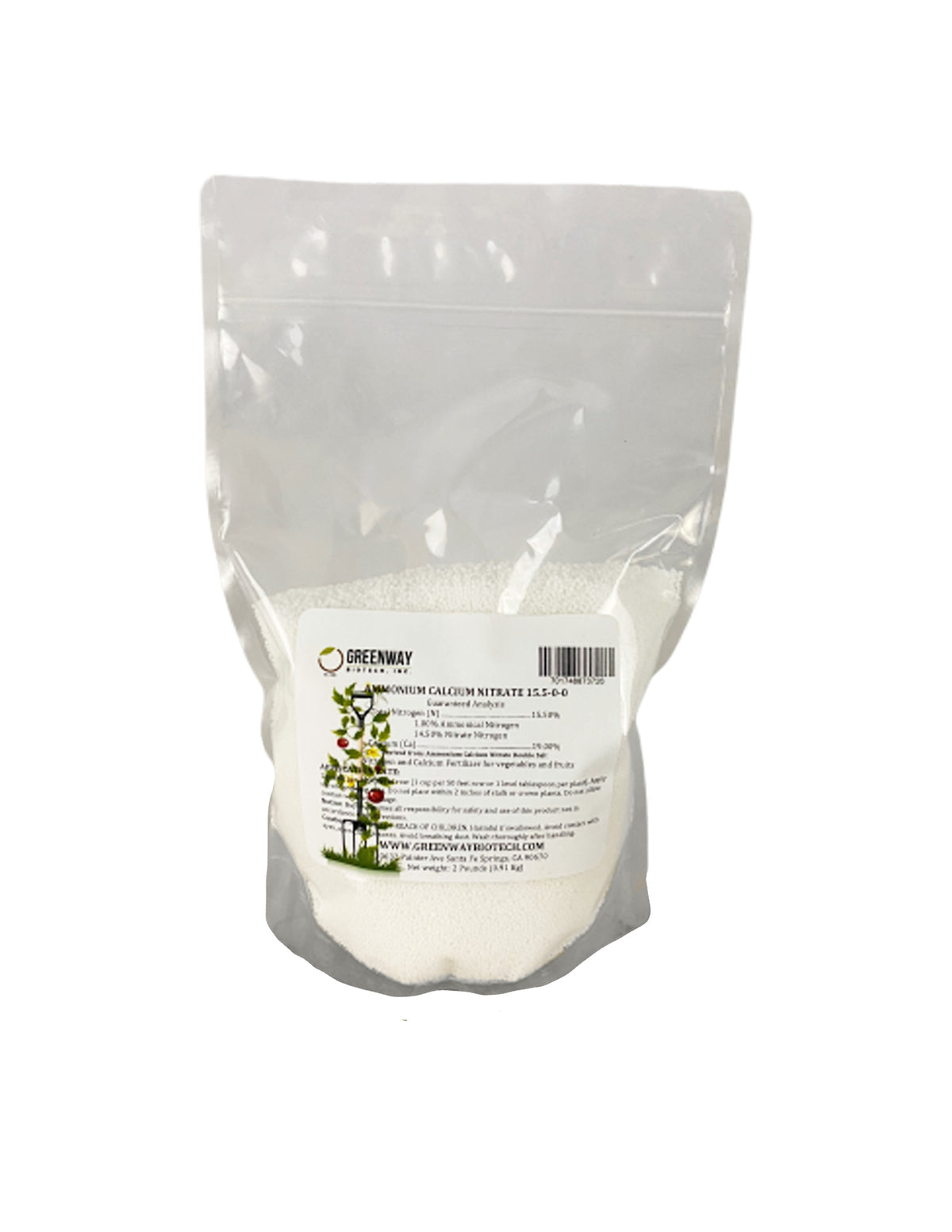
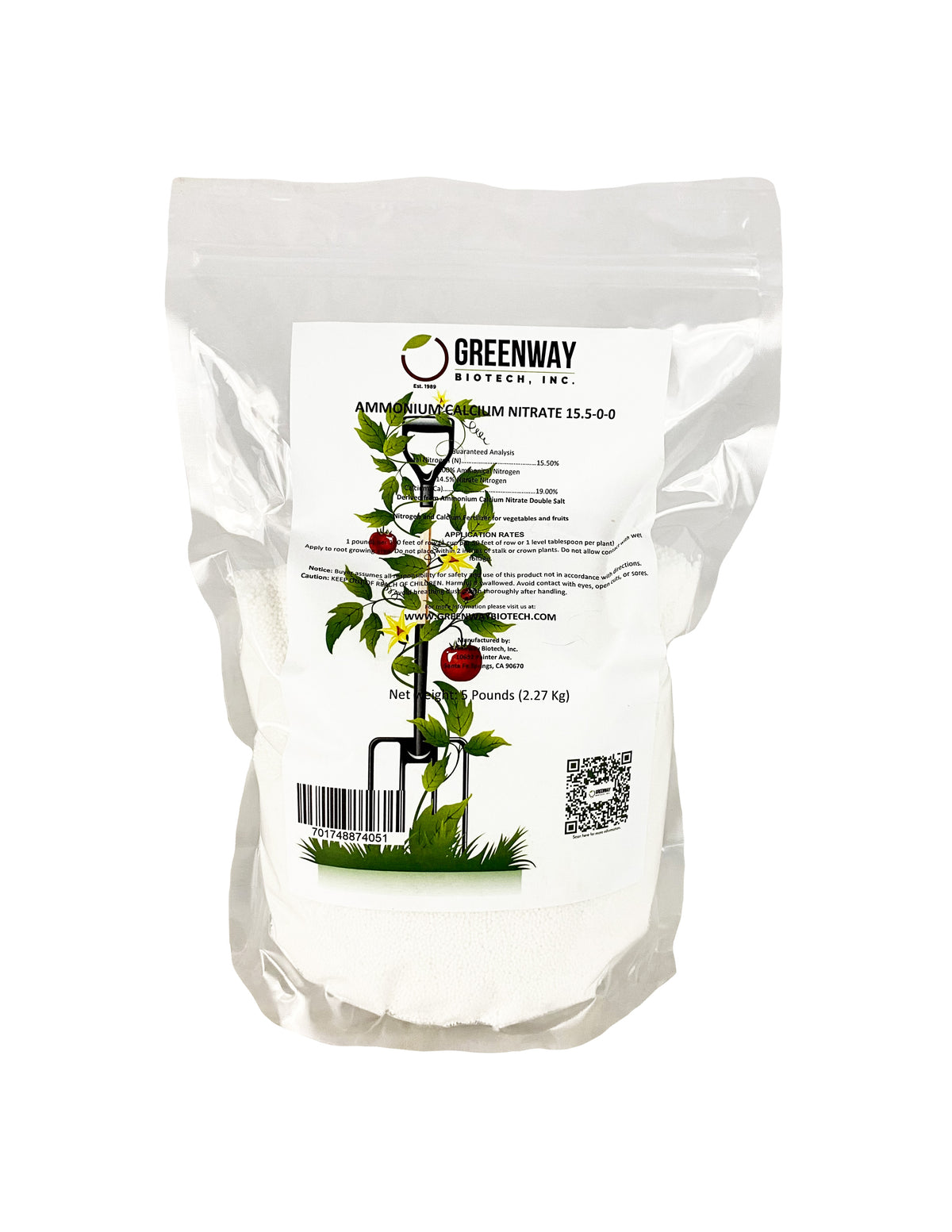
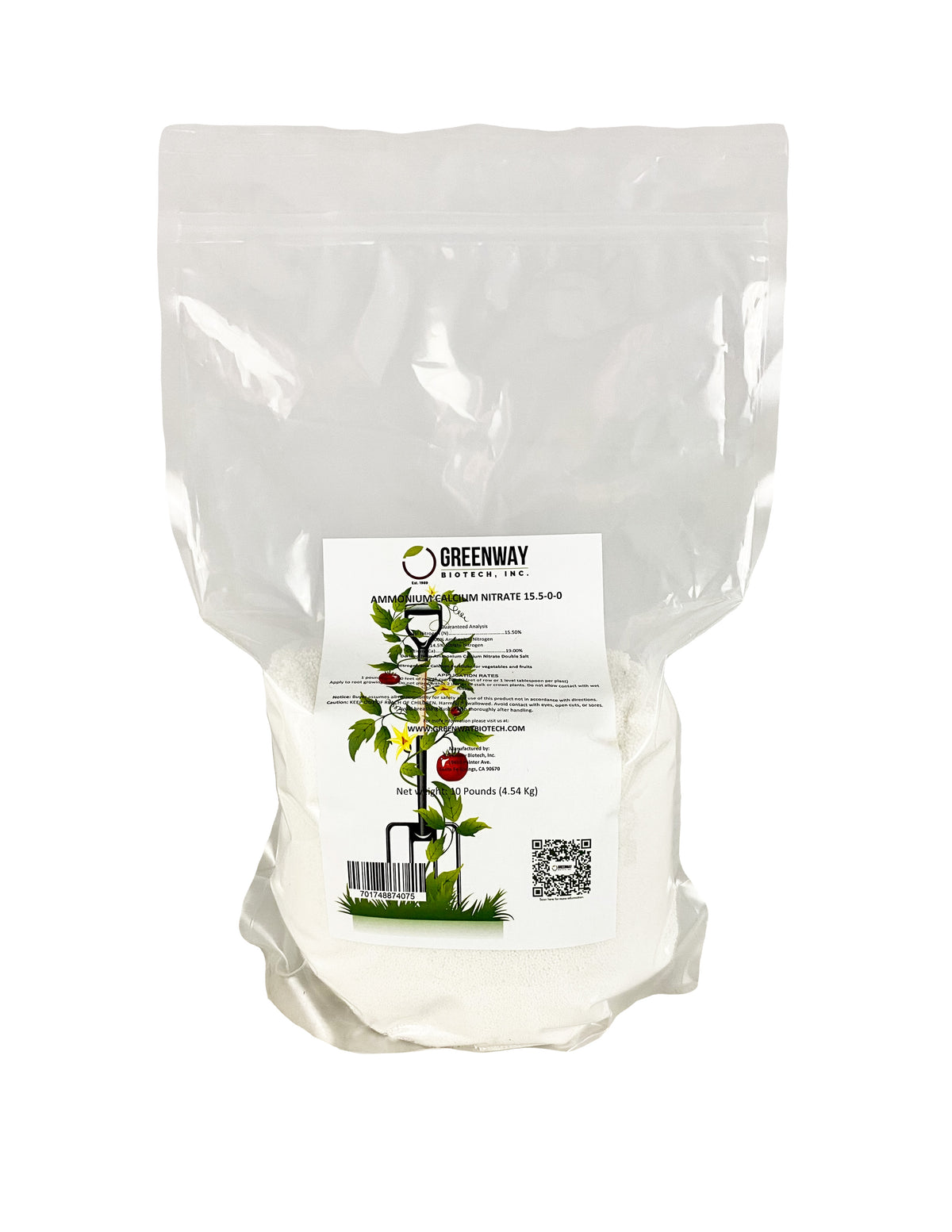
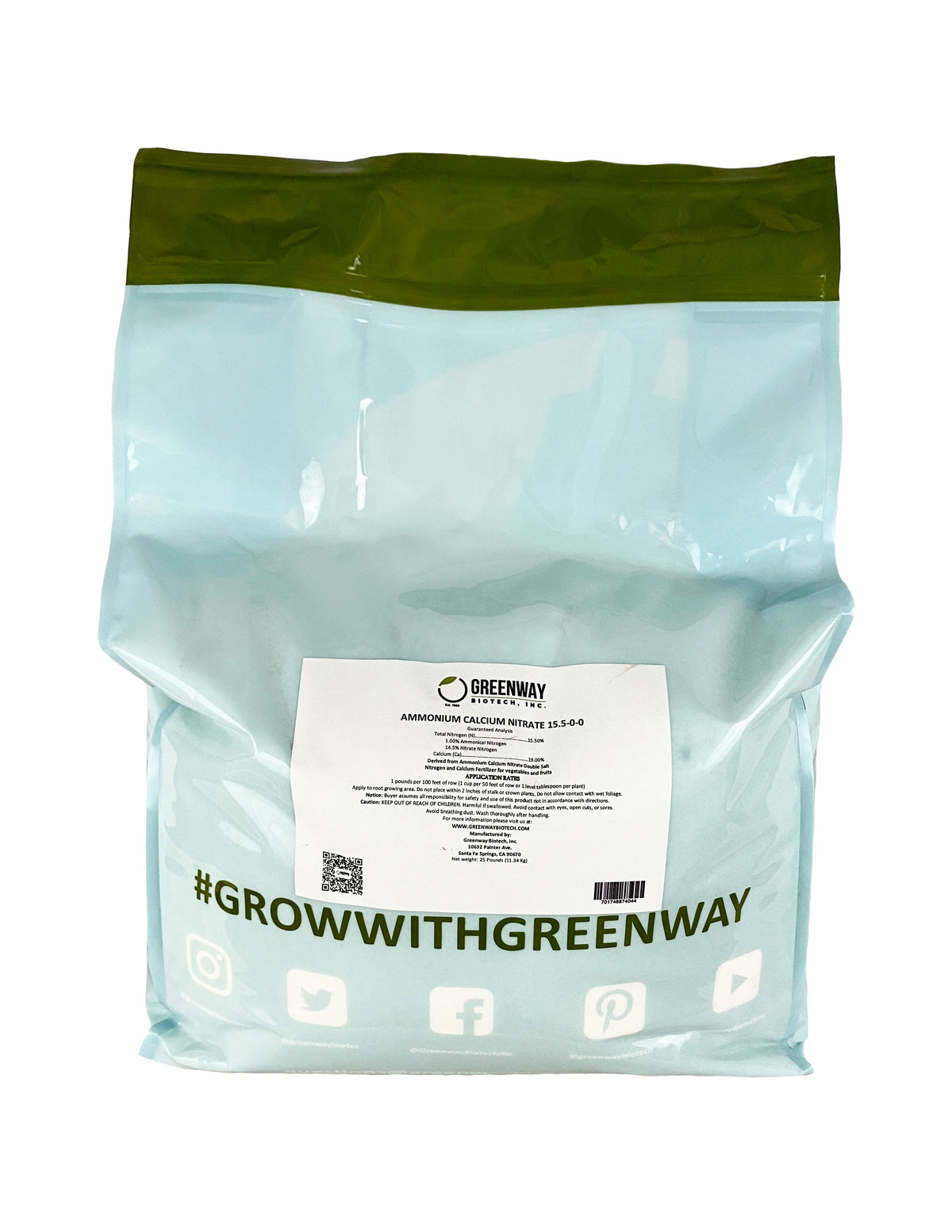
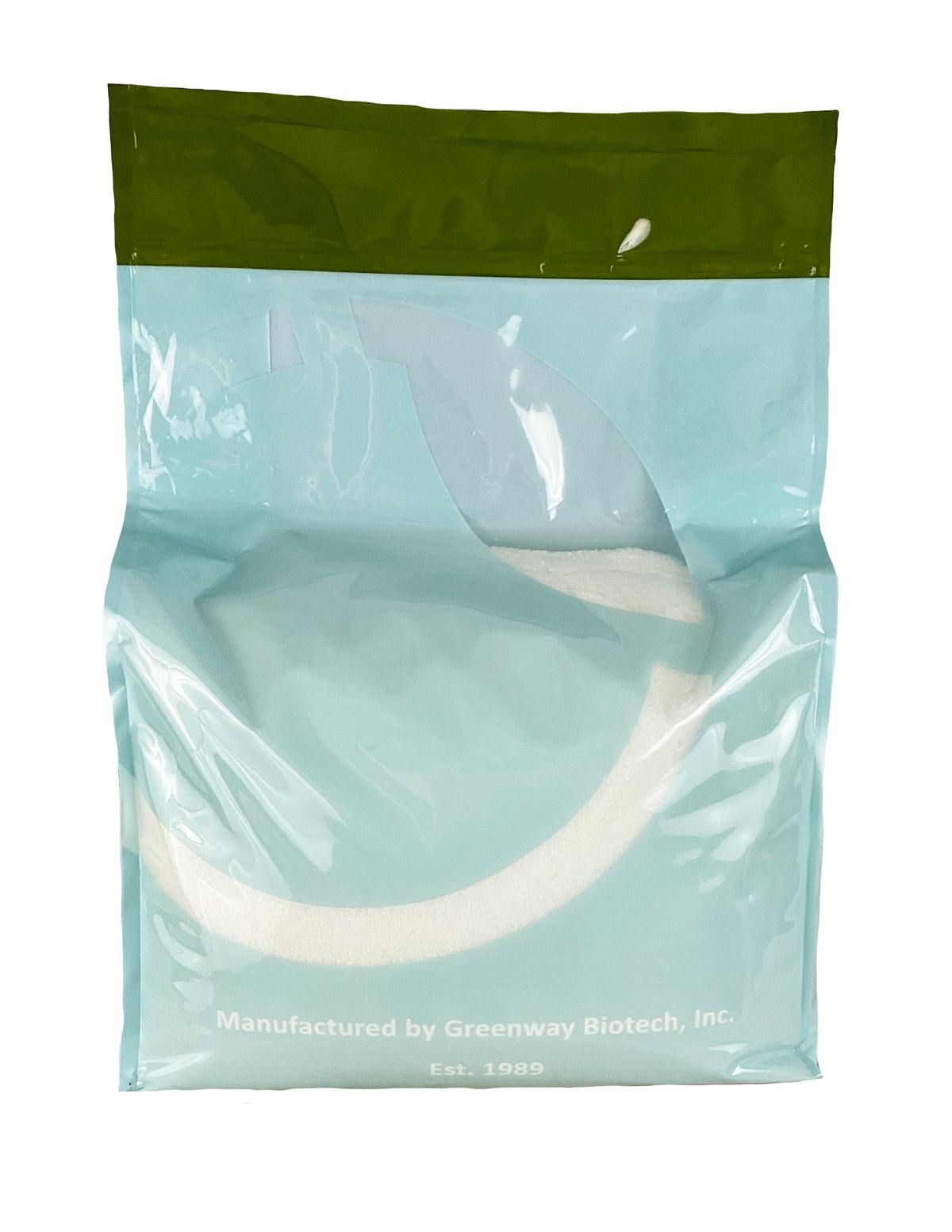

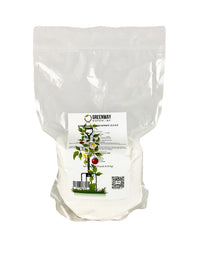
Nitrogen and calcium fertilizer · 15.5-0-0 · 19% calcium
Calcium Nitrate 15.5-0-0 is a water-soluble fertilizer that supplies nitrogen and calcium together: 15.5% nitrogen, almost all of it nitrate nitrogen (14.5% nitrate, 1% ammoniacal), and 19% calcium. Gardeners use it to sidedress vegetables during the season, and growers use it as the calcium source in hydroponic and fertigation recipes, where it goes in its own stock tank.
Every gram of calcium comes with nitrogen: 1 gram per liter of solution adds 190 ppm calcium and 155 ppm nitrogen, so choose it when your crop needs both. It is not a complete fertilizer, and it is not a cure for blossom-end rot. Clemson and University of Georgia Extension list uneven soil moisture among the factors that raise the risk, so steady watering matters as much as the fertilizer; where low soil calcium or ammoniacal nitrogen is part of the problem, a calcium nitrate sidedress can help reduce it.
| Specification | Detail |
|---|---|
| Total nitrogen (N) | 15.5% |
| Nitrate nitrogen | 14.5% |
| Ammoniacal nitrogen | 1.0% |
| Calcium (Ca) | 19.0% |
| Available phosphate (P₂O₅), soluble potash (K₂O) | None guaranteed (the grade is 15.5-0-0) |
| Derived from | Ammonium calcium nitrate double salt. The Safety Data Sheet lists calcium nitrate (CAS 10124-37-5) at 70–80% and ammonium nitrate (CAS 6484-52-2) at 7–10%. |
| Form | Dry solution (greenhouse) grade, for dissolving in water or spreading on soil |
| In solution | 1 g of product per liter adds 190 ppm calcium and 155 ppm nitrogen (145 ppm nitrate N, 10 ppm ammoniacal N). 1 g per US gallon adds 50 ppm calcium and 41 ppm nitrogen. |
| Hazards | Danger. Harmful if swallowed. Causes serious eye damage. See Handling, storage & limitations. |
| Package sizes | 2, 5, 10, 25, and 50 lb (the 50 lb size may ship as two 25 lb bags) |
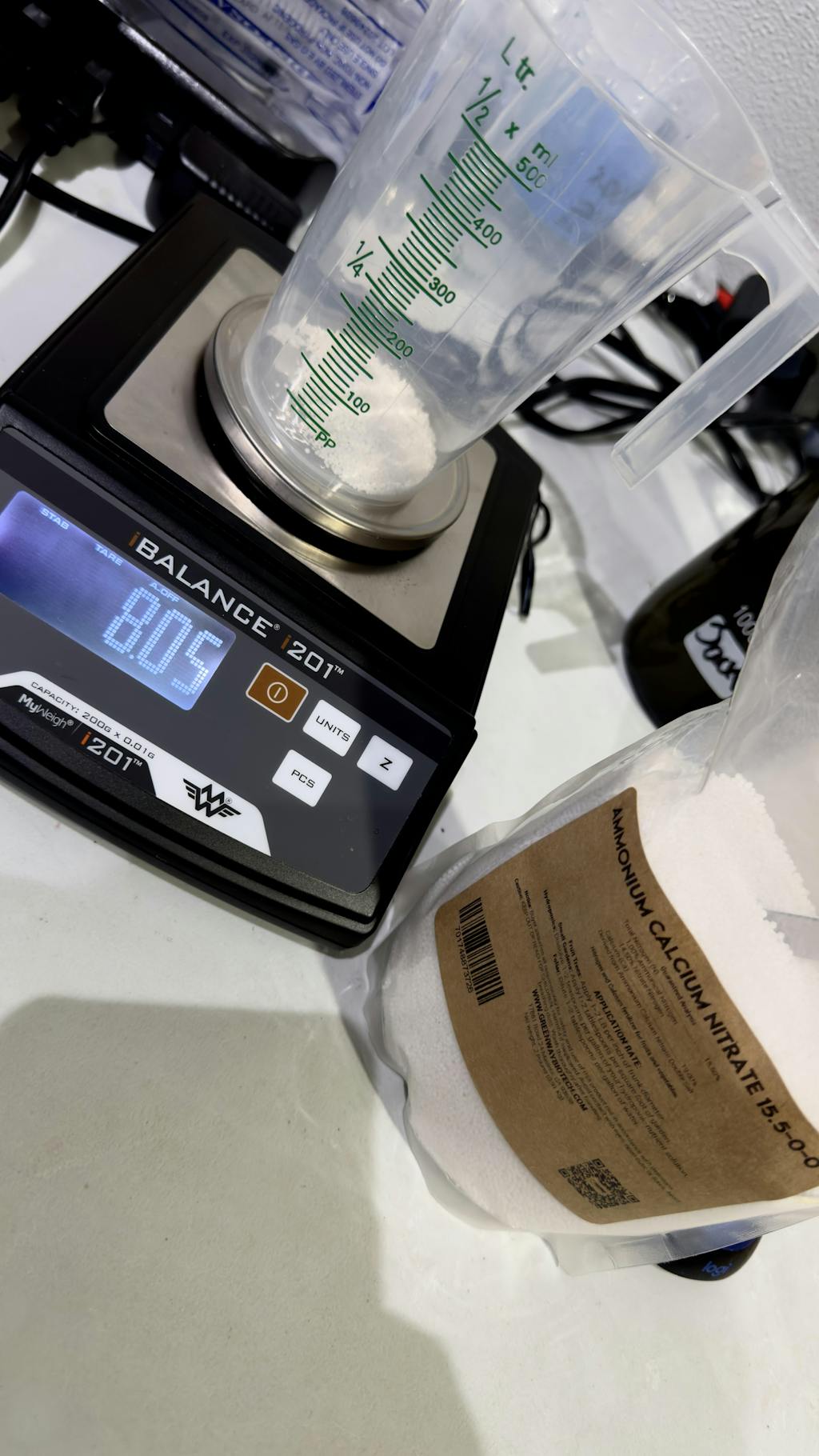
Percentages are by weight of product. One pound supplies 70 g (0.155 lb) of nitrogen and 86 g (0.19 lb) of calcium. Anhydrous calcium nitrate would analyze about 17% nitrogen and 24% calcium. Fertilizer-grade calcium nitrate is a hydrated double salt of calcium nitrate with a small share of ammonium nitrate, and its water of crystallization is the main reason the guarantee is 15.5% nitrogen and 19% calcium. Calculate from these guaranteed figures, and weigh the product: this page assumes no weight for a spoonful.
Choose calcium nitrate when your crop needs nitrogen and a soluble calcium source at the same time.
Clemson Cooperative Extension names calcium nitrate as a sidedress for tomato, pepper, eggplant, okra, cucumber, squash, melons, broccoli, cabbage, cauliflower, collards, and lettuce, with weighed rates per length of row or area of bed. See the rate table.
Clemson and University of Georgia Extension advise against ammoniacal nitrogen for sidedressing tomatoes, because ammonium competes with calcium for uptake. They call a calcium nitrate sidedress usually the best choice, applied monthly at 2 lb per 100 ft of row.
University of Florida IFAS hydroponic tomato formulas take their calcium from calcium nitrate in a separate B stock tank. University of Georgia Extension notes that calcium nitrate is routinely injected through drip irrigation for pepper and tomato, from bloom until fruit is about golf-ball size.
The soil rates below are weights of this product taken from university Extension fact sheets, stated per length of row or per area of bed. Keep the two apart: Clemson equates 100 sq ft of garden with about 30 ft of row. Weigh the product, base the season’s nitrogen on a soil test, and subtract the nitrogen in other fertilizers and compost. If the directions printed on your package differ from this page, contact us before applying.
Test first. Clemson Extension calls a soil test the best way to determine a crop’s fertilizer needs. Apply lime and preplant fertilizer by the soil test; calcium nitrate then supplies the sidedress nitrogen during the season.
| Crop | Beds (per area) | Rows (per length) | Timing | Fact sheet |
|---|---|---|---|---|
| Tomato | 1 lb per 100 sq ft (45 g per 10 sq ft) | 1 lb per 30 ft of row | Once, 3–4 weeks after planting. On sandy soil, split into two halves 3–4 weeks apart | HGIC 1323 |
| Pepper, eggplant, collards | ½ lb per 100 sq ft (5 lb per 1,000 sq ft) | ½ lb per 30 ft of row (5 lb per 300 ft) | 3–4 weeks after planting, then the same amount 3–4 weeks later | HGIC 1316, 1310, 1307 |
| Okra | 3–6 lb per 1,000 sq ft | 1–2 lb per 100 ft of row | 3–4 weeks and again 6–8 weeks after planting; more later depending on rainfall and harvest length | HGIC 1313 |
| Cucumber, summer squash | Not given | 2 lb per 100 ft of row | Before the vines develop; more often on sandy soil or after leaching rains | HGIC 1309, 1321 |
| Cantaloupe, honeydew, watermelon | Not given | 2 lb per 100 ft of row | Before the vines start to run; a second sidedressing after bloom, when fruit is developing | HGIC 1304, 1325 |
| Broccoli, cauliflower | Not given | 2 lb per 100 ft of row | 3–4 weeks after transplanting; direct-seeded broccoli when plants are 6 inches tall | HGIC 1301, 1326 |
| Cabbage, lettuce | Not given | 2 lb per 100 ft of row | Once during the season | HGIC 1303, 1312 |
| Other vegetables whose soil test calls for sidedress nitrogen | 10 lb per 1,000 sq ft | 10 lb per 300 ft of row | Once, 3–4 weeks after planting. On sandy soil, 5 lb at 3 weeks and 5 lb 3–4 weeks later | HGIC 1254 |
For scale: 2 lb per 100 ft of row is 91 g per 10 ft; ½ lb per 30 ft of row is 76 g per 10 ft; 1 lb per 100 sq ft supplies 1.55 lb of nitrogen per 1,000 sq ft.
Clemson’s blossom-end rot guidance (HGIC 2217) and University of Georgia Extension both describe a calcium nitrate sidedress as usually the best choice for tomatoes, applied monthly at 2 lb per 100 ft of row. That is 91 g (0.2 lb) per 10 ft of row per application. Clemson’s tomato fact sheet (HGIC 1323) gives a different program: 1 lb per 100 sq ft, or per 30 ft of row, once, 3–4 weeks after planting. Follow one program, not both, and adjust it to your soil test.
Placement. Clemson advises placing sidedress fertilizer 4 to 6 inches from the plants to avoid burning the roots, and, if you broadcast it, watering overhead afterward to wash granules off the leaves. Feet of row are not square feet. These are South Carolina and Georgia home-garden rates; where your own state Extension service publishes a different rate for your crop, follow it.
Formula. Grams of product = (calcium target in ppm − calcium already in your water in ppm) × liters of final solution ÷ 190. Multiply US gallons by 3.785 to get liters. Each gram per liter also adds 155 ppm nitrogen, so count that nitrogen in your recipe, and test your water for calcium first.
University of Florida IFAS gives a calcium target of 150 ppm at every growth stage for hydroponic tomatoes, with nitrogen rising from 70 to 150 ppm. Its Formula 1 puts calcium nitrate in a B stock tank of 30 gallons, injected at 1:100 (1 gallon of each stock per 100 gallons of final solution):
| Growth stage | UF/IFAS target, N and Ca (ppm) | Calcium nitrate per 30 gal of B stock | This product adds (calculated) | Same dose per 100 gal of final solution |
|---|---|---|---|---|
| 1. Transplant to first cluster | 70 N, 150 Ca | 11.5 lb | 87 ppm Ca, 71 ppm N | 174 g |
| 2. First to second cluster | 80 N, 150 Ca | 13.1 lb | 99 ppm Ca, 81 ppm N | 198 g |
| 3. Second to third cluster | 100 N, 150 Ca | 14.8 lb | 112 ppm Ca, 92 ppm N | 224 g |
| 4. Third to fifth cluster | 120 N, 150 Ca | 18.0 lb | 137 ppm Ca, 111 ppm N | 272 g |
| 5. Fifth cluster to end of crop | 150 N, 150 Ca | 18.0 lb | 137 ppm Ca, 111 ppm N | 272 g |
Calcium nitrate alone supplies less than the 150 ppm calcium target here. UF/IFAS notes that growers can take advantage of the calcium in well water, which may be 40 to 60 ppm, some but probably not all of it available to the crop, and it names calcium chloride as an option for raising calcium further. It puts the phosphate and sulfate fertilizers in a separate A stock. It also cautions that premixed materials such as its 4-18-38 example contain large amounts of potassium, and that excess potassium with well water below 50 ppm calcium can bring on early blossom-end rot, because potassium interferes with calcium uptake. These are Florida greenhouse tomato figures, not a recipe for every crop.
UMass Extension’s program for greenhouse tomatoes in soilless media dissolves calcium nitrate at 10 oz per gallon of stock, and a 7-11-27 fertilizer at 15 oz per gallon in a second, separate stock, each injected at 1:100, for 200 ppm nitrogen on bearing plants; newly set plants start at half that strength. At this product’s analysis, the calcium nitrate stock supplies about 142 ppm calcium and 116 ppm nitrogen to the final solution. For drip-irrigated pepper and tomato in soil, University of Georgia Extension (C 938) starts soluble calcium injections at bloom and continues until fruit is about golf-ball size; it gives no rate, so size the injection from your recipe.
The package label (see Product documents) prints household measures for small gardens, hydroponic solutions, and foliar sprays: tablespoons per square foot of garden, teaspoons per gallon of solution, and tablespoons per gallon of spray. The weight of a spoonful of this product has not been measured, so those measures cannot be compared with the weighed rates above, and the label does not say how often to apply them or how much to use in a season. The label also prints a fruit-tree rate by trunk diameter; this page gives no fruit-tree rate, because the label states no timing, frequency, or yearly maximum and no Extension source used here gives a calcium nitrate rate for fruit trees. If the directions on your package differ from this page, email questions@greenwaybiotech.com before applying.
No weighed calcium nitrate rate is given here for foliar sprays, containers, houseplants, or lawns, because none of the Extension sources used on this page gives one; the fruit-tree rate on the package is discussed above. For any of these uses, email questions@greenwaybiotech.com with your plant, growing method, and any soil or water test.
Formulas. Garden rows: pounds of product = feet of row ÷ 100 × the rate per 100 ft (for example 2 lb). Beds: pounds of product = square feet ÷ 100 × the rate per 100 sq ft. Solutions: grams of product = (calcium target − calcium in your water, in ppm) × liters of final solution ÷ 190. Soil-test nitrogen: pounds of product = pounds of nitrogen your soil test recommends ÷ 0.155. Multiply pounds by 453.6 for grams.
Worked examples. 25 ft of tomato row at the monthly rate of 2 lb per 100 ft: 25 × 0.02 = 0.5 lb, which is 226.8 g of product supplying 35.2 g of nitrogen and 43.1 g of calcium; a 2 lb bag covers it. 100 sq ft of peppers at ½ lb per 100 sq ft: 226.8 g per application and 1 lb (454 g) for both scheduled applications; a 2 lb bag covers both. A 50-gallon fresh batch of hydroponic tomato solution, from water with 30 ppm calcium up to 150 ppm: (150 − 30) × 189.3 L ÷ 190 = 119.5 g of product, which also adds 97.9 ppm nitrogen; a 2 lb bag covers it. That is more nitrogen than UF/IFAS targets for its first two growth stages (70 and 80 ppm) before counting any other ingredient; its Formula 1 (table above) uses less calcium nitrate and counts on well-water calcium, and it names calcium chloride as an option for raising calcium. A 30-gallon injector stock at 1:100, from water with 15 ppm calcium up to 150 ppm: 17.79 lb (8,069 g) in the stock tank, treating about 3,000 gallons; a 25 lb bag covers it.
The calculator below asks what you are growing and how it is planted, or the volume, calcium target, and water calcium of your solution. It applies the Extension rate for that crop, starting at the low end of any range, states the nitrogen and calcium supplied, and recommends the smallest single bag that covers one application (or both, if you choose, where Clemson schedules two equal applications), plus a lower-price bag combination when one exists. Prices, tax, and shipping are confirmed at checkout, and availability is confirmed when you add to cart.
The calculator needs JavaScript. If it does not appear, use the rate tables and formulas above to choose a size.
Of its 15.5% nitrogen, 14.5% is nitrate and 1% is ammoniacal. University of Georgia Extension (C 938) explains that calcium in the soil solution competes with potassium, magnesium, and ammonium nitrogen for uptake by roots. Where leaf analysis at early bloom shows excessive nitrogen and potassium, it advises cutting those rates and switching the nitrogen source to calcium nitrate. For tomato sidedressing, Clemson and University of Georgia Extension advise against ammoniacal nitrogen for the same reason and call a calcium nitrate sidedress usually the best choice.
Calcium moves in the plant only in the xylem, carried with the water drawn up from the roots into the growing leaves, and it cannot move from the leaves to developing fruit through the phloem (UGA C 938). Clemson Extension adds that when soil moisture is interrupted, so is the calcium supply, and that the skin of the fruit cannot absorb calcium sprayed onto it. That is why foliar calcium sprays are not effective against blossom-end rot, and why steady watering matters as much as the fertilizer.
If calcium runs short in developing fruit, blossom-end rot develops, and it cannot be reversed in that fruit (UGA C 938). Clemson lists extreme swings in soil moisture, rainy or cloudy humid weather, cool temperatures, low soil calcium, root pruning from nearby cultivation, and excess ammoniacal nitrogen, potassium, or magnesium fertilization as contributing factors. Used in place of an ammoniacal sidedress, calcium nitrate addresses two of those: it adds calcium, and nearly all of its nitrogen is nitrate. Steady watering, mulch, and careful cultivation address the rest.
In a nutrient solution, each gram per liter adds 190 ppm calcium and 155 ppm nitrogen, so the two always rise together. In concentrated form, calcium nitrate reacts with phosphate fertilizers to form precipitates that settle out and can clog emitters (UMass Extension), and concentrated sulfates can precipitate calcium as calcium sulfate, which is why hydroponic and fertigation programs, including the UF/IFAS formulas, keep calcium nitrate in its own stock. This describes calcium and nitrogen nutrition in general; it is not a trial of this finished product.
Match the product to the need your soil or water test shows. Analyses are each product’s guarantee as shown on its page.
| Option | Supplies | Choose it when | Limitation |
|---|---|---|---|
| Calcium Nitrate 15.5-0-0, this product | 15.5% N (14.5% nitrate), 19% Ca; water-soluble | Sidedressing, fertigation, or a hydroponic recipe needs nitrogen and calcium together | Adds nitrogen with every gram of calcium; not a liming material |
| Gypsum (Calcium Sulfate) | 22.5% Ca, 18% S; no nitrogen | A soil test shows low calcium with an adequate pH | Far less soluble than calcium nitrate, so it is not suited to stock solutions; Clemson applies it to the soil at 1–2 lb per 100 sq ft, tilled in before planting or as a sidedress supplement |
| Dolomite Lime | 22.7% Ca, 11.8% Mg | A soil test calls for raising pH, and magnesium is also needed | Slow: Clemson applies lime 3 to 6 months before planting; no nitrogen |
| Cal-Mag Plus 2-0-0 Concentrate | 3.2% Ca, 1.2% Mg, 0.1% EDTA-chelated Fe, 2% nitrate N | You want calcium and magnesium together with little nitrogen | Much less calcium per pound; follow the directions on its page |
| Ammonium Sulfate 21-0-0 | 21% ammoniacal N, 24% S; no calcium | You need nitrogen and sulfur, not calcium | Clemson and University of Georgia Extension advise against ammoniacal nitrogen for sidedressing tomatoes where blossom-end rot is a concern |
It supplies 15.5% total nitrogen, as 14.5% nitrate nitrogen and 1% ammoniacal nitrogen, plus 19% calcium, from ammonium calcium nitrate double salt. It has no phosphate or potash. Each pound supplies 70 g of nitrogen and 86 g of calcium. It is not a complete fertilizer, so apply other nutrients by soil test or build them into your nutrient recipe.
Clemson and University of Georgia Extension both give 2 lb per 100 feet of row, applied monthly, which is 91 g per 10 feet of row. Clemson’s tomato fact sheet gives a different program: 1 lb per 100 square feet, or per 30 feet of row, once, 3 to 4 weeks after planting, split into two halves on sandy soil. Follow one program, not both. Place it 4 to 6 inches from the plants, water it in, and adjust to your soil test.
Clemson Extension gives these sidedress rates for calcium nitrate: pepper, eggplant, and collards, ½ lb per 100 square feet or per 30 feet of row, 3 to 4 weeks after planting and again 3 to 4 weeks later; okra, 3 to 6 lb per 1,000 square feet or 1 to 2 lb per 100 feet of row, at 3 to 4 and 6 to 8 weeks; cucumber, summer squash, cantaloupe, honeydew, watermelon, broccoli, cabbage, cauliflower, and lettuce, 2 lb per 100 feet of row. The rate table on this page gives the timing for each crop.
No fertilizer can promise that, and calcium nitrate cannot repair fruit that already has it. Clemson and University of Georgia Extension call a calcium nitrate sidedress usually the best choice where blossom-end rot is a concern: it supplies calcium, and nearly all of its nitrogen is nitrate (14.5% of its 15.5%) rather than the ammoniacal nitrogen that competes with calcium for uptake, so it can help reduce the problem. Both list swings in soil moisture, root damage, and excess potassium or magnesium among the factors that raise the risk, and Clemson adds rainy, humid, or cool weather. Keep the soil evenly moist, mulch, and lime or add gypsum before planting if your soil test calls for it.
This page gives no foliar rate. Clemson Extension reports that foliar calcium sprays are not effective against blossom-end rot, because calcium in the leaves cannot move to the fruit and the fruit skin cannot absorb it directly. For other foliar uses, email us with your crop and we will help.
Grams of product = (your calcium target in ppm minus the calcium already in your water) × liters of final solution ÷ 190. Each gram per liter adds 190 ppm calcium and 155 ppm nitrogen, so count that nitrogen in your recipe. For example, raising 50 gallons (189.3 liters) from 30 to 150 ppm calcium takes 119.5 g and adds 97.9 ppm nitrogen. University of Florida IFAS uses a 150 ppm calcium target for hydroponic tomatoes. Weigh the product on a scale.
Not as concentrates. Concentrated calcium nitrate reacts with phosphate and sulfate fertilizers to form precipitates that can clog emitters, so keep it in its own stock tank, separate from products such as 4-18-38, monopotassium phosphate, or Epsom salt. Dilute each into the final solution, where they can be used together, and check the final solution for cloudiness, EC, and pH.
The weight of a spoonful of this product has not been measured, so a spoon measure cannot be matched to a weighed Extension rate, and the label does not say how often to apply it or how much to use in a season. This page gives weighed rates from university Extension sources instead. If the directions on your package differ from this page, email questions@greenwaybiotech.com before applying.
Keep it tightly closed in its original container in a cool, dry, well-ventilated place, away from organic and combustible materials and out of reach of children. It is harmful if swallowed and causes serious eye damage, so wear gloves and eye protection, avoid breathing dust, and wash your hands after use. If it gets in the eyes, flush with water for at least 15 minutes and get medical attention immediately.
Articles give background. For this product, use the weighed rates and documents on this page.
The sidedress rates, solution targets, stock-tank practice, and blossom-end rot statements on this page come from the university Extension publications below; the hazard, storage, and first-aid statements come from the Safety Data Sheet above. They are listed for growers, advisors, and anyone who wants to check them. The Extension sources explain crop nutrition; they do not evaluate or endorse this product.
Rates and sources reviewed September 28, 2026.
Not sure whether calcium nitrate, gypsum, or lime fits your soil test, or how to fit it into a nutrient recipe? Email your crop, growing method, and soil or water test results to questions@greenwaybiotech.com, or call (562) 351-5168, Monday to Friday, 7 AM to 5 PM Pacific, and we will work through it with you.
Ready to buy? Calculate your amount & choose a bag
Every order carries a 90-day satisfaction guarantee, and we pack and ship from Madera, California. You can also choose a package weight from the size selector at the top of this page.
Greenway Biotech, Inc. is a family-owned fertilizer company in Madera, California, blending and packaging specialty fertilizers and soil amendments since 1989.