Continental US, Standard shipping: free on orders of $100 or more, $9.99 on orders under $50, and $14.99 from $50 up to $100.
UPS and FedEx options are also offered at checkout, at their own rates.
Orders placed by 11 AM Pacific on a business day ship the same day.
Alaska, Hawaii, US territories, APO/FPO and international addresses: the cost is shown at checkout, and 2-day delivery isn’t available to Alaska, Hawaii or P.O. boxes.
Phosphate and a little nitrogen from ground fish bone · 4-17-0
About Fish Bone Meal 4-17-0
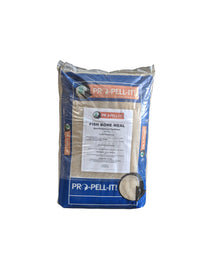
Fish Bone Meal 4-17-0 is ground fish bone that you work into garden soil as a source of phosphate. It guarantees 17% available phosphate (P₂O₅) and 4% nitrogen, all of it water-insoluble, and no guaranteed potash (K₂O). Use it where a soil test shows phosphorus is low. The package label rate around established plants in vegetable gardens and flower beds is 1 to 2 lb per 100 sq ft.
Its phosphate is held in bone mineral, which needs acid soil to release it: Colorado State University reports that phosphorus from bone meal is available to plants only in soils below pH 7.0. Check your soil pH before you buy. It is a dry meal for soil, not for hydroponics, drip lines, or sprays.
17% P₂O₅ Each pound supplies 77 g (0.17 lb) of available phosphate, so 5.9 lb supplies 1 lb
Below pH 7.0 The soil range where Colorado State University reports bone meal phosphorus is available to plants
2 to 50 lb Five bag sizes. The calculator sizes one application for a bed, a lawn, or your soil test
Product facts & composition
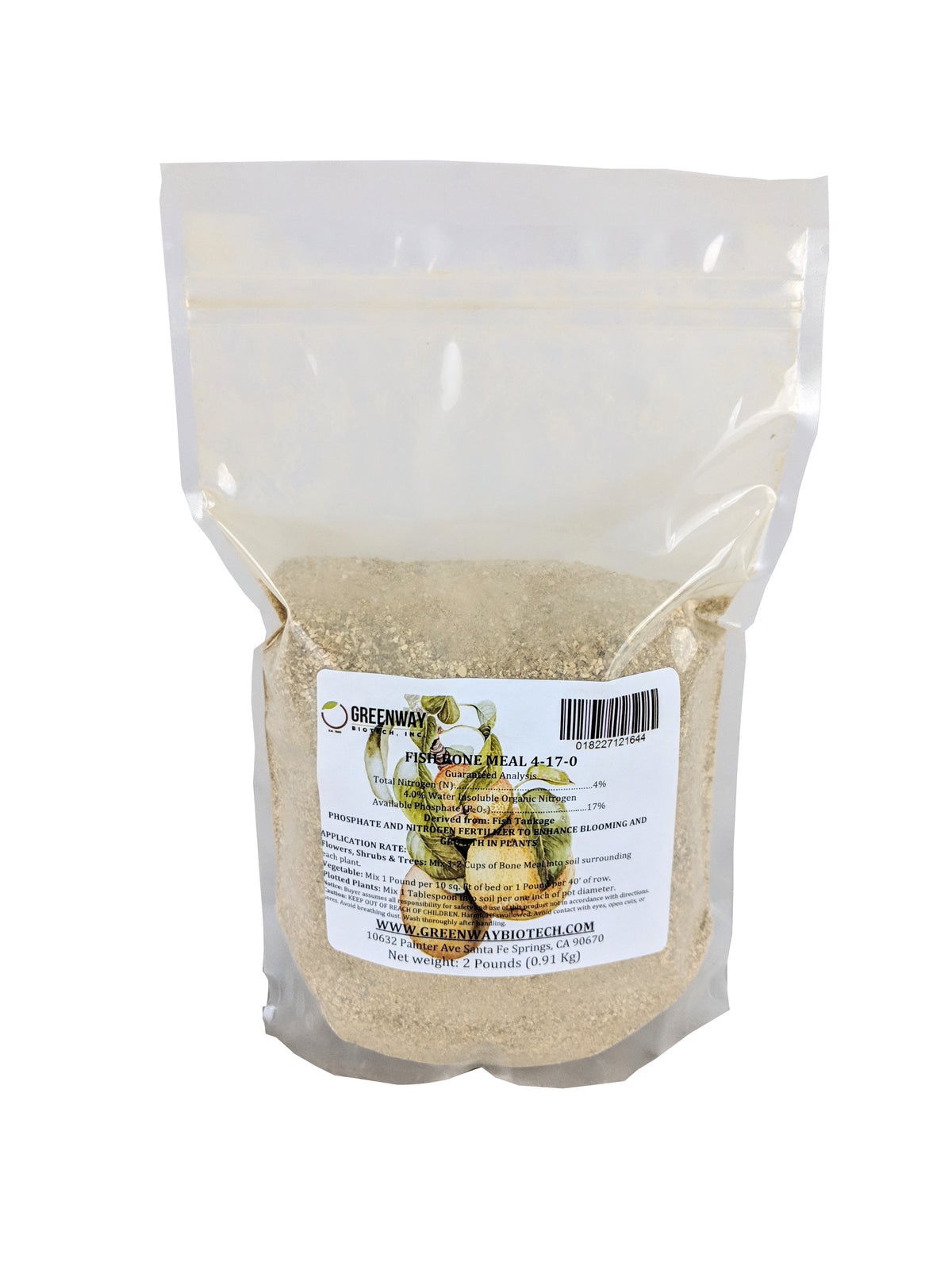
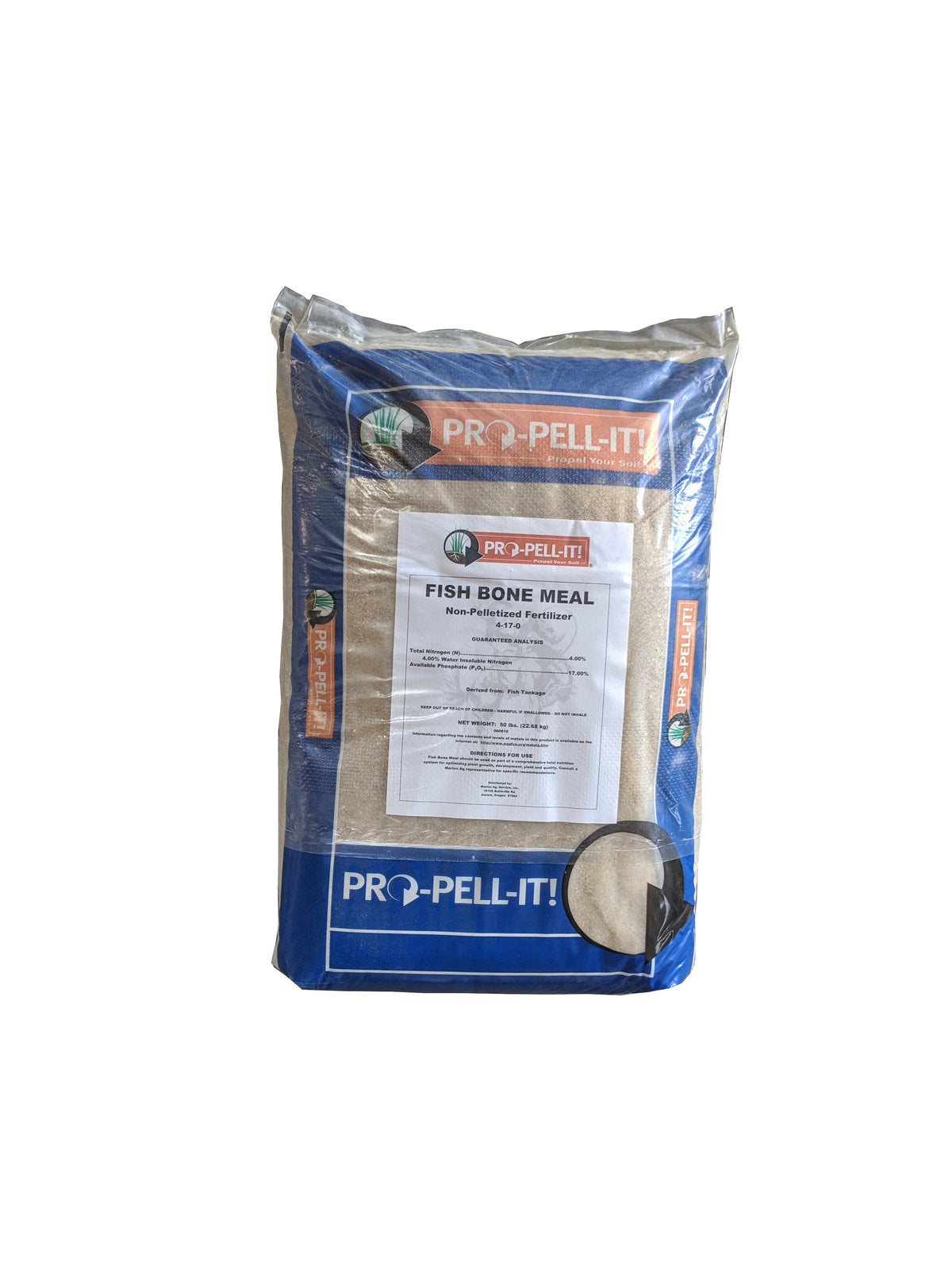
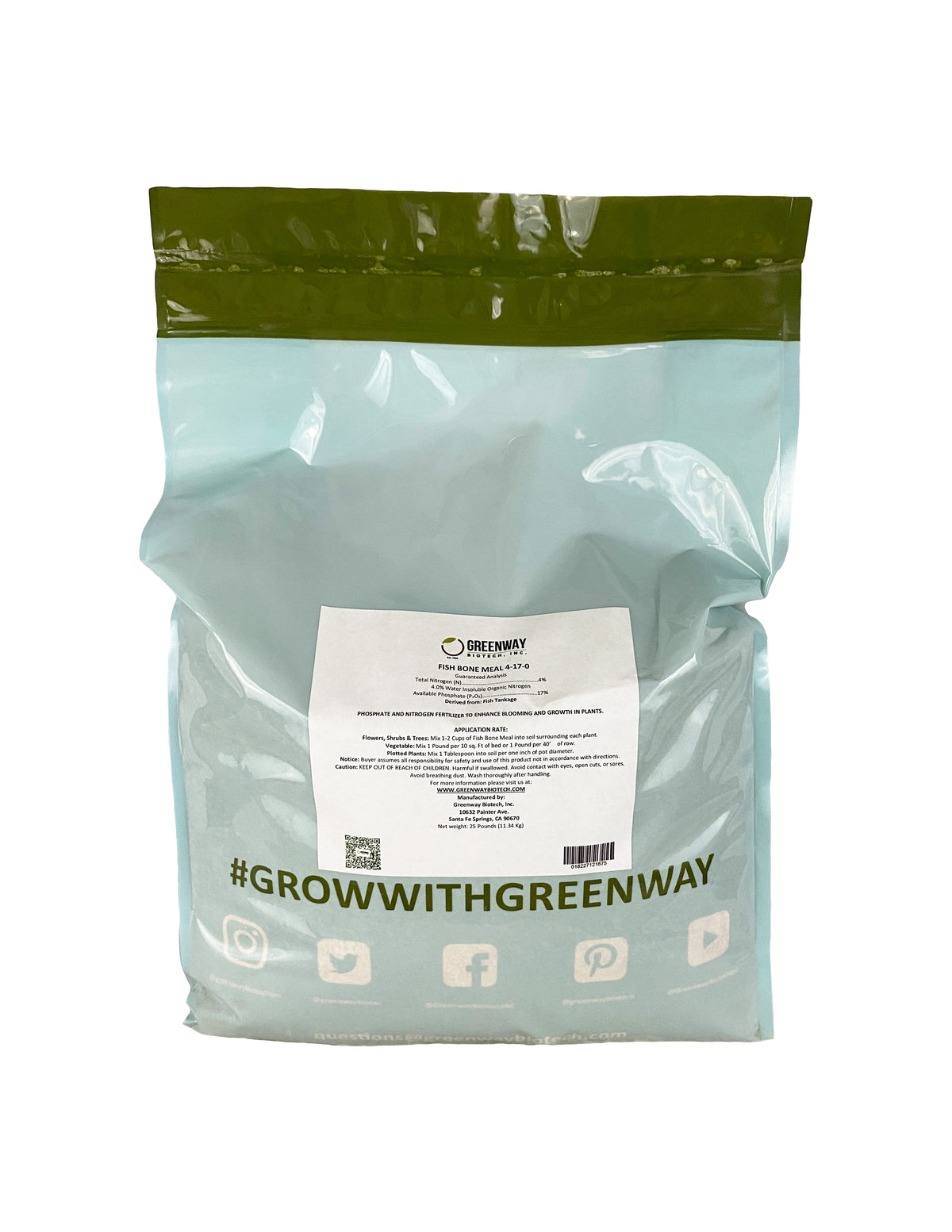
Analysis and product specifications, Greenway Biotech Fish Bone Meal 4-17-0
Specification
Detail
Total nitrogen (N)
4%, all of it water-insoluble nitrogen
Available phosphate (P₂O₅)
17%
Soluble potash (K₂O)
None guaranteed (the grade is 4-17-0)
Derived from
Fish tankage, as stated on the package label. The Safety Data Sheet describes the product as ground marine fish bone
Phosphate form
Bone mineral, a calcium phosphate that does not dissolve in water. It becomes available to plants in acid soil; see How it works
Calcium
Not guaranteed on the package label. This product is sold for its phosphate and nitrogen
Plant-available nitrogen
About a third at first. Oregon State University measured ground fish bone (5% nitrogen, dry-weight basis) at 33% of its nitrogen plant-available after 4 weeks in moist soil at 72 °F
Form
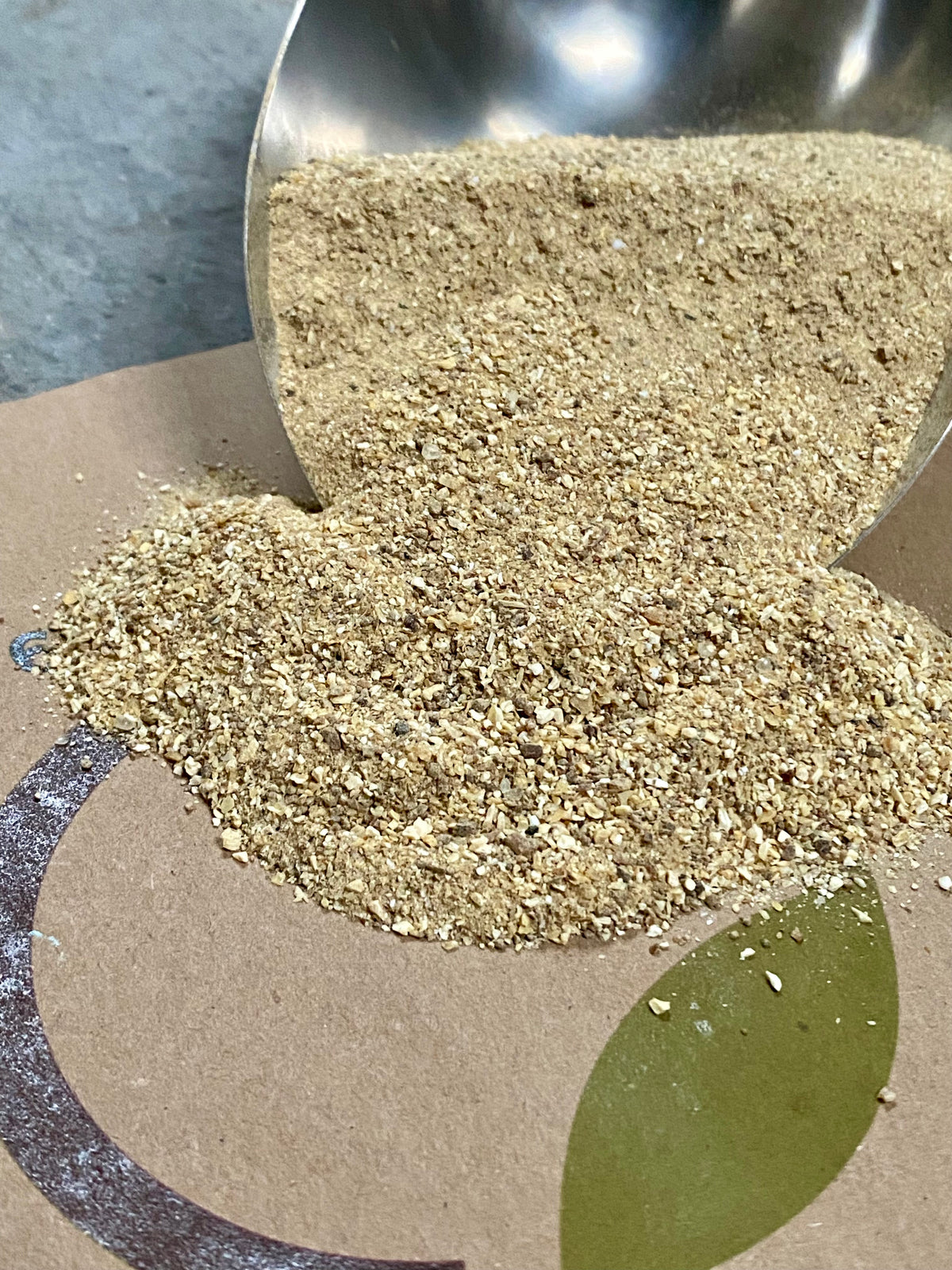
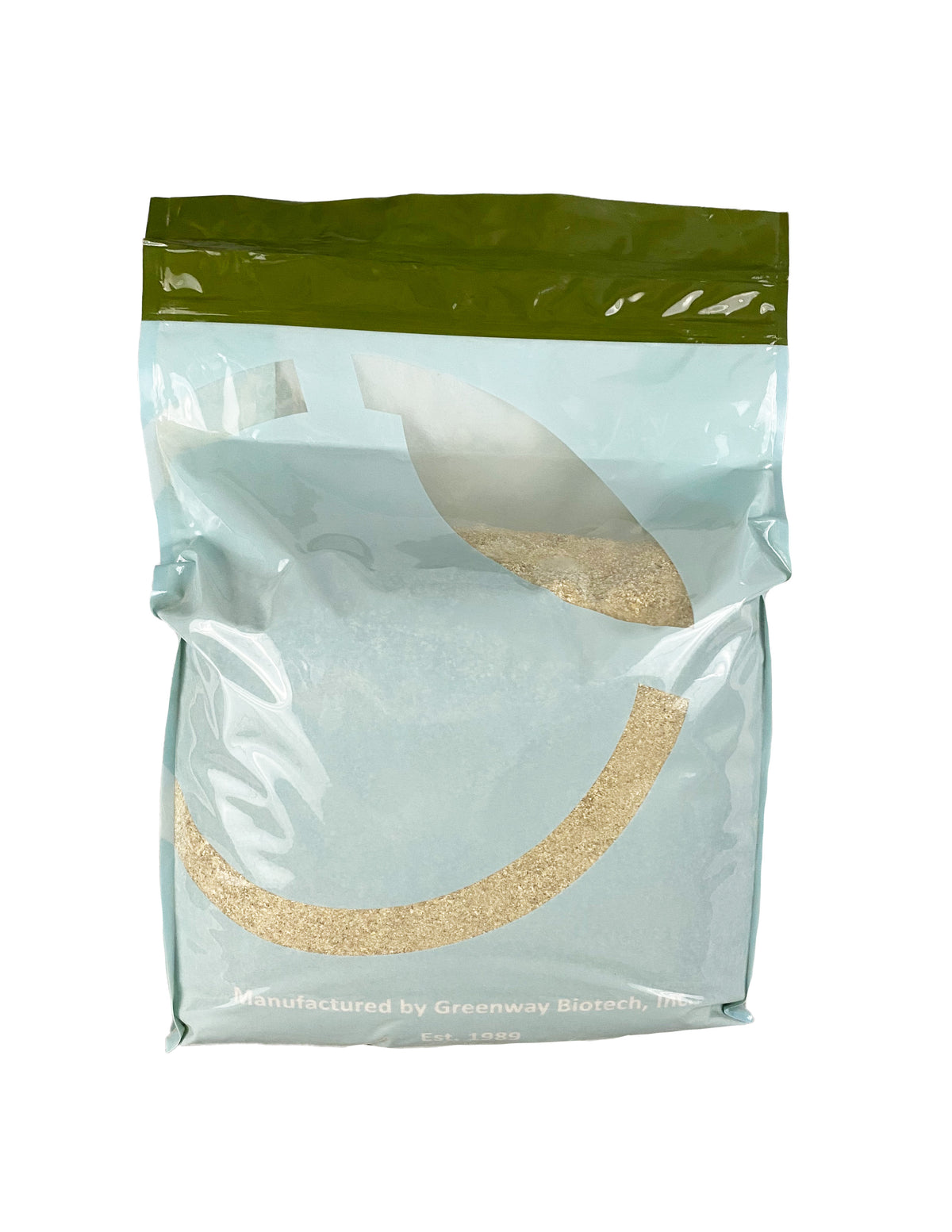
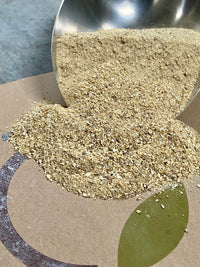
Light tan to medium brown granules or pellets with a mild marine, earthy odor. Insoluble in water
Hazards
Not classified as hazardous under the OSHA Hazard Communication Standard. Dust can irritate the eyes and airways. See Handling, storage & limitations
Package sizes
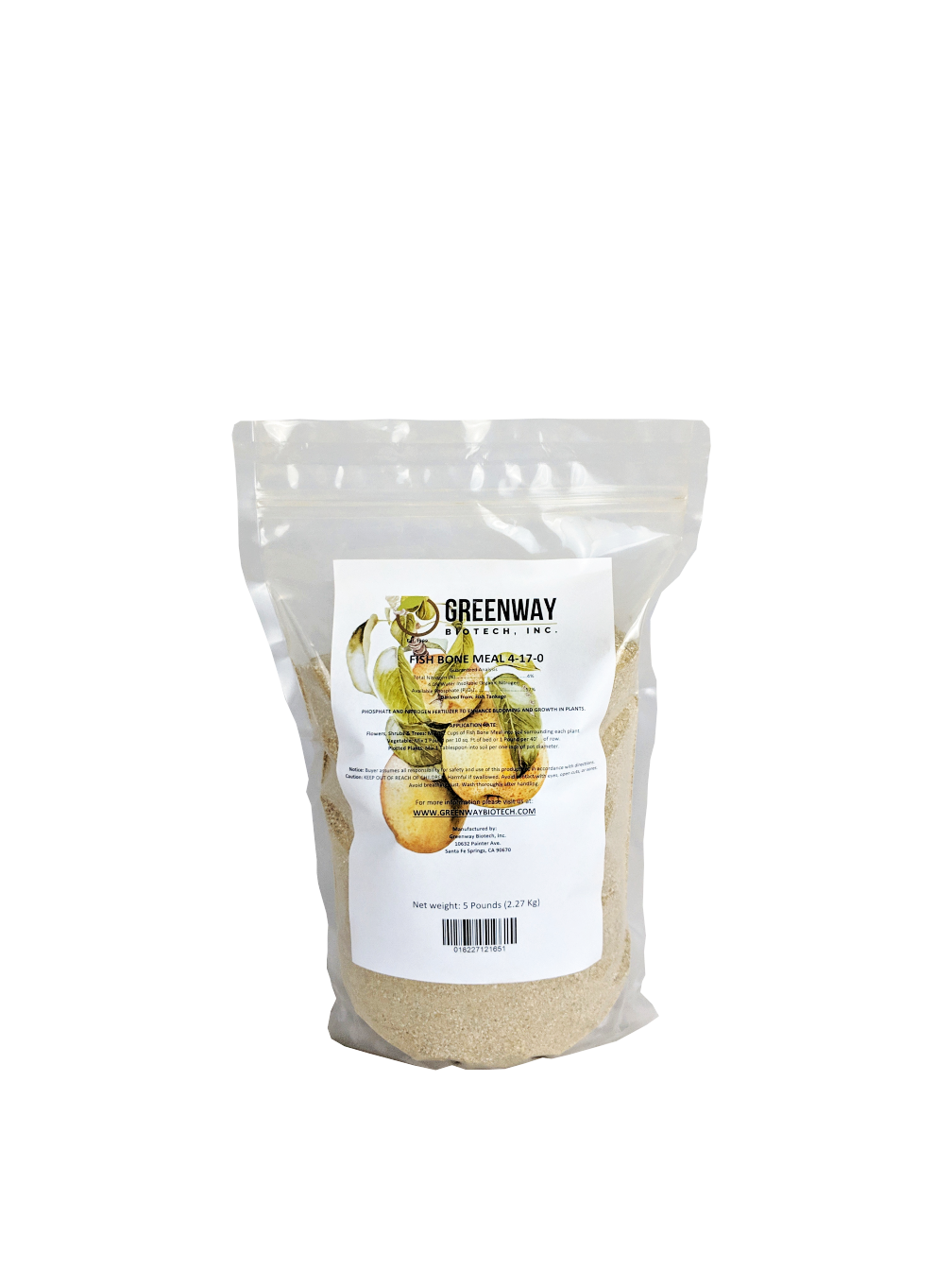
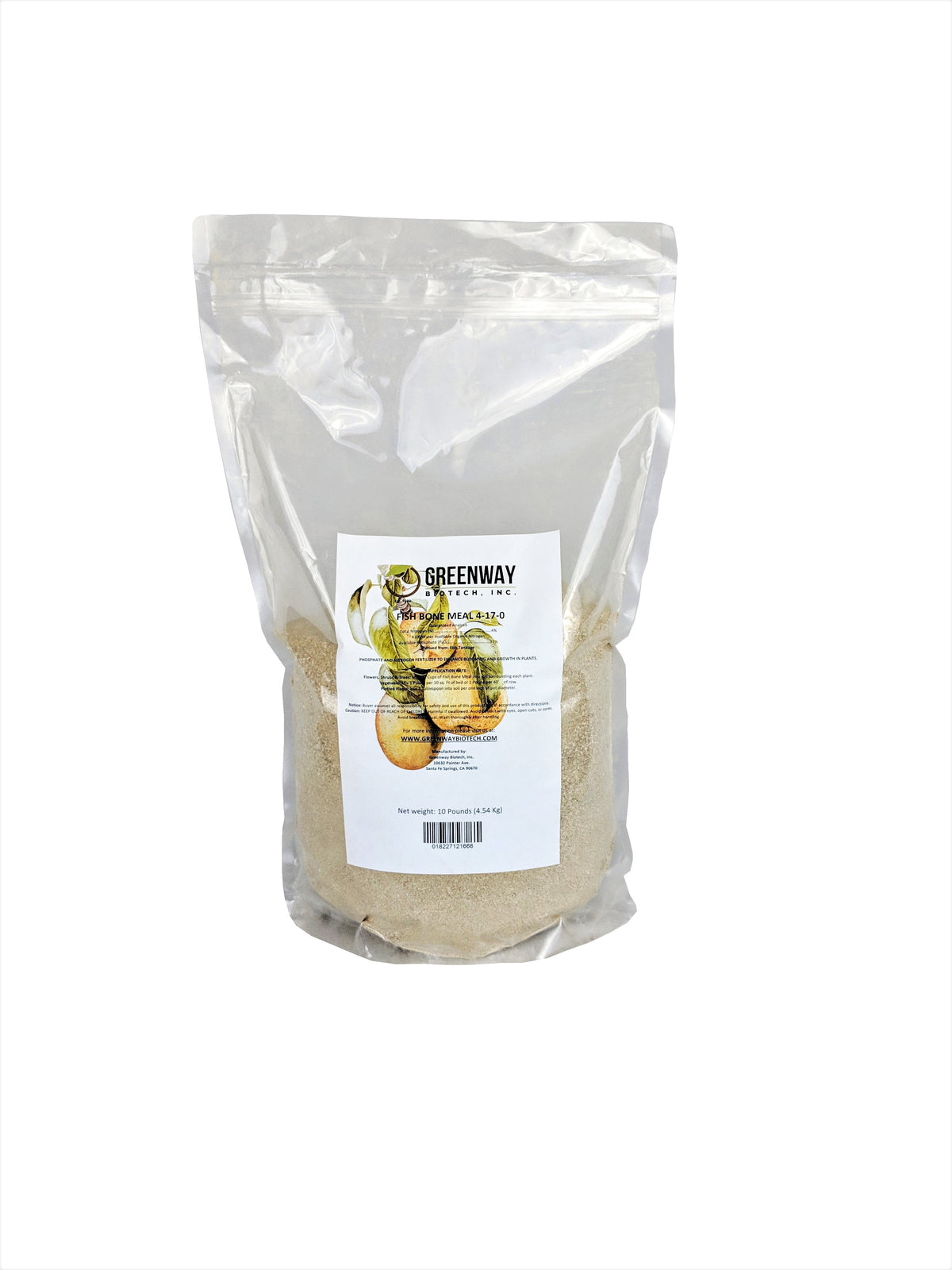
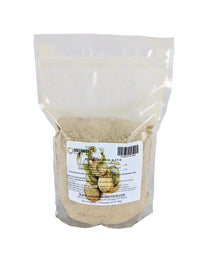
2, 5, 10, 25, and 50 lb (the 50 lb size may ship as two 25 lb bags)
Percentages are by weight of product: 1 lb of fish bone meal contains 77 g (0.17 lb) of available phosphate and 18 g (0.04 lb) of nitrogen, and a 10 lb bag contains 1.7 lb of phosphate and 181 g (0.4 lb) of nitrogen. Plan potash, most of the crop’s nitrogen, and soil pH from a soil test, using other products. Weigh it rather than measuring by cup or scoop; this page gives no volume conversions.
Best uses & benefits
Choose it when a soil test shows phosphorus is low, your soil pH is below 7.0, and you want a dry phosphate source to work into the soil.
Vegetable gardens and flower beds
The package label rate around established plants is 1 to 2 lb per 100 sq ft. Before planting, Washington State University notes that many vegetable crops benefit from phosphorus as a starter fertilizer, and Oregon State University advises phosphorus before planting flowers to enhance early growth. See Application rates.
New beds on unfertilized ground
Washington State University notes that many soils without a history of fertilization are deficient in available phosphorus. Test first, then work it in before planting.
Supplying a soil test’s phosphate
Divide the pounds of phosphate (P₂O₅) your soil test calls for by 0.17 to get pounds of this product. Each pound of phosphate takes 5.9 lb.
Lawns that test low, or a new lawn
The package label rate is about 5 lb per 1,000 sq ft. Use it on a lawn only where a soil test shows a need or you are seeding or sodding, and check your state’s rules first.
Where it is a poor fit
Soils at pH 7.0 or higher. Colorado State University reports that bone meal phosphorus is available to plants only below pH 7.0. For phosphate on alkaline soil, use a source that dissolves in soil water, such as Monoammonium Phosphate 11-52-0.
Soils that already test high in phosphorus. Washington State University notes that phosphorus builds up with repeated fertilizing and that excess can wash into lakes and streams. Colorado State University adds that gardens getting yearly manure or compost should already have enough.
Established trees and shrubs. Washington State University says landscape trees and shrubs seldom need phosphorus, and UC IPM says adding phosphorus to most California soils is rarely beneficial to landscape plants.
A nitrogen feed. At 4% nitrogen, with about a third available in the first month, it supplies little. For nitrogen, use Feather Meal 12-0-0.
Certified organic production. We do not hold an OMRI listing or a California Organic Input Material registration for this product, so we do not sell it for certified organic production. Your certifier decides which inputs you may use.
Application rates & directions
Every amount below is product weight. The first table shows the directions printed on the Greenway Biotech package label; the sections after it show how they fit university guidance. Test your soil for phosphorus and pH first. If you have questions about the directions on your package, email questions@greenwaybiotech.com.
Package label directions
Weighed rates on the Greenway Biotech Fish Bone Meal 4-17-0 label (dated April 25, 2025), and what they supply
Use on the label
Package label rate
Phosphate (P₂O₅) supplied
Nitrogen supplied
Vegetable gardens and flower beds, established plants
1 to 2 lb per 100 sq ft
77 to 154 g (0.17 to 0.34 lb) per 100 sq ft
18 to 36 g per 100 sq ft
Lawns
About 5 lb per 1,000 sq ft
386 g (0.85 lb) per 1,000 sq ft
91 g (0.2 lb) per 1,000 sq ft
The label also gives tablespoon and cup amounts for new plantings and containers. This page gives amounts by weight only and does not repeat those measures, because the weight of a spoonful of this product has not been measured. The label’s area rate is for established plants; for a new bed, the university guidance below supports working in 1 lb per 100 sq ft before planting.
Vegetable gardens and flower beds
Washington State University says garden phosphorus rates run from none to 2 lb of P₂O₅ per 1,000 sq ft, set by a soil test. In this product that is up to 1.2 lb per 100 sq ft. The label’s 1 lb per 100 sq ft supplies 1.7 lb of P₂O₅ per 1,000 sq ft, near the top of that range, so it suits a new bed worked before planting as well as established plants: start there. The 2 lb amount supplies 3.4 lb of P₂O₅ per 1,000 sq ft, more than that range, so keep it for soils that test low in phosphorus; Oregon State University’s bone meal table also uses more bone meal on soils that test low than on soils that test medium, and none on soils that test high. Skip it where your test shows high phosphorus.
Timing and placement. Oregon State University notes that phosphate moves slowly in the soil, and gets the best results by banding it 2 inches below the seed at planting or tilling it into the soil during spring preparation. The University of Connecticut mixes garden fertilizer into the top 4 to 6 inches before planting. Around established plants, work it into the soil surface rather than leaving it on top. Apply it once, then retest before adding more.
Phosphate from a soil test
Formula. Pounds of this product = pounds of phosphate (P₂O₅) your soil test calls for ÷ 0.17. Each pound of P₂O₅ takes 5.88 lb. The University of Connecticut uses the same kind of conversion for bone meal (6.75 lb of 3-15-0 bone meal per pound of phosphate).
Fish bone meal needed for common soil-test phosphate recommendations, at 17% P₂O₅
Your soil test calls for
This product per 100 sq ft
This product per 1,000 sq ft
0.5 lb P₂O₅ per 1,000 sq ft
133 g (0.29 lb)
2.94 lb
1 lb P₂O₅ per 1,000 sq ft
267 g (0.59 lb)
5.88 lb
2 lb P₂O₅ per 1,000 sq ft
1.18 lb (534 g)
11.76 lb
If your report gives phosphate per acre, divide by 43.56 for pounds per 1,000 sq ft. Some reports state the fertilizer to buy rather than the phosphate needed; email us and we will convert it.
Lawns
The label’s 5 lb per 1,000 sq ft supplies 386 g (0.85 lb) of P₂O₅, within the 0 to 1 lb per 1,000 sq ft that Washington State University gives for lawns. Use it only where a soil test shows phosphorus is needed or when you are seeding or sodding a new lawn. Minnesota allows phosphorus on lawns only in those cases (a soil or plant tissue test showing a need, or a new lawn, plus golf courses and sod farms), and Connecticut does not allow it on established lawns without a recent soil test showing a deficiency; Minnesota reports that ten other states had similar laws by 2012, so check your local rules. Spread it evenly, water it in, and keep it off pavement and out of gutters, where it can wash into waterways.
Trees, shrubs, and bulbs
Washington State University says landscape trees and shrubs seldom need phosphorus, even in previously unfertilized soils, and UC IPM says adding phosphorus to most California soils is rarely beneficial to landscape plants; its exceptions are sites where the topsoil was removed and soils formed from serpentine, as in parts of the Sierra Nevada foothills. Use it under trees and shrubs only where a soil test calls for phosphorus, with the soil-test formula above over the area under the canopy. For bulbs, University of New Hampshire Extension says a soil test will tell you whether phosphorus is needed, and warns that bone meal can attract skunks, raccoons, and dogs that dig up bulbs.
Farms and market gardens
Formula. Pounds of product per acre = pounds of P₂O₅ per acre your soil test calls for ÷ 0.17. So 50 lb of P₂O₅ per acre takes 295 lb of product, and 100 lb takes 589 lb (both rounded up). For large orders, email questions@greenwaybiotech.com for a bulk quote.
Uses with no rate on this page
This page gives no weighed rate for containers, potting mixes, seed-starting media, or houseplants, and the product is not for hydroponics, drip or injector systems, or foliar sprays. For any of these, email questions@greenwaybiotech.com with your plants and growing method.
How to use Fish Bone Meal 4-17-0
Test pH and phosphorus. Go ahead if pH is below 7.0 and phosphorus tests low or medium. At pH 7.0 or above, choose a phosphate that dissolves in soil water; if phosphorus tests high, skip it.
Weigh the amount. Use the tables or the calculator below, and a kitchen, postal, or platform scale.
Spread it evenly. Broadcast it over the bed or lawn by hand or with a spreader, or lay it in a band 2 inches below the seed row. Keep it off pavement.
Work it in. Mix it into the top 4 to 6 inches before planting, or into the soil surface around established plants. On a lawn, water it in.
Retest before adding more. Phosphorus builds up with repeated applications, so let the next soil test decide the next one.
Calculator & choosing a size
Formulas. Garden and flower beds: 1 lb per 100 sq ft to start (the package label rate for established plants, up to 2 lb on soils that test low; worked in before planting, the same 1 lb is within Washington State University’s garden range). Lawns: 5 lb per 1,000 sq ft (package label). Phosphate from a soil test: pounds of product = pounds of P₂O₅ ÷ 0.17, for any area. Multiply pounds by 453.6 for grams.
Worked examples. A 4 × 8 ft raised bed (32 sq ft): 145 g (0.32 lb); a 2 lb bag covers it. A 100 sq ft garden: 1 lb (454 g); a 2 lb bag covers it. A 1,000 sq ft garden: 10 lb; a 10 lb bag covers it. A 1,000 sq ft lawn whose soil test calls for phosphorus: 5 lb; a 5 lb bag covers it. A soil test calling for 1 lb of P₂O₅ per 1,000 sq ft on a 500 sq ft garden: 2.95 lb; a 5 lb bag covers it.
What each bag covers in one application, at the package label’s garden starting rate (1 lb per 100 sq ft) and lawn rate (5 lb per 1,000 sq ft)
Bag size
Garden or flower bed
Lawn
Phosphate (P₂O₅) in the bag
2 lb (907 g)
200 sq ft
400 sq ft
154 g (0.34 lb)
5 lb (2.27 kg)
500 sq ft
1,000 sq ft
386 g (0.85 lb)
10 lb (4.54 kg)
1,000 sq ft
2,000 sq ft
1.7 lb
25 lb (11.3 kg)
2,500 sq ft
5,000 sq ft
4.25 lb
50 lb (22.7 kg)
5,000 sq ft
10,000 sq ft
8.5 lb
The calculator below asks what you are treating, its size, and your soil pH; for a bed, your soil-test phosphorus level; for a lawn, why it needs phosphorus; and for the soil-test option, the phosphate your test calls for. It applies the rate, states the phosphate and nitrogen supplied, and recommends the smallest bag that covers one application, plus a lower-price combination of bags when one exists. Prices, tax, and shipping are confirmed at checkout, and availability is confirmed when you add to cart.
The calculator needs JavaScript. If it does not appear, use the rate tables and formulas above to choose a size.
How fish bone meal works
Bone is mostly mineral, a calcium phosphate that does not dissolve in water, and that is where this product’s phosphate sits. Acid in the soil releases it. Colorado State University reports that phosphorus from bone meal is available to plants only in soils below pH 7.0, and its fact sheet on phosphorus for organic farms advises applying bone meal to soils below pH 7 to provide the acidic soil solution the phosphorus needs to become available. Most cultivated soils in Colorado, it adds, are above pH 7.0. The University of Minnesota notes that, because of how bone meal is made up, growers should expect less plant-available phosphorus than its total phosphorus. Fish bone is bone too, so test your pH before relying on it.
Once released, phosphate moves only slowly through soil, which is why Oregon State University bands it near the seed or tills it in, rather than leaving it on the surface. Extra phosphorus does not mean extra growth: Washington State University horticulturist Linda Chalker-Scott notes that phosphorus does not stimulate growth beyond what is normal for a plant, and that high phosphorus inhibits the growth of mycorrhizal fungi, leaving plants more likely to suffer transplant shock. What plants do not use builds up in the soil, and Washington State University warns that excess phosphorus washing into lakes and streams contributes to algae growth.
The nitrogen is protein in the bone, so soil microbes must break it down before roots can use it. Oregon State University measured ground fish bone at 33% of its nitrogen plant-available after 4 weeks in moist soil at 72 °F, and Colorado State University notes that the microbes doing this work need soil warmer than 50 °F and enough moisture. We have no data showing that fish bone releases its phosphate faster than other bone meals.
This describes bone meal and fish bone as materials; it is not a trial of this finished product.
Compare your options
Match the phosphate source to your soil pH and how you apply it. Analyses are each product’s guarantee as shown on its page.
Fish Bone Meal 4-17-0 compared with other Greenway phosphate sources
Option
What it supplies
Choose it when
Fish Bone Meal 4-17-0, this product
17% phosphate in bone mineral and 4% nitrogen; 5.9 lb per pound of phosphate
Your soil is below pH 7.0 and tests low in phosphorus, and you want a dry meal to work in
52% phosphate and 34% potash, fully water-soluble, no nitrogen; 1.9 lb per pound of phosphate
You want phosphate and potash in water without adding nitrogen
Related products & compatibility
Fish bone meal supplies phosphate and a little nitrogen. These products supply what it lacks when a soil test calls for them; they are not all required. Each can be used in the same program, meaning the same bed or field in the same season.
Kelp Meal 2-0-4: a little potash, worked in at bed preparation.
Sulfate of Potash Magnesia: potash, magnesium, and sulfur from a mined mineral, for soil that tests low in potassium or magnesium.
Mixing. Dry meals and granular minerals can be spread the same day: weigh each one at its own rate first. Do not mix fish bone meal with strong alkaline materials such as hydrated lime or wood ash; the Safety Data Sheet lists strong alkaline agents as incompatible. It does not go into any tank mix, injector, or reservoir.
Handling, storage & limitations
Cautions on the package label. Keep out of reach of children. Harmful if swallowed. Avoid contact with eyes, open cuts, or sores. Avoid breathing dust. Wash thoroughly after handling.
Hazards. Not classified as hazardous under the OSHA Hazard Communication Standard. Dust may irritate the eyes and airways and may aggravate asthma or other breathing conditions. High concentrations of airborne dust can be an explosion hazard; avoid raising dust clouds. As a natural material it may carry naturally occurring microorganisms, so keep cuts covered.
Protective equipment. Wear gloves, and safety glasses when pouring or working in wind. Use an N95 or equivalent dust mask where dust cannot be controlled. Do not eat, drink, or smoke while handling it.
Animals. Its marine odor may attract dogs and wildlife. Work it into the soil and water it in so little is left on the surface.
Storage. Keep it in the original container, sealed, in a cool, dry place away from sunlight, moisture, and heat. Store it apart from food, feed, and household cleaning products, away from strong alkaline materials and strong oxidizers, and out of reach of children and pets.
Spills and runoff. Sweep up spills without raising dust; clean, uncontaminated product can still be used as fertilizer. Keep it out of drains, ponds, streams, and drinking water supplies, and off pavement.
Use limits. Weigh every application, stay within the rates on this page, and let a soil test decide whether to apply more.
First aid. Eyes: flush with clean running water for at least 15 minutes, holding the eyelids open; get medical attention if irritation persists. Skin: wash with soap and water. Inhaled: move to fresh air; get medical attention if coughing persists. Swallowed: do not induce vomiting; rinse the mouth, drink one or two glasses of water, and call Poison Control at 1-800-222-1222 or get medical attention.
What is fish bone meal’s NPK, and what does it contain?
4-17-0: ground fish bone with 4% nitrogen, all of it water-insoluble, 17% available phosphate (P₂O₅), and no guaranteed potash (K₂O). Each pound supplies 77 g (0.17 lb) of phosphate and 18 g (0.04 lb) of nitrogen. The phosphate is held in bone mineral, which does not dissolve in water.
Does fish bone meal work in alkaline soil?
Not well. Colorado State University reports that phosphorus from bone meal is available to plants only in soils below pH 7.0, because the bone mineral needs an acidic soil solution to release it. Fish bone is bone too, so test your soil pH first. At pH 7.0 or above, use a phosphate that dissolves in soil water, such as Monoammonium Phosphate 11-52-0, instead.
How much fish bone meal should I use in a garden?
The package label rate around established plants in vegetable gardens and flower beds is 1 to 2 lb per 100 sq ft. Start at 1 lb, which supplies 1.7 lb of phosphate (P₂O₅) per 1,000 sq ft, near the top of the none to 2 lb that Washington State University gives for gardens, so the same 1 lb also suits a new bed worked before planting. Keep the 2 lb amount for soils that test low in phosphorus, and skip it if your soil test shows high phosphorus. Mix it into the top 4 to 6 inches before planting, or into the soil surface around established plants.
How much fish bone meal per plant or per square foot?
Rates are set by area, so work from the space each plant occupies. At 1 lb per 100 sq ft, that is about 4.5 g per square foot: a plant spaced 2 ft by 2 ft (4 sq ft) gets about 18 g, mixed into the soil over that area. The package label also lists tablespoon and cup amounts for new plantings; this page gives weights only, because the weight of a spoonful of this product has not been measured.
Is fish bone meal faster than regular bone meal?
We have no data showing that it releases phosphate faster. Both carry their phosphate in bone mineral, so plan on both needing soil below pH 7.0. The difference you can count on is the analysis: at 17% phosphate this product takes 5.9 lb per pound of phosphate, against 6.7 lb for Bone Meal 3-15-0, so compare them by price per pound of phosphate.
How much nitrogen does it supply?
Not much. It contains 4% nitrogen, and Oregon State University measured ground fish bone at 33% of its nitrogen plant-available after 4 weeks in moist soil at 72 °F, so in warm, moist soil a pound supplies about 6 g of available nitrogen in the first month. Plan the crop’s nitrogen from another source, such as Feather Meal 12-0-0.
Can I use fish bone meal on my lawn?
Only where a soil test shows phosphorus is needed, or when you are seeding or sodding a new lawn. The package label rate is about 5 lb per 1,000 sq ft, which supplies 386 g (0.85 lb) of phosphate, within the 0 to 1 lb per 1,000 sq ft Washington State University gives for lawns. Minnesota, Connecticut, and other states restrict phosphorus on established lawns, so check your local rules, and keep it off pavement.
Should I put it in planting holes for trees, shrubs, or bulbs?
Only if a soil test calls for phosphorus. Washington State University says landscape trees and shrubs seldom need it, UC IPM says adding phosphorus to most California soils rarely benefits landscape plants, and Washington State University’s Linda Chalker-Scott notes that high phosphorus inhibits mycorrhizal fungi, leaving new transplants more likely to suffer transplant shock. For bulbs, University of New Hampshire Extension warns that bone meal can attract skunks, raccoons, and dogs that dig the bulbs up.
My plants have purple leaves. Will fish bone meal help?
Only if the cause is a phosphorus shortage. UC IPM describes phosphorus-deficient broadleaf plants with dark green young leaves and purplish veins, especially on the leaf undersides, but notes that certain herbicides cause leaf distortion and curling that can resemble phosphorus deficiency, and that phosphorus is generally adequate for most trees and shrubs. A soil test, with its pH, shows whether phosphorus is short and whether this product can supply it.
Can I use it in hydroponics, drip irrigation, or a foliar spray?
No. It does not dissolve in water, so it cannot be fed through a reservoir, drip line, or sprayer. For phosphate in water, use a fully water-soluble source such as Monoammonium Phosphate 12-61-0 or Monopotassium Phosphate 0-52-34.
Can I use it in certified organic production?
We do not hold an OMRI listing or a California Organic Input Material registration for this product, so we do not sell it for certified organic production. California requires fertilizing materials intended for organic crop production to be registered as Organic Input Materials. If you farm under organic certification, your certifier decides which inputs you may use.
Does fish bone meal smell, and is it safe around pets?
It has a mild marine, earthy odor that may attract dogs and wildlife. Work it into the soil and water it in so little is left on the surface, and keep the bag sealed and out of reach of children and pets. The package label cautions that it is harmful if swallowed; if a pet eats it, call your veterinarian.
Articles give background. For this product, use the rates and documents on this page.
Product documents & sources
Product label (PDF): guaranteed analysis, directions, and cautions, dated April 25, 2025.
Safety Data Sheet (PDF): composition, hazards, handling, storage, first aid, and emergency numbers.
Where the rates and statements on this page come from
The analysis and package label rates come from the label above, and the hazard, storage, and first-aid statements from the Safety Data Sheet. The comparisons, cautions, and soil-test guidance come from the university and agency publications below, which describe bone meal, phosphorus, and garden nutrition in general and do not evaluate or endorse this product.
Not sure whether your soil needs phosphate, or whether its pH suits fish bone meal? Email your plants, area, and any soil test to questions@greenwaybiotech.com, or call (562) 351-5168, Monday to Friday, 9 AM to 3 PM Pacific, and we will work through it with you.
Every order carries a 90-day satisfaction guarantee, and we pack and ship from Madera, California. You can also choose a package weight from the size selector at the top of this page.
Greenway Biotech, Inc. is a family-owned company that has blended and packaged specialty fertilizers and soil amendments in California since 1989, today from Madera.
5 stars: 25 (100%)
4 stars: 0 (0%)
3 stars: 0 (0%)
2 stars: 0 (0%)
1 star: 0 (0%)
A
Anonymous
Fish Bone Fertilizer
I can't say I've seen definite results. But I'm sure my plants love it. I love all of the amendments I buy from this company. They are the best.
I
Ingrid Gibson
Every Plant Loves Fish
The whole 25lbs almost gone will more soon. Every plant Loves fish
T
Timothy GILL
Fantastic
Well packaged quick delivery
Have just done first feed as they say the prove is in the eating
So guess the weeks will pass slowly as so want to sink my teeth into a freshly picked Tomato
krissie
R
ROY ADERS
great
Great, I bought from you before so that speaks for my opinion.
B
Barbara Graper
Title??
Very easy to use. It quickly helped turn purplish leaves on a tomato plant to a healthy green.
M
MaryAnn Baskinger
Fish Bone Meal Fertilizer
My order was efficiently processed and promptly delivered. Just applied the fertilizer to my rose bushes in hopes of building a better root system for next growing season.
A
Alex Haynes-Quintero
Noticeable support
I see adding this bone meal is really foundational supporting my vegetables.
Make sure you add before planting or dilute application after or it'll kill new seedlings.
A
Alex Haynes-Quintero
Noticeable results
I mixed and applied after potting. Takes a few days to know it's making a difference then it surges with healthy growth.
W
William Bell
Got what I paid for.
I ordered they shipped quickly I received and the planet like it so far only been a week
R
ROY ADERS
fertilizer
I just got it and haven't had a chance to use it. Plan to use some tomorrow.
E
Edward Lord
Great company, very easy ordering, timely delivery, very happy
L
Lindsey Manzo
Quick Shipping
From navigating the website, selecting products and receiving my order, Greenway has been fantastic.
C
Curtis Dixon
Fish Magic
Smells authentic, waiting to see results. Too soon to tell. Plants just starting to fruit. Update coming
R
Rosalicia Fajardo
Excelent
Excellent, would definitely buy again
C
C. M. Cussary
Fish Bone Meal
Tomato plants are loving it. I tried this product b/c I didn't want to buy fish and bone meal separately for my tomato planting "recipe". All the plants are thriving and some have tomatoes started on them.
S
Sharon Shimp
great plant fertilizer
Great! Easy to use and my plants are pretty dang healthy!
s
sulayman ansari
Just started
But I like the plants reaction ..they are pleased
K
Keith Anderson
First time purchase
Ordered product and received it in a timely manner. Just applied product this week and will see how well it works in time. I will update later on results.
A
Alan Williamson
Hard to find organic soil ammendments
The product arrived promptly and I was able to use it immediately.
D
Debra Long
Fertilizer
I ordered this to fertilize my tomato plants. It was well packaged and delivery timely. I am interested to see how the tomato plants respond.
R
Rodney Felps
Thank you thank you!
It was lost in shipping but you made good and very quickly! You now have a satisfied customer for life!
K
Kathy Mosley
Excellent!
So far so good. Plants really got a good burst of growth!
G
Greg Clark
Just what I needed and
Just what I needed and wanted
W
William McDonough
Just starting
Started putting my tomato plants in grow bags today with a handful of the fish bone meal under each plant. Hoping for gòod results in the near future.
E
Elverra Harris
The above
Just used it and waiting for results. Easy to apply.
G
Gloria work
What fertilizer good for bushes fence
Greenway Biotech, Inc.
For a hedge or shrub fence, Feather Meal 12-0-0 is what I'd use. It's slow release organic nitrogen that feeds for 3 to 4 months with very low burn risk, and nitrogen is what drives the dense leafy growth that fills a privacy hedge in. The Trees & Shrubs tab on the product page has the rate: https://www.greenwaybiotech.com/products/organic-feather-meal-fertilizer
Fish Bone Meal 4-17-0 pairs well with it at planting time since the phosphorus goes toward root establishment, but on its own it won't push top growth.
Tell me how many shrubs you have and how long the run is and I'll work out the amount for you.
My MSM is decreasing my osteoarthritis pain, especially in my hands
My product arrived intact. I started taking it as soon as I went into the kitchen. I mixed it with my daily Metamucil, but there was no discernible taste. I am working on making it a habit each morning. The pain from my osteoarthritis, especially in my hands, is decreasing. I expect it to continue to improve. Thank you for my MSM.
You did not send me MSM Powder, you sent me Magnesium Chloride powder. I tried contacting you 3 times, by email & phone and you didn't have the courage & honesty to return my messages & rectify the situation. I even offered to text you a photo of the mag chloride.