Continental US, Standard shipping: free on orders of $100 or more, $9.99 on orders under $50, and $14.99 from $50 up to $100.
UPS and FedEx options are also offered at checkout, at their own rates.
Orders placed by 11 AM Pacific on a business day ship the same day.
Alaska, Hawaii, US territories, APO/FPO and international addresses: the cost is shown at checkout, and 2-day delivery isn’t available to Alaska, Hawaii or P.O. boxes.
Gypsum is ground, mined calcium sulfate dihydrate (CaSO₄·2H₂O) that supplies 22.5% calcium and 18% sulfur in the sulfate form plants take up. It is a neutral salt, so it adds calcium and sulfur without raising or lowering soil pH, which makes it the calcium source for beds and fields where the pH is already right or too high for lime.
It is also the standard amendment for sodium-affected (sodic) soils, where the calcium displaces sodium so irrigation water can leach it away. Its most important limitation: gypsum does not loosen ordinary compacted clay. Its structural benefit is documented on sodium-affected and dispersive soils, so let a soil test, not the soil texture, decide whether you need it.
1 lb / 100 sq ft Starting garden rate where a soil test shows low calcium at a pH that should not move (University of Georgia Extension)
100 lb / 1,000 sq ft Label starting rate for sodic soil, applied only after a soil test confirms sodium and where the soil can be leached
1–50 lb bags Seven sizes; the calculator recommends the lowest-price bags for your area or soil-test requirement
Product facts & composition
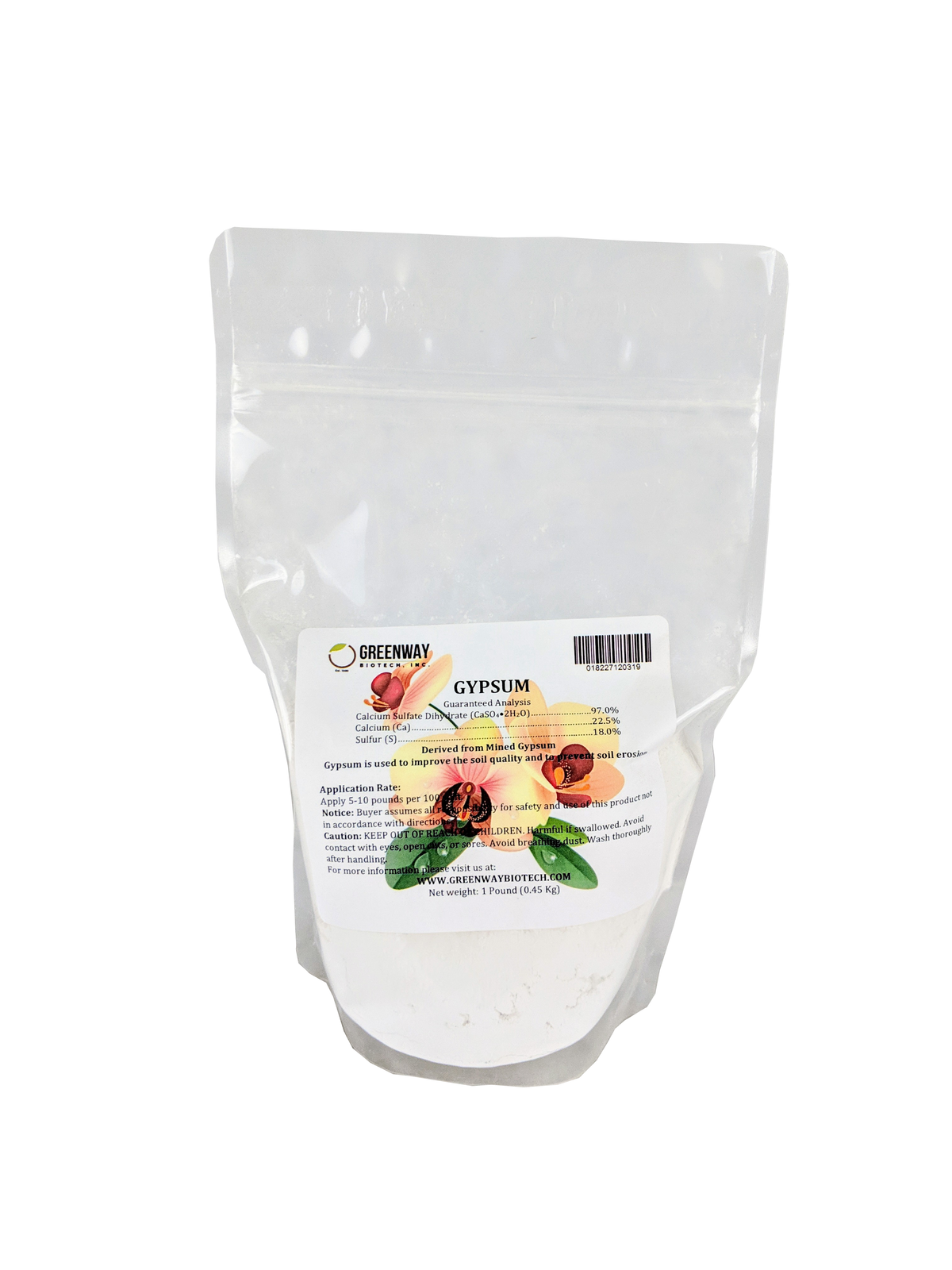
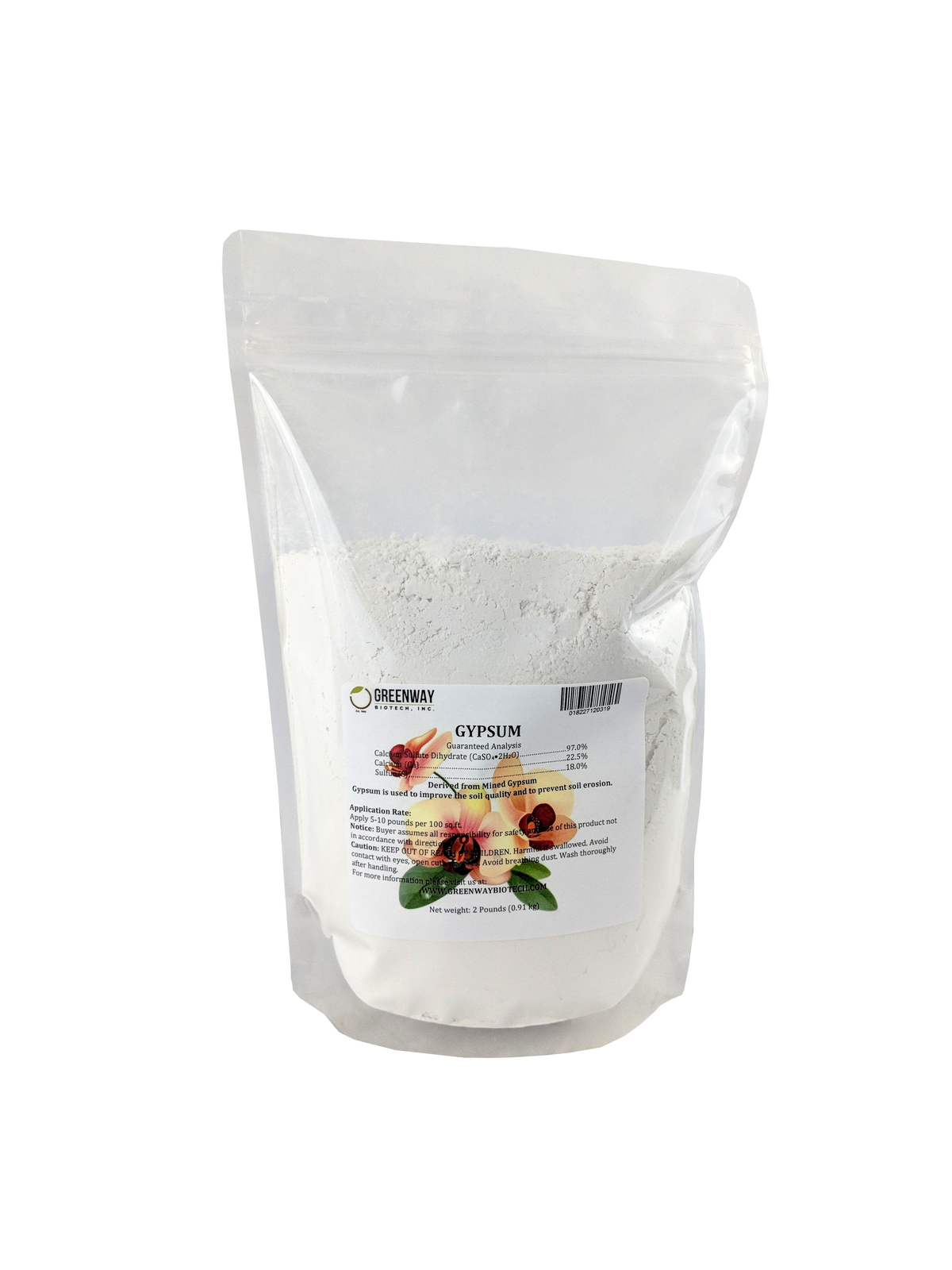
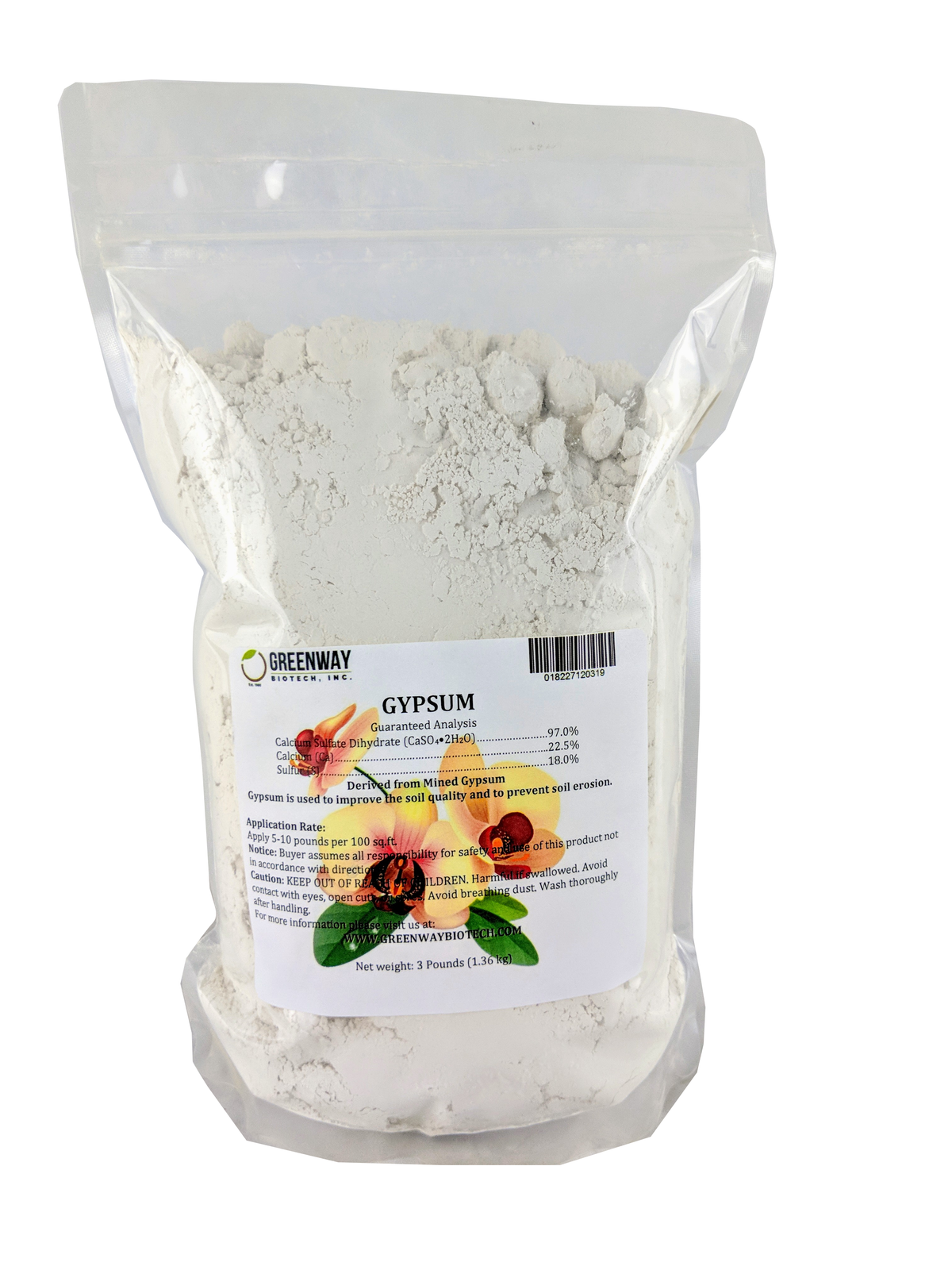
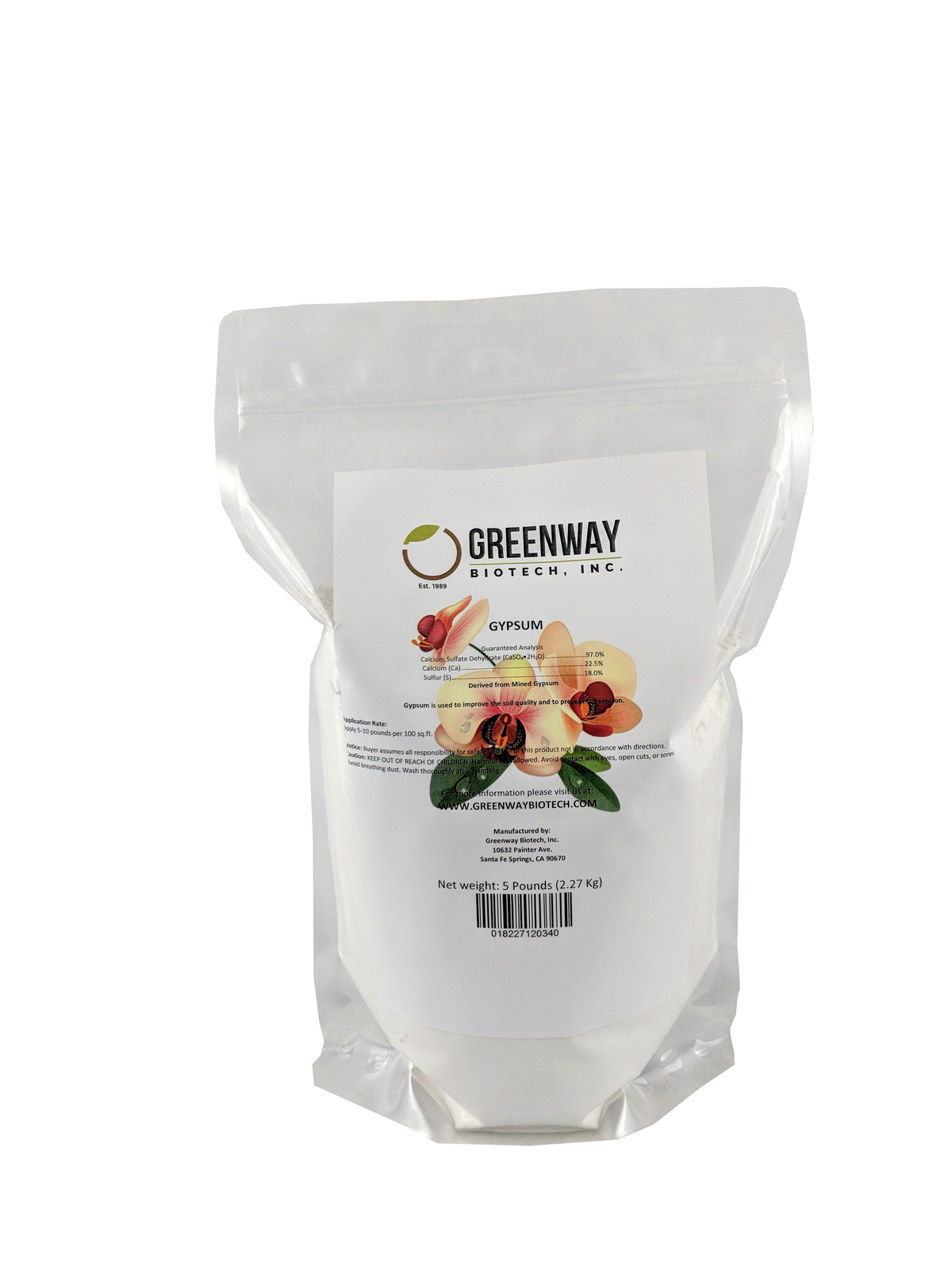
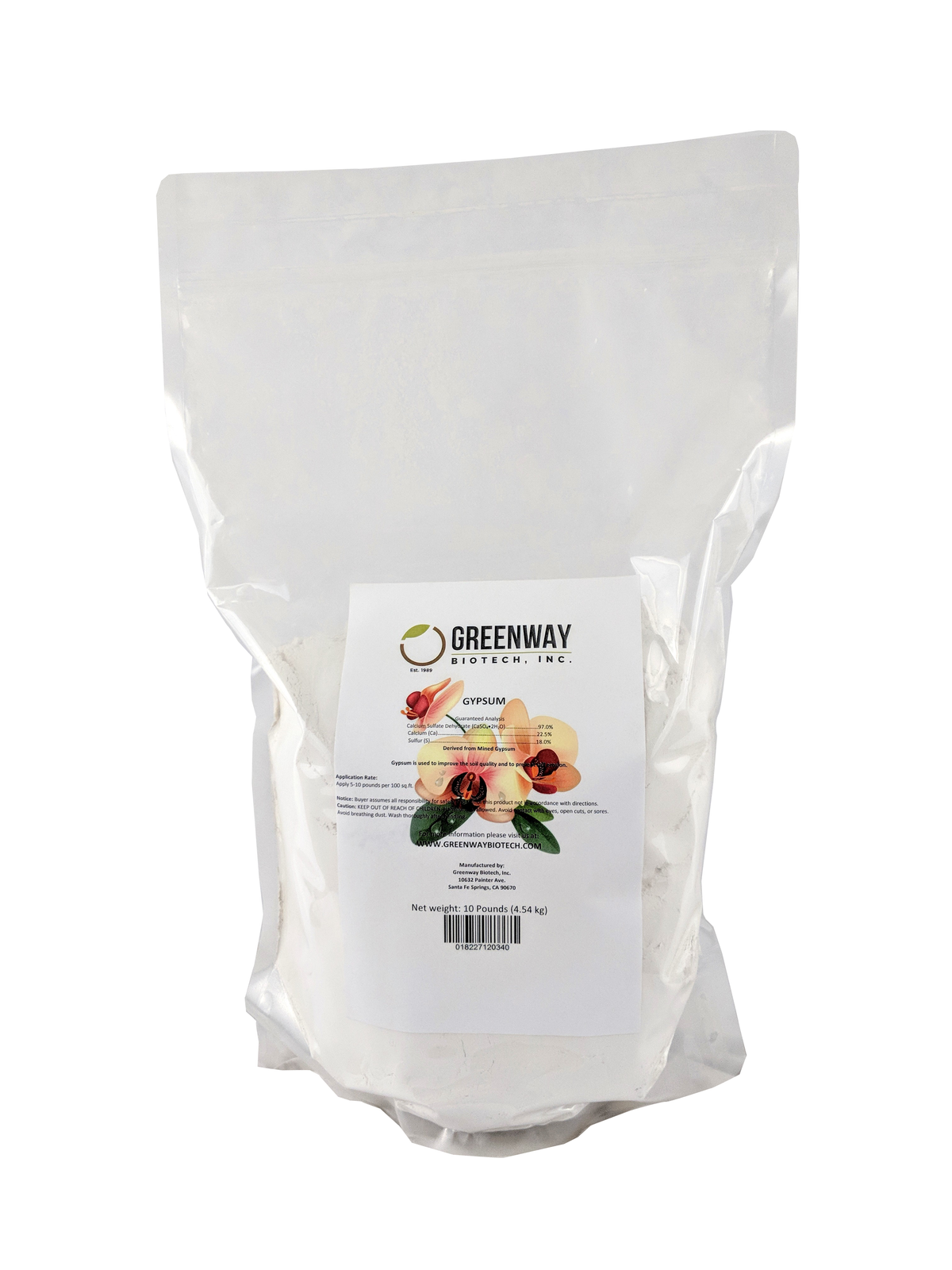
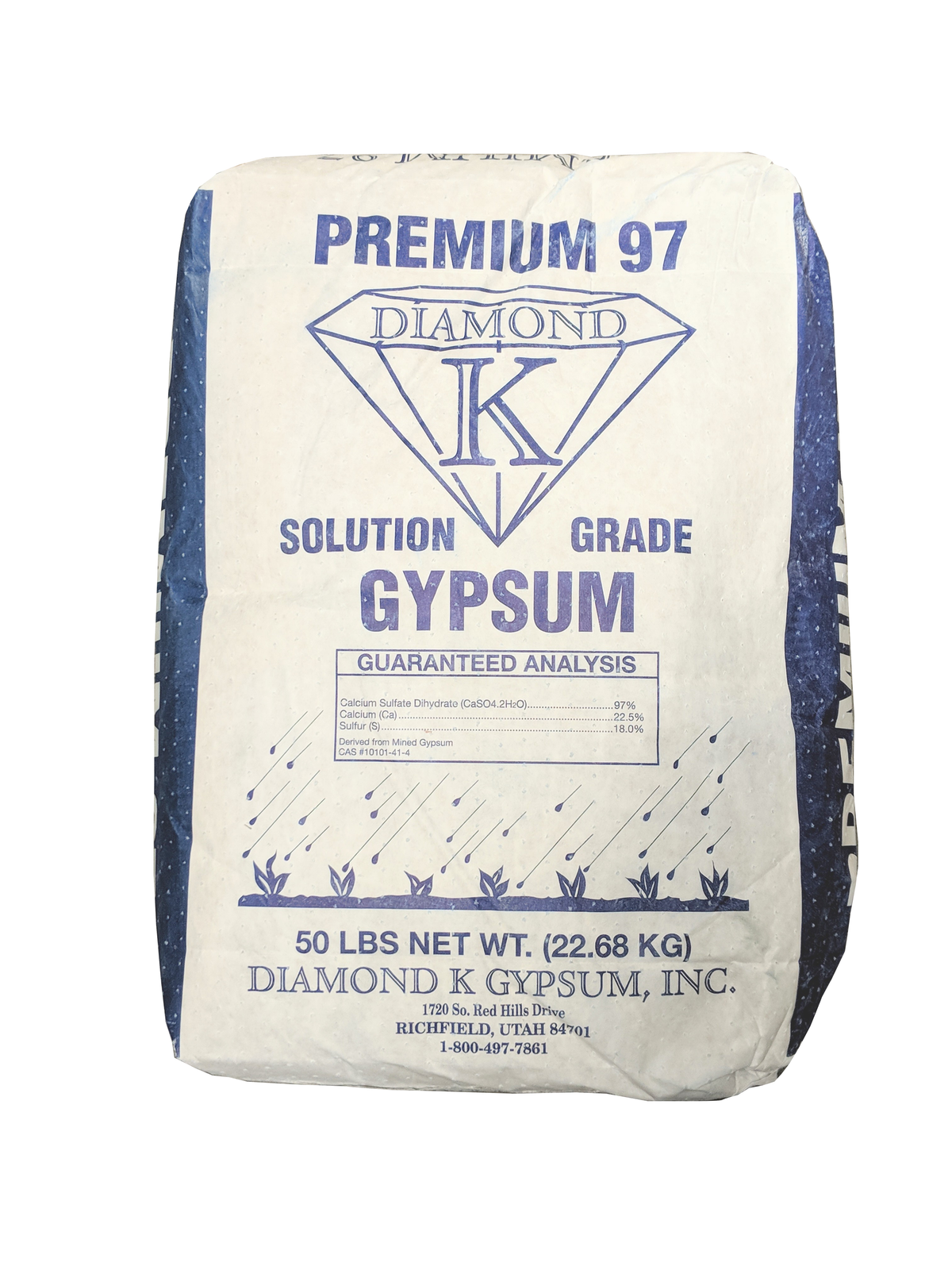
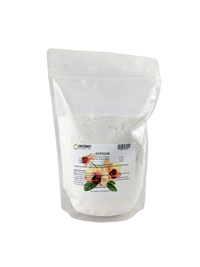
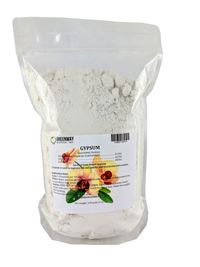
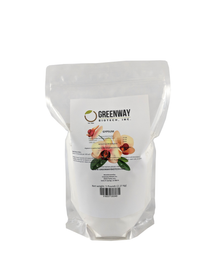
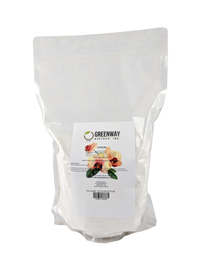
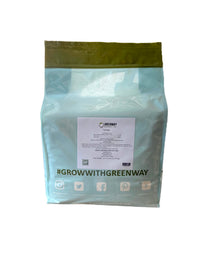
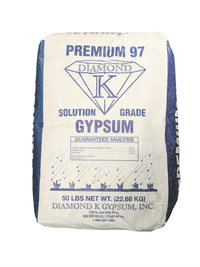
Guaranteed analysis and product specifications, Greenway Biotech Gypsum
Specification
Detail
Calcium sulfate dihydrate (CaSO₄·2H₂O)
97.0%
Calcium (Ca)
22.5%
Sulfur (S)
18.0%, as sulfate
Derived from
Mined gypsum
Physical form
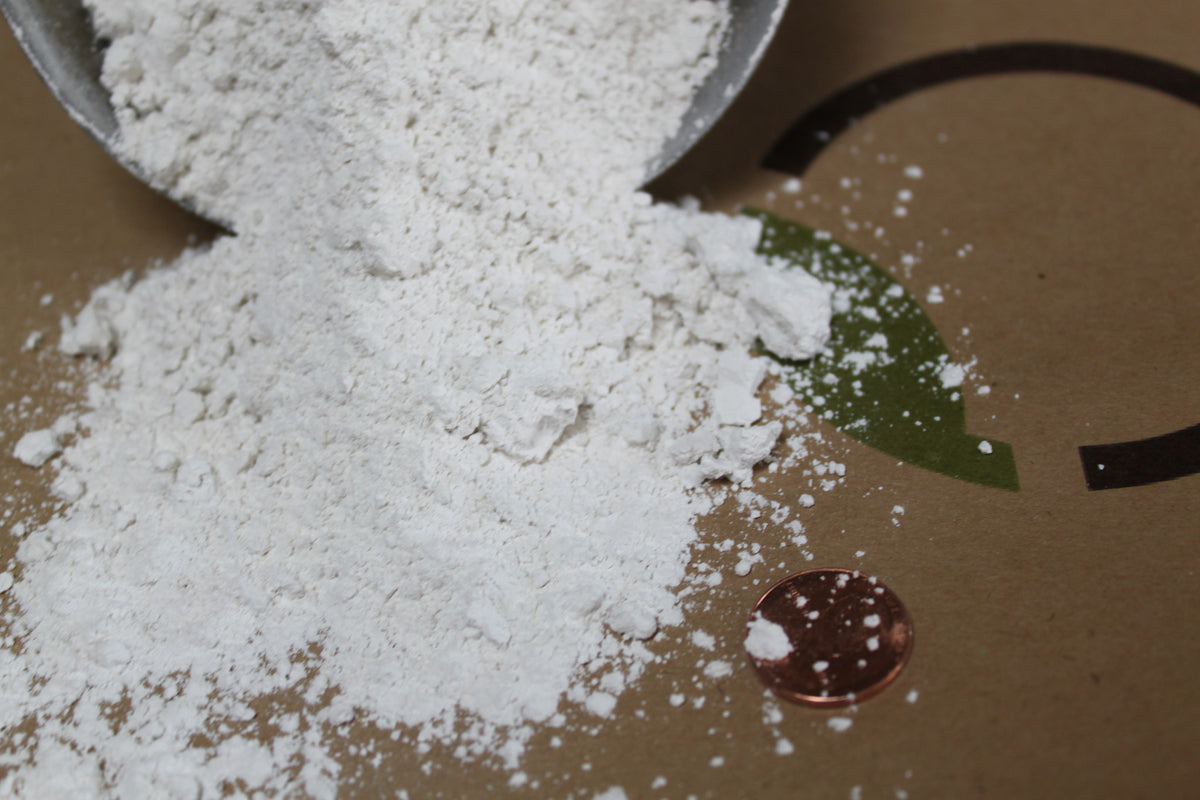
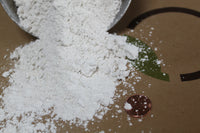
White to off-white fine powder; 97% passes a 200-mesh screen (safety data sheet, March 2026)
Solubility
About 2.1 g per liter of water (safety data sheet); Ohio State University cites 2.5 g/L, roughly 200 times agricultural lime. Enough to dissolve gradually in soil moisture, far too little for foliar sprays, drip lines, or hydroponic reservoirs.
Effect on soil pH
None. Gypsum is a neutral salt, not a liming material and not an acidifier (University of Arkansas Extension; UC Cooperative Extension).
Percentages are by weight of product, so 1 lb of gypsum contains 0.225 lb (3.6 oz) of calcium and 0.18 lb (2.9 oz) of sulfur, and a 25 lb bag contains about 5.6 lb of calcium and 4.5 lb of sulfur. When a soil laboratory reports a gypsum requirement, it is normally stated for pure calcium sulfate dihydrate; divide that figure by 0.97 to get the amount of this 97% product.
Best uses & benefits
Choose gypsum when a soil test points to one of these four situations. In each, the calcium or sulfur is delivered without moving the pH, which is the one thing lime and elemental sulfur cannot do.
Calcium for beds where the pH should stay put
University of Georgia Extension’s tomato guide puts it plainly: if the pH test comes back normal but calcium is low, apply gypsum rather than lime. Tomatoes, peppers, brassicas, melons, and root crops all draw heavily on soil calcium; gypsum supplies it at pH 6.0–7.5 and on alkaline soils where lime would push the pH higher and tie up iron and manganese.
Sulfur without acidification
Sulfur is needed for protein and chlorophyll synthesis, and low-organic-matter, sandy, or heavily leached soils run short of it. Gypsum supplies sulfur as sulfate, the form roots take up, and unlike elemental sulfur or ammonium sulfate it does not acidify the soil. Use it where a soil test recommends sulfur and the pH is already where you want it.
Sodic and saline-sodic soils
Where sodium occupies more than about 15% of the exchange capacity (ESP above 15, or SAR above 13), clay disperses, the surface crusts, and water stops infiltrating. Calcium from gypsum replaces that sodium on the exchange sites; irrigation or rainfall then leaches the sodium below the root zone. This works only where water can drain through the profile.
Peanut pegging-zone calcium (regional program)
Gypsum is the traditional calcium source for peanuts because the developing pods absorb calcium directly from the top few inches of soil. Georgia and Arkansas Extension recommend it at early bloom on a pegging-zone soil test; the rates are in the field table below and are regional programs, not general garden rates.
Where it is a poor fit
Compacted clay that is not sodium-affected. Washington State University Extension calls adding gypsum to sandy or non-sodic soils a waste of money, and University of California Cooperative Extension states that gypsum will not improve infiltration or structure when the problem is not sodium. Ohio State trials on non-sodic soils found no change in penetration resistance or hydraulic conductivity. For ordinary compaction, organic matter is the fix; see how to amend your clay soil.
Soil that needs its pH raised. Gypsum does not neutralize acidity. Use Dolomite Lime (calcium plus magnesium) based on a lime requirement test.
Soil that needs its pH lowered. Gypsum does not acidify. Use Elemental Sulfur Powder at the rate your test calls for.
Foliar sprays, drip fertigation, and hydroponics. Gypsum will not dissolve enough and clogs emitters. Use Calcium Nitrate 15.5-0-0 or Cal-Mag Plus 2-0-0 for soluble calcium.
Sandy, low-CEC, or magnesium-poor soils. Heavy or repeated gypsum applications can leach magnesium and potassium and, on acid soils, induce magnesium deficiency (Washington State University Extension; Ohio State University Extension). Test first, and watch magnesium after large applications.
Container and potting mixes. Not a supported use on this page: there is no Extension rate for gypsum in soilless media and no measured density for a volume measure. Use a soluble calcium source for containers.
Application rates & directions
Every rate below is product weight, spread evenly and then watered in or worked into the soil. They are grouped by the evidence behind them: university Extension garden rates, the directions on the Greenway Biotech label, a soil-test calculation for sodic soils, and conversions for a laboratory sulfur or calcium recommendation. Base any application on a soil test taken within the last year; gypsum applied where it is not needed adds salts and can leach magnesium.
Weigh it. Gypsum powder settles and packs, so cups and spoons are unreliable for this product. A kitchen or bathroom scale is the accurate tool: 1 lb is 16 oz; 2.4 lb is about 38 oz.
Vegetable and flower beds: calcium where the pH should not change
Garden calcium rates for gypsum, product weight per 100 sq ft per application, from university Extension
Situation
Rate
Calcium and sulfur delivered per 100 sq ft
Method and timing
Basis
Starting rate: low calcium, pH normal
1 lb per 100 sq ft (0.16 oz per sq ft)
0.225 lb Ca, 0.18 lb S
Tomatoes, peppers, brassicas, melons, root crops. Work into the top 4–6 inches before planting, or spread around established plants and water in; once per season
University of Georgia Extension B1271: 1 lb gypsum per 100 sq ft when pH is normal but calcium is low
Upper garden rate: low calcium, blossom-end rot history
2 lb per 100 sq ft (0.32 oz per sq ft)
0.45 lb Ca, 0.36 lb S
Same; before planting
UGA Extension, Colquitt County: 1–2 lb per 100 sq ft before planting
Lab says raise calcium to high, no lime
10 lb per 100 sq ft (1.6 oz per sq ft)
2.25 lb Ca, 1.8 lb S
Incorporate before planting; one application, then retest
Virginia Tech Extension, Soil Test Note 19: 10 lb gypsum per 100 sq ft where limestone is not recommended
Gypsum supplies the soil-calcium side of fruit calcium nutrition; it does not cure blossom-end rot. The disorder is driven at least as much by uneven watering, root damage, and excess nitrogen or potassium as by soil calcium, and Extension trials have not shown calcium applications to fix fruit already affected. Use the starting rate, mulch, and water evenly.
Directions printed on the Greenway Biotech Gypsum label (December 2024), product weight per 1,000 sq ft, with the soil-test condition under which each applies
Label use
Label rate
Equivalent per acre
Apply only when
Extension context
Heavy clay soil
50–100 lb per 1,000 sq ft (start at 50)
1.1–2.2 tons per acre
A soil test shows sodium is the cause of poor structure (ESP above about 15, SAR above 13) or your laboratory recommends gypsum for dispersion or crusting. Texture alone is not a reason to apply.
OSU Extension Bulletin 945: 1,000–5,000 lb per acre is the usual range for improving physical properties. USDA NRCS Practice Standard 333 scales annual rates by CEC: about 11 lb per 1,000 sq ft below CEC 5, 23 lb at CEC 5–10, 46 lb at 10–15, and 92 lb above 15, so on low-CEC soils the label’s starting rate is already generous; let the soil-test CEC decide.
Sodic soils
100–200 lb per 1,000 sq ft (start at 100)
2.2–4.4 tons per acre
A soil test confirms sodicity and the soil can be leached with good-quality water; retest after several months of leaching before repeating
UC Cooperative Extension landscape guidance: about 20 lb per 100 sq ft (200 lb per 1,000 sq ft) followed by repeated leaching over several months; OSU Bulletin 945: 1–5 tons per acre every few years as needed
pH adjustment
Not a use for gypsum
—
Never. Gypsum neither raises nor lowers pH; use lime or elemental sulfur based on a soil test.
University of Arkansas Extension FSA2199: “Gypsum will not change the soil pH”; OSU Bulletin 945: a neutral salt, not a liming agent
Sodic soil: calculate the rate from your soil test
If your report gives exchangeable sodium percentage (ESP) and cation exchange capacity (CEC), you can calculate the gypsum requirement with the University of Arkansas rule of thumb: 1.7 tons of pure gypsum per acre replaces 1.0 cmolc/kg (1.0 meq/100 g) of exchangeable sodium. That coefficient corresponds to about a foot of soil depth, the basis used in USDA Agriculture Handbook 60.
Sodium to replace (cmolc/kg) = (current ESP − target ESP) ÷ 100 × CEC. A target ESP of 5% is typical.
Pure gypsum (tons per acre) = 1.7 × sodium to replace.
This product (tons per acre) = pure gypsum ÷ 0.97. Multiply tons per acre by 45.9 to get lb per 1,000 sq ft.
Worked example (from FSA2199): CEC 20 cmolc/kg, ESP 15%, target 5%. Sodium to replace = 0.10 × 20 = 2.0 cmolc/kg. Pure gypsum = 1.7 × 2.0 = 3.4 tons per acre; this 97% product = 3.4 ÷ 0.97 = 3.5 tons per acre, or about 160 lb per 1,000 sq ft. Many laboratories report a “gypsum requirement” directly; use it the same way, adjusting for purity.
Drainage and leaching are the prerequisite. Gypsum only reclaims a sodic soil if the displaced sodium can be leached below the root zone with good-quality water (University of Arkansas Extension; Utah State University Extension). Where drainage is poor, tile drainage, deep ripping, or a change in irrigation water must come first. USDA NRCS caps gypsum at 5 tons per acre per year; split larger requirements over more than one season, retest after several months of leaching, and do not apply more than the calculation calls for, because excess gypsum raises soil salinity.
Sulfur or calcium from a laboratory recommendation
When a soil test recommends a quantity of sulfur or calcium, convert it with the label guarantee: lb of gypsum = lb of sulfur recommended ÷ 0.18, or lb of gypsum = lb of calcium recommended ÷ 0.225, on the same area basis as the recommendation. Broadcast before planting and incorporate where practical. Sulfate leaches, so gypsum may need reapplying every couple of years in wet climates or on irrigated fields (OSU Bulletin 945); let the soil test decide.
Field-crop gypsum rates from Extension programs, product weight per acre, shown as regional examples with their conditions
Crop or purpose
Rate of this product
Condition and timing
Basis
Sulfur replacement, corn, soybean, or wheat
About 170 lb per acre (30 lb S)
Pre-plant, broadcast or banded, where a soil test or tissue test shows sulfur is short
OSU Extension Bulletin 945, Table 4-3 (suggested rates based on harvest removal plus leaching losses), converted at 18% S
Sulfur replacement, alfalfa
About 390 lb per acre (70 lb S)
Pre-plant or early spring; alfalfa has a high sulfur demand
OSU Bulletin 945, Table 4-3, converted at 18% S
Sulfur replacement, tomato or cotton
About 560 lb per acre (100 lb S)
Pre-plant
OSU Bulletin 945, Table 4-3, converted at 18% S
Peanut, pegging-zone calcium (Georgia)
1,000 lb per acre
At early bloom. All seed peanut fields receive it; other fields are tested in the pegging zone (top 4 inches), where a response is unlikely above 500 lb Ca per acre with a Ca:K ratio of 3:1 or higher
University of Georgia Extension peanut fertilization guidance
Peanut, pegging-zone calcium (Arkansas)
1,500 lb per acre
When Mehlich-3 calcium in the pegging zone is below 600 ppm
University of Arkansas Extension FSA2199
Reducing dissolved phosphorus in runoff (conservation practice)
At least 1 ton per acre, broadcast; about 2 tons per acre was the most effective and cost-efficient rate in Ohio research
Where soil-test phosphorus is more than twice the optimum, or within 5 days after manure application; no more than 5 tons per acre per year
USDA NRCS Conservation Practice Standard 333 (2024); OSU Bulletin 945; OSU ANR-0153: two 1-ton-per-acre applications cut dissolved reactive phosphorus in runoff by 41%
Positive yield responses to gypsum are uncommon where soil sulfur and calcium are already adequate: a 2024 Ohio State review of 62 gypsum trials found yield increases in only four. Apply for a tested need, not as insurance.
Test the soil. Ask the laboratory for calcium, magnesium, sulfur, pH, and, if water stands or the surface crusts, CEC and exchangeable sodium (ESP or SAR). Gypsum is the answer when calcium or sulfur is low at a pH that should stay where it is, or when sodium is confirmed. It is not the answer for low pH, high pH, or compaction without sodium.
Weigh the amount. Measure the bed or field, pick the matching rate from the tables above or let the calculator apply it, and weigh the product. Start at the low end of any range; you can retest and add more, but you cannot take gypsum back out.
Spread evenly. A drop spreader or a gloved hand spreads this fine powder more evenly than a rotary spreader, which it tends to bridge in. Work on a calm day so the dust does not drift, and keep it out of drainage ditches and off pavement.
Work it in, or water it in. Before planting, incorporate into the top 4–6 inches with a fork, tiller, or disk. Around established plants and on lawns, leave it on the surface and irrigate until it has moved into the soil; it dissolves gradually over several weeks of moisture.
Leach and retest sodic soils. On sodium-affected soil, follow the application with enough good-quality irrigation to carry the displaced sodium below the root zone; UC Cooperative Extension notes that repeated leaching over several months may be needed before the effect shows. Retest before deciding on a second application.
Calculator & choosing a size
Formula: pounds of gypsum = area × rate. For garden calcium at the starting rate, area in sq ft × 0.01 (1 lb per 100 sq ft). For the label’s sodic starting rate, area in sq ft × 0.10 (100 lb per 1,000 sq ft). For a laboratory gypsum requirement in tons per acre, multiply by 2,000 × acres and divide by 0.97 for this 97% product. For a sulfur recommendation, divide the pounds of sulfur by 0.18.
Worked examples: a 240 sq ft vegetable bed testing low in calcium at pH 6.8 needs 240 × 0.01 = 2.4 lb at the starting rate; a 3 lb bag covers it. A 2,500 sq ft sodic patch at the label’s 100 lb per 1,000 sq ft needs 250 lb: five 50 lb orders (each shipped as 2 × 25 lb bags). A laboratory requirement of 1.2 tons per acre on 0.5 acre is 1.2 × 2,000 × 0.5 ÷ 0.97 = 1,237 lb, which is a bulk order; contact us for a quote above 500 lb.
Area covered per bag of Greenway Biotech Gypsum at three supported rates, one application
Bag
Garden calcium, 1 lb per 100 sq ft
Label heavy clay (sodium-affected), 50 lb per 1,000 sq ft
Label sodic soil, 100 lb per 1,000 sq ft
1 lb
100 sq ft
20 sq ft
10 sq ft
2 lb
200 sq ft
40 sq ft
20 sq ft
3 lb
300 sq ft
60 sq ft
30 sq ft
5 lb
500 sq ft
100 sq ft
50 sq ft
10 lb
1,000 sq ft
200 sq ft
100 sq ft
25 lb
2,500 sq ft
500 sq ft
250 sq ft
50 lb (2 × 25 lb)
5,000 sq ft
1,000 sq ft
500 sq ft
The calculator below applies these rates, converts a laboratory gypsum, sulfur, or calcium requirement, shows the calcium and sulfur you are adding, and recommends the lowest-price bag combination that covers the amount (and the least-leftover combination when that differs). Prices are shown in USD; tax and shipping are added at checkout, and availability is confirmed when you add to cart.
The calculator needs JavaScript. If it does not appear, use the formula and coverage table above to choose a size.
How it works
Gypsum dissolves slowly in soil water, releasing calcium (Ca²⁺) and sulfate (SO₄²⁻) ions. Both are taken up directly by roots: calcium builds cell walls and root tips and is barely mobile once inside the plant, so a steady soil supply matters, and sulfate is the form of sulfur that plants use to make the amino acids cysteine and methionine. Because neither ion consumes or releases acidity, the soil pH does not change. Our guide to calcium in plants covers the plant side in more depth.
The structural effect is a matter of which cation sits on the clay. Sodium ions carry a single charge and a large shell of water, so they are weakly held; sodium-dominated clay particles repel one another, disperse, seal the surface, and stop water moving. Calcium ions are held tightly and let clay particles flocculate into stable aggregates with pores between them. Add gypsum to a sodic soil and the calcium displaces sodium from the exchange sites; the sodium sulfate that forms is soluble and leaches away with irrigation. That is why gypsum needs drainage to work, and why it is measured in tons per acre on badly sodic fields. University of Arkansas Extension notes that surface crusting is a significant problem on some silt loam soils, where the same dispersion mechanism is at work.
On clay that is compacted by traffic or tillage, calcium is usually already the dominant cation, so adding more changes nothing about the structure. Gypsum does raise the calcium in the soil solution enough to move some magnesium and potassium off the exchange sites and down the profile, which is a benefit on magnesium-dominated soils and a risk on sandy or magnesium-poor ones. The evidence above concerns gypsum in general; it is not a trial of this finished product, and the response you see will depend on your soil test, water, and drainage.
Compare your options
Calcium can come from several Greenway products, and they differ in speed, pH effect, and what else they carry. Analyses below are each product’s label guarantee as shown on its page. For a longer discussion, read calcium nitrate vs. gypsum vs. lime.
Greenway Biotech Gypsum compared with other calcium sources
Product
Analysis
pH effect
Choose it when
Limitation
Gypsum (Calcium Sulfate), this product
22.5% Ca, 18% S
None
Soil calcium or sulfur is low at a pH that should not change, or sodium must be displaced
Slow (weeks); not for foliar, drip, or hydroponic use; no help for non-sodic compaction; can leach Mg and K
An organic calcium and nitrogen source that feeds soil biology
Slow (2–3 months); lower calcium per pound; no sulfur
To lower pH rather than supply calcium, the comparable Greenway product is Elemental Sulfur Powder; it is not a calcium source and is not interchangeable with gypsum.
Related products & compatibility
Gypsum is applied dry to the soil, so “compatible” here means it can be used in the same program as the products below, each at its own rate. Nothing on this list is dissolved with gypsum: it will not fully dissolve in a stock tank or reservoir, and with phosphate fertilizers such as MAP or MKP it precipitates insoluble calcium phosphate. Add a companion only when a soil test or plant symptom shows the need.
Tomato Fertilizer 4-18-38: supplies N, P₂O₅, K₂O, and chelated micronutrients but no calcium. Apply gypsum to the bed before planting where the test shows low calcium, then feed 4-18-38 through the season. Same program; never in the same solution.
Calcium Nitrate 15.5-0-0: the fast, soluble calcium for drenching or fertigating a crop that is already showing a shortfall, while gypsum builds the slower soil reserve. Same program; keep calcium nitrate out of any concentrate containing phosphate or sulfate.
Dolomite Lime: when the same soil also tests acid, lime is the pH tool and gypsum is not. A laboratory may recommend both; apply each at its own rate, and expect gypsum to add calcium without adding to the lime effect.
Elemental Sulfur Powder: the product for lowering pH on alkaline soil. Gypsum supplies sulfate sulfur without that acidifying effect, so choose by what the soil test asks for: pH change (elemental sulfur) or sulfur nutrition at a stable pH (gypsum).
Handling, storage & limitations
Dust. This is a fine powder, and the safety data sheet reports that it contains less than 1% crystalline silica (quartz). Avoid creating dust, spread on a calm day, and wear safety glasses, gloves, and an N95 particulate respirator when handling larger quantities or working in enclosed or windy conditions. Wash hands and exposed skin after use; launder dusty clothing before reuse.
California Proposition 65. The safety data sheet carries a Proposition 65 statement for crystalline silica (quartz), a chemical known to the State of California to cause cancer. Follow the dust precautions above.
Storage. Keep the bag sealed in a cool, dry place off the floor. Gypsum absorbs moisture and cakes when damp; caked product is still usable once broken up but harder to spread evenly. Store away from strong mineral acids, which the safety data sheet lists as incompatible (they may generate sulfur dioxide gas), and out of reach of children and pets.
Where not to use it. Not a pH adjuster in either direction. Not for foliar sprays, drip lines, hydroponic reservoirs, or fertilizer stock solutions. Not a fix for compaction unless sodium is the cause. Never add gypsum or gypsum bedding to liquid manure storage: under anaerobic conditions it can generate hydrogen sulfide at concentrations dangerous to life (USDA NRCS Practice Standard 333).
Rate limits. Do not exceed 5 tons per acre (about 230 lb per 1,000 sq ft) in any year; apply only the amount a soil test or the label calls for, because surplus gypsum raises soil salinity and can leach magnesium and potassium. Keep it out of ditches, storm drains, and surface water.
First aid (from the safety data sheet). Eyes: flush with clean water for at least 15 minutes and get medical attention if irritation persists. Skin: wash with mild soap and water. Inhalation: move to fresh air. Swallowed: do not induce vomiting; rinse the mouth and contact Poison Control at 1-800-222-1222.
Frequently asked questions
Will gypsum change my soil pH?
No. Gypsum is a neutral salt; at any recommended rate it neither raises nor lowers soil pH. To raise pH you need a liming material such as dolomite lime, and to lower it you need elemental sulfur. Gypsum is the calcium source for soil whose pH is already right or is too high for lime.
What is the difference between gypsum and lime?
Both supply calcium, but lime (calcium carbonate or dolomite) neutralizes acidity and raises pH as it dissolves, while gypsum (calcium sulfate) leaves the pH alone and adds sulfur. Use lime when a soil test says the pH is too low; use gypsum when the pH is fine but the test shows low calcium, low sulfur, or excess sodium. They are not interchangeable in either direction.
Will gypsum loosen my compacted clay soil?
Only if sodium is the reason the clay is dispersed and sealed, which a soil test (ESP or SAR) will show. On sodium-affected soil, gypsum replaces the sodium with calcium so the clay can re-aggregate and drain. On ordinary compacted clay, where calcium is already the main cation, university trials show no change in structure from gypsum; organic matter, avoiding work on wet soil, and mulch are what help.
How much gypsum does a sodic soil need?
Calculate it from your soil test: 1.7 tons of pure gypsum per acre replaces 1 cmolc/kg of exchangeable sodium (University of Arkansas Extension rule of thumb), and this product is 97% pure, so divide by 0.97. The worked example under Application rates shows the arithmetic. A typical moderately sodic field lands between 2 and 5 tons per acre, applied no faster than 5 tons per acre per year, and it only works if the soil can be leached with good-quality water. The label’s 100–200 lb per 1,000 sq ft covers most garden and lawn cases.
Does gypsum prevent blossom-end rot?
Not by itself. Blossom-end rot is a calcium delivery problem inside the fruit, driven by uneven watering, root damage, rapid growth, and excess nitrogen or potassium as much as by soil calcium. Where a soil test shows calcium is low and the pH is fine, gypsum at 1–2 lb per 100 sq ft before planting supplies the soil calcium the test shows is missing; mulch and steady irrigation do the rest. Calcium applied after fruit is affected does not repair it.
How much calcium and sulfur does a bag add?
Every pound of product contains 0.225 lb of calcium and 0.18 lb of sulfur by the label guarantee, so a 5 lb bag adds about 1.1 lb of calcium and 0.9 lb of sulfur, and a 25 lb bag about 5.6 lb of calcium and 4.5 lb of sulfur. To convert a soil-test sulfur recommendation, divide the pounds of sulfur by 0.18; for calcium, divide by 0.225.
Can I dissolve gypsum for a foliar spray, drip system, or hydroponics?
No. Gypsum dissolves only to about 2–2.5 grams per liter, so it leaves residue on leaves, settles in reservoirs, and clogs emitters. For soluble calcium use Calcium Nitrate 15.5-0-0, or Cal-Mag Plus 2-0-0 where you also need magnesium and iron.
How often should I apply it?
Apply for a tested need, then retest rather than repeating on a schedule. Garden calcium is usually a once-per-season pre-plant application. Sodic reclamation may take more than one application, guided by a retest after several months of leaching. Sulfate leaches, so on sandy or irrigated soils a sulfur application may be needed every year or two when the test shows a shortfall. Never exceed 5 tons per acre in a year.
Is it allowed in organic gardens?
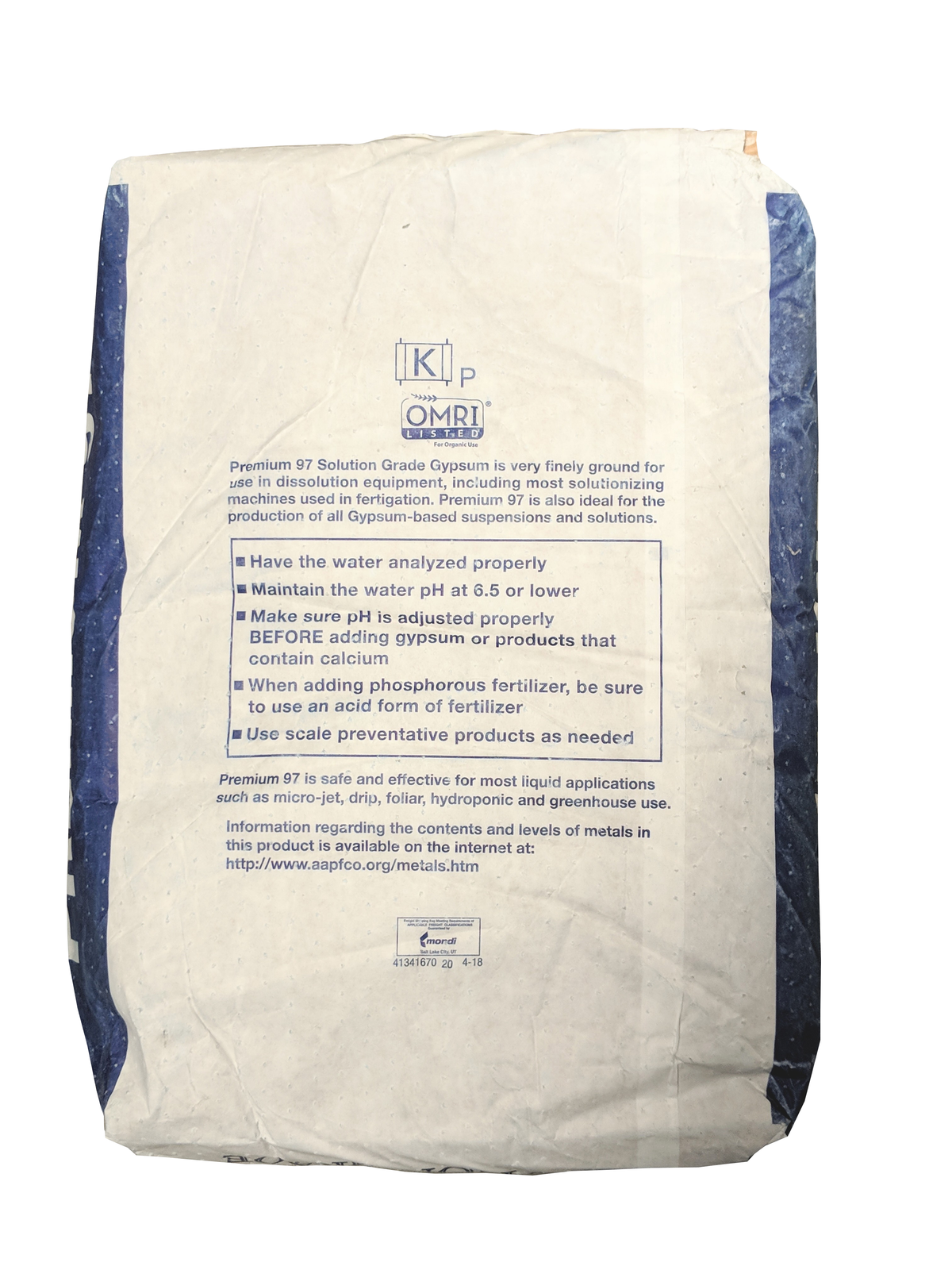
Mined gypsum is a natural mineral that many organic certifiers allow, but this product does not carry an OMRI listing or a California Organic Input Material registration of its own. If you grow under certification, confirm its status with your certifier before use; we can supply the label and safety data sheet your certifier asks for.
Can gypsum cause a magnesium shortage?
It can on sandy, low-CEC, or magnesium-poor soils, and on acid soils, because the extra calcium pushes magnesium and potassium off the exchange sites and lets them leach. This is one reason to apply only the tested amount. If your test shows magnesium is already low, address it separately and keep the gypsum rate at the low end.
Product label (PDF, December 2024): guaranteed analysis and package directions. The label lists a “pH adjustment” rate; gypsum does not change pH, so that line is not a supported use and the rate tables on this page apply.
Safety Data Sheet (PDF, March 2026): composition, hazard classification (not classified as hazardous under OSHA HazCom 2012; not regulated for transport), handling, and first aid.
Where the rates and statements on this page come from
Every rate and claim above traces to a university Extension publication, USDA NRCS, or the product label and safety data sheet. The references are listed here for growers, advisors, and certifiers who want to check them.
Not sure whether your soil needs gypsum, lime, or neither? Email your soil test to questions@greenwaybiotech.com or call (562) 351-5168, Monday to Friday, 9 AM to 3 PM Pacific, and we will read it with you. Every order carries a 90-day satisfaction guarantee.
Greenway Biotech, Inc. is a family-owned fertilizer company based in Madera, California, blending and packaging specialty fertilizers and soil amendments in California since 1989.
5 stars: 33 (89%)
4 stars: 2 (5%)
3 stars: 0 (0%)
2 stars: 1 (3%)
1 star: 1 (3%)
A
Anonymous
High quality
High quality, reasonably priced and the product breaks down nicely. Interested in buying this gypsum in pallet sized increments
J
Jenenne
High quality clean product. I love it
W
William Graham
Gypsum
It was great, didn't have to wait long for delivery either!
T
Thomas Beidleman
So Far So Good !
Ordering, Shipping and ultimate delivery all executed without a problem.
Haven't used the product yet so can't comment on effectiveness.
I
Ibrain Ortega
The best
High quality, fast shipping. I'll buy again.
G
Gayle Edwards
Water soluble Calcium
The Gypsum was spread thin and worked into the garden soil as a sidedressing. Blossom rot vanished and the next set of veggies and fruits to ripen were scrumptious.
R
Raquel Guevarra
ordered the wrong items
need to return items and change to correct items, but no customer service to talk to.
j
joshua barfield
Very fast shipping
First time buyer and forever client.
K
Kaja Bojmic
Great Service
Everything drom the shipping to quality was excellent
W
WILFREDA GASCON
Fast shipping.
Its great, work on mushroom inoculation. Thank you so much.
H
Heather Hurley
Good service
Excellent, I got exactly what I ordered.
D
Donald Bascle
Order as expected
Worked great, will be ordering more as needed. . Packed nice was exactly as described and fast shipping.
J
Jayson Machado
Fast
Fast delivery exactly what I wanted
K
Kate Grimaldi
Worked great
Just as expected
R
Rod Hunt
A "Happy Shopper"
Great experience!
G
George Hogg
Good company
I have made multiple orders with greenway. Always good service and fast delivery
A
Alyson Goncalves
Excellent
Quick ,easy, and exactly what I was looking for will be buying again
A
Adda Pratt
Ordered gypsum for blossom end rot
Really like the gypsum product! Nice package, received when you said! If I need something else, will definitely order from you again! So happy I found your company!
M
Max Tarrant
Shid fire yo!
Twas a fantastic pH buffer and nutrient to my substrate
D
David moreno
Great product
It dissolves well in water
E
Elliott Wilshaw
Koi not happy within it
Koi hated it in pond
T
Terry Lutz
Prevent blossom rot
Too early to tell, but is supposed to work.
M
Mervin Schneider
Great quality
It arrived before expected. Great in these times.
S
Sam Phillips
Powderdered gypsum
Good product, solving my problem.
P
Patrick Myers
Fast
Nice and easy. Fast shipping. Decent price
K
Kyle Connors
Works
Good for what it does.
J
John Els
Very Expensive
I bought a 40# bag of Gypsum from my local feed store for $10. You charged $27 for a 10# bag. I can't help but assume all of your products are ridiculously over priced so NO, I will not be purchasing anything from you in the future. I'll bet this review doesn't go public either. I'm not angry, just feeling stupid for trusting you. At the age of 66 I should know better.
J
Jonell Perez
Great Service
Quick and easy with fast shipping and delivery! Thank you for providing the product I needed and getting it to me so quickly! I would definitely continue using this site and recommended as well
T
Tim Lormer
Calcium sulfate
I think its worth noting that i got this at the best price (for me in AK) with shipping in a very timely manner. I've not used the product, but that should be simple enough since its what I ordered. 4 X 25 bags that are well packaged / saled and sent and received w/in 3 days. Very happy w/ the service
t
tom stansberry
Repeat buyer
Second time around using these products I really like using the azomite and the gypsum powder.speedy delivery with excellent quality and good prices.would definitely recommend.
C
Charity Smith
Quick turnaround excellent price
I will be a forever client. Excellent product!
C
Clare S.
Gypsum
Great experience. Fast shipping.
A
Annette R.
Gypsum
It came really quickly and is a good product and well packaged
W
Wesley B.
As described, shipped very fast,
As described, shipped very fast, even during the spring busy season. Will continue to purchase from Greenway.
My MSM is decreasing my osteoarthritis pain, especially in my hands
My product arrived intact. I started taking it as soon as I went into the kitchen. I mixed it with my daily Metamucil, but there was no discernible taste. I am working on making it a habit each morning. The pain from my osteoarthritis, especially in my hands, is decreasing. I expect it to continue to improve. Thank you for my MSM.
You did not send me MSM Powder, you sent me Magnesium Chloride powder. I tried contacting you 3 times, by email & phone and you didn't have the courage & honesty to return my messages & rectify the situation. I even offered to text you a photo of the mag chloride.