Continental US, Standard shipping: free on orders of $100 or more, $9.99 on orders under $50, and $14.99 from $50 up to $100.
UPS and FedEx options are also offered at checkout, at their own rates.
Orders placed by 11 AM Pacific on a business day ship the same day.
Alaska, Hawaii, US territories, APO/FPO and international addresses: the cost is shown at checkout, and 2-day delivery isn’t available to Alaska, Hawaii or P.O. boxes.
Boron micronutrient fertilizer · 17% B · 99% boric acid
About Boric Acid Fertilizer
Boron is needed in tiny amounts, and the gap between too little and too much is narrow. That is why this product is sold as a single, nearly pure ingredient: boric acid (H₃BO₃), guaranteeing 17% boron, so a weighed amount delivers a known amount of boron to a bed, a field, an orchard, or a nutrient solution.
Use it where a soil, leaf, or tissue test shows low boron, or where university Extension services list your crop as boron-responsive. Keep it off peas and beans, never put it in the seed row, and weigh every dose. It is sold only as a fertilizer, not as a pesticide.
17% B Each pound supplies 0.17 lb (77 g) of boron. The “99%” is the purity of the boric acid, not its boron content
Grams, not pounds University soil rates of 1 to 3 lb of boron per acre come to 61 to 184 g of product per 1,000 sq ft. Weigh it on a scale
1–25 lb bags Six sizes. The calculator below applies the university rate for your crop, soil test, orchard, or nutrient solution and recommends a bag
Product facts & composition
Guaranteed analysis and product specifications, Greenway Biotech Boric Acid Fertilizer
Specification
Detail
Boron (B)
17%
Derived from
Boric acid (H₃BO₃), CAS 10043-35-3
Purity
At least 99% boric acid (Safety Data Sheet). Pure boric acid is about 17.5% boron by weight; the guarantee is 17%.
Nitrogen, phosphate, potash
None. This is a boron micronutrient source, not an N–P₂O₅–K₂O fertilizer.
Physical form
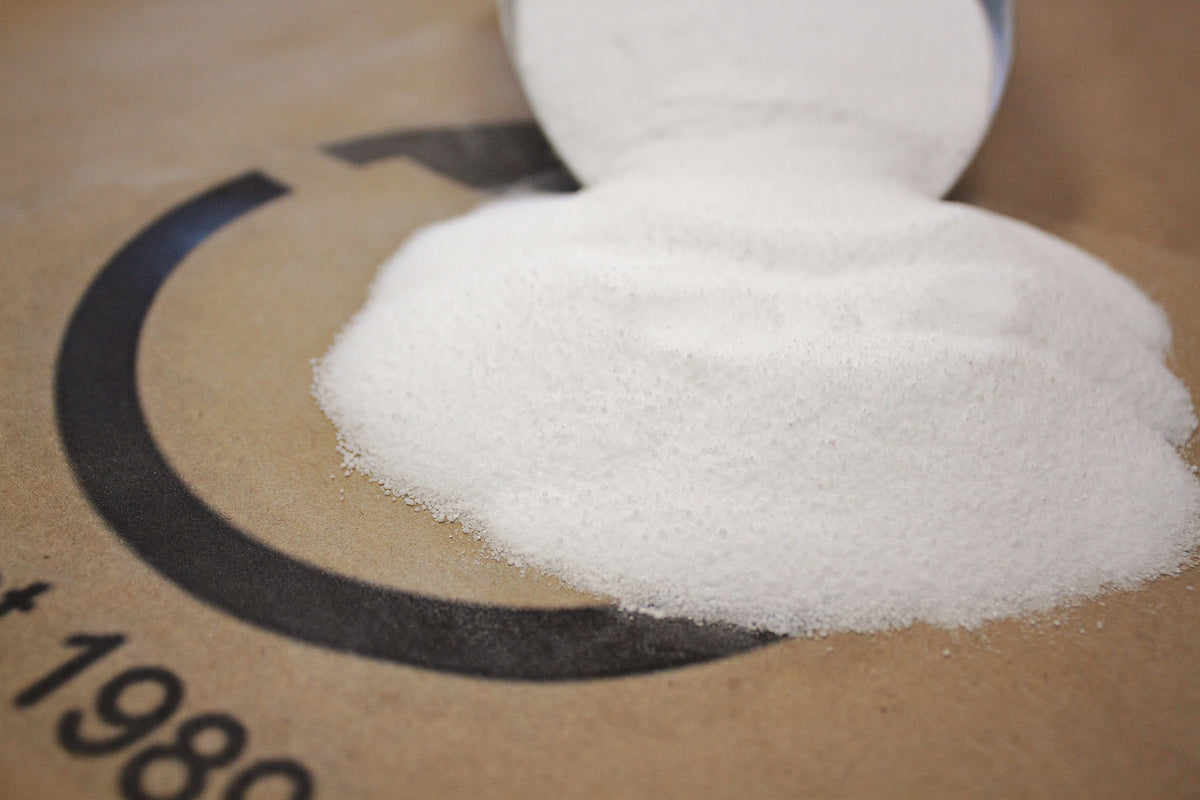
White crystals or crystalline powder; odorless
Solubility
47.2 g per liter of water at 20 °C (68 °F), about 179 g per US gallon (Safety Data Sheet)
Solution pH
A weak acid: about pH 4 to 5 as a saturated solution (Safety Data Sheet)
Use
Sold as a boron fertilizer only. Not registered as a pesticide, not sold for pest control, and not for use on or in people or animals.
Registration
California Department of Food and Agriculture (CDFA) fertilizer registration No. 805102 (Safety Data Sheet)
Percentages are by weight of product. One pound of product contains 0.17 lb (77.1 g) of boron, one ounce contains 4.8 g, and one gram contains 170 mg. University Extension publications state boron rates as pounds of elemental boron per acre; this page divides those figures by 0.17 (the same as multiplying by 5.88) to give the weight of this product, and shows both.
Best uses & benefits
Choose this product when a test, or your crop, calls for boron in one of these situations.
Boron-responsive vegetables on low-testing soils
University of Wisconsin Extension places beet, cauliflower, celery, and tomato among crops with a high boron requirement, and broccoli, cabbage, carrot, lettuce, radish, and spinach among those with a medium requirement. It finds deficiency most often on sandy, low-organic-matter soils and on soils at pH 7.0 or above. Michigan State University Extension gives boron to responsive vegetables as a yearly broadcast before planting.
Alfalfa and other forage legumes
University of Minnesota Extension reports that alfalfa responds to boron more than any other commodity crop in Minnesota. University of Wisconsin Extension recommends a boron topdressing for forage legumes on soils that test low.
Orchards with low leaf boron
Washington State University’s tree-fruit guide lists dry boric acid, 17% B, by name for foliar sprays at prepink to pink, with separate amounts for maintenance and for a deficiency diagnosed by leaf analysis, and gives a soil application once every three years.
Nutrient solutions that call for boron
Hydroponic recipes list boron in fractions of a milligram per liter; the University of Florida tomato program uses 0.7 mg/L. Boric acid dissolves completely at those doses, and a measuring stock makes the small amounts easy to dose.
Where it is a poor fit
Symptoms that have not been tested. Boron shortages look like other problems; University of Minnesota Extension notes that alfalfa symptoms can be confused with leafhopper burn. Test soil, leaves, or plant tissue before applying.
Soils that already test optimum or higher. University of Wisconsin Extension recommends no boron at those levels and advises stopping altogether when a soil tests excessively high.
Peas, beans, and soybeans. Michigan State University Extension says boron should not be applied to beans and peas, to soil or foliage, and University of Minnesota Extension says to avoid it on soybean and edible bean regardless of the soil test.
The seed row, and corn, oat, or soybean without plant analysis. University of Wisconsin Extension rates these as low-requirement crops, says to confirm the need with plant analysis, and warns never to put borated fertilizer in the row for corn or soybean or in the drill for oat.
Extra doses on top of a complete fertilizer. Many complete fertilizers already contain boron. Count it before adding more.
Fertilizer only. This product is sold only as a boron fertilizer and is not registered as a pesticide. For ants, cockroaches, or other pests, buy a product registered with the EPA and your state for that use and follow its label. It is not for use on or in people or animals.
Application rates & directions
Boron rates come from university Extension and state agency recommendations. They are stated as pounds of elemental boron per acre; the tables convert them to this product at 17% boron (lb of product = lb of boron ÷ 0.17) and to garden-scale amounts in grams. Each table is one university’s or agency’s recommendation for its region; where your own state Extension service publishes a boron rate for your crop and soil, follow it. Weigh the product: a kitchen scale reading to 1 g works for amounts of about 5 g and more; smaller amounts and nutrient solutions need a scale reading to 0.01 g, or the measuring stock described below. If the directions printed on your package differ from this page, contact us before applying.
Test, start low, and do not stack doses. University of Minnesota Extension describes “a fine line between meeting B requirements and B toxicity in plants.” Apply one rate from one table for your situation, count boron from other fertilizers, and retest before applying again.
With a boron soil test: University of Wisconsin rates
Boron recommendations from University of Wisconsin Extension A2522, Soil and Applied Boron (K.A. Kelling, 1999), by crop requirement and soil test level, with the equivalent weight of this 17% B product
Crop boron requirement (crops as listed by the University of Wisconsin)
2 lb B/acre = 11.8 lb product/acre; 123 g per 1,000 sq ft
1 lb B/acre = 5.9 lb product/acre; 61 g per 1,000 sq ft
None
Low: corn, oat, soybean
Confirm the need with plant analysis before applying any boron
Interpretation of the boron soil test, parts per million (ppm) boron, from University of Wisconsin Extension A2522, Table 3
Soil texture
Very low
Low
Optimum
High
Excessively high
Sands, loamy sands
Below 0.2
0.3–0.4
0.5–1.0
1.1–2.5
Above 2.5
Sandy loams, loams, silt loams, silts, clays
Below 0.3
0.4–0.8
0.9–1.5
1.6–3.0
Above 3.0
Mucks, peats
Below 0.5
0.6–1.0
1.1–2.0
2.1–4.0
Above 4.0
Most soil laboratories offer a hot-water boron test (University of Minnesota Extension). The University of Wisconsin advises discontinuing boron when the soil tests excessively high, and notes that the boron soil test is less reliable than phosphorus and potassium tests, because it is hard to predict how much boron organic matter will release during the season. A result that falls between two printed classes is read here as the higher class, which carries the lower rate. For forage legumes on low-testing soils it gives 0.5 to 1.0 lb of boron per acre each year, or 2 lb once in the rotation, as a topdressing; on sandy soils the yearly 0.5 to 1.0 lb limits leaching. University of Minnesota Extension advises withholding boron from a new alfalfa seeding with an oat companion until after the first production year, because oat is sensitive at alfalfa rates. For apple orchards, use the Washington State rates below.
Vegetables without a boron soil test: Michigan State rates
Soil boron rates for vegetables by crop response, from Michigan State University Extension, Boron in vegetables: Not too little, not too much (2025, adapted from MSU bulletin E2934), with the equivalent weight of this 17% B product
Michigan State bases these vegetable rates on crop response rather than soil test level, applied as a yearly broadcast before planting, well blended with the rest of the broadcast fertilizer. It warns that banding boron with starter fertilizer carries a greater risk of toxicity. Start at the low end of the range for your crop. As a general guide it treats a soil test below 0.7 ppm boron as low and above 1.0 ppm as adequate; with a soil test, the Wisconsin table above is the more specific basis.
Foliar sprays on vegetables
The NCDA&CS Agronomic Division (Note 6, Fertilization of Commercial Vegetable Crops, 2013) recommends 0.2 lb of boron per acre “in sufficient water for coverage”: 1.18 lb of this product per acre, or 12.3 g per 1,000 sq ft. It says timing is critical: spray before heading in cole crops, before root swell in root crops, and at first bloom in tomatoes and okra. University of Minnesota Extension uses foliar boron only on severely deficient fields, at 0.1 to 0.3 lb of boron per acre (6.1 to 18.4 g of this product per 1,000 sq ft), and warns not to spray on hot days when the crop is under moisture stress. Michigan State notes that the foliar amount may be split across more than one spray. Do not spray peas or beans.
Orchards: Washington State University tree-fruit rates
Boron for tree fruit from Washington State University, Crop Protection Guide for Tree Fruits in Washington, Applications, for dry boric acid, 17% B, per acre of orchard
Application
This product per acre
Boron per acre
Per 1,000 sq ft of orchard
Timing
Foliar spray, maintenance
3 lb
0.5 lb
31 g
Prepink to pink, or postharvest
Foliar spray, diagnosed deficiency
6 lb
1.0 lb
62 g
Prepink to pink; after bloom only if deficiency appears during the growing season
Soil application
17.6 lb
3 lb
184 g
Surface-broadcast once every three years
Washington State says rates of actual boron should not exceed 1.0 lb per acre for a deficiency spray or 0.5 lb per acre for a maintenance spray, and does not recommend applying boron through fertigation, because leaks and junctions can concentrate it and cause toxicity. Base the choice on soil and leaf tests: it gives normal leaf boron as 20–60 mg/kg for apple and pear, 17–60 for cherry, 20–80 for peach, and 20–70 for apricot. Dissolve the weighed amount completely in the spray volume you normally use for that orchard.
Hydroponic and soilless nutrient solutions
Dose to the boron target in your nutrient recipe: grams of product = mg/L of boron to add × liters of solution ÷ 170. Raising 100 US gallons (378.5 L) by 1 mg/L takes 2.23 g. The University of Florida tomato program (HS796/CV216, perlite, rockwool, and NFT) holds boron at 0.7 mg/L through every growth stage, which is 1.56 g of this product per 100 gallons when no other boron source is present. Subtract the boron your base fertilizer and source water already supply. For small batches, make a measuring stock: dissolve 10 g of product and make it up to exactly 1 liter of water, which holds 1.7 mg of boron per mL. An EC or TDS meter does not measure boron; confirm with a laboratory analysis of the solution or the plants.
How to use Boric Acid Fertilizer
Confirm the need. Get a soil test that includes boron, or a leaf or tissue analysis, and look up your crop in the tables above. University of Minnesota Extension suggests collecting soil samples along with tissue samples to confirm a deficiency.
Find your rate and weigh it. Use one table for your situation, measure the area or volume, and let the calculator convert the rate to a weight of product. Weigh it; amounts for beds are a few grams to a few hundred grams.
Apply soil rates evenly before planting. Broadcast and work the product into the soil; University of Minnesota Extension says broadcast applications are safer one to two weeks before seeding and that boron should never touch the seed. Mix it with the rest of your dry fertilizer, or dissolve it in water for an even spread: Penn State gives boron in 100 gallons of water per acre, about 2.3 gallons per 1,000 sq ft. Keep soil rates on bare soil; University of Minnesota Extension warns that boron applied directly to actively growing green tissue can cause serious injury.
Spray foliar rates at the right stage. Dissolve the weighed amount completely, spray it in enough water to cover the foliage evenly at the timing given above, and avoid hot days when plants are moisture-stressed.
Retest before you repeat. Do not add boron on a schedule. Retest soil or leaves before the next application, follow the three-year interval for orchard soil applications, and, as Penn State advises, do not grow peas, beans, or Jerusalem artichokes in the year after a boron application.
Calculator & choosing a size
Formulas. Product (lb) = boron rate (lb B per acre) ÷ 0.17 × acres. Square feet ÷ 43,560 = acres. For garden beds, product per 1,000 sq ft (g) = boron rate (lb B per acre) × 61.25. For nutrient solutions, product (g) = mg/L of boron to add × liters ÷ 170.
Worked examples. A 100 sq ft broccoli bed on sandy soil testing 0.3 ppm boron (Wisconsin low, medium-requirement crop, 1 lb B per acre): 6.13 g of product, delivering 1.04 g of boron; a 1 lb bag covers it. A 1,000 sq ft beet bed on loam testing 0.2 ppm (very low, high requirement, 3 lb B per acre): 183.8 g; a 1 lb bag. A 200 sq ft tomato bed with no boron soil test (Michigan State, 2 to 3 lb B per acre): start with 24.5 g, at most 36.8 g; a 1 lb bag. Two acres of orchard, maintenance spray (Washington State, 3 lb per acre): 6 lb; a 5 lb and a 1 lb bag. A 50-gallon reservoir raised by 0.5 mg/L boron: 0.56 g, or 55.7 mL of the 10 g per liter measuring stock; a 1 lb bag.
The calculator below asks what you are treating and what you know: crop, soil texture and soil test, area, orchard application, or nutrient-solution target and volume. It applies the matching university rate, states the boron delivered, and recommends the lowest-price bag combination that covers one application, plus the least-leftover combination when that differs. Prices, tax, and shipping are confirmed at checkout, and availability is confirmed when you add to cart.
The calculator needs JavaScript. If it does not appear, use the formulas and worked examples above to choose a size.
How boric acid works as a fertilizer
Boron is an essential plant micronutrient. In most crops it moves little within the plant, so University of Wisconsin Extension notes that shortages show first on younger tissue, and University of Minnesota Extension advises sampling newly developed tissue. Typical signs include hollow stems and brown, deformed curds in cauliflower and broccoli, brown heart in beets, cracked stems in celery, and dead growing tips with a bushy, rosetted look in alfalfa.
University of Wisconsin Extension explains that most soil boron is held in organic matter, and only 0.5 to 2.5% of the total is available to plants. Boron moves with water through coarse soils and often leaches below the root zone, soils at pH 7.0 or above are more prone to deficiency, and when the surface soil dries, plants cannot reach the boron-rich layer until rain or irrigation returns. Boric acid dissolves readily, so it supplies boron in a soluble form for soil application, foliar sprays, or nutrient solutions; Wisconsin lists it among the boron sources used for direct soil application or foliar spray.
The same solubility is why rates must be weighed. University of Wisconsin Extension describes “a very narrow range between boron deficiency and toxicity.” Excess boron shows as yellowing leaves with scorched edges (University of Minnesota Extension), and Michigan State University Extension reports that most toxicity it sees comes from miscalculated rates, application mistakes, or improper blending. Because boron is mobile in soil, plants can sometimes recover with adequate rain or irrigation, and Michigan State calls leaching with low-boron water the most effective remedy. This evidence concerns boron nutrition in general; it is not a trial of this finished product.
Compare your options
Boron sources differ in boron content, so rates convert by boron, not by weight of product. Boron percentages are the approximate figures given by University of Minnesota and University of Wisconsin Extension; Micro Green 2-0-3 is described on its own page.
Greenway Biotech Boric Acid Fertilizer compared with other boron sources
Option
Boron
Product to supply 1 lb of boron
Choose it when
Limitation
Boric Acid Fertilizer, this product
17% B as boric acid
5.9 lb
You need a weighed boron dose for soil, a foliar spray, an orchard, or a nutrient solution
Supplies boron only. Small rates must be weighed, or measured as a stock solution
Borax (sodium tetraborate decahydrate)
About 11% B
9.1 lb
A soil application; the University of Wisconsin names borax and sodium tetraborate as the most common soil sources
Contains sodium. About 1.5 times the product weight of boric acid for the same boron
Boron with iron, zinc, manganese, copper, and molybdenum
Not used to supply boron alone
A hydroponic, coco, or soilless system needs the whole trace-element package
Not a boron-only correction; its boron counts toward the solution total
Related products & compatibility
Micro Green 2-0-3: a water-soluble trace-element concentrate for hydroponic, coco, and soilless growing that already includes boron. Choose it when several micronutrients are needed; if you use it, count its boron before adding boric acid.
Applied together, not mixed as concentrates. University of Minnesota Extension recommends broadcasting boron with phosphate or potash fertilizers, and Michigan State suggests blending it well with broadcast N–P–K. That describes dry fertilizers spread on the soil together. It is not a claim that boric acid can be combined with other fertilizer concentrates: dissolve it on its own in water, add it to the diluted spray or reservoir, and follow each product’s own directions.
Handling, storage & limitations
Hazard. Warning: suspected of damaging fertility or the unborn child. Read all safety precautions before handling, and get medical advice if you are exposed or concerned. Boric acid is not for ingestion.
Children, pets, and food. Keep the product and its solutions out of reach of children and pets, away from food and animal feed, and out of food or drink containers. Label any stock solution.
Dust and protective equipment. Keep dust down, do not eat, drink, or smoke while handling, and wash your hands afterward. Wear safety glasses with side shields, or dust goggles where dust is generated, and nitrile gloves. A respirator is not normally needed with good ventilation; where dust is generated or may exceed exposure limits, wear a NIOSH-approved N95 or better particulate respirator.
Storage. Store in a dry place in the closed original container, locked up and out of reach of children and pets. Reseal the bag after each use.
Plants, water, and spills. Boric acid is water-soluble and can damage trees and plants through their roots. Sweep or vacuum spills dry, keep product, solutions, and rinse water out of drains, ditches, and waterways, and do not irrigate with water a spill has reached.
Incompatible materials. Keep it away from strong bases, strong reducing agents such as alkali metals, and acetic anhydride. Dissolve it in clean water in a container kept for that use, and label it.
Use limits. Sold only as a boron fertilizer and not registered as a pesticide. Not sold for pest control, not for use on or in people or animals, and not sold for certified organic production. Do not apply it to peas or beans or in the seed row, and do not exceed the rates on this page.
First aid. Eyes: rinse cautiously with clean water for at least 15 minutes, holding the eyelids open; remove contact lenses if present and easy to do, and get medical advice if irritation persists. Skin: wash with soap and water, and get medical advice if irritation develops or persists. Inhaled: move to fresh air, and get medical attention if coughing, irritation, or breathing difficulty continues. Swallowed: rinse the mouth and do not induce vomiting; call Poison Control at 1-800-222-1222 or a doctor, and get medical attention if a child or pet has swallowed it. For a spill or chemical emergency, CHEMTREC is available 24 hours at 1-800-424-9300.
Frequently asked questions
What is Boric Acid Fertilizer, and how much boron does it contain?
It is boric acid (H₃BO₃), at least 99% pure, guaranteeing 17% boron (B). The 99% is the purity of the boric acid, not its boron content: each pound supplies 0.17 lb (77 g) of boron, and each gram supplies 170 mg. Greenway Biotech sells it as a boron fertilizer for soils, orchards, and nutrient solutions where a test or a boron-responsive crop calls for it. University rates are stated in pounds of boron per acre, so divide them by 0.17 to get pounds of this product.
Is boric acid safe to handle?
Handle it with care. The Safety Data Sheet classifies it as suspected of damaging fertility or the unborn child, and it is not for ingestion. Keep dust down, wear safety glasses and nitrile gloves, wash your hands after handling, and store it dry in the closed original container, locked up, out of reach of children and pets, and away from food and feed. If any is swallowed, rinse the mouth, do not induce vomiting, and call Poison Control at 1-800-222-1222 or a doctor.
How do I know whether my plants need boron?
Test before you treat. A soil test that includes boron (most labs offer a hot-water boron test) or a leaf or tissue analysis tells you. University of Wisconsin Extension finds deficiency most often on sandy, low-organic-matter soils, on soils at pH 7.0 or above, and when the surface soil dries out. Signs appear first on new growth: hollow stems and brown curds in cauliflower and broccoli, brown heart in beets, cracked stems in celery, and dead growing tips in alfalfa. Other problems can look similar, so confirm with a test.
How much boric acid should I put on my garden?
Very little, and weighed. With a boron soil test, University of Wisconsin Extension recommends 1 to 3 lb of boron per acre depending on the crop and how low the test is: 61 to 184 g of this product per 1,000 sq ft, or 6.1 to 18.4 g per 100 sq ft. Without a soil test, Michigan State University Extension gives vegetables 2 to 3 lb of boron per acre for crops such as broccoli, cauliflower, carrot, beet, and tomato, 1 to 2 lb for cabbage, lettuce, and spinach, and 0.5 to 1 lb for onion, pepper, and cucumber. Start at the low end, broadcast it evenly before planting, and never put it in the seed row. The calculator converts these rates for your area.
Can I spray boric acid on leaves?
Yes, at foliar rates, which are far lower than soil rates. For vegetables, the NCDA&CS Agronomic Division recommends 0.2 lb of boron per acre in enough water for coverage, which is 1.18 lb of this product per acre or 12.3 g per 1,000 sq ft, sprayed before heading in cole crops, before root swell in root crops, and at first bloom in tomatoes and okra. University of Minnesota Extension uses foliar boron only on severely deficient fields and warns against spraying on hot days when the crop is moisture-stressed. For orchards, Washington State University gives 3 lb of this product per acre for maintenance and 6 lb per acre for a diagnosed deficiency, at prepink to pink. Do not spray peas or beans.
How much boric acid do I add to a hydroponic nutrient solution?
Use the boron target in your nutrient recipe. Grams of product = mg/L of boron to add × liters of solution ÷ 170, so raising 100 US gallons by 1 mg/L takes 2.23 g, and the University of Florida tomato program, at 0.7 mg/L, takes 1.56 g per 100 gallons. Subtract the boron your base fertilizer and water already supply. Amounts this small are easier to measure as a stock: 10 g of product made up to 1 liter of water holds 1.7 mg of boron per mL. An EC or TDS meter does not measure boron, so confirm with a laboratory analysis.
Which plants should not get boron?
Do not apply boron to peas or beans. Michigan State University Extension says it should not be applied to them, to soil or foliage, and University of Minnesota Extension says to avoid it on soybean and edible bean regardless of the soil test. University of Wisconsin Extension rates corn, oat, and soybean as low-requirement crops, says to confirm the need with plant analysis, and warns never to put borated fertilizer in the row for corn or soybean or in the drill for oat, because concentrated boron is toxic to germination. Penn State advises not growing peas, beans, or Jerusalem artichokes in the year after a boron application.
What happens if I apply too much boron?
The margin between enough and too much is narrow. Excess boron shows as yellowing leaves with scorched edges, and severe cases stunt or kill plants. Michigan State University Extension reports that most boron toxicity it sees comes from miscalculated rates and application mistakes, which is why this page gives every rate as a weight. Because boron moves with water in soil, plants can sometimes recover with adequate rain or irrigation, and Michigan State calls leaching with low-boron water the most effective remedy; leaching also removes nitrogen, which then has to be replaced.
Can I use boric acid for ants, roaches, or other pests?
No. Controlling insects or other pests is a pesticide use. This product is sold only as a boron fertilizer and is not registered as a pesticide. For pest control, buy a product registered with the EPA and your state for that use, and follow its label.
Is Boric Acid Fertilizer OMRI Listed or approved for organic production?
We do not hold an OMRI listing or a California Organic Input Material registration for this product, so we do not sell it for certified organic production. California requires fertilizing materials intended for organic crop production to be registered as Organic Input Materials. If you farm under organic certification, your certifier decides which inputs you may use.
Where the rates and statements on this page come from
The soil, foliar, orchard, and nutrient-solution rates, the crop and soil conditions, and the deficiency and toxicity statements on this page come from the university and state agency publications below, converted at the guaranteed 17% boron; the hazard, handling, storage, and first-aid statements come from the Safety Data Sheet. The publications describe boron nutrition in general and do not evaluate or endorse this product.
Not sure whether boron is the problem, or which rate fits your crop? Email your crop, soil or tissue test results, soil type, area or reservoir size, and how you plan to apply it to questions@greenwaybiotech.com. Or call (562) 351-5168, Monday to Friday, 7 AM to 5 PM Pacific, and we will work through it with you.
Every order carries a 90-day satisfaction guarantee, and we pack and ship from Madera, California. You can also choose a package weight from the size selector at the top of this page.
Greenway Biotech, Inc. is a family-owned California fertilizer company, blending and packaging specialty fertilizers since 1989 and now based in Madera.
5 stars: 13 (87%)
4 stars: 1 (7%)
3 stars: 0 (0%)
2 stars: 0 (0%)
1 star: 1 (7%)
G
Grigoras Petrescu
Easy to order
Easy to order , good quality product, the shipping took little longer than expected
K
Kristi Huyck
Strawberries in tubs depleted of BA
I bought it for my strawberries and it perked them right up! They had been in tubs for years and all the BA had washed out.
V
Vilma Frias
Great
It was flawless .
T
Theodore Church
Boric Acid purchase
Great, fast shipping, received in about two days.
w
winping jong
good buy
I use it on vegetables. Vegetables grow well 👍
A
Adolph Audain
Great products, great prices
Delivery was prompt, products are good quality, prices are competitive. Wide range to choose from. As a hydroponics growers flexibility with nutrients is essential and being able to source everything in one place is a big bonus.
A
Anthony W Singleton
Worked Great
I used this to cur some bamboo before drying and it worked for purging the water from the bamboo.
A
Anthony Bonanno
Ruined my plants
Ruined all 7 of my plants
J
Jason Noble
First time
I spread this product over my winter crop yesterday. In a couple weeks Ill know what happens. I mixed six tablespoons with several gallons of water. Should have plenty of boron in the soil next spring
A
Anatoly Ivasyuk
Boric acid
Great product good for tomatoes!
R
Robert Berish
Very interesting: it would take me 10 lifetimes to use this product
I purchased this as a lawn shrub perennial support for soil on my east coast location.where soil samples showed extremely low boron. However at 1/2 teaspoon per gallon-- the amount for my needs --is much less than purchased. I am counting on the product to certainly raise the boron levels.....
F
Faranak Mousavi
Came.ontime
This was the only online place I could find that would sell the product on want in smaller size. It was smooth transaction. Came onetime, I was provided with tracking number and was a correct order
E
Ed A.
tku
TKU
Excellent: I would definitely buy from you again
M
Michael B.
Another happy customer.
Product is exactly what it is supposed to be.
Arrives in heavy gauge plastic bag such that I ordered three separate products/packages and none were punctured.
C
Carol S.
great product
great, great service
R
Roberto Reyes
Which of your boric acid products are best for growing garlic in a raised bed size 6x12"
Greenway Biotech, Inc.
Subject: Re: Your question about Organic Boric Acid
Our Organic Boric Acid (17% boron) is our only boric acid product, and it's the one to use.
Garlic needs only a little boron and is sensitive to too much, so the rate is 0.5 to 1 lb of boron per acre. For a 6 x 12 ft bed (72 sq ft), that's 2.2 to 4.4 grams of Organic Boric Acid, roughly 1/2 to 1 1/4 teaspoons. Dissolve it in a gallon of water, sprinkle it evenly over the bed, and water it in.
Test your soil first and start at the low end. The 1 lb bag is plenty.
D
Doctor
To kill roaches powder
Greenway Biotech, Inc.
Yes. Use it as a dry powder and put a light dusting into the cracks and crevices where the roaches travel. Keep it off food prep surfaces and out of spots where pets or kids can get into it.
My MSM is decreasing my osteoarthritis pain, especially in my hands
My product arrived intact. I started taking it as soon as I went into the kitchen. I mixed it with my daily Metamucil, but there was no discernible taste. I am working on making it a habit each morning. The pain from my osteoarthritis, especially in my hands, is decreasing. I expect it to continue to improve. Thank you for my MSM.
You did not send me MSM Powder, you sent me Magnesium Chloride powder. I tried contacting you 3 times, by email & phone and you didn't have the courage & honesty to return my messages & rectify the situation. I even offered to text you a photo of the mag chloride.