Organic Pink Grapefruit Essential Oil (Citrus paradisi) — 15 ml
- Regular Price
- $ 27.99
- Sale Price
- $ 27.99
- Regular Price
Sold Out
- Unit Price
- per
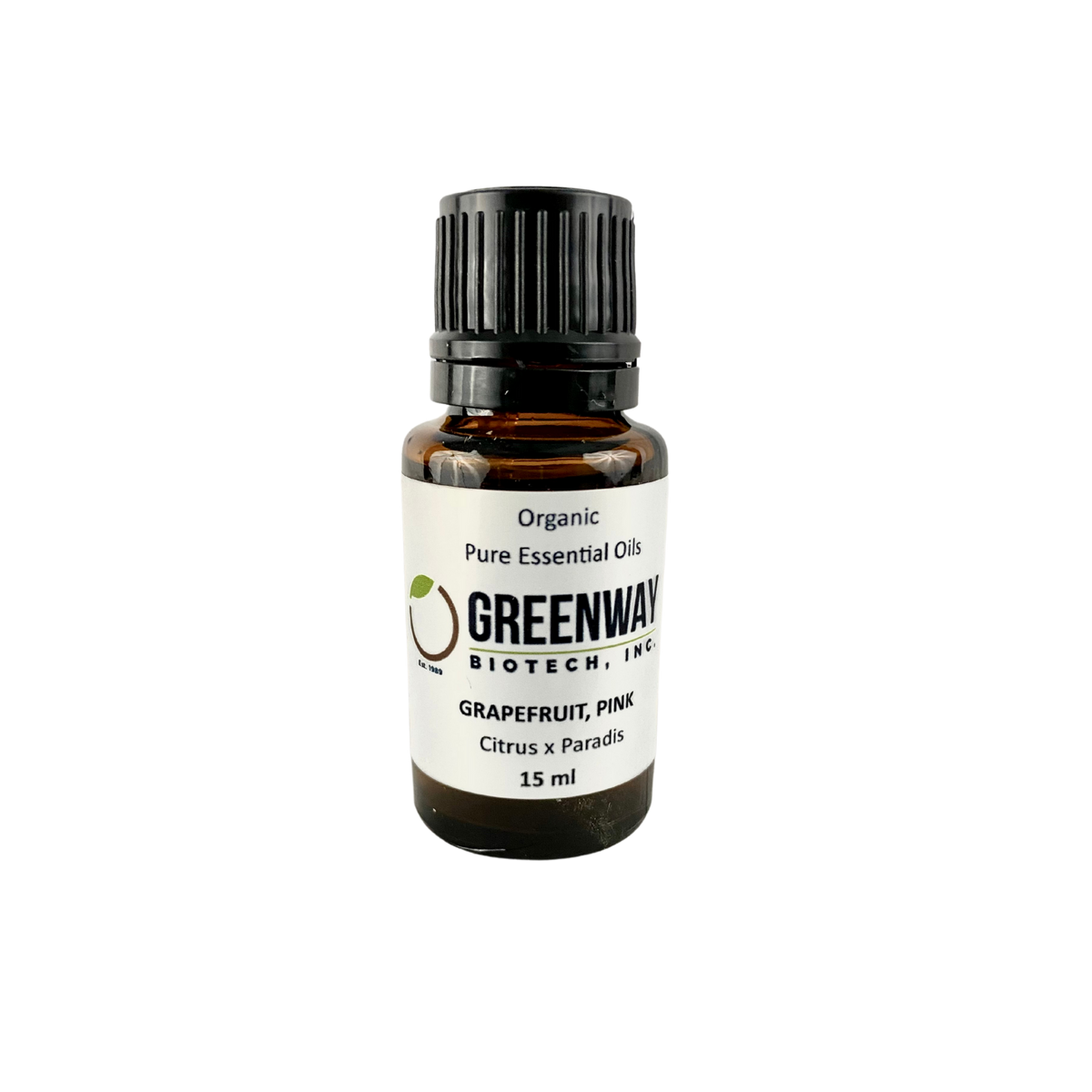
100% pure organic Citrus paradisi oil, cold-pressed from USA-grown pink grapefruit peels. A bright, tangy top note for aromatherapy diffusing, skincare blends, natural cleaning sprays, and roller-bottle perfumes — rich in limonene (88-95%) and protected in a 15 ml dark amber glass bottle.
Find your size → See how to use itShips from California · 90-day guarantee · GC/MS available on request
100%
Pure organic Citrus paradisi
15ml
≈ 300 drops per bottle
88-95%
Limonene — the headline compound
12hr
UV avoidance window after topical use
Cold-pressed citrus oils have shorter shelf lives than steam-distilled oils — pink grapefruit is best used within 6 to 12 months of opening. Refrigerate after opening to push to the longer end of that window.
| Size | Typical Duration | Uses per Bottle | Best For |
|---|---|---|---|
| 15 ml dark amber glass | 6-12 months opened (refrigerated) | ~300 drops | Best starter size |
| Product Type | Single-origin cold-pressed citrus essential oil |
|---|---|
| Size | 15 ml (≈ 300 drops) dark amber glass with euro dropper cap |
| Key Ingredient | Pink Grapefruit Peel Oil (Citrus paradisi) |
| Source / Origin | Certified-organic grapefruit groves in the United States |
| Grade / Purity | 100% pure, certified organic, GC/MS verified — no fillers, no carrier oils, no synthetic fragrance |
| Aroma | Fresh, tangy, invigorating citrus with a slightly bitter-sweet undertone — like freshly squeezed pink grapefruit |
| Aromatic Note | Top note — evaporates quickly; creates a bright, immediate impression in blends |
| Extraction | Cold pressing (expression) from fresh grapefruit peels |
| Phototoxic | Yes — avoid direct UV exposure for 12 hours after topical use |
| Max Topical Dilution | 4% per IFRA phototoxicity limits (~12-18 drops per tablespoon of carrier oil) |
| Storage | Refrigerate after opening; replace within 6-12 months. See Safety section below for full guidance. |
Pink grapefruit shines in aromatherapy, skincare blends, and natural cleaning — anywhere a bright, sparkling top note adds energy to a routine.
Three to five drops in a diffuser. The fresh, tangy citrus aroma is popular for morning, workspace, and kitchen diffusing.
Six to eight drops per tablespoon of carrier oil for the face. Skip morning use on sun-exposed skin — apply at night and follow the 12-hour UV window.
Twelve to eighteen drops per tablespoon of carrier oil — within the 4% maximum topical limit. Pairs naturally with lavender for a citrus-floral massage blend.
Fifteen to twenty drops per 16 oz spray bottle of water with an emulsifier. Limonene is a well-known natural degreaser; the fresh aroma deodorizes as it cleans.
Twelve to eighteen drops in a 10 ml roller filled with jojoba or fractionated coconut. A bright citrus top note for daytime perfume — observe the 12-hour UV window on application areas.
Cold-pressed peel oil from American grapefruit groves, free of fillers and synthetic fragrance — the same juicy citrus character you'd recognize from a fresh-cut pink grapefruit, concentrated.
Cold-pressed from organically-grown pink grapefruit peels in the United States. American grapefruit groves produce a particularly bright, sparkling oil — slightly different in character from Italian or Brazilian variants. Domestic sourcing also shortens the transit time between harvest and bottling, which matters for a relatively short-shelf-life citrus oil.
Mechanical cold pressing of the fruit peel — the same extraction method used for orange and lemon oils. No heat, no solvents. Cold pressing preserves the full spectrum of volatile aromatic compounds, capturing the true scent of fresh grapefruit zest rather than a heat-altered or solvent-residue profile.
Limonene makes up 88-95% of pink grapefruit oil — one of the highest limonene concentrations of any commercial essential oil. Limonene gives the oil its bright citrus character and its well-known practical reputation as a natural solvent in DIY cleaning sprays. The remaining 5-12% is myrcene, nootkatone (trace; the compound primarily responsible for grapefruit's distinctive bitter-sweet edge), linalool, and α-pinene.
Pink grapefruit's IFRA maximum topical dilution is 4% — higher than lemon (2%), sweet orange (2.5%), and most other expressed citrus oils. That gives you more headroom for body blends and massage oils. The phototoxic UV window applies at any concentration, but the topical ceiling itself is more generous than most citrus alternatives.
Each batch is independently analyzed by GC/MS to verify the constituent profile (limonene, myrcene, nootkatone, linalool, α-pinene) and screen for adulterants. Citrus oils are commonly cut with synthetic limonene or other citrus species in the global market — third-party verification matters here. Lot-coded for traceability.
Pressed at the source, then hand-filled and inspected at our family-owned Madera, California facility — registered with the FDA. Six to twelve month shelf life refrigerated in dark amber glass. Backed by a 90-day money-back guarantee on every bottle.
88-95% limonene
The monoterpene that defines all expressed citrus oils
Pink grapefruit essential oil is dominated by a single compound: (R)-(+)-limonene, a monoterpene that makes up 88-95% of the oil. Limonene is the bright, fresh citrus note you smell when you cut into the peel of any citrus fruit — orange, lemon, lime, grapefruit, all share it as their dominant compound. Limonene is also a well-documented natural solvent and degreaser, which is why cold-pressed citrus oils show up in so many DIY cleaning sprays.
What gives pink grapefruit its distinctive bitter-sweet edge — different from sweet orange's roundness or lemon's sharpness — is a trace compound called nootkatone. Present in tiny amounts (well under 1% of the oil by weight), nootkatone is named for Alaska's Nootka cypress where it was first isolated, and it carries an enormous amount of grapefruit's aromatic identity. The supporting cast: myrcene (1-4%) adds a slight herbal-resinous tone, linalool a soft floral background, and α-pinene a faint pine-forest lift.
Two practical implications follow from this chemistry. First, the oil is phototoxic — cold-pressed citrus peel oils contain trace furanocoumarins (notably bergapten) that bind to skin and cause UV-sensitized burns. Second, that same limonene-rich composition means the oil oxidizes quickly in the presence of air, light, and heat. Both are real, both are manageable, and both are why this page repeats the 12-hour UV window and the refrigerate-after-opening guidance more than once.
Constituent ranges below reflect typical batch profiles for cold-pressed pink Citrus paradisi peel oil. The current-batch GC/MS report is available on request.
The dominant monoterpene of all expressed citrus oils. Responsible for the bright, fresh citrus character and the practical solvent/degreaser activity that makes this oil useful in DIY cleaning. Pink grapefruit has one of the highest limonene percentages of any commercial EO.
A monoterpene with a slight herbal-resinous, balsamic character. Also a major component in hops and bay laurel. Adds subtle complexity to the citrus headline.
Despite the trace concentration, nootkatone is responsible for much of grapefruit's distinctive bitter-sweet aromatic signature. Named for Nootka cypress where it was first isolated.
A soft, floral terpene alcohol — the same compound that dominates lavender. Contributes a delicate floral background to the citrus profile.
A monoterpene found across many conifers. Adds a faint pine-forest lift to the lower-volatility tail of the aromatic profile.
Including bergapten and bergamottin. These are the compounds responsible for the phototoxicity profile — they bind to skin proteins and create UV-sensitized reactions. Cold-pressed peel extraction captures them; steam-distilled grapefruit oil would not.
Drug-interaction note: grapefruit juice and pulp are well known to interact with many prescription medications by inhibiting the intestinal CYP3A4 enzyme. The cold-pressed essential oil also contains trace bergamottin and furanocoumarins (the responsible compounds), though at much lower oral exposures than juice. Topical and diffused use is not believed to cause meaningful CYP3A4 inhibition, but oral exposure to the oil is contraindicated regardless, and customers taking grapefruit-interacting medications should consult their pharmacist before any topical or aromatic use.
| Botanical Name | Citrus paradisi Macfad. |
|---|---|
| Common Names | Pink Grapefruit, Grapefruit (Pink Variety) |
| Plant Part Used | Fruit peel (rind) |
| Extraction Method | Cold pressing (expression) |
| Country of Origin | United States (certified organic) |
| Grade | 100% pure, certified organic, GC/MS verified |
| Color & Appearance | Pale yellow to pink-tinged, mobile liquid |
| Aroma Profile | Fresh, tangy, invigorating citrus with a slightly bitter-sweet undertone |
| Aromatic Note | Top note (fast-evaporating) |
| Primary Constituent | (R)-(+)-Limonene (88-95%) |
| Signature Compound | Nootkatone (trace; primarily responsible for the bitter-sweet grapefruit signature) |
| Net Volume | 15 ml (≈ 300 drops) |
| Container | Dark amber glass bottle with euro dropper cap and tamper-evident seal |
| Phototoxicity | Yes — IFRA-restricted; 12-hour UV-avoidance window after topical use |
| Maximum Topical Dilution | 4% per IFRA (Tisserand & Young, 2014) |
| Shelf Life | 6-12 months opened; refrigerate after opening to maximize |
| Packaged At | Greenway Biotech facility, Madera, California |
| Testing | Third-party GC/MS verification per batch; lot-coded for traceability |
Three primary use methods. Topical drop counts below stay within the IFRA 4% maximum from Tisserand & Young (2014). After any skin application, avoid direct sunlight for 12 hours.
Quick answer: 6-8 drops per tablespoon of carrier oil for the face (~1.2-1.6%); 12-18 drops for body (~3-4%). Patch test first. After any topical use, avoid sun for 12 hours.
| Use | Grapefruit Drops | Carrier Volume | Approx. Dilution |
|---|---|---|---|
| Facial serum (nighttime use) | 6-8 drops | 1 tbsp (15 ml) | ~1.2-1.6% |
| Body oil / massage blend | 12-18 drops | 1 tbsp (15 ml) | ~3-4% (max) |
| Scalp pre-wash treatment | 10-15 drops | 2 tbsp (30 ml) | ~1-1.5% |
| Add to existing moisturizer | 1-2 drops | 1 oz cream/lotion | ~0.2-0.3% |
Phototoxic — read carefully: after topical use, avoid direct sunlight, tanning beds, UV lamps, and steam rooms for 12 hours on the application area. Phototoxic reactions can be severe: hyperpigmentation, blistering, sunburn-like burns. If you need a non-phototoxic citrus oil for morning skincare, use Sweet Orange Essential Oil instead. Suitable carriers: jojoba (excellent for face), rosehip seed (facial serums), sweet almond (body massage), fractionated coconut (roller bottles). Patch test on the inner forearm and wait 24 hours before broader use.
Quick answer: 3-5 drops in a diffuser for medium rooms; 12-18 drops in a 10 ml roller bottle for perfume. Diffusing is not phototoxic; topical roller-bottle use is.
| Method | Grapefruit Drops | Duration / Base | Notes |
|---|---|---|---|
| Small room diffuser | 2-3 drops | 20-30 min | Bathroom, closet, small office |
| Medium room diffuser | 3-5 drops | 30-40 min | Bedroom, office |
| Large room diffuser | 5-7 drops | 40-60 min | Living room, open kitchen |
| Tissue / cotton-ball inhalation | 1-2 drops | As needed | For on-the-go aromatherapy |
| Roller-bottle perfume | 12-18 drops | 10 ml carrier oil | Daytime perfume; observe 12-hr UV window on application areas |
Starter morning blend: 3 drops Pink Grapefruit (top) + 2 drops Rosemary (middle) + 2 drops Peppermint (top). Diffuse 30 minutes — popular for morning routines and workspace freshening.
Quick answer: 15-20 drops per 16 oz spray bottle of water with emulsifier.
Essential oils don't mix with bathwater, so we don't recommend adding them to a bath or to bath salts.
Pink grapefruit has two things to track that most EOs don't: aggressive oxidation and a strict UV-avoidance window after topical use. Four habits make this oil pleasant to keep around.
Mix 1 drop of grapefruit in 1 tablespoon of carrier oil. Apply a small amount to the inner forearm and wait 24 hours. If no redness or irritation appears, the dilution is workable for you. Re-test if you take an extended break and return to the oil — oxidized grapefruit oil can irritate skin that fresh oil didn't.
Pink grapefruit oxidizes quickly due to its high limonene content. Refrigerate after opening to slow that down significantly. Plan to use within 6 months if stored at room temperature, or up to 12 months refrigerated. If the aroma turns harsh, sharp, or chemical-smelling, the oil has oxidized — discontinue topical use (oxidized oil can irritate skin). Diffusing oxidized oil is still safe but the aroma won't be pleasant.
After applying to skin (massage, facial serum, roller-bottle perfume), avoid direct sunlight, tanning beds, UV lamps, and steam rooms for at least 12 hours on the application area. Phototoxic reactions can cause hyperpigmentation, blistering, and severe sunburn-like burns. Diffusing is not phototoxic — only direct skin application is.
Never ingest. Beyond the standard EO safety reason, grapefruit specifically interacts with many prescription medications by inhibiting the intestinal CYP3A4 enzyme — the cold-pressed peel oil contains the responsible compounds (bergamottin and other furanocoumarins). Topical and diffused use is not believed to cause meaningful CYP3A4 inhibition; oral use is contraindicated regardless. If you take grapefruit-interacting medications, talk to your pharmacist before any use.
Pink grapefruit is a top note — bright, immediate, fast-fading. For diffuser blends or roller-bottle perfumes that hold their structure through a full session, pair with a middle note (lavender, rosemary, geranium) and a base note (patchouli, vetiver).
The dark amber glass bottle shields against UV light, which is the main cause of EO oxidation. Air exposure is the other main cause — keep the cap tight when not in use, and don't decant into a larger bottle that leaves a lot of headspace.
For aromatherapy use. Dilute before topical application. Avoid sun exposure for 12 hours after topical use. Keep out of reach of children. Essential oils are not intended to diagnose, treat, cure, or prevent disease.
Cold-pressed citrus oils share a lot of family resemblance but differ in aroma, phototoxicity status, and topical limits. This is how Greenway's citrus options stack up.
| Oil | Aroma | Extraction | Phototoxic | Max Topical | Best For |
|---|---|---|---|---|---|
| Pink Grapefruit (this product) | Fresh, tangy, bitter-sweet | Cold pressed | Yes — 12 hr UV | 4% | Diffusing, body massage, cleaning, daytime perfume |
| Lemon | Bright, sharp, clean | Cold pressed | Yes — 12 hr UV | 2% | Cleaning blends, focus diffusing, kitchen freshening |
| Sweet Orange | Warm, sweet, rounded | Cold pressed | No | 2.5% | Daytime skincare, child-friendly diffusing, mood-lifting |
| Lemongrass | Herbal-citrus, grassy | Steam distilled | No | 0.7% | Massage, deodorizing, scalp blends |
Honest sorting — pink grapefruit does some things very well and isn't the right pick for every routine.
A bright top note works best alongside a balancing middle and a grounding base. These four make the most-reached-for partners for pink grapefruit across diffusing, perfume, and skincare blends.
The classic floral middle note to balance grapefruit's bright citrus energy. Together they create a calming yet uplifting blend for evening diffusing or roller-bottle perfume.
Essential OilAdds warm, sweet depth to grapefruit's tangy edge. Sweet orange is also non-phototoxic — a useful daytime alternative if you can't observe the UV window.
Essential OilAn herbaceous middle note that pairs with grapefruit for fresh, invigorating diffuser blends. Popular for morning routines and workspace freshening.
Essential OilA rosy floral middle note that softens grapefruit's sharpness and adds complexity to skincare blends and natural perfumery.
Pink grapefruit has a real phototoxicity profile, fast oxidation kinetics, and a drug-interaction note that most other EOs don't carry. None of these are minor.
If your question isn't here, contact our team at questions@greenwaybiotech.com.
Yes. Our pink grapefruit essential oil is 100% pure, certified-organic Citrus paradisi. It contains no synthetic additives, fillers, fragrance oils, or carrier oils. It is cold-pressed from organically-grown grapefruit peels in the United States and hand-bottled at our family-owned Madera, California facility.
Fresh, tangy, invigorating citrus — like freshly squeezed pink grapefruit with a slightly bitter-sweet undertone. Brighter and more sparkling than sweet orange, less sharp than lemon. As a top note, the aroma announces itself immediately when you uncap the bottle and fades faster than middle and base notes in a blend.
Yes. Like most cold-pressed citrus peel oils, pink grapefruit increases UV sensitivity on skin. After any topical application — massage, facial serum, or roller-bottle perfume — avoid direct sunlight, tanning beds, UV lamps, and steam rooms for at least 12 hours on the application area. Diffusing is not phototoxic; only direct skin application is. For a non-phototoxic citrus oil for daytime skin use, see Sweet Orange Essential Oil.
Grapefruit juice and pulp are well known to interact with many prescription medications by inhibiting the intestinal CYP3A4 enzyme. The cold-pressed essential oil contains the responsible compounds (bergamottin and other furanocoumarins), though at much lower oral exposures than juice. Topical and diffused use is not believed to cause meaningful CYP3A4 inhibition, but oral use of the oil is contraindicated regardless. If you take medications with known grapefruit interactions (some statins, certain calcium-channel blockers, several immunosuppressants, and others), consult your pharmacist before any topical or aromatic use of grapefruit essential oil.
Maximum topical dilution is 4% — one of the most generous among citrus oils. For body and massage, use 12-18 drops per tablespoon of carrier oil (around 3-4%). For face and neck, use a gentler 6-8 drops per tablespoon (around 1.2-1.6%). Add 1-2 drops to one ounce of existing moisturizer or lotion for a much lower (~0.2-0.3%) blend. Patch test on the inner forearm before broader use, and remember the 12-hour UV avoidance window after any topical application.
Both are phototoxic expressed citrus oils, but they contain different concentrations of the UV-sensitizing furanocoumarins. IFRA sets lemon at 2% and pink grapefruit at 4% based on these compound-level differences. The 12-hour UV avoidance rule applies to both regardless of concentration — the topical ceiling sets how much oil can be in a blend, not whether the sun-window is needed.
Jojoba is excellent for facial use — lightweight, non-comedogenic, and a popular pairing with citrus oils in natural skincare. Sweet almond works well for body massage. Fractionated coconut is ideal for roll-on blends (long shelf life, smooth absorption).
Cats are particularly sensitive to citrus oils because they lack the liver enzymes to metabolize certain compounds. Do not apply citrus essential oils directly to pets. When diffusing, keep the area well-ventilated and ensure animals have a clear exit route. Consult your veterinarian before any essential-oil use around pets, especially cats.
Approximately 300 drops using the standard euro dropper cap included with each bottle. Actual count varies slightly depending on oil viscosity and dispensing speed. Pink grapefruit is used in modest amounts across most applications, so a 15 ml bottle stretches across many blends — though plan to use it within 6-12 months due to oxidation kinetics.
Refrigerate after opening. Pink grapefruit oil oxidizes quickly due to its high limonene content. Keep the cap tightly sealed (air is the main oxidation driver), store away from heat and direct light, and plan to replace within 6-12 months. Let refrigerated oil reach room temperature before use — cold oil flows slowly through the dropper. If the aroma becomes harsh, sharp, or chemical-smelling, discontinue topical use; oxidized citrus oil can irritate skin.
No. Our essential oils are formulated and labeled for external aromatherapy use only. Essential oils are extremely concentrated — roughly 50 grapefruits go into a single 15 ml bottle of cold-pressed peel oil. For culinary grapefruit flavor in food and drinks, use fresh juice or zest instead, or food-grade grapefruit extract. Essential oils are not intended to diagnose, treat, cure, or prevent disease.
No. Pink grapefruit essential oil is not a weight-loss product and has no demonstrated effect on body weight. Some preliminary animal studies have examined whether inhaling citrus aromas can influence appetite signaling, but the evidence in humans is limited and does not support using grapefruit oil for weight management. We sell this oil as a fragrance and aromatherapy product — not as a diet or appetite tool. Balanced nutrition, exercise, and (where appropriate) medical guidance are the right path for weight goals.
Both are Citrus paradisi, but the pink variety yields an oil with a slightly sweeter, more rounded aroma compared to the white variety's sharper, more astringent profile. The chemical profiles are similar overall, with pink varieties often containing slightly more myrcene. Our organic oil is specifically cold-pressed from pink grapefruit peels.
One 15 ml dark amber glass bottle. Cold-pressed from certified-organic, USA-grown pink Citrus paradisi peels; hand-filled in Madera, California. Free shipping on orders over $100 in the continental US, and a 90-day money-back guarantee.
Choose your size →Ships from California · 90-day guarantee · GC/MS reports above