Continental US, Standard shipping: free on orders of $100 or more, $9.99 on orders under $50, and $14.99 from $50 up to $100.
UPS and FedEx options are also offered at checkout, at their own rates.
Orders placed by 11 AM Pacific on a business day ship the same day.
Alaska, Hawaii, US territories, APO/FPO and international addresses: the cost is shown at checkout, and 2-day delivery isn’t available to Alaska, Hawaii or P.O. boxes.
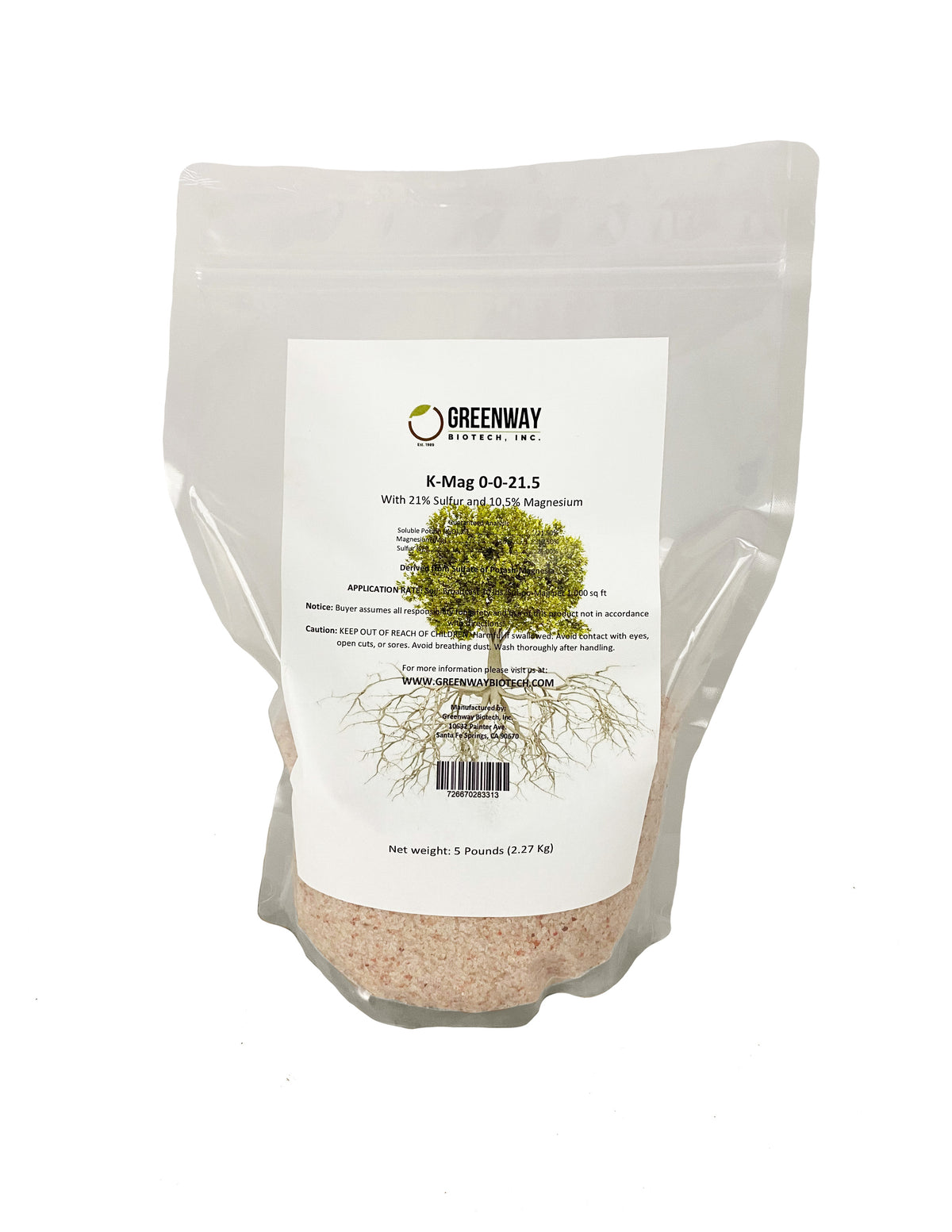
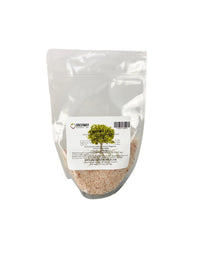
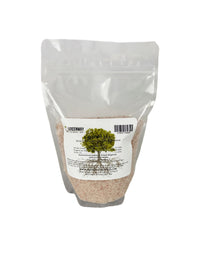
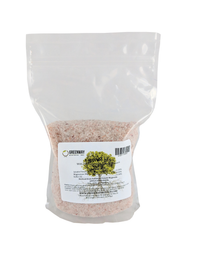
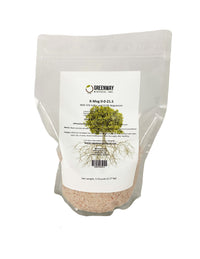
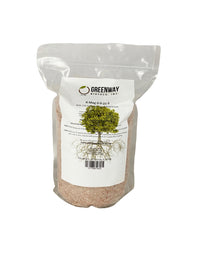
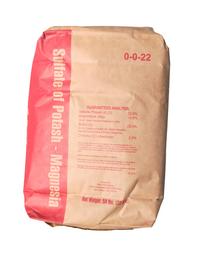
Potassium, magnesium and sulfur fertilizer · 0-0-22 · 11% Mg · 22% S · langbeinite
About Sulfate of Potash Magnesia 0-0-22
Sulfate of potash magnesia, also called langbeinite or potassium magnesium sulfate, is a naturally mined mineral (K₂SO₄·2MgSO₄) that carries 22% soluble potash (K₂O), 11% magnesium, and 22% sulfur in every granule, with no nitrogen or phosphate and little chloride. Spread it on soil when a soil or leaf test shows potassium and magnesium are both low, use it as a magnesium source when you do not want to raise soil pH, and choose it as a low-chloride potash for chloride-sensitive crops such as blueberries, strawberries, and potatoes.
Two limitations decide whether it fits. Its potash is dilute, and every pound of potash it supplies brings half a pound of magnesium with it, so it is the wrong product where the soil already holds plenty of magnesium and a costly way to meet a large potash need on its own. Its dense granules also dissolve slowly, so it goes on soil, not into sprayers, drip lines, or hydroponic reservoirs. A soil test gives the best amount; without one, start with the amounts this page lists for common plants.
22% K₂O · 11% Mg · 22% S Guaranteed potash, magnesium, and sulfur, all from one mineral, langbeinite
pH neutral Does not raise soil pH the way dolomite does or lower it the way elemental sulfur does
1–50 lb bags Eight sizes; the calculator turns a soil test result, or a plant without one, into an amount and a bag size
Product facts & composition
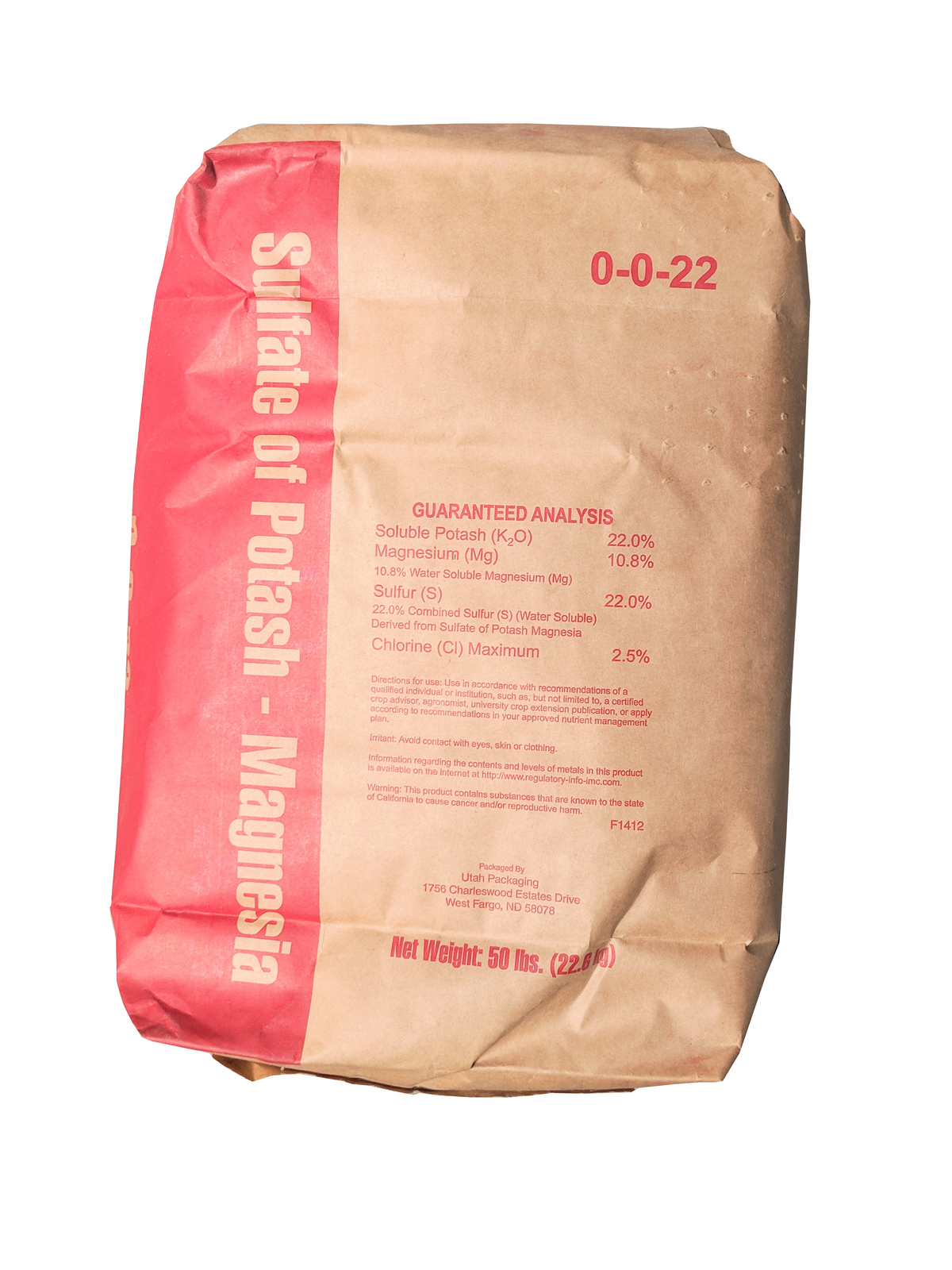
Guaranteed analysis and product specifications, Greenway Biotech Sulfate of Potash Magnesia 0-0-22
Specification
Detail
Soluble potash (K₂O)
22% (guaranteed analysis)
Magnesium (Mg)
11% (guaranteed analysis), equal to about 18% expressed as magnesium oxide (MgO)
Sulfur (S)
22% (guaranteed analysis), present as sulfate
Chloride (Cl)
Less than 2.5% (safety data sheet); the composition lists sodium chloride at 0.5–2.0% as a trace component
Derived from
Potassium magnesium sulfate (langbeinite), K₂SO₄·2MgSO₄, CAS 14977-37-8, 94.5–99.5% (safety data sheet)
Nitrogen and phosphate
None. This is a potassium, magnesium, and sulfur source, not a complete fertilizer.
Physical form
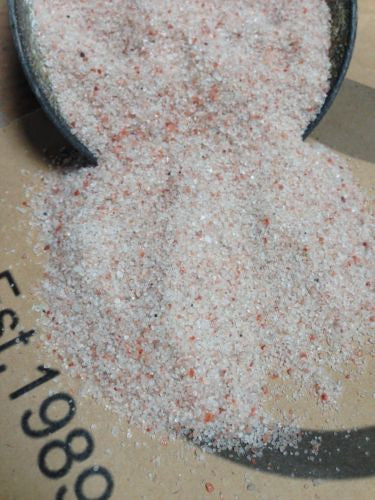
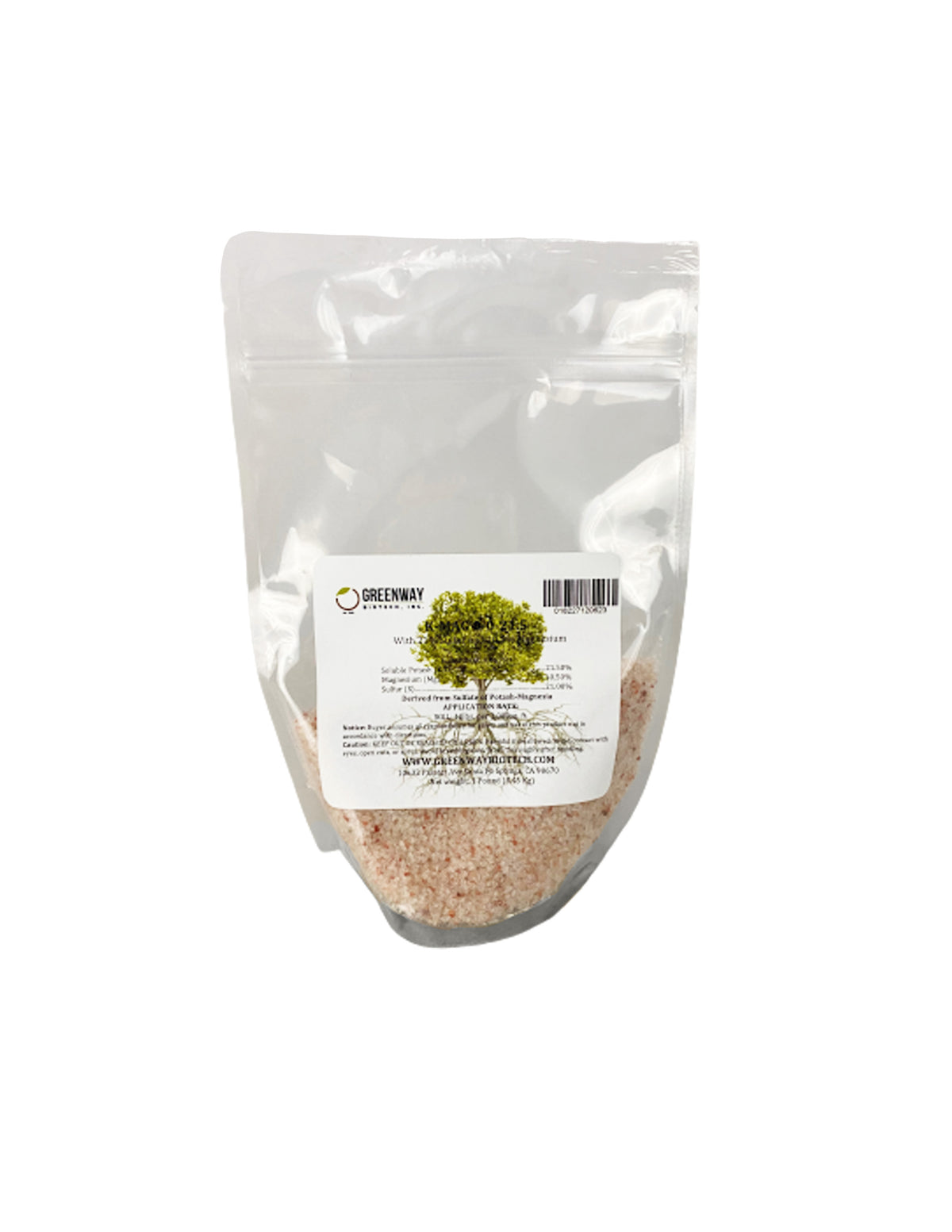
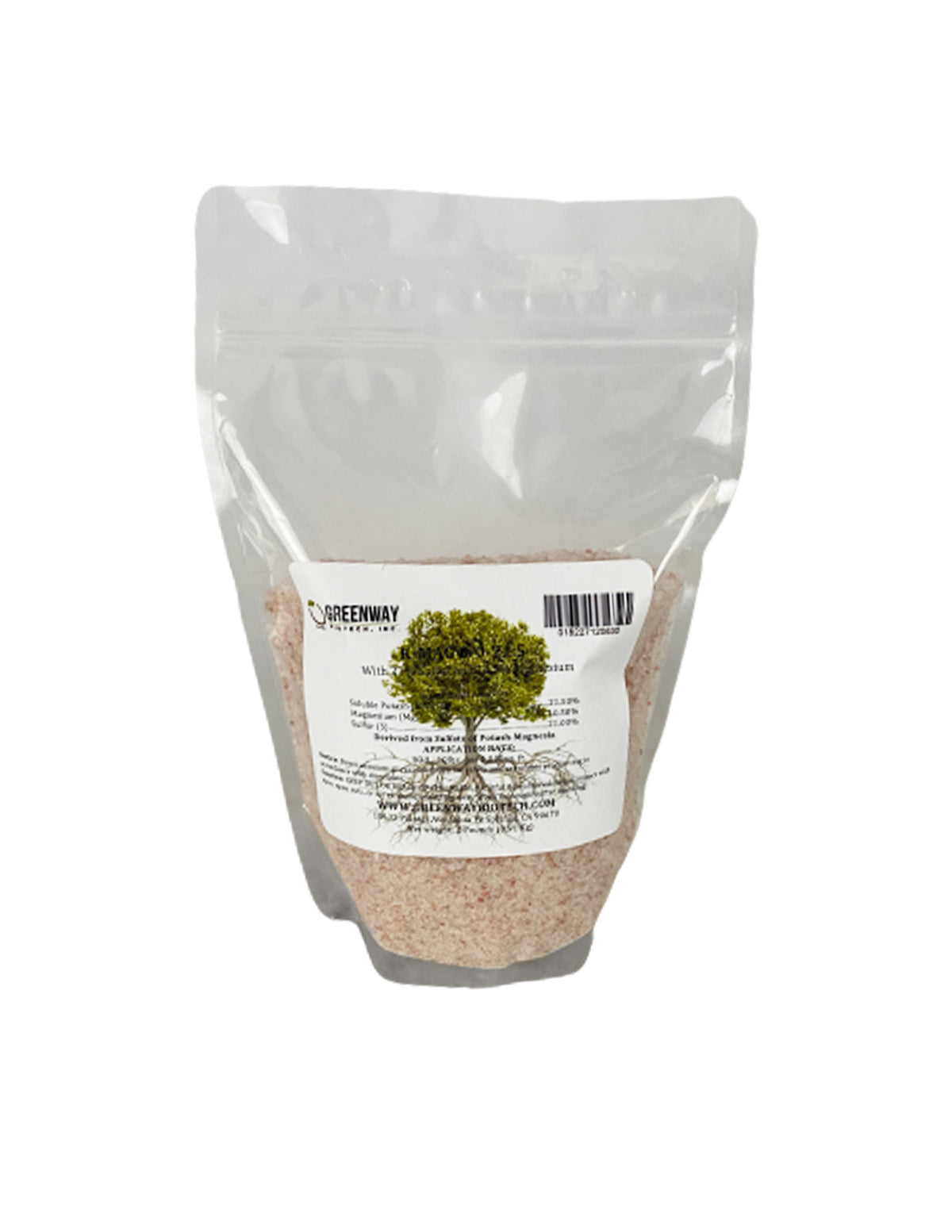
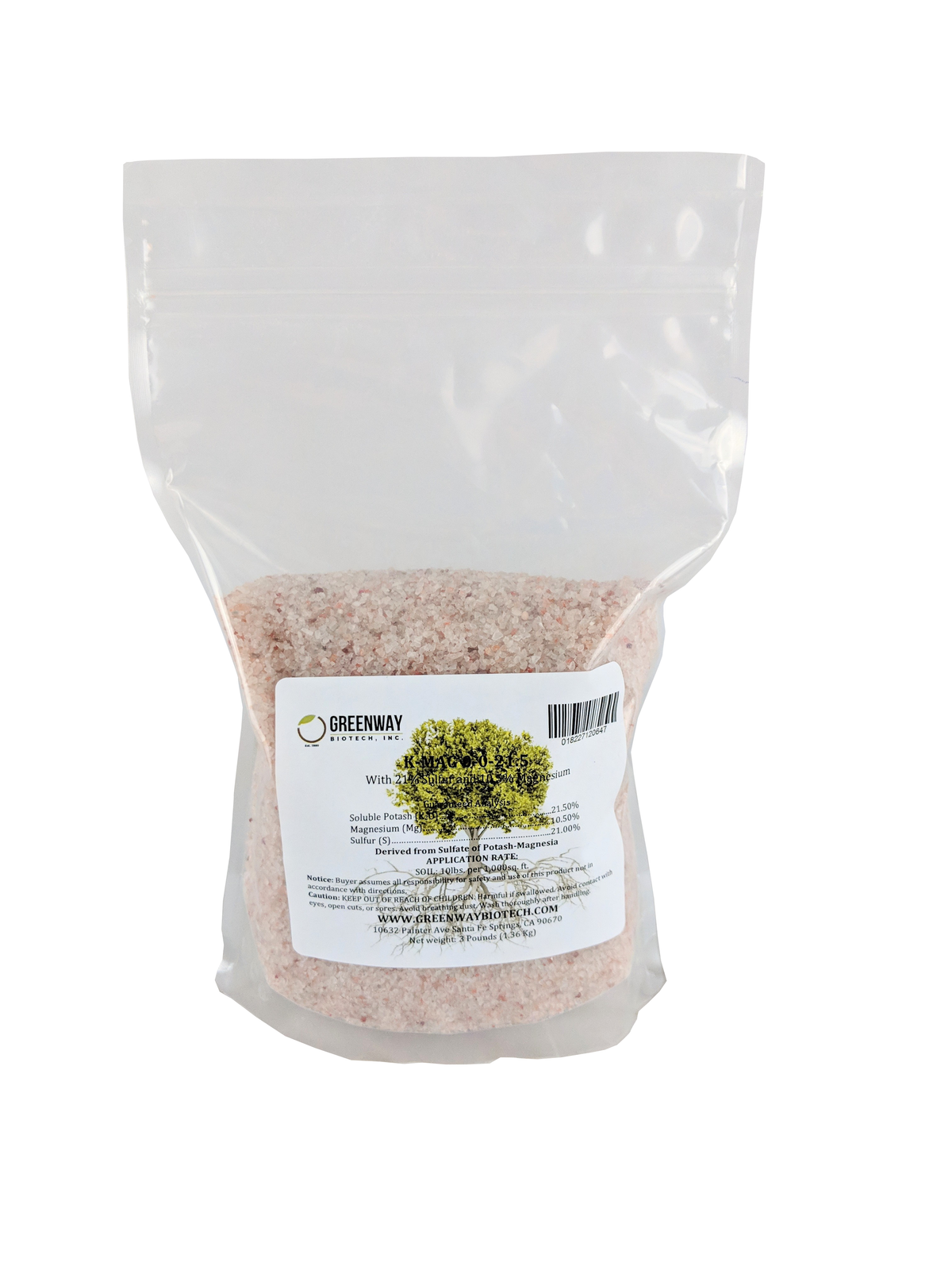
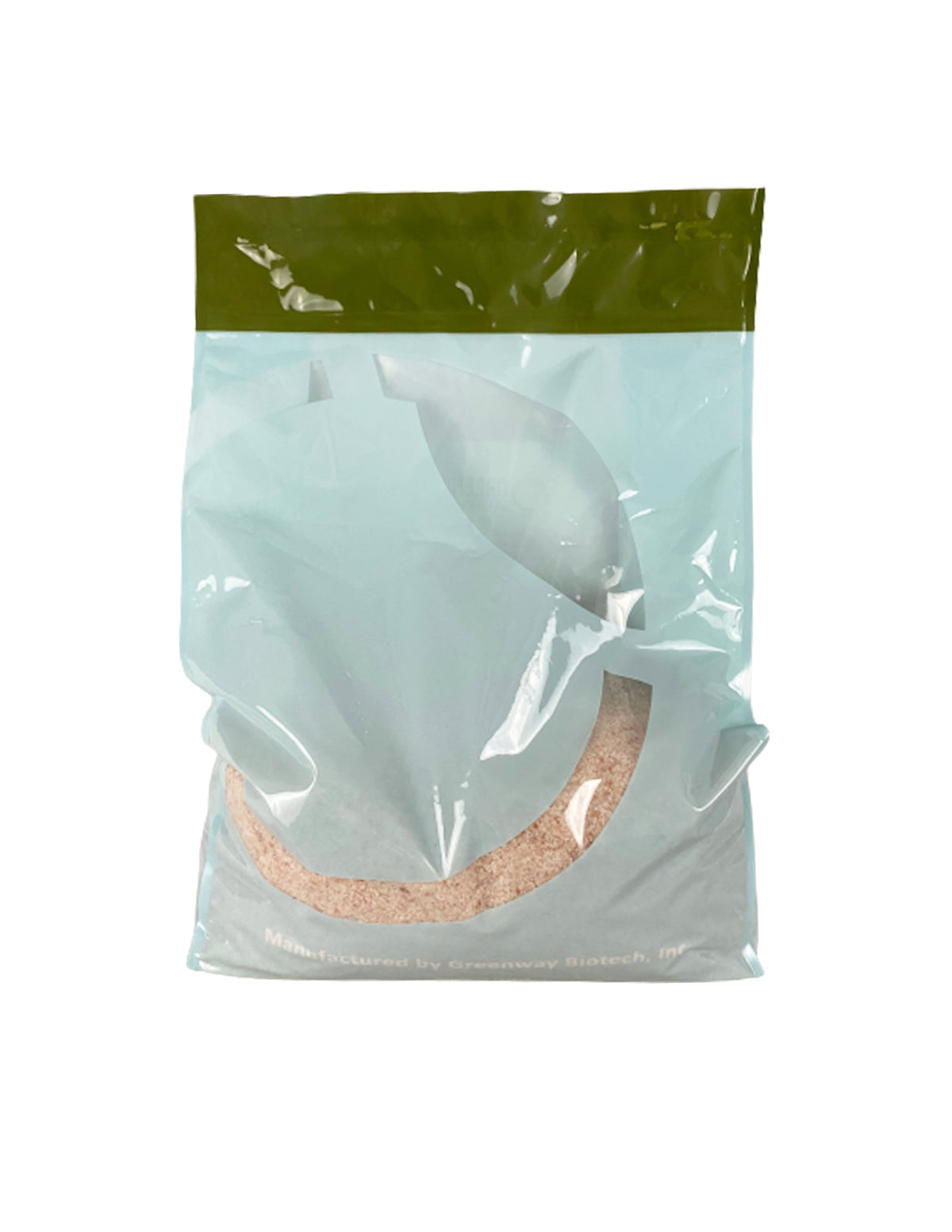
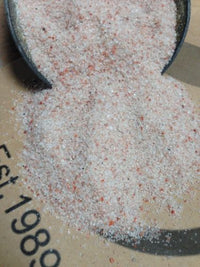
White to pinkish-gray granules, odorless; bulk density 83–94 lb per cubic foot (safety data sheet)
Solubility
Water-soluble, about 24% (240 g per liter) at room temperature, but the dense granules dissolve slowly (safety data sheet; International Plant Nutrition Institute). A 5% solution has a pH of about 7.0.
Salt index
43 per pound of product, against 116 for potassium chloride and 46 for potassium sulfate (University of Wisconsin A2521). Per unit of potash it is about the same as potassium chloride: 2.0 against 1.9 (International Plant Nutrition Institute).
Hazard classification (SDS, March 2026)
Not classified as hazardous. Dust can mechanically irritate the eyes, skin, nose, and throat.
Registration
CDFA-registered fertilizer
Package sizes
1, 2, 3, 5, 10, 20, 25, and 50 lb (the 50 lb size may ship as two 25 lb bags)
Packed by
Greenway Biotech, Inc., Madera, California
Percentages are by weight of product: 1 lb contains 0.22 lb (100 g) of potash as K₂O, 0.11 lb (50 g) of magnesium, and 0.22 lb (100 g) of sulfur, and a 25 lb bag contains 5.5 lb of potash, 2.75 lb of magnesium, and 5.5 lb of sulfur. Every rate on this page is product weight unless it says otherwise.
Best uses & benefits
Choose it when a test shows the need. Potassium and magnesium compete for uptake, so adding one that the soil already has in excess can create a shortage of the other; Penn State Extension notes that magnesium deficiency can develop in grapes when the soil potassium-to-magnesium ratio is above 3, and that excess magnesium can cause potassium deficiency.
Soil low in both potassium and magnesium
One product supplies both, plus sulfate sulfur, and because all three sit in the same granule they spread evenly together. The International Plant Nutrition Institute notes that the rate is often set by the crop’s magnesium or sulfur need, with any further potash from a more concentrated source.
Magnesium without changing soil pH
University of Minnesota Extension describes this fertilizer as a magnesium source “when there is no desire to increase soil pH,” and Mississippi State Extension recommends soluble magnesium sources when lime is not needed. Dolomite also adds magnesium, but it raises pH.
Low-chloride potash for sensitive crops
Oregon State Extension tells blueberry growers to avoid muriate of potash because chloride can reduce growth or injure the plants, and names sulfate of potash-magnesia where potassium and magnesium are both needed. Lettuce, strawberries, and apples are among the crops most sensitive to soil chloride.
Potatoes
University of Alaska Fairbanks Extension reports that a sulfate potash source often, though not always, gives tubers a higher specific gravity than potassium chloride, and lists this mineral as a magnesium source for potatoes on soil that tests low in magnesium.
Sulfur in the form plants use
The 22% sulfur is sulfate, the form roots take up, so it is available as the granules dissolve, without the weeks to months of bacterial conversion that elemental sulfur needs. It supplies sulfur without lowering soil pH.
Acid soil that needs lime. Mississippi State Extension says dolomitic lime can address magnesium deficiency when lime is required. Dolomite raises pH and adds calcium and magnesium in one step.
A large potash need on soil with enough magnesium. At 22% K₂O it takes about 4.5 lb of product to supply 1 lb of potash, against about 2 lb of potassium sulfate (UConn Soil Nutrient Analysis Laboratory), and the magnesium comes along whether you need it or not.
Sprayers, drip lines, fertigation, and hydroponics. The International Plant Nutrition Institute says the dense granules dissolve slowly and are not suited to fertigation unless finely ground. Use Potassium Sulfate, MKP 0-52-34, Epsom Salt for Plants, or Magnesium Nitrate 11-0-0 in solutions.
A quick fix for yellowing leaves. Soil-applied potash and magnesium work slowly; Oregon State notes that leaf potassium may take a year or two to change. A foliar magnesium sulfate spray, as Penn State Extension uses in vineyards, is the short-term fix while the soil is corrected.
Raising forage magnesium for grass tetany. University of Minnesota Extension reports grass tetany where high potash rates were applied to grass pastures, and found that supplementing the animals’ diet with a magnesium salt cost less than fertilizing. Talk to your veterinarian or livestock advisor.
Nitrogen. It contains none.
Application rates & directions
The amount depends on how much potassium and magnesium your soil already holds, so a soil test, or a soil and leaf test for blueberries, gives the best rate. Without a test, use the starting amounts for common plants further down. Rates come from the university Extension publications listed in section 13 and are converted to product weight with this product’s guarantee of 22% K₂O and 11% magnesium. Apply once, then retest before the next season.
Two numbers convert any soil test. Pounds of product = pounds of K₂O ÷ 0.22 (about × 4.5), or pounds of magnesium ÷ 0.11 (about × 9.1). Start from the nutrient your test calls for, and check that the other one is not already high. Weigh the product; spoon and cup measures are not converted.
From a soil test: potash (K₂O)
Potash recommendations converted to this product, one application; each pound of potash from this product also adds 0.5 lb of magnesium and 1 lb of sulfur
Soil test asks for
Product per 1,000 sq ft
Product per 100 sq ft
Magnesium it also adds per 1,000 sq ft
0.5 lb K₂O per 1,000 sq ft
2.3 lb
3.6 oz (103 g)
0.25 lb
1 lb K₂O per 1,000 sq ft
4.5 lb
7.3 oz (206 g)
0.5 lb
2 lb K₂O per 1,000 sq ft
9.1 lb
14.5 oz (412 g)
1 lb
3 lb K₂O per 1,000 sq ft
13.6 lb
1.36 lb (619 g)
1.5 lb
50 / 100 / 150 lb K₂O per acre
227 / 455 / 682 lb of product per acre
UConn’s Soil Nutrient Analysis Laboratory gives the same conversion for home gardens: 4.5 lb of sul-po-mag (0-0-22) supplies 1 lb of potash. Broadcast it evenly and mix it into the top few inches before planting, or spread it around established plants and water it in.
From a soil test: magnesium, fruits and vegetables
University of Minnesota Extension magnesium recommendations for fruit and vegetable crops (Table 3), broadcast, converted to this product
Soil test magnesium
Magnesium to apply
Product per acre
Product per 1,000 sq ft
Potash it also adds
Low, 0–50 ppm
100 lb per acre
909 lb
20.9 lb
200 lb K₂O per acre (4.6 lb per 1,000 sq ft)
Medium, 51–150 ppm
50 lb per acre
455 lb
10.4 lb
100 lb K₂O per acre (2.3 lb per 1,000 sq ft)
High, 151 ppm and above
None
None
None
—
For a band beside the row, the same table gives 20 lb of magnesium per acre on low-testing soil and 10 lb on medium (182 and 91 lb of product per acre). If your soil test shows potassium already high, supply the magnesium with Epsom Salt for Plants instead. If your soil pH is low enough to need lime, dolomite is the more economical magnesium source.
Blueberries
Oregon State University Extension potassium guidance for established blueberries (EM 8918), from soil and leaf tests
Soil test K
Leaf K
Potash to apply
0–100 ppm
Below 0.20%
75–100 lb K₂O per acre
101–150 ppm
0.21–0.40%
0–75 lb K₂O per acre
Above 150 ppm
Above 0.40%
None
Where both potassium and magnesium are needed, the same publication gives 400 lb of sulfate of potash-magnesia per acre, which is 9.2 lb per 1,000 sq ft or 14.7 oz (417 g) per 100 sq ft. Apply it in late fall or in spring before budbreak, and irrigate if no rain falls within 1 or 2 days. Oregon State advises applying potassium only when leaf analysis shows a deficiency, notes that excess potassium can interfere with magnesium uptake, and says to avoid muriate of potash on blueberries. Its home-garden guide adds that most garden soils hold enough potassium for blueberries.
Potatoes
University of Alaska Fairbanks Extension potassium recommendations for potatoes (FGV-00246A), Mehlich 3 soil test
Soil test K
Potash to apply
As this product alone
0–75 ppm
180 lb K₂O per acre
818 lb per acre (18.8 lb per 1,000 sq ft)
76–150 ppm
120 lb K₂O per acre
545 lb per acre (12.5 lb per 1,000 sq ft)
151–300 ppm
60 lb K₂O per acre
273 lb per acre (6.3 lb per 1,000 sq ft)
Above 300 ppm
None
None
Apply it before or at planting, banded or broadcast. Supplying all the potash from this product also adds 90, 60, or 30 lb of magnesium per acre, and the same publication says potatoes seldom need magnesium except on well-drained sandy soil, where it lists this mineral at 50–100 lb of magnesium per acre broadcast (455–909 lb of product) or 10–20 lb banded (91–182 lb of product). Where magnesium is not low, use potassium sulfate for the potash.
Without a soil test: starting amounts
A soil test gives the best amount. Without one, University Extension general garden guidelines use a complete fertilizer such as 10-10-10, and the amounts below supply the same potash from this product, plus the magnesium and sulfur that come with it. They supply no nitrogen or phosphate, so feed nitrogen as you normally would. Start at the low end of a range, apply once a season, and skip it if a past test showed potassium or magnesium high or if the plants already get a complete fertilizer that contains potash.
Vegetables, flowers, and berries without a soil test: the potash in Extension general garden rates, supplied by this product
Plant
Extension general rate
Potash it supplies
This product
When
Vegetables and annual flowers
10 lb of 10-10-10 per 1,000 sq ft (UMass)
1 lb K₂O per 1,000 sq ft
4.5 lb per 1,000 sq ft, or 7.3 oz (206 g) per 100 sq ft
Before planting, mixed into the soil
Perennial flowers
1 lb of 10-10-10 per 100 sq ft (UMass)
0.1 lb per 100 sq ft
7.3 oz (206 g) per 100 sq ft
Early spring
Strawberries, new bed
2 lb of 10-10-10 per 100 sq ft (UMass)
0.2 lb per 100 sq ft
14.5 oz (412 g) per 100 sq ft
Before planting
Strawberries, June-bearing
5 lb of 10-10-10 per 100 ft of row (Iowa State)
0.5 lb per 100 ft of row
2.3 lb per 100 ft of row
Right after the last harvest, at renovation
Raspberries and blackberries
4–5 lb of 10-10-10 per 100 ft of row (Iowa State)
0.4–0.5 lb per 100 ft of row
1.8–2.3 lb per 100 ft of row
Spring, before new growth
Grapes, fruit trees, and shrubs without a soil test: the potash in Extension general garden rates, supplied by this product
Plant
Extension general rate
Potash it supplies
This product
When
Grapes, only with weak growth or pale leaves
½ lb of 10-10-10 per vine (Iowa State)
0.05 lb per vine
3.6 oz (103 g) per vine
Early spring
Young apple, plum, or cherry trees
½ lb of 10-10-10 per year of tree age (UMass)
0.05 lb per year of age
3.6 oz (103 g) per year of age
Mid-April to early May; not at planting
Young pear trees
¼ lb of 10-10-10 per year of tree age (UMass)
0.025 lb per year of age
1.8 oz (52 g) per year of age
Mid-April to early May; not at planting
Young peach trees
1 lb of 10-10-10 per year of tree age (UMass)
0.1 lb per year of age
7.3 oz (206 g) per year of age
Mid-April to early May; not at planting
Mature apple, plum, cherry, or pear trees
5–8 lb of 10-10-10 per tree (UMass)
0.5–0.8 lb per tree
2.3–3.6 lb per tree
Mid-April to early May
Mature peach trees
7–10 lb of 10-10-10 per tree (UMass)
0.7–1 lb per tree
3.2–4.5 lb per tree
Mid-April to early May
Shrubs, single plants
½–1 lb of 10-10-10 per shrub (UMass)
0.05–0.1 lb per shrub
3.6–7.3 oz (103–206 g) per shrub
Mid-April to mid-May
Shrub beds
2–4 lb of 10-10-10 per 100 sq ft (UMass)
0.2–0.4 lb per 100 sq ft
0.9–1.8 lb per 100 sq ft
Mid-April to mid-May
Spread tree amounts in a band from 2 to 3 feet out from the trunk to just past the drip line. Iowa State Extension notes that trees growing near a regularly fertilized lawn usually need nothing more, and that young trees growing 15 to 30 inches a year and bearing trees growing 8 to 15 inches a year are getting enough. These starting amounts add little magnesium: the vegetable rate adds 0.5 lb per 1,000 sq ft, less than half of what University of Minnesota recommends for soil testing medium in magnesium. Test the soil every few years to see whether to keep applying it. For blueberries, follow the leaf-test guidance above instead.
Not for sprays, drip, or hydroponics
The granules dissolve too slowly for sprayers, injectors, and reservoirs. For dissolved potash use Potassium Sulfate or MKP, and for dissolved magnesium use Epsom Salt for Plants or Magnesium Nitrate.
Keep it off seeds and stems. Spread it evenly and mix it in or water it in. Do not pile granules against stems or trunks or drop them in the seed furrow, and do not exceed the amount your test or the starting amount calls for.
How to use sulfate of potash magnesia
Test first if you can. Get a soil test that reports potassium, magnesium, and pH; for blueberries and other fruit, add a leaf test. Without one, use the starting amounts for your plant in section 4. Magnesium deficiency shows as yellowing between the veins of older leaves first, and potassium deficiency as scorched leaf edges, but salinity and root problems look similar.
Pick the rate. Convert the potash or magnesium your test asks for with the formulas in section 4, and check that the other nutrient is not already high, or pick your plant’s starting amount. If the soil needs lime, use dolomite instead.
Measure and weigh. Measure the bed, row, or field, or count the plants, and weigh the product on a scale; do not use spoon or cup measures.
Spread and work it in. Broadcast evenly before planting and mix it into the top few inches, or spread it around established plants, keep it off stems, and water it in. For blueberries, apply in late fall or in spring before budbreak.
Check before applying again. Potassium moves slowly in soil, and Oregon State notes that leaf levels may take a year or two to respond. Retest the soil, and the leaves for fruit crops, before the next application; without a test, apply no more than once a season.
Calculator & choosing a size
Formulas. From a potash recommendation: product (lb) = lb of K₂O ÷ 0.22. From a magnesium recommendation: product (lb) = lb of magnesium ÷ 0.11. For an area: product = rate per 1,000 sq ft × square feet ÷ 1,000, or rate per acre × square feet ÷ 43,560. Blueberries needing both nutrients: 400 lb per acre, or 9.2 lb per 1,000 sq ft. Without a soil test: the starting amount for your plant from section 4 × square feet ÷ 100, feet of row ÷ 100, or number of plants. Multiply pounds by 453.6 for grams.
Worked examples. A soil test asks for 2 lb of K₂O per 1,000 sq ft on a 300 sq ft bed: 2 ÷ 0.22 × 0.3 = 2.73 lb, which also adds 0.30 lb of magnesium; a 3 lb bag. An 800 sq ft vegetable garden testing medium in magnesium: 455 lb per acre × 800 ÷ 43,560 = 8.35 lb; a 10 lb bag. A 500 sq ft blueberry planting whose soil and leaf tests call for both nutrients: 9.2 lb × 0.5 = 4.6 lb; a 5 lb bag. Without a test, a 200 sq ft vegetable bed: 7.3 oz × 2 = 14.5 oz (0.91 lb); a 1 lb bag. A 4-year-old apple tree: 3.6 oz × 4 = 14.5 oz; a 1 lb bag.
What each bag covers at three of the rates on this page
Bag
1 lb K₂O per 1,000 sq ft from a soil test, or vegetables without a test (4.5 lb of product)
Medium magnesium, fruits and vegetables (10.4 lb per 1,000 sq ft)
Blueberries needing K and Mg (9.2 lb per 1,000 sq ft)
1 lb
220 sq ft
96 sq ft
109 sq ft
2 lb
440 sq ft
192 sq ft
218 sq ft
3 lb
660 sq ft
287 sq ft
327 sq ft
5 lb
1,100 sq ft
479 sq ft
545 sq ft
10 lb
2,200 sq ft
958 sq ft
1,089 sq ft
20 lb
4,400 sq ft
1,917 sq ft
2,178 sq ft
25 lb
5,500 sq ft
2,396 sq ft
2,723 sq ft
50 lb
11,000 sq ft
4,792 sq ft
5,445 sq ft
About the calculator. Choose how your recommendation is written: a potash amount from a soil test, a magnesium amount from a soil test, a fruit and vegetable soil test magnesium level (University of Minnesota), blueberries whose soil and leaf tests call for both nutrients (Oregon State), or, without a test, your plant and the starting amount from section 4. It converts the rate to product weight, starting at the low end of a range, shows the potash, magnesium, and sulfur that amount supplies, and warns when the second nutrient may not be needed. Bag suggestions use the current price and stock of all eight sizes, 1 to 50 lb, and the 50 lb size counts as 50 lb. Tax and shipping are added at checkout.
The calculator needs JavaScript. If it does not appear, use the formulas, examples, and table above to choose a size.
How sulfate of potash magnesia works
Langbeinite is a double sulfate of potassium and magnesium that formed as seabed salts evaporated millions of years ago. The International Plant Nutrition Institute describes it as mined from underground deposits, washed, and sized. In moist soil each granule dissolves into potassium, magnesium, and sulfate ions, the same forms that roots take up from any soluble potash, magnesium, or sulfate fertilizer. None of the three ions acidifies or neutralizes soil, which is why its effect on pH is neutral, and because the granules are dense they dissolve more slowly than potassium chloride or potassium sulfate granules even though the mineral itself is quite soluble.
Potassium regulates water movement and the opening of leaf pores, activates many enzymes, and moves sugars into fruit and tubers; a shortage shows first as scorched edges on older leaves. Magnesium sits at the center of every chlorophyll molecule and moves out of old leaves when supply runs short, so deficiency appears as yellowing between the veins of the older leaves. Sulfur is built into proteins. Because potassium and magnesium compete for uptake, a soil heavily loaded with one can starve the plant of the other, which is why supplying them together in proportion helps on soils low in both, and why it can hurt on soils already high in either.
Its low chloride content matters for crops that chloride injures, and its salt index per pound is far lower than that of potassium chloride. Per pound of potash delivered, though, the salt effect is about the same as potassium chloride, because each pound of potash comes with magnesium sulfate. The evidence on this page concerns langbeinite as an ingredient; it is not a trial of this finished product.
Compare your options
Which product fits depends on which nutrient your soil test is short of, whether the soil needs lime, and whether you will apply it dry or dissolved. Analyses are each product’s label guarantee.
Sulfate of Potash Magnesia 0-0-22 compared with other potassium and magnesium sources
Option
Supplies
Choose it when
Limitation
Sulfate of Potash Magnesia 0-0-22, this product
22% K₂O, 11% Mg, 22% S; chloride under 2.5%
Soil low in both potassium and magnesium, magnesium without a pH change, chloride-sensitive crops
Dilute potash; adds magnesium whether needed or not; dissolves slowly, soil use only
Add a companion only when your soil test shows the need; none is required with this product.
Potassium Sulfate 0-0-53: the rest of the potash where the crop needs more potassium than this product should supply without overloading magnesium.
Epsom Salt for Plants: magnesium alone, and a foliar spray as a short-term fix while the soil is corrected.
Ammonium Sulfate 21-0-0: nitrogen with sulfur, which this product lacks; it acidifies soil over time, which suits blueberries and other acid-loving plants.
Dolomite: in place of this product when the soil test calls for lime as well as magnesium.
Same program is not the same tank. This product goes on soil dry, so it is not mixed into spray or injector tanks. Do not dissolve it together with calcium fertilizers such as calcium nitrate in a concentrate, because calcium and sulfate form gypsum, which settles out. The safety data sheet lists strong oxidizers and strong acids as incompatible, and notes that the product is mildly corrosive to metal when wet.
Handling, storage & limitations
Classification (SDS, March 2026). Not classified as hazardous under GHS or OSHA. Dust can mechanically irritate the eyes, skin, nose, and throat.
Protective equipment. Safety glasses or goggles and cloth or leather gloves; an N95 or P100 respirator when dust is heavy. Wash your hands after handling.
Storage. Cool, dry, well-ventilated place in the sealed original bag; the product absorbs moisture from the air. Away from strong oxidizers and strong acids, and out of reach of children and animals.
Equipment. Wet product is mildly corrosive to metal, so rinse and dry spreaders after use.
Spills and water. Sweep up spills while avoiding dust, and keep product out of storm drains, sewers, and waterways. Large spills can injure or kill plants.
Application limits. Soil use only, at the amount a soil test calls for. One application, then retest. Not for sprayers, drip lines, or hydroponic reservoirs.
First aid (from the safety data sheet). Eyes: flush with clean water for at least 15 minutes, holding the eyelids open; get medical attention if irritation persists. Skin: wash with mild soap and water and remove contaminated clothing. Inhaled: move to fresh air. Swallowed: do not induce vomiting; for large amounts get emergency care. Poison Control: 1-800-222-1222.
Disposal. Recover or reuse spilled product where possible; otherwise dispose of it according to local, state, and federal rules.
California Proposition 65 warning (from the safety data sheet): this product can expose you to chemicals listed under Proposition 65. For more information go to www.P65Warnings.ca.gov.
The full handling and first-aid directions are in the Safety Data Sheet.
Frequently asked questions
What is sulfate of potash magnesia? Is it the same as langbeinite or K-Mag?
Sulfate of potash magnesia is the fertilizer name for langbeinite, a naturally mined potassium magnesium sulfate mineral, K₂SO₄·2MgSO₄. This product supplies 22% potash (K₂O), 11% magnesium, and 22% sulfur, with less than 2.5% chloride. K-Mag and Sul-Po-Mag are trade names other companies use for langbeinite fertilizers; this is Greenway Biotech’s product.
How much should I use?
A soil test gives the best amount: divide the pounds of potash (K₂O) it asks for by 0.22, or the pounds of magnesium by 0.11, to get pounds of product. For example, 1 lb of K₂O per 1,000 sq ft takes 4.5 lb of product, and fruit or vegetable soil testing medium in magnesium takes about 10.4 lb per 1,000 sq ft (University of Minnesota). Without a test, start with the same potash as Extension general garden rates: 4.5 lb per 1,000 sq ft (7.3 oz per 100 sq ft) for vegetables and annual flowers before planting, 2.3 lb per 100 ft of row for June-bearing strawberries after harvest, 3.6 oz per year of age for young apple trees, and 3.6 oz per vine for grapes with weak growth. Section 4 lists more plants.
Should I use this or Epsom salt for magnesium?
Use this product when your soil test shows potassium is also low or medium, because it supplies both. Use Epsom salt for plants when potassium is already adequate or high, because adding potassium you do not need can reduce magnesium uptake. Epsom salt also dissolves completely, so it is the choice for a foliar spray or a nutrient solution, while this product is for spreading on soil.
Should I use this or potassium sulfate?
Both are low-chloride potash sources. Choose this product when the soil also needs magnesium. Choose potassium sulfate when magnesium is adequate, when you need a lot of potash, or when you want to dissolve it for drip, foliar, or hydroponic use: it carries 53% K₂O against 22%, and it adds no magnesium.
Will it change my soil pH?
No. It is pH neutral: a 5% solution has a pH of about 7, and the International Plant Nutrition Institute describes it as neither acidifying nor liming. That is why University of Minnesota Extension recommends it as a magnesium source when you do not want to raise soil pH. To raise pH and add magnesium, use dolomite; to lower pH, use elemental sulfur.
Is it a slow-release fertilizer?
Not in the sense of a coated or controlled-release product. The mineral is water-soluble, about 24% at room temperature, but its dense granules dissolve more slowly than potassium chloride or potassium sulfate granules. The nutrients become available as the granules dissolve in moist soil, so water it in after spreading.
Can I dissolve it for a foliar spray, drip system, or hydroponics?
It is not a good choice for any of them. The granules dissolve slowly and can leave residue that clogs sprayers and emitters, and the International Plant Nutrition Institute says it is not suited to fertigation unless finely ground. For dissolved potash use Potassium Sulfate or MKP 0-52-34, and for dissolved magnesium use Epsom Salt for Plants or Magnesium Nitrate 11-0-0.
Is it a good potash for blueberries and other chloride-sensitive crops?
Yes, when a test shows the need. It contains less than 2.5% chloride, and Oregon State Extension names sulfate of potash-magnesia for blueberries that need both potassium and magnesium, while warning against muriate of potash. Oregon State also advises applying potassium to blueberries only when leaf analysis shows a deficiency, because most garden soils already have enough.
Can I use it in organic production?
Langbeinite is a mined mineral, and the International Plant Nutrition Institute notes that some sources are certified for organic production in some countries. This product is not sold with an organic listing, so check with your certifier before using it on certified ground.
Is it safe around children and pets?
It is not classified as hazardous, but the dust can irritate eyes, skin, and airways, and it should not be eaten. Store the bag sealed and out of reach of children and animals, wear gloves and safety glasses when spreading, water it in, and sweep up spills. If a large amount is swallowed, get emergency care and call Poison Control at 1-800-222-1222.
Articles give background. For this product, use the directions and documents on this page.
Product documents & sources
Safety Data Sheet (PDF, March 2026): composition, physical properties, handling, storage, first aid, disposal, and the California Proposition 65 statement.
Product label and heavy-metal test results: available on request. Email questions@greenwaybiotech.com with the product name and we will send the current documents.
Where the rates and statements on this page come from
The rates come from the university Extension publications below, converted to this product’s 22% potash and 11% magnesium guarantee; the starting amounts without a soil test give the same potash as those publications’ general 10-10-10 rates. The publications explain soil fertility and do not certify or endorse this product.
UMass Extension, Fertilizing Guidelines: the general 10-10-10 rates for vegetables, flowers, strawberries, fruit trees, and shrubs behind the starting amounts without a soil test.
Not sure whether your soil needs potassium, magnesium, or both, or how to read your soil test? Email your crop, soil test results, and area to questions@greenwaybiotech.com or call (562) 351-5168, Monday to Friday, 9 AM to 3 PM Pacific, and we will work through it with you. Every order carries a 90-day satisfaction guarantee, and Standard shipping is free on orders over $100 to the continental US.
Greenway Biotech, Inc. has been a family-owned fertilizer company in California since 1989. This product is packed at our facility in Madera, California, and is a CDFA-registered fertilizer.
5 stars: 18 (90%)
4 stars: 1 (5%)
3 stars: 0 (0%)
2 stars: 0 (0%)
1 star: 1 (5%)
C
Chris Moses
Always the best quality!
A
Anonymous
Love It!
Love it!
A
Anonymous
Sulfate of potassium magnesium
I love it!. Add it to myrose fertilizer regime. Plants look much nicer
S
Steven Schlesser
It’s to soon
Won’t be able to evaluate my overall experience for about 2-3 months, when our fruit trees have produced the harvest. Sorry !
m
marian sarosiek
Super Serwis
great product Super Serwis
B
BARRY JOHNSON
Order Processing and Delivery
5 Stars - the ordering process was easy and the delivery process was seamless and without fault - the product packaging was excellent and survived the pummeling given the usps boxes (4) - it’s too soon to speak of how the product works as it has only been applied for 3 days
P
Peter Geraci
Good
Hard to get 50 pounds of potatoes delivered to Maui but they did it, and free. Shipped in four different USPS arrived in a couple days, very nice. A lot of so-called businesses don’t know that the United States Postal Service services Hawaii
H
Hsiao Chiang
Great
Decent price. Fast shipping. Great experience. Thanks.
J
Joseph Wisgirda
Bag was split open upon arrival
Poorly packed, thrown in a box with no padding and shipped. Made a huge mess and lost a lot due to spillage.
G
George Hansen
An effective product that is easy to apply
I ordered on Monday and shipment reached SE PA Friday afternoon by USPS. The two bags were each boxed and boxes were tapped well. Great service !
The granules were dense but very free flowing through my Earthway Evn Spread broadcast spreader. I poured in only a half bag at a time and used the lowest possible setting opening and it was still easy see the spread range. After application we fortunately had a lot of rain which resulted in a very noticeable thickening in the weaker areas of my lawn.
I plan to make a winter application in mid November.
Regards,
George
S
Suzanne Horn
Great product for use on my 500+ roses
I was so pleased with this product that I have ordered it twice. I grow roses in containers and potassium leaches out of the pots quickly. This product allows me to supplement the potassium in the pots for the health of my roses. The product was shipped quickly and well packed. Excellent seller. I plan to order again in the future.
S
Suzanne Horn
Great product shipped quickly and reasonably priced.
This is an excellent product that I will surely be buying again from this seller. It was well packed and quickly shipped. AAA+ rating.
C
Carter Ferguson
Good service!
I was very pleased with your order and delivery process.
The tracking and communications were timely and helpful.
I have used the product and think it will help my gardening issues.
I would recommend this vendor and will use again.
Many thanks
d
diane Lane
Satisfied
Overall. time will tell.However I will be purchasing again.
G
Gloria Barr
Grate We need more Arbivita’s
Grate
We need more Arbivita’s
S
Steven S.
very good no complaints
very good no complaints
B
BRYAN S.
great fertilizer
great source of mg for tomatoes
J
Joanne h.
great service and product
I have yet to see results but my garden soil was so lacking in the nutrients that Sul-Po-Mag delivers and I could not find the product anywhere locally that matched this fertilizer so ordered this and very pleased with the service. I will certainly choose to do business again with you!
L
Lori L.
Good purchase!
Very quick shipping and good communication.
B
Bryan F.
Spot On
Got it fast ! Great product
R
Robin
I have a 1/2 acre St Augustine yard in Houston Tx. My soils test showed I need K-Mag. What rate should I apply your product?
Greenway Biotech, Inc.
The full turf rate is 4.55 lbs of K-Mag per 1,000 sq ft, which puts 1 lb of potash per 1,000. A half acre is about 21,780 sq ft, so roughly 99 lbs, or two 50 lb bags. If your soil test only calls for a light correction, half that, about 50 lbs, is a good maintenance rate. Broadcast it evenly with a spreader and water it in. It's slow release, so one application covers you for the season.
My MSM is decreasing my osteoarthritis pain, especially in my hands
My product arrived intact. I started taking it as soon as I went into the kitchen. I mixed it with my daily Metamucil, but there was no discernible taste. I am working on making it a habit each morning. The pain from my osteoarthritis, especially in my hands, is decreasing. I expect it to continue to improve. Thank you for my MSM.
You did not send me MSM Powder, you sent me Magnesium Chloride powder. I tried contacting you 3 times, by email & phone and you didn't have the courage & honesty to return my messages & rectify the situation. I even offered to text you a photo of the mag chloride.