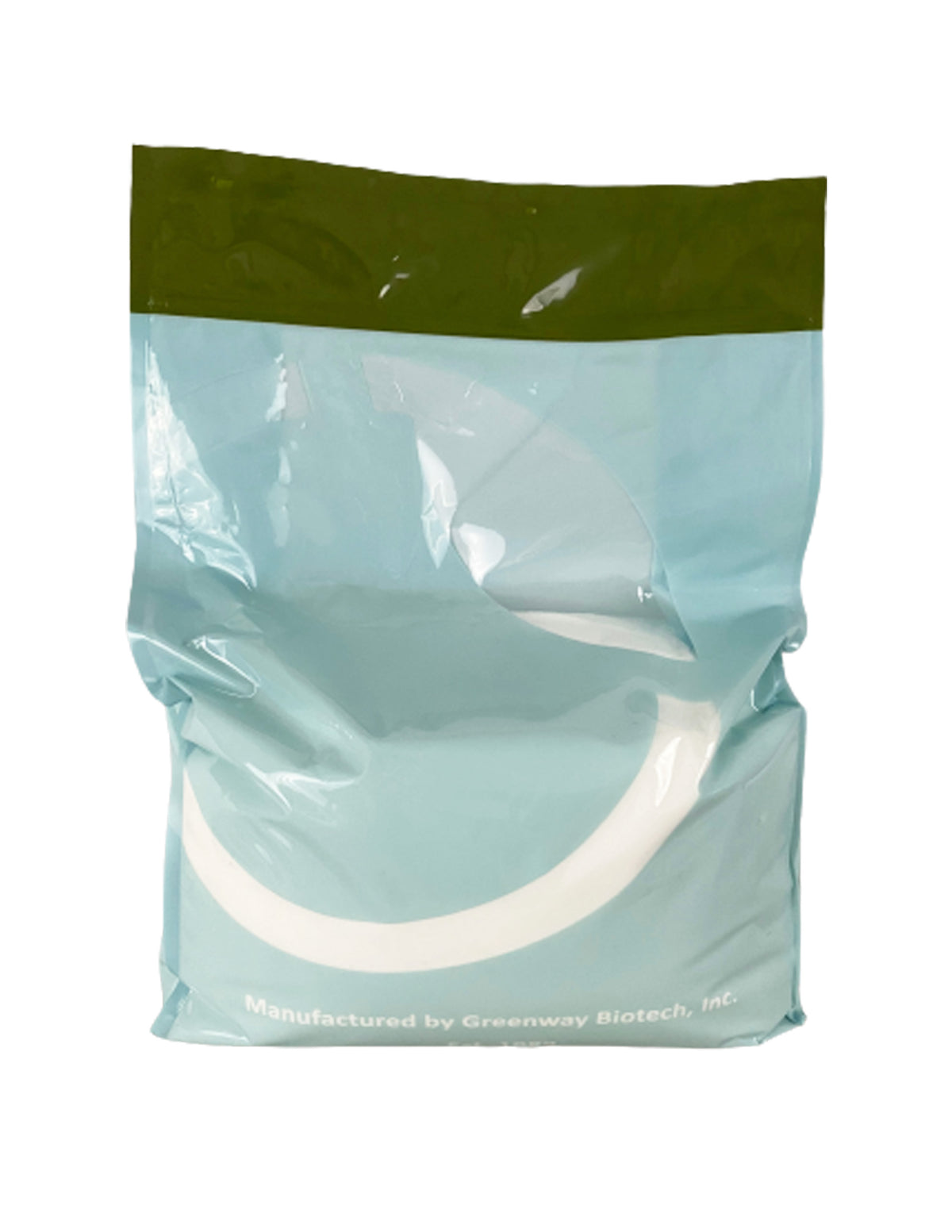
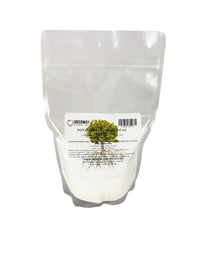
Continental US, Standard shipping: free on orders of $100 or more, $9.99 on orders under $50, and $14.99 from $50 up to $100.
UPS and FedEx options are also offered at checkout, at their own rates.
Orders placed by 11 AM Pacific on a business day ship the same day.
Alaska, Hawaii, US territories, APO/FPO and international addresses: the cost is shown at checkout, and 2-day delivery isn’t available to Alaska, Hawaii or P.O. boxes.
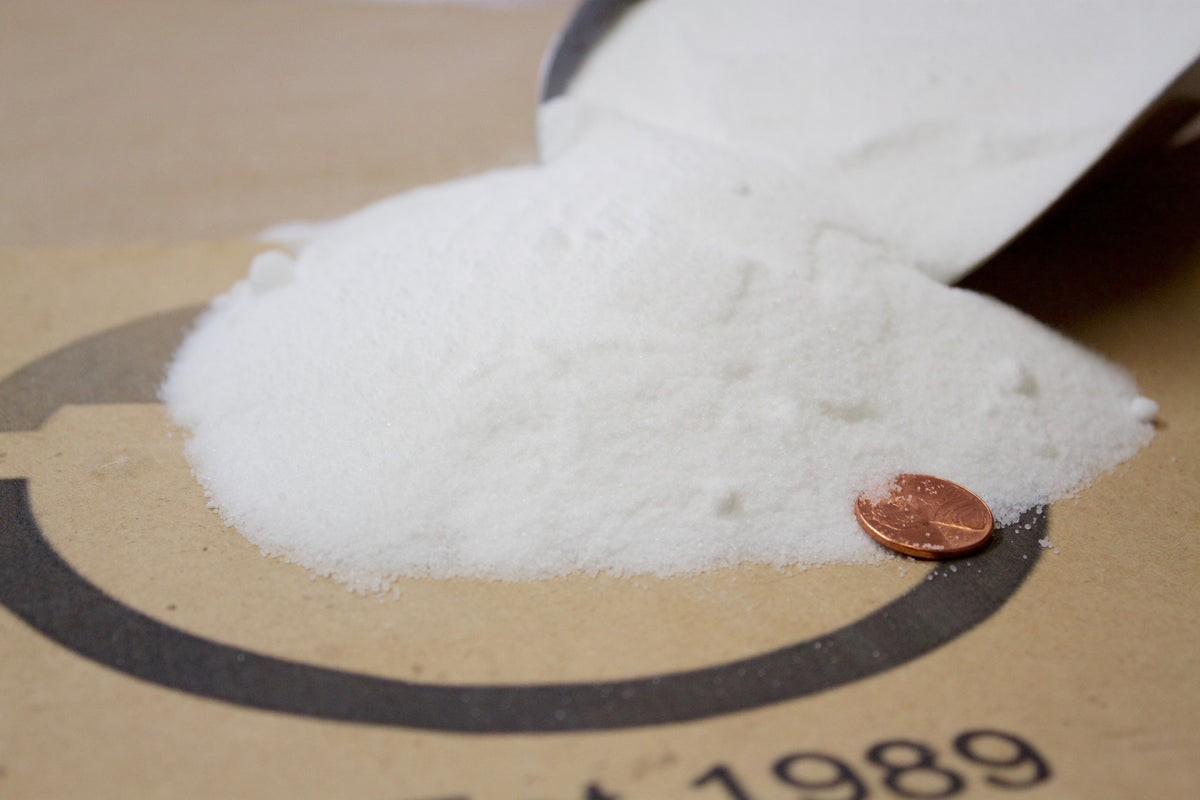
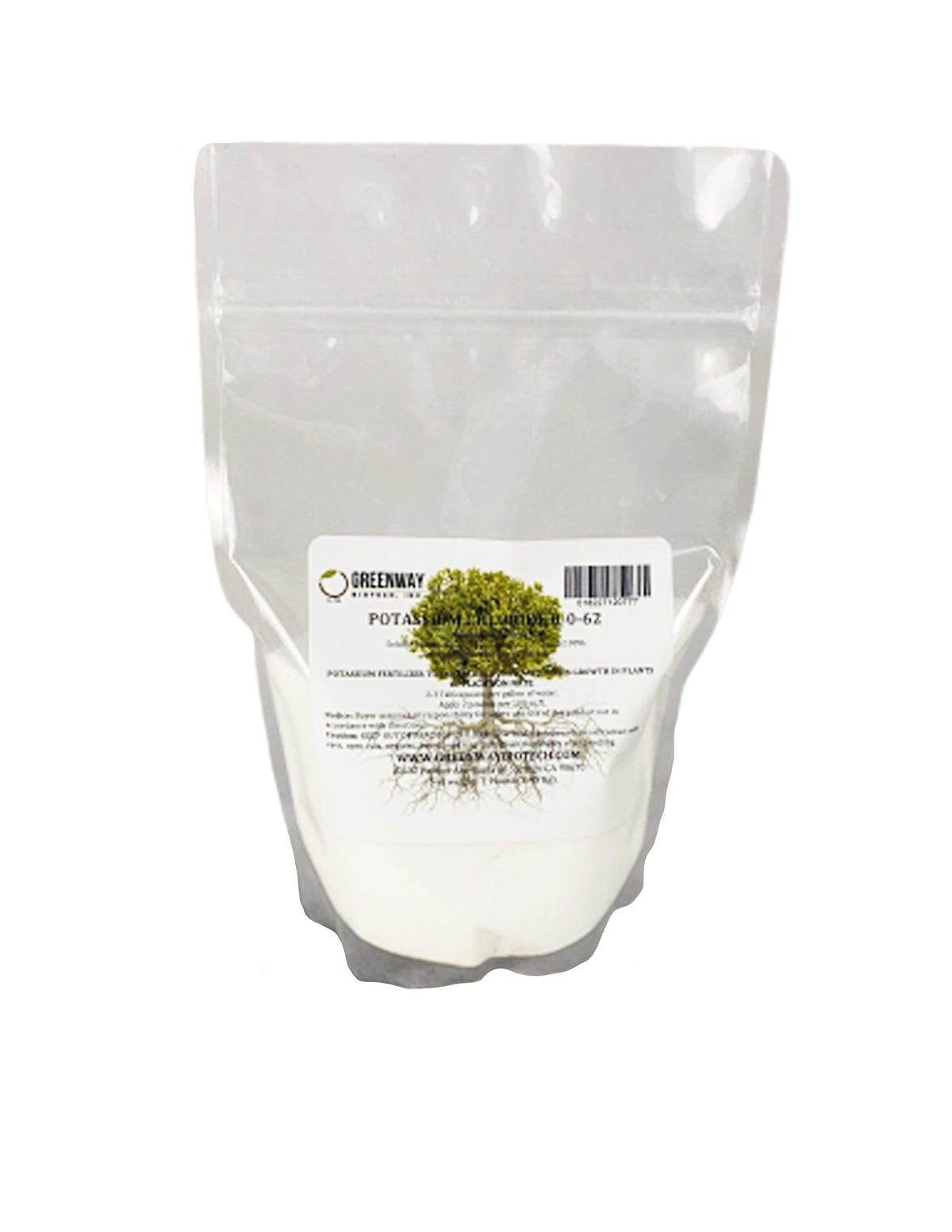
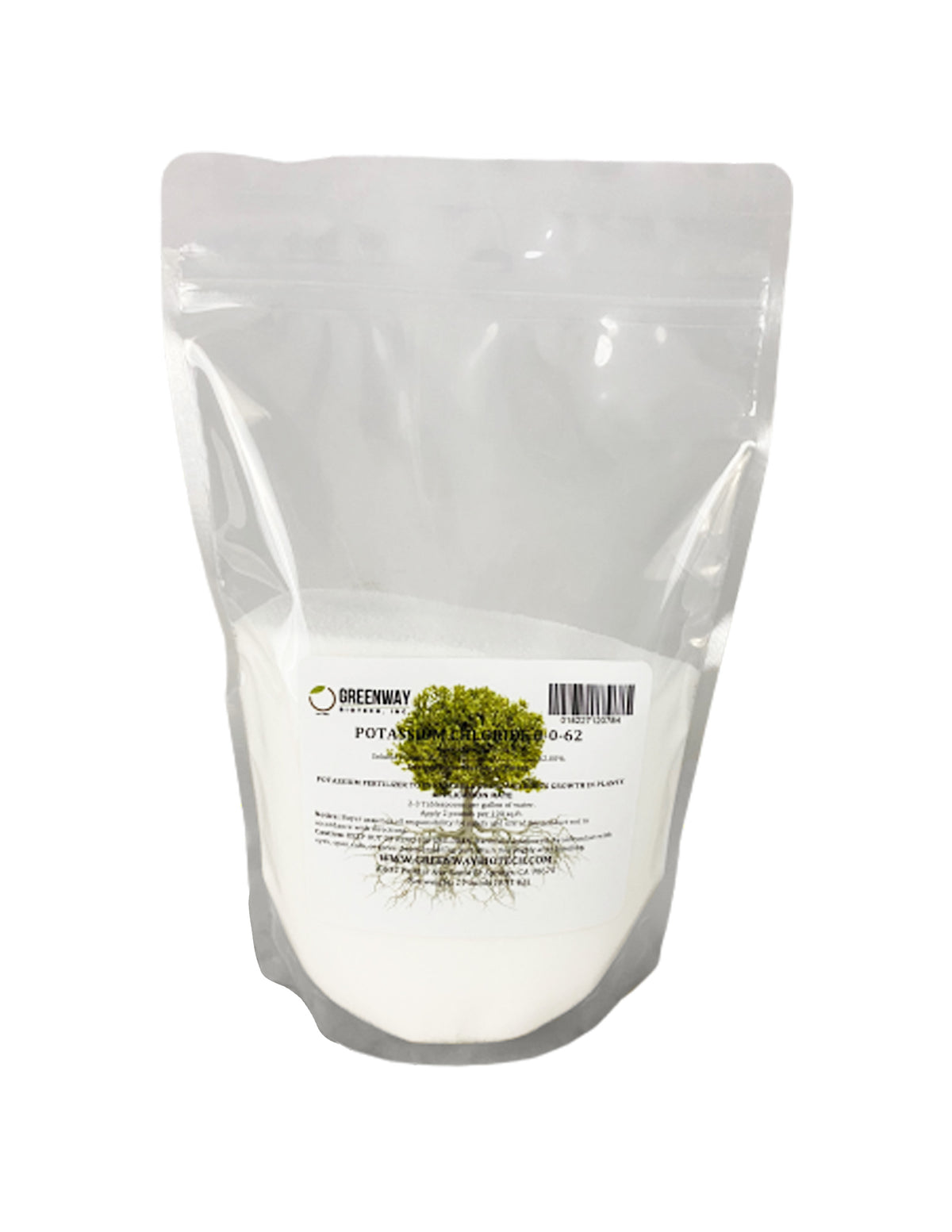
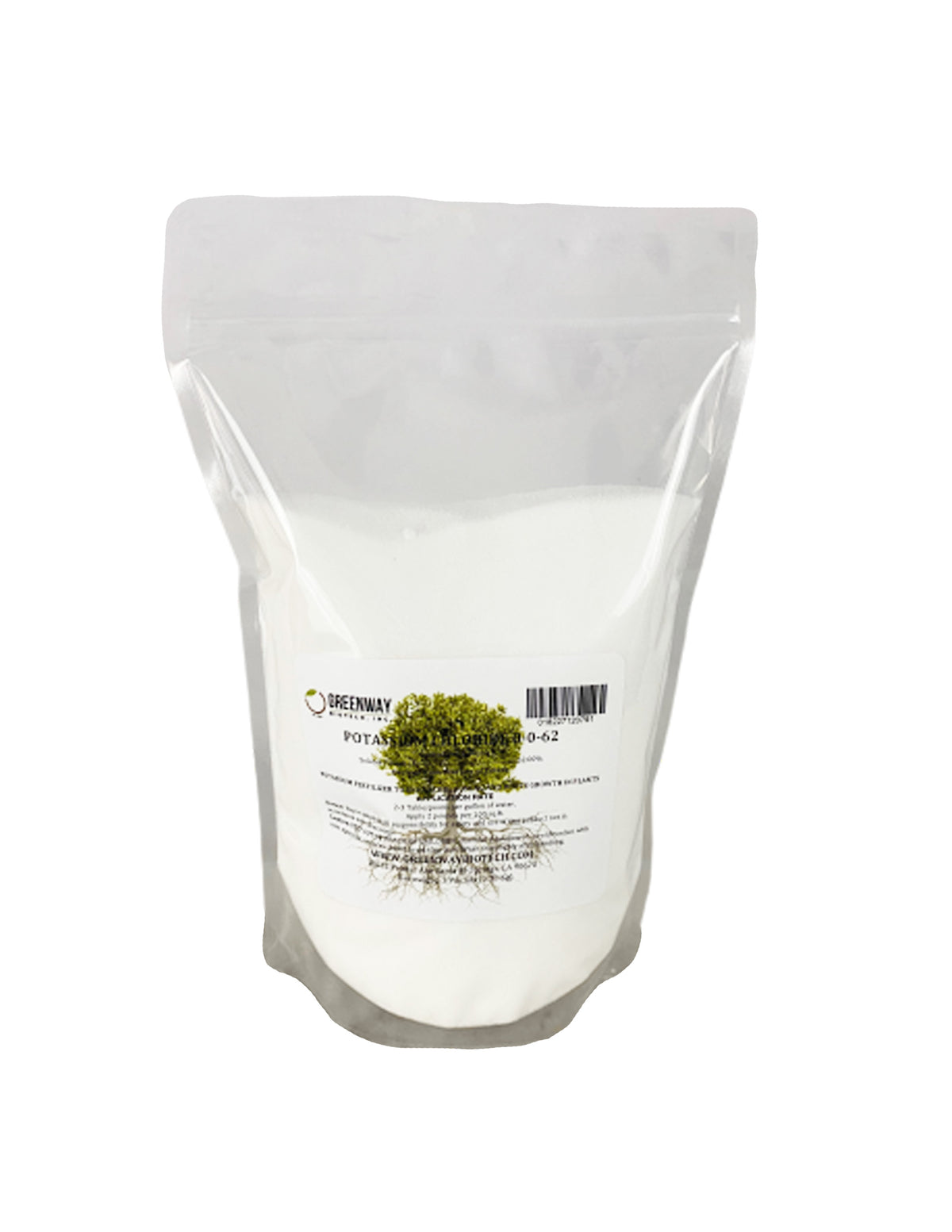
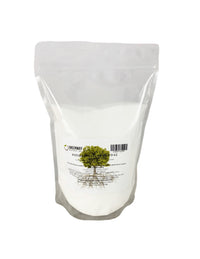
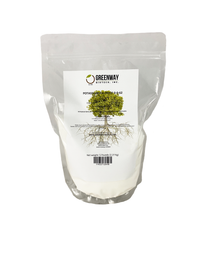
Potassium chloride, also called muriate of potash (MOP), is the most concentrated common potassium fertilizer: a water-soluble salt that guarantees 62% soluble potash (K₂O) and no other nutrient. Use it where a soil test shows potassium is low on lawns, field crops, and chloride-tolerant vegetables and flowers, spread on the soil and watered in, or dissolved for drip irrigation of tolerant crops.
Two things decide whether it fits. About 47% of the product is chloride, which lettuce, strawberries, beans, potatoes, grapes, fruit trees, and other woody plants tolerate poorly; for those, choose a sulfate source. And it has the highest salt index of any common dry fertilizer, so keep it away from seeds and young roots, stay within the rates on this page, and water it in.
62% K₂O Guaranteed soluble potash, the highest of the common potassium fertilizers. No nitrogen or phosphate
About 47% chloride Fine for lawns, corn, small grains, and many vegetables; the wrong choice for chloride-sensitive plants
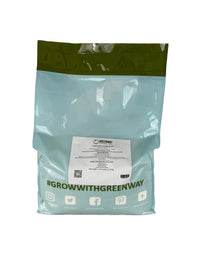
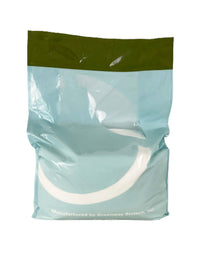
1–50 lb bags Eight sizes; the calculator turns your bed, lawn, field, or drip tank into an amount and a bag size
Product facts & composition
Guaranteed analysis and product specifications, Greenway Biotech Potassium Chloride 0-0-62
Specification
Detail
Soluble potash (K₂O)
62% (guaranteed analysis), equal to about 51.5% potassium (K)
Derived from
Muriate of potash (potassium chloride, KCl, CAS 7447-40-7)
Chloride
About 47% by weight. Not guaranteed; worked out from the composition below
None. This is a potassium source, not a complete fertilizer.
Salt index
116, the highest of the common dry fertilizers (University of Wisconsin A2521; USDA technical report)
Solubility
34.2 g per 100 mL of water at 68°F (20°C) (safety data sheet)
Physical form
Crystalline solid; absorbs moisture and cakes above about 72% relative humidity; bulk density 64–75 lb per cubic foot (safety data sheet)
Hazard classification (SDS)
Not classified as hazardous under OSHA HazCom 2012; dust may irritate the eyes, skin, nose, and throat
Registration
CDFA-registered fertilizer
Package sizes
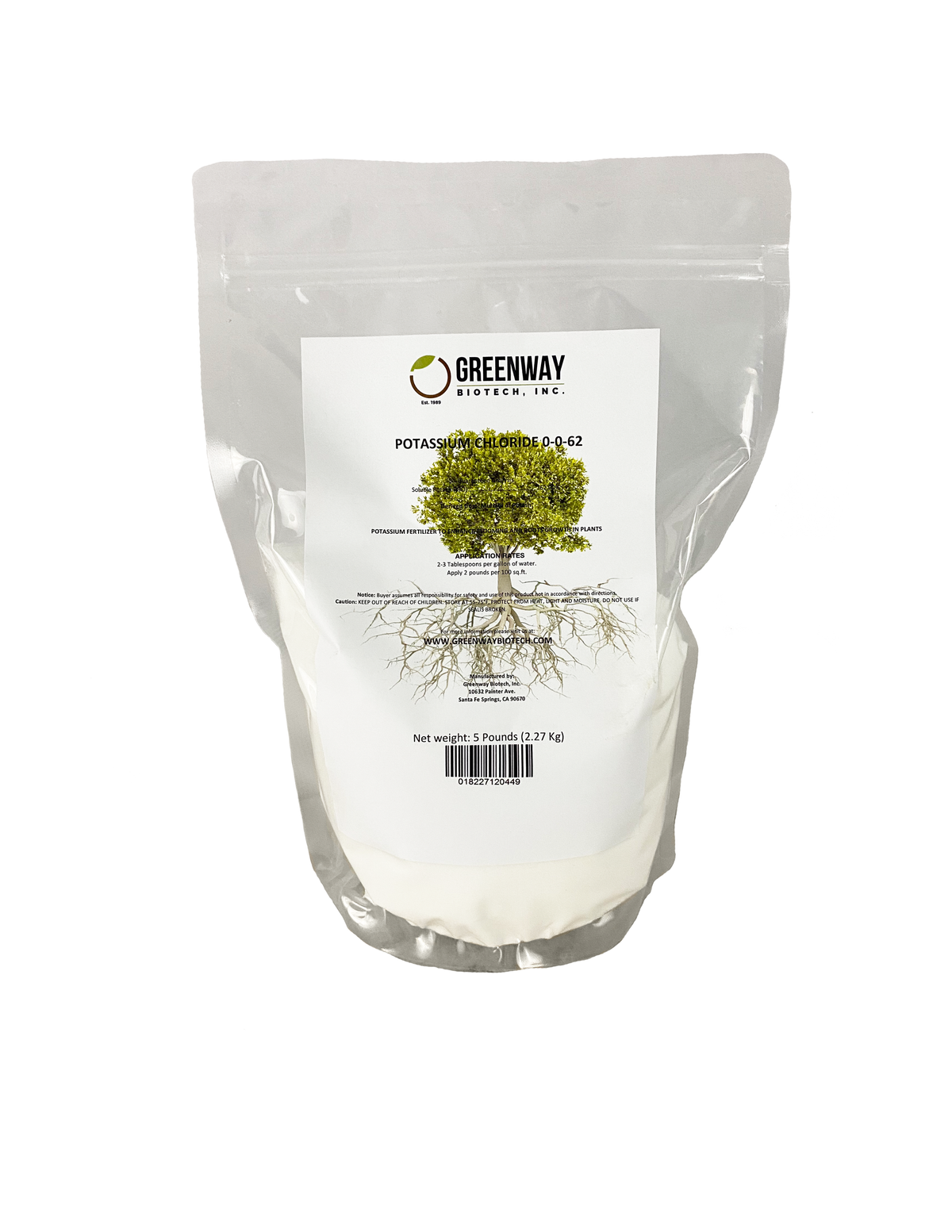
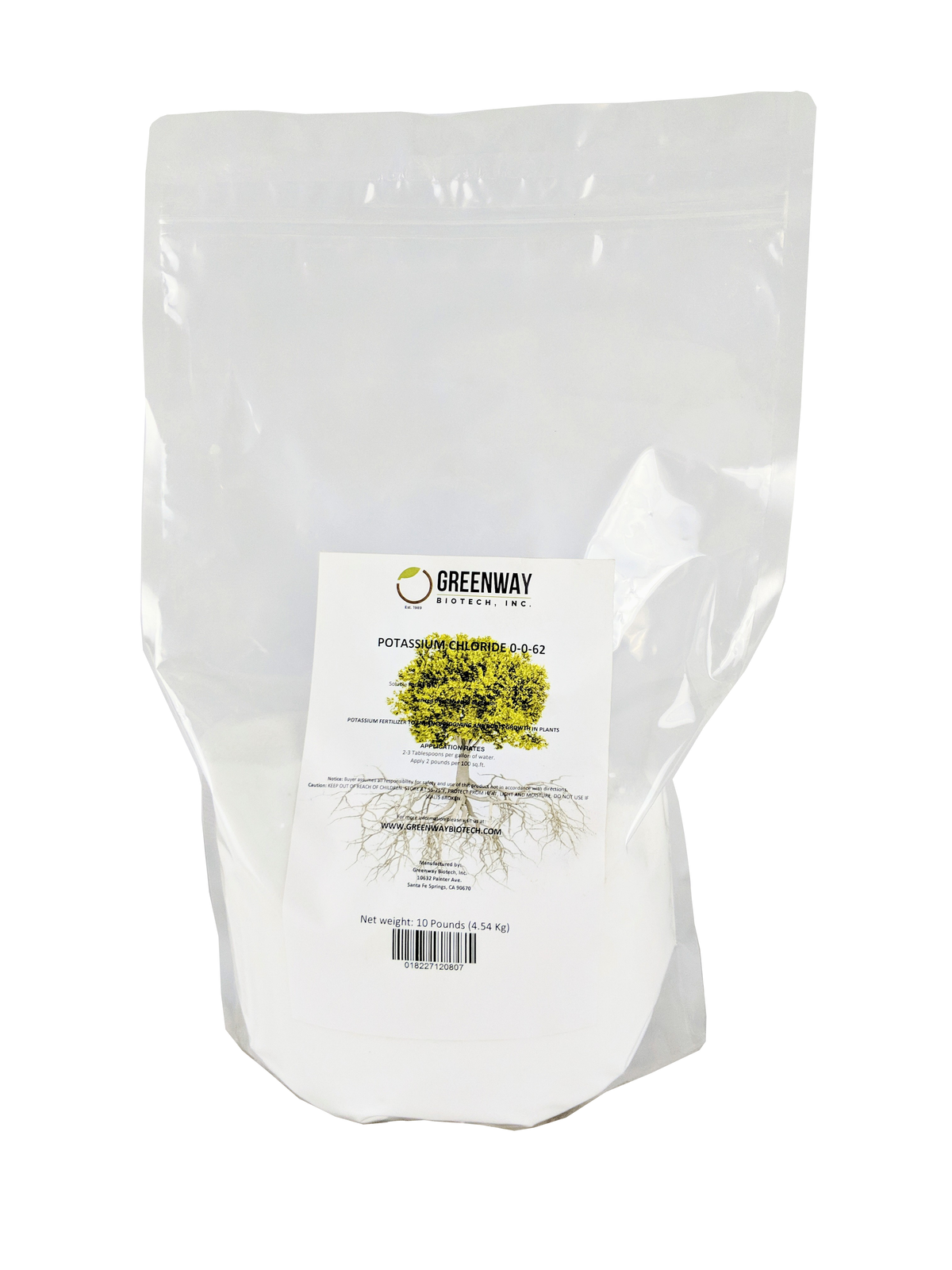
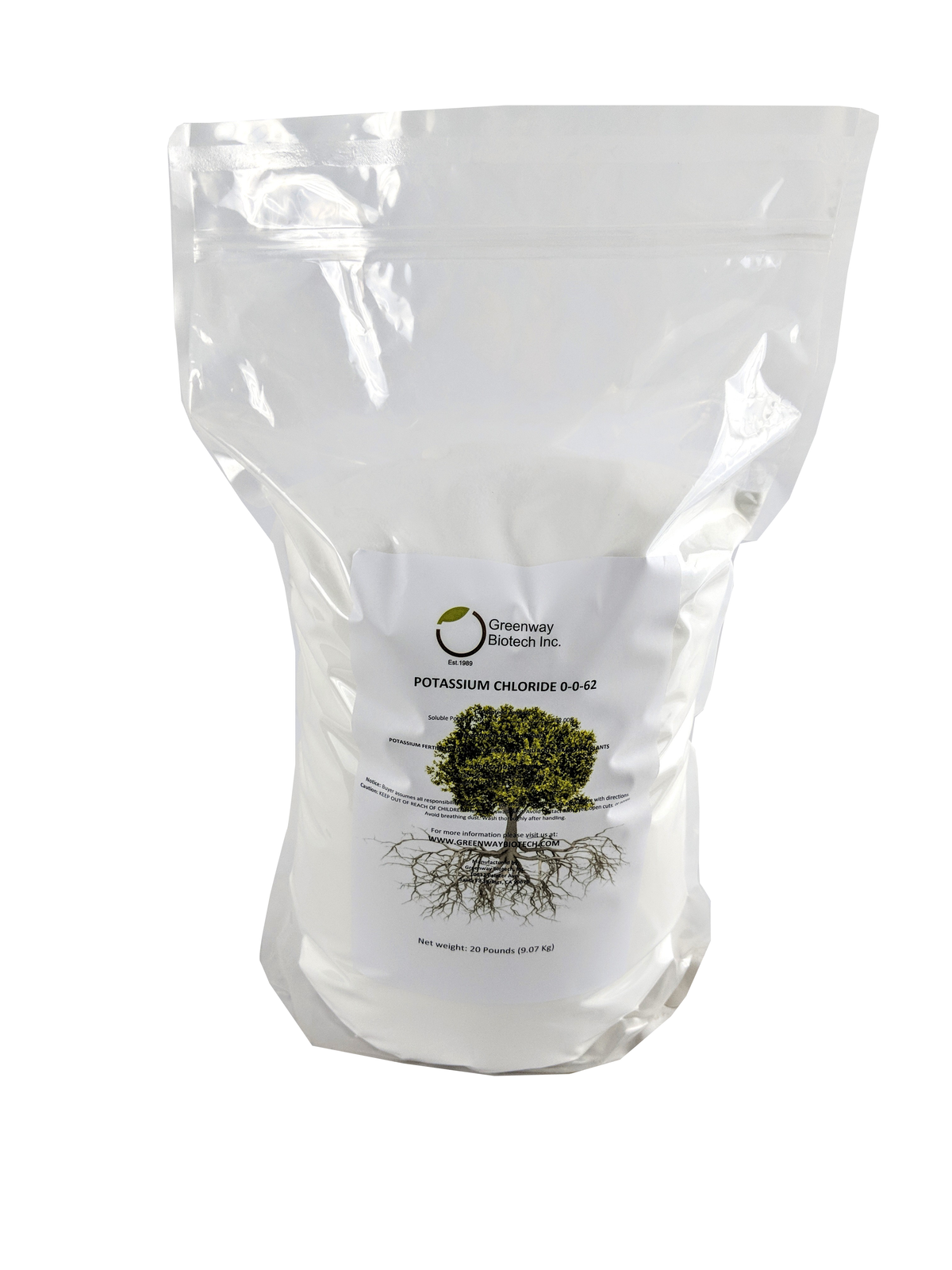
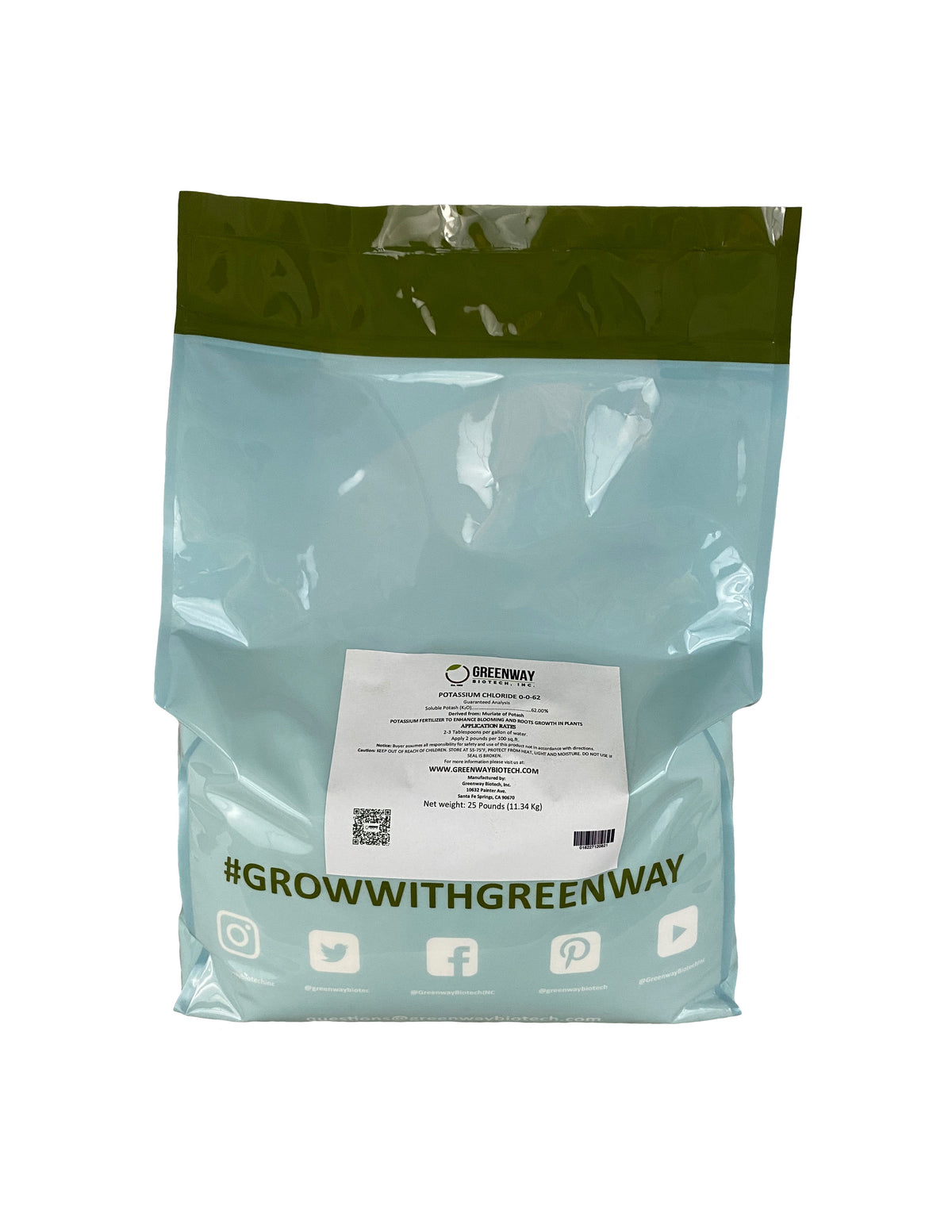
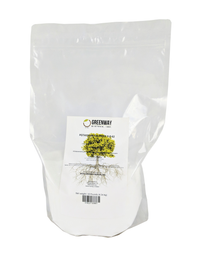
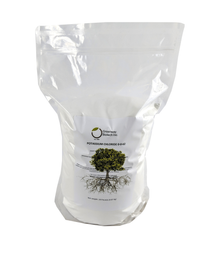
1, 2, 3, 5, 10, 20, 25, and 50 lb (the 50 lb size may ship as two 25 lb bags)
Packed by
Greenway Biotech, Inc., Madera, California
Percentages are by weight of product: 1 lb contains 0.62 lb of potash (K₂O), about 0.51 lb of potassium, and about 0.47 lb of chloride. Soil tests and Extension guides give potassium as pounds of K₂O, so pounds of product = pounds of K₂O ÷ 0.62. Every amount on this page is product weight unless it says K₂O.
Best uses & benefits
Choose it when a soil test shows potassium is low and the plants tolerate chloride. Potassium deficiency yellows or scorches the margins of older leaves first, because potassium moves out of old leaves to new growth (University of Wisconsin A2521).
Lawns on a soil test
University of Missouri Extension sets lawn potash by soil test level and lists potassium chloride as one of the two common sources. Apply it in cool weather and water it in soon after, no more than 1.5 lb of K₂O (2.4 lb of product) per 1,000 sq ft at a time.
Corn, small grains, and hay
Potassium chloride is the most common potassium source on Minnesota farms (University of Minnesota) and the least expensive one (University of Wisconsin). Corn shows no timing penalty, so it can go on in fall or spring.
Soybeans, applied in fall
University of Minnesota trials found spring potash cost soybeans yield through extra chloride uptake. Apply it in fall, or keep a spring application below 100 lb of product per acre.
Chloride-tolerant vegetables and flowers
Without a soil test, the potash in UMass Extension’s general garden rate, 1.6 lb of this product per 1,000 sq ft, suits cabbage, cucumbers, sweet corn, and annual and perennial flowers. That amount adds little chloride.
Drip irrigation of tolerant crops
It dissolves completely. Every 100 ppm of potassium it supplies in the water brings about 91 ppm of chloride, so it suits open drip systems on tolerant crops at modest strengths; section 4 shows the arithmetic.
The most potash per pound
At 62% K₂O it carries more potash per pound than potassium sulfate (53%) or sulfate of potash magnesia (22%), so it takes the least product to supply a given amount.
Where it is a poor fit
Chloride-sensitive plants. In the USDA’s 2023 technical report, yield starts to fall at the lowest soil chloride for lettuce, then strawberries and apples, sweet potatoes, and grapes; woody plants and beans are more susceptible than other crops. Grapes and avocados are sensitive to excess chloride (International Plant Nutrition Institute). Use Potassium Sulfate 0-0-53 or Sulfate of Potash Magnesia 0-0-22 for these, and for fruit trees, berries, and shrubs.
Potatoes and tobacco. Potatoes fertilized with potassium chloride may have lower specific gravity (University of Minnesota), and tobacco’s burning quality suffers (University of Wisconsin); growers use potassium sulfate where quality matters.
Recirculating hydroponics. Chloride stays in the solution and builds up with each top-up. Use Potassium Sulfate or MKP 0-52-34 in a nutrient recipe.
Seed contact and foliar sprays. Its salt index of 116 is the highest of the common dry fertilizers. Keep it out of the seed furrow except within the small limits in section 4, and do not spray it on leaves; this page gives no foliar rate.
Saline soil, or water already high in chloride. At high rates or on saline soils, University of Wisconsin recommends split applications or a lower-salt source such as potassium sulfate.
Soil already high in potassium. High and very high soil tests are not expected to respond to more potash (University of Minnesota).
Application rates & directions
Every rate below is product weight and names its source, a university Extension service or the USDA, listed in section 13. A soil test gives the best rate: most labs report the potassium to add as pounds of K₂O, and pounds of product = pounds of K₂O ÷ 0.62. Without a test, use only the starting amounts in the first table, and only on chloride-tolerant plants.
Weigh it. The weight of a spoonful of this product has not been measured, so no spoon or cup measure is given. Use a kitchen scale for beds and a calibrated spreader for lawns and fields.
Without a soil test: starting amounts for chloride-tolerant plants
UMass Extension’s general garden guidelines use a complete fertilizer such as 10-10-10; the amounts below supply the same potash from this product. They supply no nitrogen or phosphate, so feed those as you normally would, apply once a season, and skip it if a past test showed potassium high or the bed already gets a complete fertilizer with potash.
Potassium chloride starting amounts without a soil test: the potash in UMass Extension general garden rates
Plants
UMass general rate
Potash it supplies
This product
When
Vegetables and annual flowers, except lettuce, beans, potatoes, sweet potatoes, and strawberries
10 lb of 10-10-10 per 1,000 sq ft
1 lb K₂O per 1,000 sq ft
1.6 lb per 1,000 sq ft, or 2.6 oz (73 g) per 100 sq ft
Once, before planting, mixed into the top few inches of soil
Perennial flowers and groundcovers
1 lb of 10-10-10 per 100 sq ft
0.1 lb K₂O per 100 sq ft
2.6 oz (73 g) per 100 sq ft
Early spring, spread over the bed and watered in
Flowering bulbs
1 lb of 10-10-10 per 100 sq ft
0.1 lb K₂O per 100 sq ft
2.6 oz (73 g) per 100 sq ft
Before planting, mixed into the soil
The vegetable amount adds about 0.76 lb of chloride per 1,000 sq ft, about 16 mg per kg in the top 6 inches of soil if none of it washes down, well below the 100 mg per kg above which lettuce, the most sensitive crop in the USDA table, loses yield. Even so, use Potassium Sulfate for the excluded crops, fruit trees, berries, grapes, shrubs, and azaleas and other acid-loving plants. This page gives no lawn amount without a soil test: Missouri, Kansas State, and Rutgers all set lawn potash from a soil test.
Lawns, from a soil test
University of Missouri lawn potassium (G6954) by soil test level, per 1,000 sq ft per year, converted to this product
Soil test potassium
Established lawn
New lawn (establishment)
Very low: 0–100 lb per acre (0–50 ppm)
1.0–2.5 lb K₂O: 1.6–4.0 lb
1.5–4.5 lb K₂O: 2.4–7.3 lb
Low: 100–200 lb per acre (50–100 ppm)
0.5–1.0 lb K₂O: 0.8–1.6 lb
0.5–2.5 lb K₂O: 0.8–4.0 lb
Medium: 200–300 lb per acre (100–150 ppm)
0–0.5 lb K₂O: up to 0.8 lb
0–1.0 lb K₂O: up to 1.6 lb
High or very high: above 300 lb per acre (150 ppm)
None
None
Missouri limits established turf to 1.5 lb of K₂O per 1,000 sq ft at a time, which is 2.4 lb of this product, so split larger yearly amounts. It notes that potassium chloride can burn turf more than potassium sulfate: apply it in cool weather and water the lawn soon after. Test sandy soils every year, because they hold potassium poorly. If your lab rates soil differently, use the K₂O amount on its report and divide by 0.62.
Field crops, from a soil test
Use your state’s soil-test recommendation in pounds of K₂O per acre and divide by 0.62: 100 lb of K₂O per acre is 161 lb of this product. University of Minnesota guidance on placement and timing:
Corn. Timing did not affect corn yield in Minnesota trials; the best yields came at 80–120 lb of K₂O per acre (129–194 lb of product) on low-testing soils. In ridge-till and no-till, band 40–50 lb of K₂O (65–81 lb of product) even on high-testing soils; banded near the seed at planting, half the broadcast rate does the job.
Soybeans. Apply potash in fall where you can. Spring potash lowered soybean yield when 80 lb of K₂O or more went on just before planting, so keep a spring application below 100 lb of product per acre, and put most of the rotation’s potassium ahead of corn.
Seed placement. A liquid starter that contains potassium chloride should carry no more than 10 lb of N + K₂O per acre with the seed on loamy soil, or 4 lb on sandy soil. Never drill the dry product with the seed.
Sandy soils. They hold potassium poorly, so apply it closer to planting there.
Drip irrigation and nutrient solutions
Potassium chloride for a potassium target in irrigation water, and the chloride it adds
Potassium (K) in the water
Per 100 US gal
Chloride it adds
50 ppm
36.8 g (1.3 oz)
About 46 ppm
100 ppm
73.5 g (2.6 oz)
About 91 ppm
150 ppm
110 g (3.9 oz)
About 137 ppm
Grams of product = ppm K × liters ÷ 515. The USDA technical report classes irrigation water below 70 ppm chloride as generally safe for all plants, 70–140 ppm as enough to injure sensitive plants slightly to moderately, and above 350 ppm as able to cause severe problems; count the chloride already in your water too. So use it for the potassium of tolerant crops in open, drain-to-waste systems, and not in recirculating systems, where chloride builds up. Dissolve it separately before combining it with calcium nitrate or other concentrates (safety data sheet). A stock solution can hold at most about 2.8 lb per gallon of water at 68°F, and less in cold water.
Foliar sprays
This page gives no foliar rate. Potassium chloride has the highest salt index of the common dry fertilizers; where a crop needs potassium on the leaves, use Potassium Sulfate 0-0-53 or MKP 0-52-34 at the rates on their pages.
Salt and water. Keep it off seeds, seedling roots, stems, and wet foliage, stay within these rates, and water it in. Sweep granules off sidewalks and drives, and keep spills and rinse water out of drains, ponds, and streams; large amounts raise salinity enough to harm freshwater life (safety data sheet).
How to use potassium chloride
Check the plants. Make sure what you are feeding tolerates chloride. For lettuce, beans, strawberries, potatoes, sweet potatoes, grapes, fruit trees, berries, and shrubs, use potassium sulfate instead.
Find the amount. Take the K₂O amount from your soil test and divide by 0.62, or use the starting amounts in section 4 for tolerant vegetables and flowers. Measure the area, or the gallons of irrigation water.
Weigh it. Weigh small amounts on a kitchen scale, and calibrate a spreader for lawns and fields. Wear gloves and safety glasses.
Spread or dissolve, then water. Spread it evenly, mix it into a bed before planting, or dissolve it fully for drip. Keep it off seeds, stems, and leaves, and water lawns and beds soon after.
Retest. Test lawns and gardens every few years, sandy soils every year, and fields before each crop, and stop once potassium tests high.
Calculator & choosing a size
Formulas. From a soil test: product (lb) = lb of K₂O ÷ 0.62. Area rates: product = rate per 1,000 sq ft × square feet ÷ 1,000, or rate per acre × acres. Irrigation water: grams of product = ppm K × liters ÷ 515. Chloride added: about 0.47 lb per lb of product.
Worked examples. A 400 sq ft bed of cabbage and cucumbers without a soil test: 2.6 oz × 4 = 10.3 oz (293 g); a 1 lb bag. A 5,000 sq ft established lawn testing low: Missouri’s 0.5–1.0 lb of K₂O per 1,000 sq ft is 0.8–1.6 lb of product; at the middle, 1.2 lb, that is 6 lb in one application; a 10 lb bag. An acre of corn where the test calls for 100 lb of K₂O: 161 lb. A 500 gal drip tank at 100 ppm potassium: 368 g (13 oz), adding about 91 ppm chloride.
What each bag covers at three of the rates on this page
Bag
Garden starting amount, 1.6 lb per 1,000 sq ft
Lawn, the most at one time, 2.4 lb per 1,000 sq ft
Drip water at 100 ppm potassium
1 lb
620 sq ft
410 sq ft
617 gal
2 lb
1,240 sq ft
830 sq ft
1,230 gal
3 lb
1,860 sq ft
1,240 sq ft
1,850 gal
5 lb
3,100 sq ft
2,070 sq ft
3,080 gal
10 lb
6,200 sq ft
4,130 sq ft
6,170 gal
20 lb
12,400 sq ft
8,270 sq ft
12,300 gal
25 lb
15,500 sq ft
10,300 sq ft
15,400 gal
50 lb
31,000 sq ft
20,700 sq ft
30,800 gal
About the calculator. Choose the job: chloride-tolerant vegetables and flowers without a soil test, a lawn by soil test level, a K₂O amount from your soil test, a field crop, or irrigation water. It applies the rate from section 4, at the middle of a range where the source gives one, shows the potash and chloride supplied, splits lawn amounts so no application tops 2.4 lb per 1,000 sq ft, and recommends a bag. It works in weights only. Bag suggestions use the current price and stock of all eight sizes, 1 to 50 lb, and the 50 lb size counts as 50 lb. Tax and shipping are added at checkout.
The calculator needs JavaScript. If it does not appear, use the formulas, examples, and table above to choose a size.
How potassium chloride works
Potassium moves from old leaves to new growth, so a shortage shows first on older leaves: yellow or scorched margins in corn and soybeans, and whitish-gray spots along the leaflet edges in alfalfa (University of Wisconsin A2521). Potassium chloride dissolves into potassium and chloride ions. The potassium is held on clay and organic matter, which keeps it in the root zone on most soils; sandy soils and peats hold it poorly, so some washes down there and they need smaller, more frequent applications.
The chloride is not held. It moves down with rain and irrigation water, which is why University of Minnesota advises fall potash ahead of soybeans: winter and spring moisture carries the chloride below the roots before the crop takes it up. Chloride is a plant nutrient in its own right, and Kansas trials found winter wheat responded to it (International Plant Nutrition Institute), but in excess it limits sensitive crops.
The salt index measures how much a fertilizer raises the salt concentration of the soil solution. Pound for pound, potassium chloride scores 116, against about 43 for potassium sulfate (USDA technical report); per unit of potash the gap narrows to 1.9 against 0.9 (International Plant Nutrition Institute), because potassium chloride carries more potash. That salt is what injures seeds and seedling roots in close contact, and why heavy rates are split. The red color of some potash comes from iron impurities; red and white potash are equivalent sources of potassium (University of Wisconsin; University of Minnesota). The evidence on this page concerns potassium chloride as an ingredient; it is not a trial of this finished product.
Compare your options
Pick by what the plant tolerates and what else the soil needs. Analyses are each product’s label guarantee; salt index is per pound of product.
Potassium Chloride 0-0-62 compared with other Greenway potassium sources
Option
Supplies
Choose it when
Limitation
Potassium Chloride 0-0-62, this product
62% K₂O; about 47% chloride
Lawns, field crops, and chloride-tolerant vegetables and flowers on a low soil test
Salt index 116; not for chloride-sensitive plants, foliar sprays, or recirculating hydroponics
Same program is not the same tank. Dissolve potassium chloride and calcium nitrate concentrates separately before combining them (safety data sheet), dissolve each product in its own water before it goes into a tank, and jar-test any new mix at working strength. Rinse spreaders and injectors after use: the product is mildly corrosive to metals when wet (safety data sheet).
Handling, storage & limitations
Classification (SDS). Not classified as hazardous under OSHA HazCom 2012. Dust may cause mechanical irritation of the eyes, skin, nose, and throat.
Protective equipment. Safety glasses or goggles and gloves; long sleeves and closed-toe shoes for bulk handling; a NIOSH-approved particulate respirator where dust may exceed exposure limits. Wash after handling.
Storage. Sealed original container in a cool, dry, well-ventilated place, below 104°F (40°C) and out of direct sunlight, away from strong oxidizers and concentrated acids, and out of reach of children and pets. It absorbs moisture and cakes, so reseal the bag promptly.
Plants and soil. Keep it off seeds, seedling roots, and stems; do not spray it on leaves; water it in; stay within the rates on this page.
Water. Keep product, spills, and rinse water out of storm drains, ponds, and streams.
First aid (from the safety data sheet). Eyes: flush with clean water for at least 15 minutes, lifting the eyelids, and get medical attention if irritation persists. Skin: wash with mild soap and water. Inhaled: move to fresh air. Swallowed: rinse the mouth with water, and get emergency medical care for large amounts. Poison Control: 1-800-222-1222.
Disposal. Dispose of unused product and containers according to local, state, and federal rules.
California Proposition 65 (from the safety data sheet): this product can expose you to chemicals known to the State of California to cause cancer and birth defects or other reproductive harm. For more information go to www.P65Warnings.ca.gov.
Frequently asked questions
What is potassium chloride used for?
Potassium chloride, or muriate of potash, supplies potassium where a soil test shows it is low. This product guarantees 62% soluble potash (K₂O). It is used on lawns, corn, small grains, hay, soybeans, and chloride-tolerant vegetables and flowers, spread on the soil and watered in, or dissolved for drip irrigation of tolerant crops. About 47% of it is chloride, so it is not for chloride-sensitive plants.
How much potassium chloride should I use in a garden without a soil test?
For chloride-tolerant vegetables and annual flowers, the potash in UMass Extension’s general garden rate is 1.6 lb of this product per 1,000 sq ft, or 2.6 oz (73 g) per 100 sq ft, mixed into the soil once before planting. Perennial flowers, groundcovers, and bulbs take the same 2.6 oz per 100 sq ft. Leave out lettuce, beans, potatoes, sweet potatoes, strawberries, and woody plants, and use potassium sulfate for those.
How much potassium chloride should I put on my lawn?
Base it on a soil test. University of Missouri gives an established lawn 0.5 to 1.0 lb of K₂O per 1,000 sq ft a year on soil testing low (0.8 to 1.6 lb of this product) and 1.0 to 2.5 lb on very low soil (1.6 to 4.0 lb), and none on high-testing soil. Apply no more than 2.4 lb of product per 1,000 sq ft at a time, in cool weather, and water it in soon after, because it can burn turf.
Which plants should not get potassium chloride?
Lettuce is the most sensitive crop in the USDA’s chloride table, followed by strawberries and apples, sweet potatoes, and grapes; woody plants and beans are more susceptible than other crops, and avocados are sensitive too. Potatoes may lose specific gravity and tobacco its burning quality. Use Potassium Sulfate 0-0-53 or Sulfate of Potash Magnesia 0-0-22 for these.
Is potassium chloride bad for soil?
Not at the rates on this page. It has the highest salt index of the common dry fertilizers, 116, so it injures seeds and young roots in close contact, and heavy rates can add salt. The chloride is not held by soil and washes down with rain and irrigation. On saline soil, or with water already high in chloride, University of Wisconsin recommends split applications or a lower-salt source such as potassium sulfate.
Should I use potassium chloride or potassium sulfate?
Potassium chloride carries more potash per pound, 62% against 53%, and is the least expensive potassium source (University of Wisconsin), so it suits lawns, field crops, and tolerant vegetables. Potassium sulfate adds no chloride and has a lower salt index, and it supplies sulfur, so choose it for chloride-sensitive plants, fruit, berries, potatoes, foliar sprays, and hydroponic recipes.
Can I use potassium chloride in drip irrigation or hydroponics?
In open, drain-to-waste drip systems on tolerant crops, yes: 73.5 g per 100 gallons supplies 100 ppm potassium and adds about 91 ppm chloride. The USDA technical report classes irrigation water above 70 ppm chloride as enough to injure sensitive plants, so count the chloride already in your water. In recirculating hydroponics chloride builds up, so use potassium sulfate or MKP there instead.
When should I apply potash before soybeans?
In the fall where you can. University of Minnesota trials found spring potash lowered soybean yield when 80 lb of K₂O or more went on just before planting, because the soybeans took up extra chloride. If you apply in spring, keep it below 100 lb of product per acre. Corn showed no timing penalty, so put most of the rotation’s potassium ahead of corn.
Is red potash different from white potash?
Not as a potassium source. The red color of some potash comes from iron impurities that have no effect on the availability of potassium or other nutrients (University of Wisconsin), and University of Minnesota treats red, pink, and white potassium chloride as equivalent sources. White soluble grades are recrystallized, which suits them to dissolving for drip systems.
Can I use it in organic production?
The USDA National Organic Program prohibits potassium chloride unless it is derived from a mined source and applied in a manner that minimizes chloride accumulation in the soil. Greenway Biotech’s potassium chloride is not sold with an organic listing, so check with your certifier before using it on certified ground.
Articles give background. For this product, use the directions and documents on this page.
Product documents & sources
Product label and Safety Data Sheet: available on request. Email questions@greenwaybiotech.com with the product name and we will send the current documents.
Where the rates and statements on this page come from
The rates come from the university Extension and USDA publications below, converted to this product’s 62% K₂O guarantee; they explain plant nutrition and do not certify or endorse this product.
Not sure whether your plants tolerate chloride, or how to read your soil test? Email the test, what you are growing, and the area to questions@greenwaybiotech.com or call (562) 351-5168, Monday to Friday, 9 AM to 3 PM Pacific, and we will work through it with you. Every order carries a 90-day satisfaction guarantee, and Standard shipping is free on orders over $100 to the continental US.
Greenway Biotech, Inc. has been a family-owned fertilizer company in California since 1989. This product is packed at our facility in Madera, California, and is a CDFA-registered fertilizer.
5 stars: 17 (81%)
4 stars: 0 (0%)
3 stars: 3 (14%)
2 stars: 0 (0%)
1 star: 1 (5%)
J
Joanne Chen
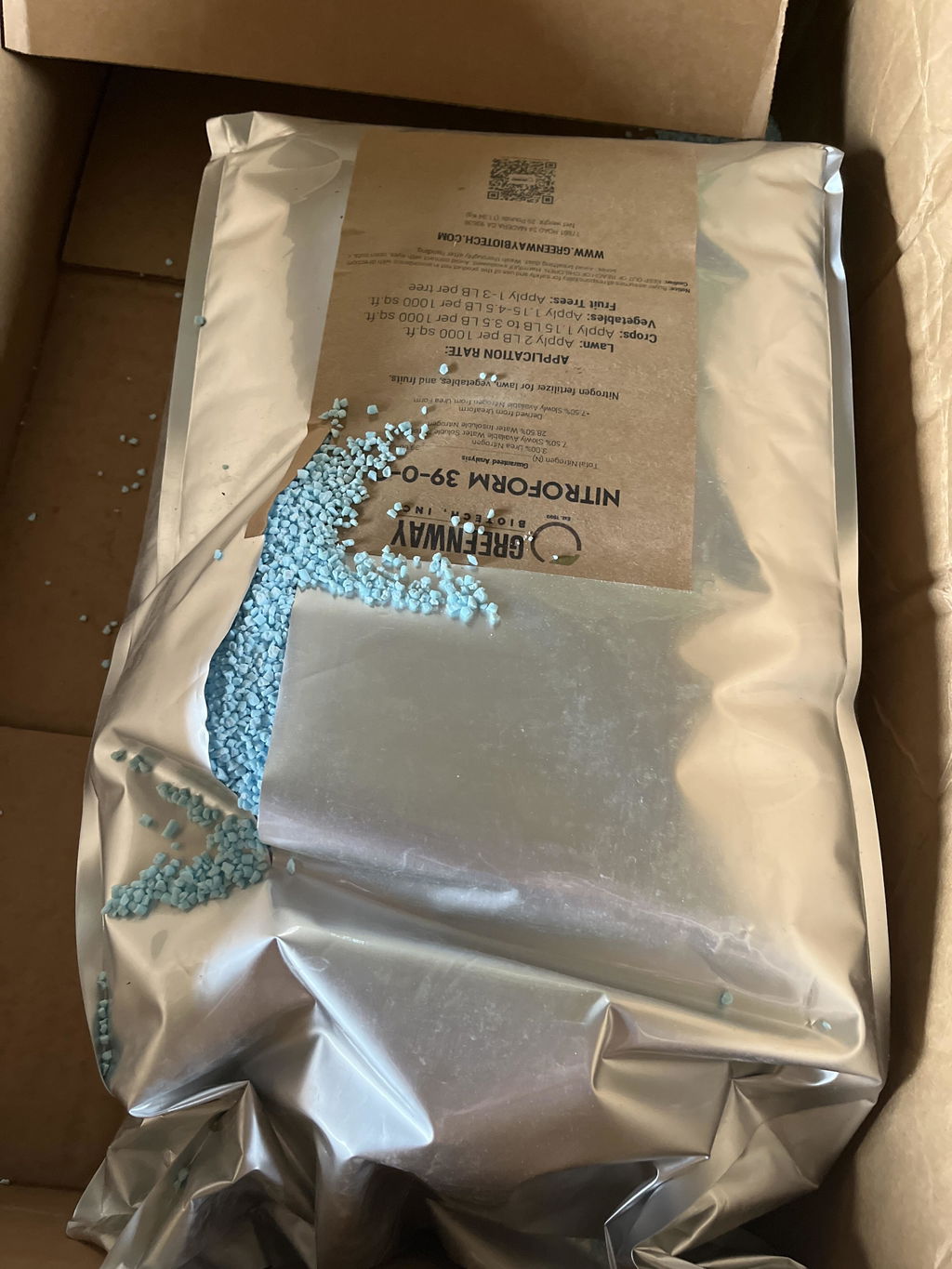
I am not not sure the bag broken caused by shipping or the original packing not good?
I ordered three 25lbsproducts this time. Two of them were broken and the powder spilled. Hope, that will not happen again.
J
Jeffrey Zimmerman
Great as usual !
C
Charlie Bauerelen
Happy customer
Very easy
J
Jeffrey Zimmerman
Muriate of Potash
This product arrived on time . This company has quality products such as this.
Potash is great for those underground vegetables.
E
Eduardo Saldana
Great Service!
Great customer service!
I
Ian Allerdice
Potassium Chloride
Nicely packaged and fast shipping. Hard to say how my pumpkins will react.
s
shiner antiorio
used it up
Works for me, and when I was out i reordered it from them
P
Philip Patrick
Waiting for delivery
I am still waiting for delivery of murate of potash. The FedEx tracking number tells me shipment was canceled. I don't know what's going on with my order
E
Ed Schmidt III
Muriate of Potash
Beautifully packed, arrived on time, broad casts well and watered in instantly. Very happy with the product and the company.
S
Somsak Phommahasay
Fast delivery
awsome product
F
Frank Jarman
No Notable difference
I saw no notable difference after using this product on my garden.
C
Clayton Thomas
Fast service and shipping.... great product... will be ordering again... thanks
N
Nathaniel Powell
Received on time and well packaged
Did not notice any difference in grass growth. Hope I did not waste my money and no way of testing product myself.
k
karl kriegel
potassium cloride
just used a very little so far to start out . So far everything is good.
S
Samuel Bennett
For garden
So far just fine. 👍
C
Claire Agan
Very good
Very convenient to buy and apply to the plants.
J
James Welch
Very Happy with Purchase
My order was shipped and received promptly. Packaging is good. Very pleased with the purchase, product and price.
R
Robert C.
Great product
Worked as expected. Granular application went down smoothly and easily
B
Brent W.
Exactly what I’m looking for
I was surprised how difficult it was to find a bag of just potassium chloride. There are differences in how a lawn treats KCl and potassium sulfate. After reading many agriculture papers, KCl supplies readily available potassium and the chloride will wash away. Sulfate will linger for a lot longer which could be a problem if you’re rich in sulfur and sulfates already. So first test your soil, then determine what you need. A large percentage of lawns are low in potassium and if you are, I recommend Greenways product.
B
Brent W.
Just what I needed
Items shipped quickly. There was confusion on how many packages were shipped but they supplied the second tracking number. The bags were relatively intact. One bag looked like it popped open during shipping but the contents did not spill out. This will be applied as the ground thaws.
My MSM is decreasing my osteoarthritis pain, especially in my hands
My product arrived intact. I started taking it as soon as I went into the kitchen. I mixed it with my daily Metamucil, but there was no discernible taste. I am working on making it a habit each morning. The pain from my osteoarthritis, especially in my hands, is decreasing. I expect it to continue to improve. Thank you for my MSM.
You did not send me MSM Powder, you sent me Magnesium Chloride powder. I tried contacting you 3 times, by email & phone and you didn't have the courage & honesty to return my messages & rectify the situation. I even offered to text you a photo of the mag chloride.