Glossary of Gardening TermsAnnual: This type of plant has its complete life cycle, beginning from a seed and producing new seed for a succeeding generation, during a single season and then dies at the end of that season. Marigolds and zinnias are annuals many of us have grown. Biennial: It takes this type of plant two seasons to go from seed to seed, like hollyhocks and foxglove, develop roots and leaves during their first growing season and then grow flowers and set seed during the second year. Biennial plants die at ...
Azomite 0-0-0.2 FAQ1. What is AZOMITE? AZOMITE is a highly mineralized complex silica ore (Hydrated Sodium Calcium Aluminosilicate or HSCAS), mined in Utah from an ancient deposit left by a volcanic eruption that filled a small nearby seabed an estimated 30 million years ago. AZOMITE is used as a naturally rich soil re-mineralizer for plants, as well as a feed ingredient for animals. In a typical chemical assay, AZOMITE contains more than 70 trace minerals which include many rare earth elements (lanthanides). M...
Heavy Metal AnalysisHeavy Metal Analysis for all Greenway Biotech, Inc. products: Chelated Iron Ferrous Sulfate Manganese Sulfate Monoammonium Phosphate 11-52-0 Monopotassium Phosphate 0-52-34 Potassium Sulfate 0-0-53 Zinc Sulfate Monohydate
Humic Acid FAQ1. How much Humic Acid 35% powder should I add in respect to the total substrate or per quantity of compost? It depends on a lot of different factors such as your composting methods, the materials you are composting, other nutrients you are adding, etc. Compost naturally produces Humic so in some cases, there is no need to add Humic Acid at all. However, generally, we recommend adding 1% compared to your compost either by weight or volume. 2. Is your Humic Acid water soluble? No, our Humic ...
HomeSince 1989, Greenway Biotech has been a world leader in providing organic gardening solutions that are potent, economical and eco-friendly. From our organic fertilizers and plant food products, to our pesticides, fungicides and personal care products, when you buy from us, you know you’re getting the best that money can buy. At the core of our strategy is a resilient integrated agribusiness model that encompasses the entire value chain of the agricultural commodity processing business, from o...
Urea 46-0-0 FAQ1. What's the application rate of Urea 46-0-0 fertilizer on an everyday lawn? As a general (albeit not scientific) rule of thumb, the formula for determining the application rate for nitrogen, divide 100 by the percentage of nitrogen in the compound and apply the result to 1,000 sq.ft. For Urea, which contains 46% nitrogen, the formula would be 100/46 = 2.17 lb. per 1000 sq.ft. Therefore, depending on the quality of your soil we recommend 2-3 pounds per 1000 sq.ft. Note: Urea 46-0-0 (46%...
Blood Meal 13-0-0 FAQ1. What are the Nitrogen (N), Phosphorous (P), and Potassium (K) ratios for Blood Meal fertilizer? The three numbers after each fertilizer indicate percentages of Nitrogen (N), Phosphorous (P), and Potassium (K). Greenway Biotech, Inc. Blood Meal fertilizer 13-0-0 contains 13% Nitrogen (N) and no Phosphorous (P) or Potassium (K). 2. What is the difference between Organic and non-Organic Blood Meal? There are two ways we can answer that question. First, what's legally organic and secon...
Bone Meal 3-15-0 FAQ1. How often should I apply Bone Meal to my roses? Roses need more phosphorous compared to other plants and Bone Meal is a natural source of phosphorous. Greenway Biotech, Inc. Bone Meal contains 15% phosphorous and because Bone Meal is slow to work through the soil we recommend adding it to your soil at planting time or at the beginning of a new season. The best way to determine if you need more Bone Meal is through soil test but if that's not available or cost effective then I recommend...
Terms1. Terms By accessing this web site, you are agreeing to be bound by these web site Terms and Conditions of Use, all applicable laws and regulations, and agree that you are responsible for compliance with any applicable local laws. If you do not agree with any of these terms, you are prohibited from using or accessing this site. The materials contained in this web site are protected by applicable copyright and trade mark law. 2. Use License Permission is granted to temporarily download one c...
Our StoryDr. Mounir Girgius founded Greenway Biotech Inc. in 1989 after successfully serving southern California for over 20 years. He eventually decided to sell the company due to health and personal matters. At the time I (Amir Tajer) just graduated from Washington State University with a bachelor’s degree in mechanical engineering -- eager to begin a new chapter in my life, and start my own business. Most of my family and friends thought it would be a big mistake for a 21 year old to start his own ...
Tomato Fertilizer 4-18-38 FAQ1. How often should I apply tomato fertilizer if I am growing in containers with soil? It really depends on the quality of your soil. However, I recommend to start with applying tomato fertilizer once every 2-3 weeks and after that based on how your tomato plants react then you would either continue at the same rate or increase it if they look like the need more food or decrease it if they are doing fine. 2. How do I apply tomato fertilizer? Can I mix it in a bucket of water and pour it on t...
Zinc Sulfate FAQ1. What is the application rate of Zinc Sulfate for pecan trees? We recommend using 1 tablespoon per gallon of water for foliar application or 1.5-2 pounds per 1 inch of trunk diameter for soil additive. 2. How much Zinc Sulfate do I need to use as a roof treatment? If you are asking about using Zinc Sulfate to get rid of the moss on the roof, please follow the instruction below: 1. Mix 2.5 Pounds of Greenway Biotech Zinc Sulfate with 7 Gallons of water. 2. Spray Zinc Sulfate Solution ...
Ammonium Sulfate 21-0-0 FAQ1. Is Ammonium Sulfate fertilizer good for tomato plants? We recommend using Greenway Biotech, Inc. Tomato Fertilizer for tomato plants since that was specifically formulated for maximum yield for tomato plants. However, if you are using dry granular fertilizer then you should apply Ammonium Sulfate at the rate of 1 tablespoon per plant. Make sure not to over apply because Nitrogen fertilizers could kill plants easily. 2. Is Ammonium Sulfate fertilizer good for blueberries? Yes, the best ki...
Chelated Iron EDTA 6-0-0 FAQ1. Is Chelated Iron EDTA safe for use in a freshwater planted aquarium? It depends on what kind of fish and plants you have. Chelated Iron EDTA could be toxic to some plants and you might want to use Chelated Iron DTPA. Even though Chelated Iron DTPA is slightly more expensive but it is better suited for most fish and plants and it is also available for plants at a wider range of pH levels compared to Chelated Iron EDTA. If you are interested in Chelated Iron DTPA please click on the link bel...
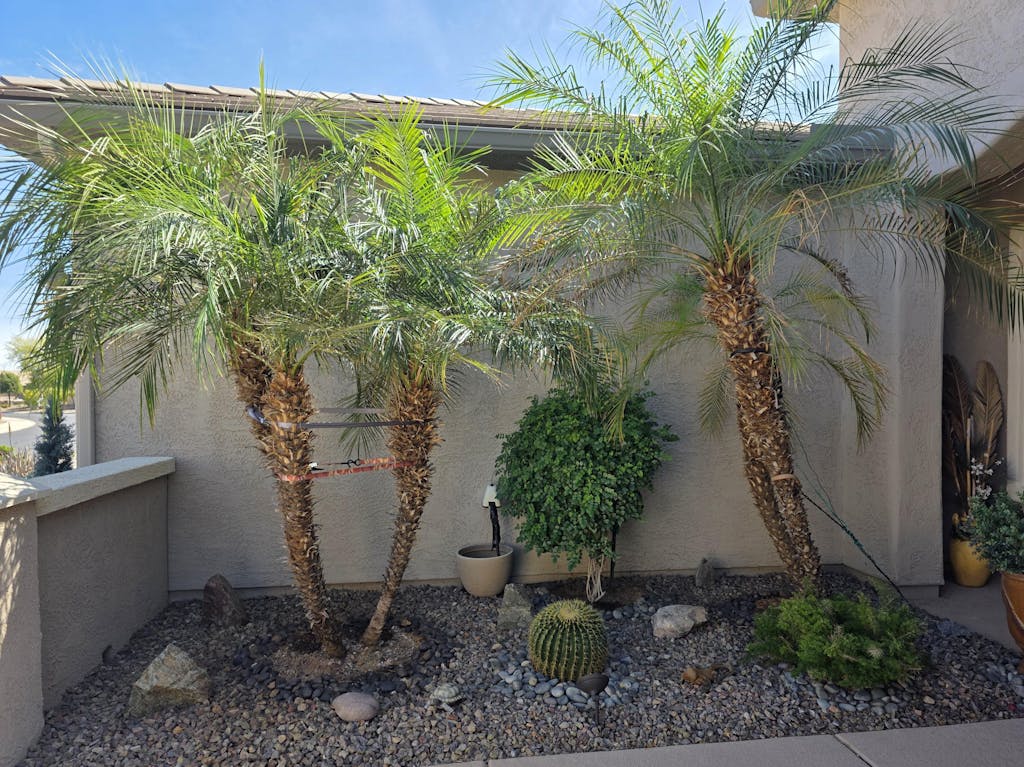
I live in AZ and several years ago my palm trees were not doing so well
I live in AZ and several years ago my palm trees were not doing so well. During a discussion with a friend in Florida, she told me that I needed manganese sulfate fertilizer. I immediately did an internet search and found Greenway Biotech and have been using it ever since. My palm trees are healthy and looking great!