Chelated Iron EDTA Fertilizer
- Regular Price
- $ 29.99
- Sale Price
- $ 29.99
- Regular Price
- $ 25.99
Sold Out
- Unit Price
- per
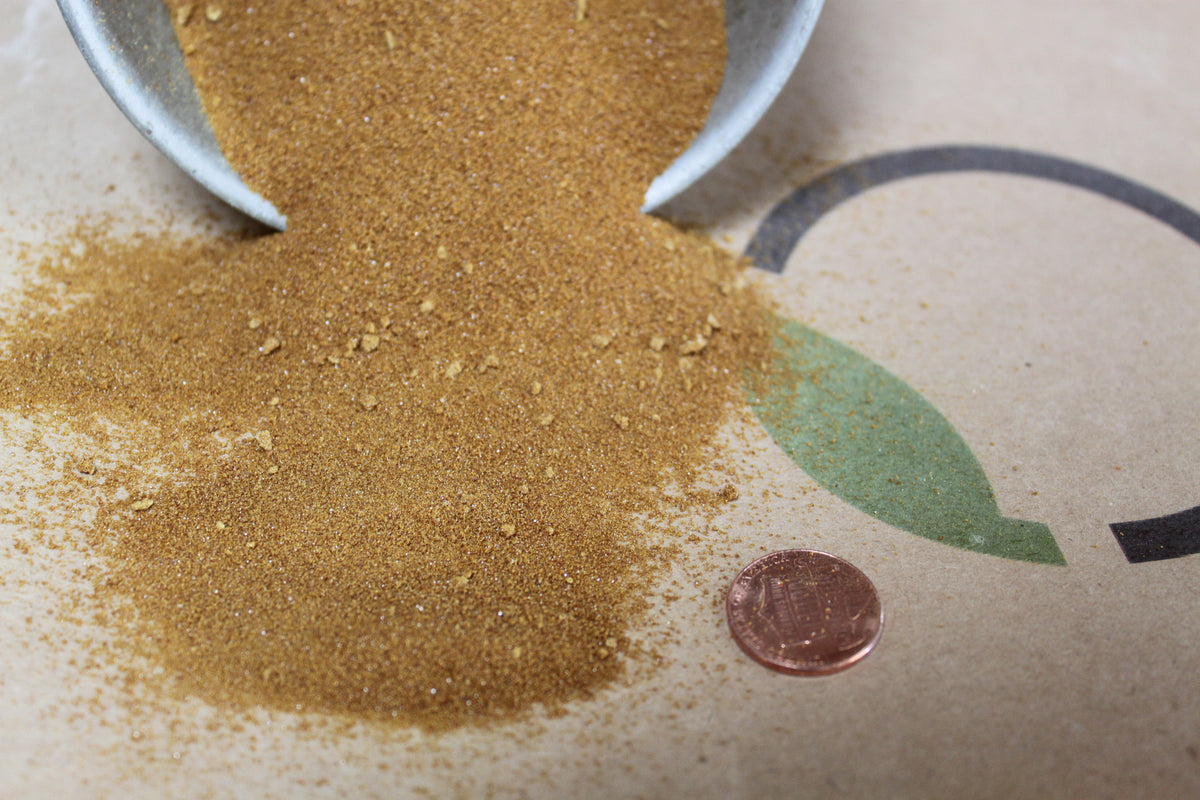
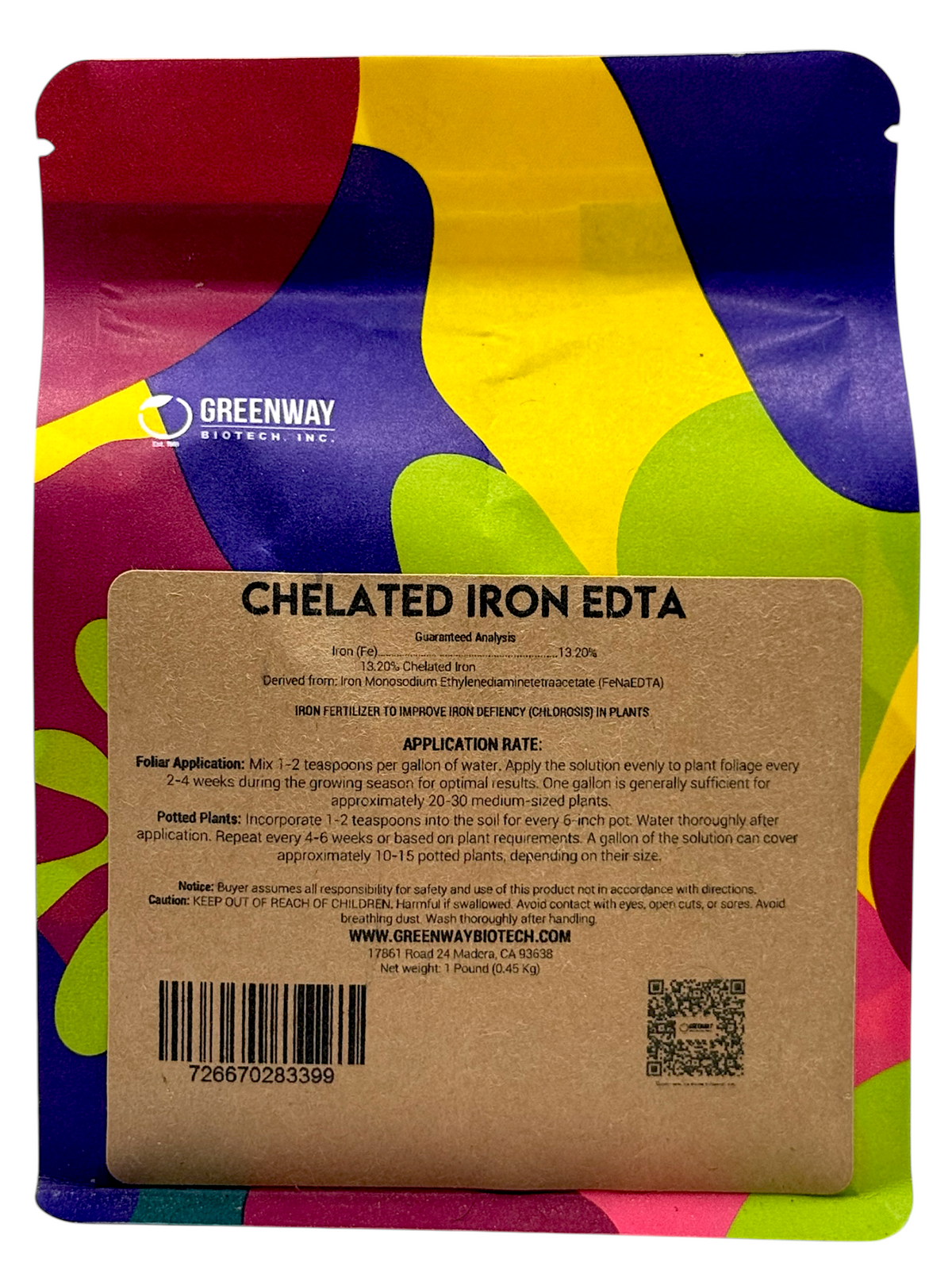
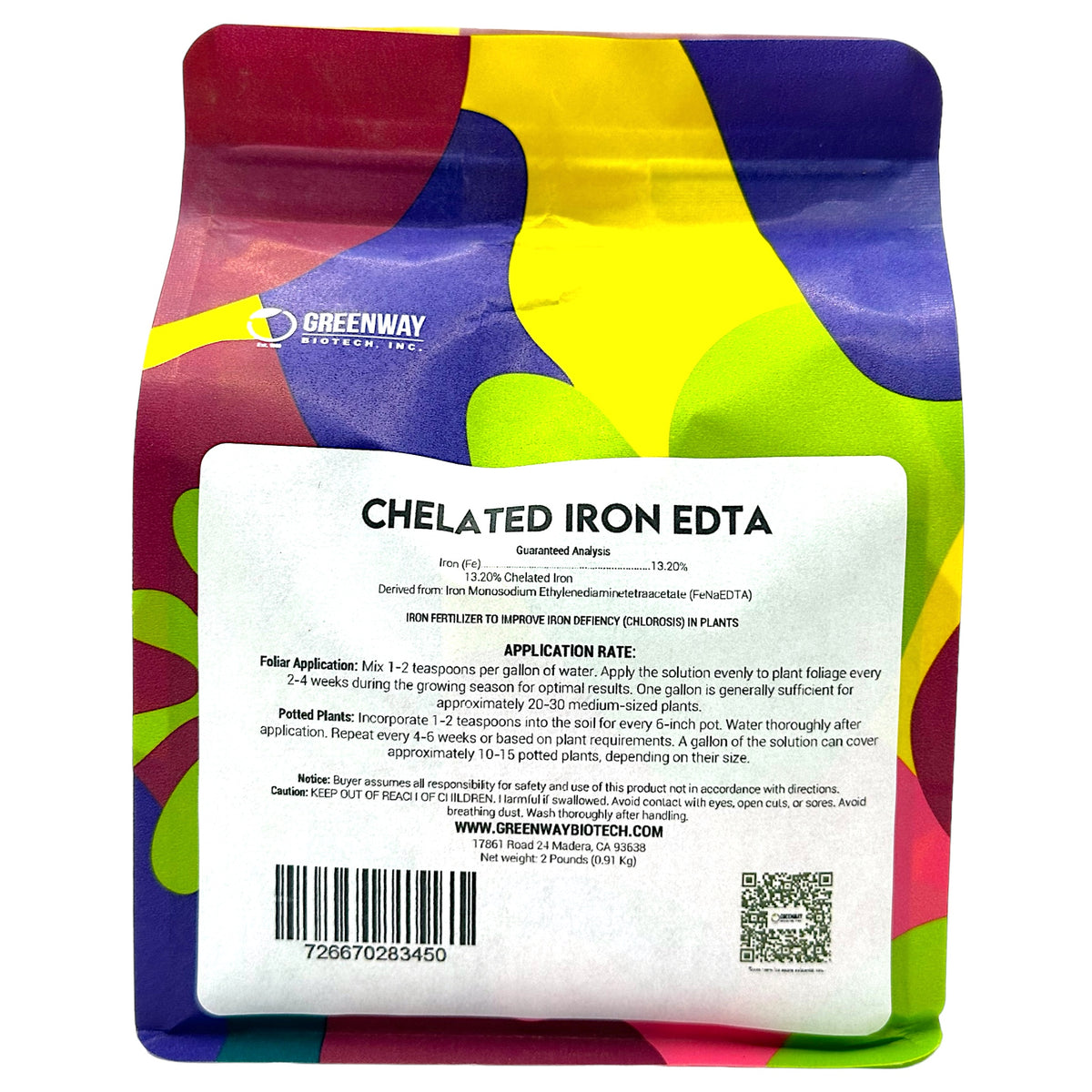
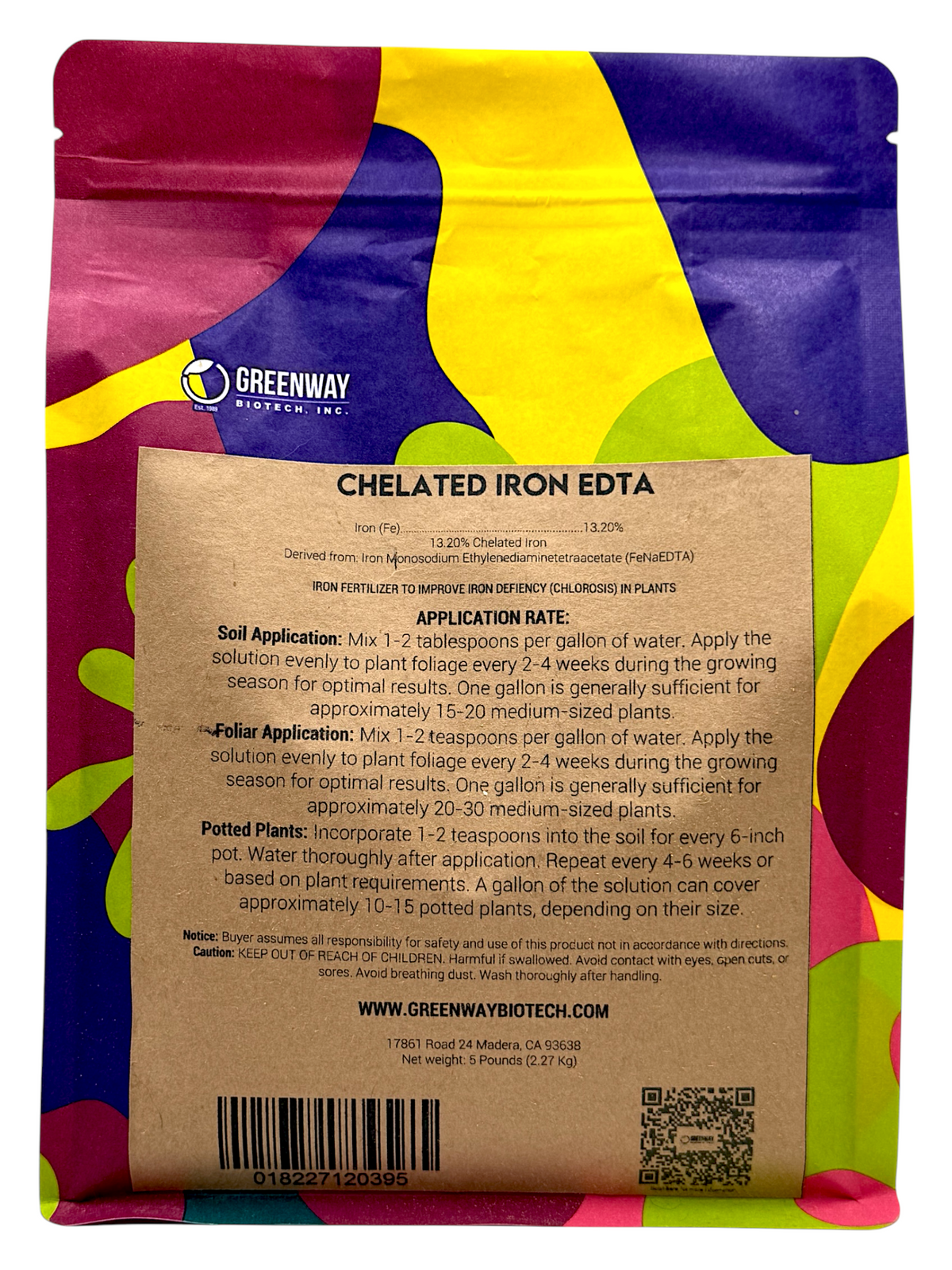
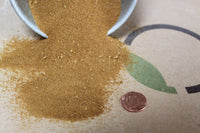
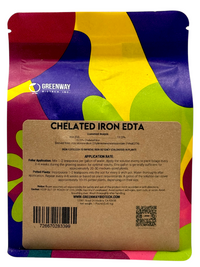
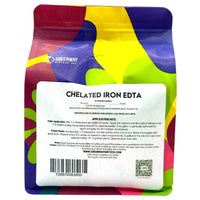
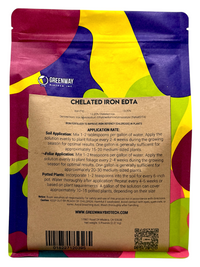
A 100% water-soluble, EDTA-chelated iron delivering 13% Fe — one of the highest iron concentrations among chelated iron forms. Formulated to correct interveinal chlorosis in acidic to neutral soils (pH 4.0–7.0) for gardens, raised beds, containers, and hydroponics. CDFA registered and independently lab tested for heavy metals.
Find your size → Calculate how much I need13.2%
Chelated iron by guaranteed analysis
4–7pH
Effective soil and solution pH range
100%
Water soluble — no residue or clogging
35+yrs
Family-owned, California-made since 1989
Coverage estimates below assume a typical foliar maintenance rate of about 1 teaspoon per gallon and a soil-drench rate of 1–2 tablespoons per gallon. Actual product use varies with deficiency severity, plant size, and application method — use the calculator further down for a precise figure.
| Bag Size | Foliar Coverage (maintenance) | Soil Drench Coverage | Best For |
|---|---|---|---|
| 1 lb | ~90 gallons of spray | ~30–60 plant treatments | Houseplants, small gardens, trial use |
| 2 lb | ~180 gallons of spray | ~60–120 plant treatments | Home gardens, mixed beds |
| 5 lb | ~450 gallons of spray | ~150–300 plant treatments | Most popular |
| 25 lb | ~2,250 gallons of spray | Landscape & commercial programs | Best value |
Chelated Iron EDTA dissolves completely, so the same powder works across foliar, soil, garden, and hydroponic programs — as long as your soil or solution pH stays in the 4.0–7.0 range.
The fastest route to visible greening. Iron is delivered straight to leaf tissue, with new growth often beginning to green within days. Apply in cool conditions to reduce leaf-scorch risk.
Builds a longer-lasting root-zone reservoir. Slower to show than foliar, but a single application can stay active for several weeks at pH 4.0–7.0.
Broadcast and water in, or apply dissolved as a bed-wide drench. Well suited to raised beds and in-ground beds testing in the acidic-to-neutral range.
Best used via the stock-solution method to hit a 2–5 ppm Fe target accurately. Keep reservoir pH at 5.5–6.5; for systems running higher, Iron DTPA is the steadier choice.
Azaleas, rhododendrons, gardenias, and blueberries are prone to iron chlorosis. Monthly maintenance applications can help keep new growth green through the season.
High-value crops where iron chlorosis affects appearance and vigor. A combined foliar-plus-soil approach is a common practice for faster recovery.
EDTA is the most cost-effective iron chelate for the pH range that covers most home gardens. Here is what it does well — and where another chelate takes over.
At 13.20% chelated iron by guaranteed analysis, this EDTA chelate carries more iron per ounce than typical Iron DTPA (around 11%) or Iron EDDHA (around 6%). Within the pH 4.0–7.0 range, that can mean fewer applications to resolve a deficiency.
The EDTA ligand wraps iron ions in a stable ring structure, helping protect them from reacting with soil calcium, phosphate, and carbonate. Iron stays plant-available through the pH 4.0–7.0 range — where unprotected iron sulfate can precipitate within hours. Above pH 7.0, step up to Iron DTPA 11%.
Dissolves completely for foliar sprayers, soil drenches, fertigation lines, and hydroponic reservoirs. No undissolved particles to clog emitters or settle in tanks.
Registered with the California Department of Food & Agriculture as a specialty fertilizer. Each batch is independently tested for heavy metals, with results consistently well below required limits — verification that matters for edible crops and hydroponic food production.
EDTA is among the most affordable chelation technologies available. Combined with a 13% iron concentration, it is often the lowest-cost way to correct iron chlorosis when soil pH sits in the 4.0–7.0 range. For calcareous soils above pH 7.5, Iron EDDHA is the more practical — though more expensive — option.
6.5pH
Above this point, unprotected soil iron rapidly turns insoluble
Iron is abundant in most soils, yet iron chlorosis is one of the most common micronutrient disorders gardeners encounter. The reason is chemistry, not scarcity: as soil pH climbs above roughly 6.5, iron rapidly converts to insoluble ferric oxides and hydroxides that plant roots cannot absorb. The iron is physically present but chemically unavailable.
A chelate solves the availability problem rather than the supply problem. EDTA — ethylenediaminetetraacetic acid — bonds to the iron ion across multiple sites, forming a stable, claw-like ring (the word chelate comes from the Greek chele, meaning claw). That ring shields the iron from reacting with competing calcium, phosphate, and carbonate ions, keeping it dissolved and plant-available until a root releases a natural acid that exchanges the iron from the chelate for uptake. This product is derived from iron monosodium ethylenediaminetetraacetate (FeNaEDTA), the form named on the CDFA-registered label.
Each chelating agent holds its ring stable over a different pH window. EDTA is reliable from roughly pH 4.0 to 7.0 — the range covering most home gardens, raised beds, containers, and well-managed hydroponic systems. Beyond pH 7.0 the EDTA ring begins to release its iron, which is why DTPA (stable to about pH 7.5) and EDDHA (stable in strongly alkaline, calcareous soils) exist as higher-pH alternatives. Iron itself is essential for chlorophyll synthesis and for electron transport in photosynthesis, which is why a deficiency shows first as interveinal chlorosis — yellow tissue between still-green veins — on the newest leaves.
For deeper coverage, see Essential Micronutrients for Healthier Plants and Sulfate vs. Chelated Fertilizers.
Home-garden rates below follow the Greenway Biotech CDFA-registered product label. Commercial and field-crop rates are drawn from university extension and peer-reviewed sources, cited in each table. Always confirm soil or solution pH before treating — EDTA is effective only at pH 4.0–7.0.
Four steps cover most situations. Use the calculator alongside them to turn your garden size or reservoir volume into an exact amount — and the right bag.
Test soil or solution pH before anything else. EDTA is effective only at pH 4.0–7.0. If you read above 7.0, switch to Iron DTPA 11%; above 7.5, an EDDHA chelate is the practical option.
Mix the measured powder into water until fully dissolved — no undissolved particles. For foliar sprays, adjust spray-water pH to 5.5–6.5 and add a non-ionic surfactant for better coverage.
Foliar: spray upper and lower leaf surfaces to just before runoff, in cool conditions. Soil: pour evenly around the drip line of moist soil, not against the stem. Water in soil applications afterward.
Dissolve 2 oz (57 g) into 1 gallon of pH-neutral water for a concentrate of roughly 1,900 ppm Fe. Dose 1–2 tsp of that stock per gallon of reservoir water to target 2–5 ppm Fe. Verify with a meter where precision matters.
The right iron source depends almost entirely on your pH. This is how Iron EDTA compares to the alternatives — see Sulfate vs. Chelated Fertilizers for the full breakdown.
| Product | Iron Content | Effective pH | Best For | Notes |
|---|---|---|---|---|
| Chelated Iron EDTA 13% (this product) | 13.2% Fe | 4.0–7.0 | Most home gardens, raised beds, containers, lower-pH hydroponics | Highest iron concentration here; most economical chelate for this pH range |
| Chelated Iron DTPA 11% | ~11% Fe | 4.0–7.5 | Soils trending above neutral; recirculating hydroponic systems | Wider pH stability than EDTA; the standard step-up choice |
| Iron EDDHA | ~6% Fe | 4.0–9.0 | Calcareous, strongly alkaline soils above pH 7.5 | Most pH-stable; lowest iron concentration; most expensive — contact us for options |
| Ferrous Sulfate | ~20% Fe | Below 6.0 | Strongly acidic soils; sulfur supplementation; soil acidification | Not chelated — precipitates quickly in neutral or alkaline soil |
Iron EDTA is the right call for the majority of gardeners — but not everyone. Here is an honest split.
Iron deficiency often appears alongside other micronutrient gaps. A complete trace-element program helps prevent deficiencies before they affect yield and appearance.
For areas of your garden or system where pH trends above 7.0. Keeping both on hand covers variable soil conditions.
ManganeseManganese deficiency mimics iron chlorosis. If iron applications do not resolve yellowing, manganese is the next thing to test — the two are often co-deficient.
ZincZinc deficiency frequently co-occurs with iron deficiency in alkaline or high-phosphate soils. Tank-mix compatible with Iron EDTA in dilute solution.
Magnesium + SMagnesium sits at the center of every chlorophyll molecule. Iron and magnesium deficiencies look similar, so addressing both supports overall leaf color.
Chelated Iron EDTA is straightforward to handle, but a few precautions keep application safe and effective.
If your question isn't here, contact our team at questions@greenwaybiotech.com.
Iron EDTA uses ethylenediaminetetraacetic acid (EDTA) to form a protective, claw-like ring around iron ions. This chelation helps protect the iron from reacting with calcium, phosphates, and carbonates in the soil — reactions that quickly render unprotected iron insoluble and unavailable to plants. The chelated iron stays dissolved in soil water until a plant root releases a natural acid that exchanges the iron from the chelate for uptake. EDTA chelation is effective in soils with pH between 4.0 and 7.0 — the range covering most home gardens, raised beds, and hydroponic systems. Learn more about essential micronutrients and how chelation works.
Choose EDTA when your soil or media pH is between 4.0 and 7.0 — the most common range for home gardens, lawns, and container plants. EDTA is among the most cost-effective chelates and carries a high iron concentration of about 13%. If your soil pH is 7.0–7.5, switch to Iron DTPA 11%. For strongly alkaline soils above pH 7.5 — common in parts of the Southwest and on calcareous soils — an Iron EDDHA chelate is the practical option. When in doubt, test your soil pH first with a digital meter or test kit.
Foliar applications typically show the first signs of greening in 3–5 days, with significant visible improvement in 7–14 days. New growth emerges green, though severely chlorotic older leaves may not fully recover — the recovery indicator to watch is new leaf color. Soil applications take 2–3 weeks for visible results but provide longer-lasting correction. For severe chlorosis, apply foliar spray until new growth is consistently green, then reduce to monthly maintenance. Results vary with temperature, application method, and how long the deficiency has persisted.
Use the stock-solution method for accurate dosing: dissolve 2 oz (57 g) in 1 gallon of water to make a concentrate of roughly 1,900 ppm Fe. Then add 1–2 teaspoons of that stock per gallon of reservoir water to reach 2–5 ppm Fe in the nutrient solution. This avoids the guesswork of measuring tiny powder quantities. Maintain reservoir pH at 5.5–6.5 — EDTA stability decreases above 6.5. If your system tends to run higher, consider Iron DTPA for steadier results. See our complete guide to hydroponic fertilizers.
Yes, when used as directed. Iron EDTA is widely used on edible crops in commercial vegetable and fruit production. Our product is independently tested for heavy metal content, with results consistently well below required limits. Apply to the root zone rather than directly onto edible portions close to harvest, follow all label directions, and observe any pre-harvest intervals specified.
Iron sulfate requires strongly acidic conditions, below about pH 6.0, to remain plant-available. In neutral or slightly alkaline soils — extremely common across much of the country, especially in the West — iron sulfate oxidizes and precipitates within hours of application. Chelated Iron EDTA can help by protecting the iron from that reaction, keeping it available through the pH 4.0–7.0 range. If your soil pH is above 7.0, neither iron sulfate nor EDTA will work well — you would need Iron DTPA or an EDDHA chelate. Read: Sulfate vs. Chelated Fertilizers.
Yes. Iron EDTA is compatible with most NPK fertilizers, calcium nitrate, magnesium sulfate, and most micronutrient solutions in dilute working solutions. Use caution when combining with copper or zinc chelates in concentrated stock solutions — jar-test first. Avoid combining with high-phosphate concentrates in stock solutions, where precipitation can occur. Always prepare final dilute working solutions before mixing, and use within 24 hours of preparation.
The CDFA-registered guaranteed analysis is 13.20% chelated iron (Fe), derived from iron monosodium ethylenediaminetetraacetate (FeNaEDTA). That places it among the highest iron concentrations of any chelated iron form — higher than typical Iron DTPA (around 11%) or Iron EDDHA (around 6%). The product is a pure, dry, fully water-soluble powder with no fillers or carriers.
Chelated Iron EDTA 13% is available from 1 lb up to 25 lb, with free shipping on orders over $100. Every order is backed by our 90-day money-back guarantee — if you are not satisfied for any reason, contact us for a full refund.
Choose your size →