Organic Rosemary Essential Oil — Steam Distilled, 15 ml
- Regular Price
- $ 20.99
- Sale Price
- $ 20.99
- Regular Price
Sold Out
- Unit Price
- per
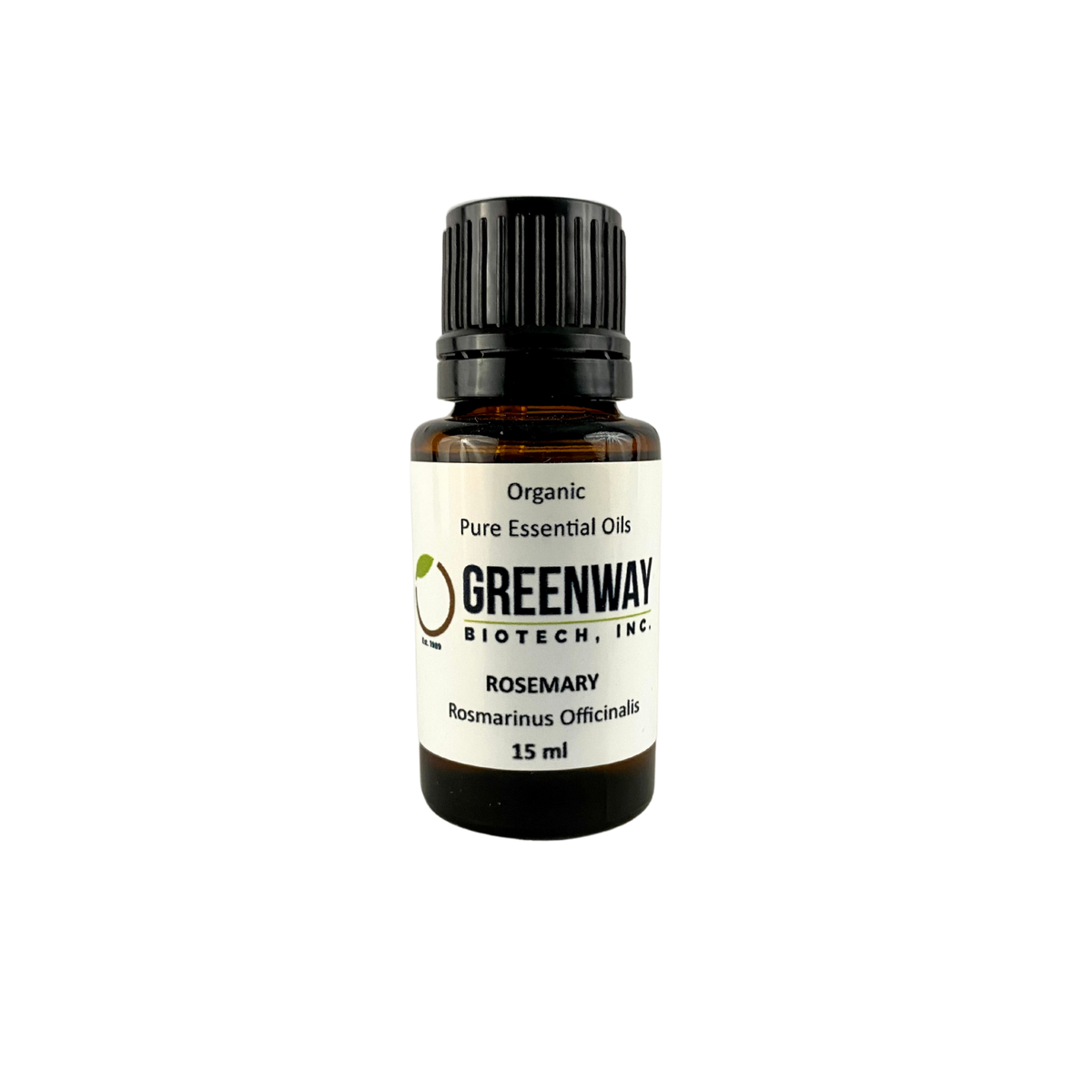
100% pure organic Rosmarinus officinalis, steam-distilled from South African rosemary and hand-bottled in a dark amber glass bottle. A fresh, camphoraceous middle note rich in 1,8-cineole (38-55%) — one of the most popular oils for hair and scalp care, focus blends, post-activity massage, and natural cleaning.
See the details → How to use itHand-bottled in the USA · 90-day guarantee · For external use only
38-55%
1,8-cineole content
15ml
~300 drops, amber glass
2.5%
Max skin dilution
35+yrs
Family-owned in California
One 15 ml bottle holds roughly 300 drops. Smells fresh, herbaceous, and camphoraceous — like a crushed rosemary sprig with woody, slightly medicinal undertones.
| Botanical Name | Rosmarinus officinalis (syn. Salvia rosmarinus) |
|---|---|
| Key Constituents | 1,8-cineole (38-55%), camphor (5-15%), α-pinene (9-14%), camphene, borneol |
| Chemotype | ct. cineole — the most versatile, widely used form |
| Extraction | Steam distilled from flowering tops and leaves |
| Origin | South Africa — certified organic |
| Aroma | Fresh, herbaceous, camphoraceous — like a crushed rosemary sprig with woody, slightly medicinal undertones |
| Aromatic Note | Middle note — provides body and staying power, bridging top and base notes |
| Bottle | 15 ml (~300 drops) in dark amber glass with euro dropper cap |
| Skin Safety | Non-phototoxic; max skin dilution 2.5% (~1% on the face) |
| Important Restrictions | Avoid with epilepsy/seizure disorders; not for children under 5; consult a clinician if pregnant or with high blood pressure |
| Use | For external use only — hair/scalp care, aromatherapy, diluted topical, and cleaning |
Rosemary is one of the most useful oils to keep on hand. These are common reasons shoppers reach for it — general uses, not medical claims.
One of the most popular essential oils for hair care. Research suggests it may help support a healthy scalp environment and the appearance of thicker hair with consistent use over months.
Widely used in aromatherapy to help create an alert, focused atmosphere. The fresh, camphoraceous aroma is a popular choice for work and study.
Commonly used in massage blends after exercise. The warming camphor and cineole make it a favourite in sports aromatherapy, especially with eucalyptus.
A clean, invigorating diffuser oil — 3-5 drops fills a room with a fresh herbal scent. A natural pick for a workspace or study area.
A fresh, herbal scent for natural cleaning sprays — 15-20 drops per 16 oz. A popular addition to DIY household products.
Chemotype, origin, and purity all shape a rosemary oil. Here is what sets this one apart.
Rosemary comes in several chemotypes; this is the ct. cineole type — the most versatile and widely used. 1,8-cineole is the fresh, camphoraceous compound that defines its bright, clean aroma and makes it the go-to rosemary for aromatherapy, hair care, and general wellness.
Sourced from certified organic rosemary fields in South Africa, where the climate produces robust plants with a rich, full-bodied essential oil profile.
Pure organic Rosmarinus officinalis — no synthetic additives, fillers, fragrance oils, or carrier oils. Every bottle is steam-distilled rosemary leaf and flower oil and nothing else.
Rosemary is one of the most popular essential oils in natural hair and scalp routines. Research suggests it may help support a healthy scalp environment and the appearance of thicker hair when used consistently over several months — the key word being consistently.
Packaged in dark amber glass to shield the oil from UV light. The euro dropper cap gives precise drop control and limits air exposure between uses.
Every bottle is hand-filled and inspected at our US facility and lot-coded for traceability, so each batch can be tracked back to its source.
38-55% 1,8-cineole
Steam-distilled Rosmarinus officinalis, ct. cineole
Rosemary is a woody evergreen herb native to the Mediterranean, prized for centuries in cooking, medicine, and ritual. The essential oil is steam-distilled from the flowering tops and leaves, and its character is dominated by 1,8-cineole (38-55%) alongside camphor (5-15%), α-pinene, camphene, and borneol. That cineole content is what gives the oil its fresh, sharp, camphoraceous, instantly-recognizable rosemary aroma.
One thing that trips up shoppers is chemotypes. The same rosemary species can produce oils with quite different chemical profiles depending on where and how it is grown — ct. cineole (fresh, camphoraceous, the most versatile), ct. camphor (sharper, more medicinal), and ct. verbenone (gentler, more skincare-oriented). This oil is the cineole type, the most popular for aromatherapy, hair care, and everyday use.
Rosemary is the oil most associated with hair care, and there is genuine research interest here: studies have looked at rosemary oil applied to the scalp over several months. The honest framing is that it may help support a healthy scalp environment and the appearance of thicker hair with consistent use — it is not an overnight fix or a guaranteed treatment, and the research involves daily or near-daily application over months.
As a middle note, rosemary brings body and staying power to a blend, bridging bright top notes and grounding base notes. It is non-phototoxic, so there is no UV-avoidance window after diluted topical use.
One ingredient — pure steam-distilled rosemary oil. Its character comes from the natural constituent profile below.
The dominant constituent (also called eucalyptol). Source of the fresh, camphoraceous, clean aroma and the cineole chemotype designation.
Adds a sharp, warming, slightly medicinal facet. Also the constituent behind the epilepsy/seizure caution.
Minor constituents (α-pinene 9-14%) that contribute fresh, woody, evergreen notes.
Safety note: non-phototoxic and generally well-tolerated at standard dilutions, but it has specific restrictions: avoid with epilepsy/seizure disorders (camphor), not for the face of children under 5, and consult a clinician if pregnant or managing high blood pressure. Max skin dilution 2.5%. For external use only. See the Safety band.
| Botanical Name | Rosmarinus officinalis |
|---|---|
| Plant Part | Flowering tops and leaves |
| Extraction | Steam distilled |
| Chemotype | ct. cineole |
| Primary Constituent | 1,8-cineole, 38-55% |
| Secondary Constituents | Camphor (5-15%), α-pinene (9-14%), camphene, borneol |
| Aromatic Note | Middle note |
| Origin | South Africa — certified organic |
| Phototoxic | No |
| Max Skin Dilution | 2.5% |
| Key Restrictions | Epilepsy/seizures; under-5; pregnancy; high blood pressure |
| Net Volume | 15 ml (~300 drops) |
| Shelf Life | 2-3 years stored properly |
| Bottled At | Greenway Biotech facility, USA — lot-coded |
First impression: Fresh, sharp, and herbaceous with a camphor edge — clean and invigorating, with more depth and staying power than a citrus oil.
For hair care: A scalp routine, not a quick fix. The research involves consistent application over months, so set expectations accordingly and give it time.
In blends: A versatile middle note that brings body. It pairs naturally with citrus, mint, eucalyptus, and florals — bright partners that lift its herbal depth.
Rosemary is versatile and well-tolerated, but it has real restrictions — check the Safety band first. Always dilute before skin use and patch test. For external use only.
Quick answer: 5-8 drops per 2 tbsp carrier oil for a pre-wash scalp massage; or 2-3 drops into your shampoo. Consistency over months matters more than any single use.
Set expectations: rosemary may help support a healthy scalp environment and the appearance of thicker hair with consistent use. It is a long-game scalp routine, not an overnight fix or a guaranteed treatment.
Quick answer: 3-5 drops in the diffuser for focus; 10-12 drops per tbsp carrier for a post-activity massage blend.
| Use | Drops | Base | Notes |
|---|---|---|---|
| Diffuser | 3-5 drops | Water reservoir | Diffuse 30-40 min at a time |
| Face & neck | 5-6 drops | 1 tbsp (15 ml) carrier | ~1% — gentle for facial care |
| Body & massage | 10-12 drops | 1 tbsp (15 ml) carrier | 2-2.5% — for tired muscles after activity |
Quick answer: 15-20 drops per 16 oz water + emulsifier for a fresh-scented cleaner.
Note: rosemary is a popular natural-cleaning oil with a fresh, herbal scent. A DIY rosemary spray is intended for everyday freshening, not for eliminating germs.
Rosemary is forgiving in a blend, but its restrictions are real. A few principles keep it safe and effective.
Avoid entirely with epilepsy, a seizure disorder, or seizure history (camphor). Not for the face of children under 5. Consult a clinician if pregnant or managing high blood pressure. These come before any dilution math.
2.5% on the body (about 10-12 drops per tablespoon of carrier), a gentler ~1% on the face, and 5-8 drops per 2 tablespoons for scalp work. Always patch test first.
Rosemary brings body and bridges bright top notes with grounding bases. Pair with citrus (lemon), mint (peppermint), eucalyptus, or florals (lavender) for balance.
Scalp results — where they happen — come from consistent use over months, not a single treatment. Build it into a regular routine rather than expecting a quick change.
Study Session: 3 drops Rosemary + 2 drops Lemon + 2 drops Peppermint.
Post-Activity Recovery: 3 drops Rosemary + 3 drops Eucalyptus + 1 drop Peppermint.
Scalp Revival: 3 drops Rosemary + 2 drops Lavender + 2 drops Tea Tree in 2 tbsp carrier.
Essential oils are not intended to diagnose, treat, cure, or prevent any disease. For external use only.
Two questions come up most: which rosemary chemotype this is, and how rosemary compares to other fresh, focus-friendly oils.
| Attribute | Rosemary ct. cineole (this oil) | Eucalyptus | Peppermint | Lemon |
|---|---|---|---|---|
| Dominant Compound | 1,8-cineole (38-55%) | 1,8-cineole | Menthol | Limonene |
| Aroma | Fresh, herbaceous, camphoraceous | Sharp, fresh, camphoraceous | Sharp, cooling mint | Bright, clean citrus |
| Aromatic Note | Middle | Top | Top | Top |
| Signature Use | Hair/scalp, focus | Respiratory-fresh, muscle | Focus, cooling | Cleaning, focus |
| Phototoxic | No | No | No | Yes (12 hr UV avoidance) |
| Key Restriction | Epilepsy; under-5 | Under-10 | G6PD; under-6 | Phototoxic |
A short fit-check so you can decide quickly.
Rosemary is a versatile middle note that bridges bright top notes and soft florals.
Rosemary + peppermint is a favourite focus-and-alertness combination — both invigorating, with complementary herbal-minty profiles.
Essential OilBoth are cineole-rich and fresh. Combined, they make a popular invigorating post-activity and diffuser blend.
Essential OilThe classic herbal pairing — lavender softens rosemary's sharpness and adds calming floral depth to massage and scalp blends.
A "carrier oil" is any vegetable-based oil used to dilute essential oils before skin application — jojoba (great for scalp), sweet almond, and fractionated coconut are popular options. Browse the full Essential Oils Collection for more.
For external use only. Rosemary has specific health restrictions. Keep out of reach of children and pets.
If your question is not here, contact our team at questions@greenwaybiotech.com.
Yes. It is 100% pure, certified organic Rosmarinus officinalis — no synthetic additives, fillers, fragrance oils, or carrier oils. It is steam-distilled from organically grown rosemary in South Africa and hand-bottled at our US facility.
Fresh, herbaceous, and camphoraceous — like a crushed rosemary sprig with woody, slightly medicinal undertones. It is invigorating and clean, with more depth and staying power than most citrus oils. As a middle note, it gives body to blends and bridges top and base notes.
Rosemary is one of the most popular essential oils for hair care. Some research suggests it may help support a healthy scalp environment and the appearance of thicker hair when used consistently over several months. Add 5-8 drops to 2 tablespoons of carrier oil, massage into the scalp, and leave 30 minutes before shampooing. Consistency matters — occasional use is less likely to show a difference, and results vary from person to person.
The maximum safe skin dilution is 2.5%. For body and massage, use 10-12 drops per tablespoon of carrier oil; for the face, use a gentler 5-6 drops per tablespoon (about 1%); for scalp treatments, 5-8 drops per 2 tablespoons. Always patch test before first use.
No. Rosemary should be avoided entirely if you have epilepsy, a seizure disorder, or a history of seizures — some constituents, particularly camphor, may lower the seizure threshold, and this applies to diffusing as well as topical use. If you want a focus-friendly aromatherapy oil without this concern, consider Peppermint or Lemon (and check their own safety notes).
Do not use rosemary on or near the face or nostrils of children under 5 — the 1,8-cineole and camphor content can cause breathing difficulties in very young children. For ages 5 and up, use half the adult dilution (about 1-1.25%) and avoid the face. Always consult a pediatrician before using essential oils on children.
Rosemary oil comes in several chemotypes (chemical profiles) depending on where it grows: ct. cineole (ours — the most versatile, fresh and camphoraceous), ct. camphor (sharper, more medicinal), and ct. verbenone (gentler, more suited to skincare). Our cineole-rich chemotype is the most popular and widely used for aromatherapy, hair care, and general wellness.
No. Rosemary is non-phototoxic, so you do not need to avoid sunlight after applying it (diluted) to skin. It is fine for daytime topical use with no UV restrictions.
For scalp treatments, jojoba closely resembles the scalp's natural sebum and is an excellent choice; fractionated coconut is lightweight and absorbs well. Sweet almond works well for body massage.
Cats are particularly sensitive to essential oils because they lack the liver enzymes to metabolize certain compounds. Do not apply essential oils directly to pets, and ensure diffusing areas are well-ventilated with an exit route for animals. Consult your veterinarian before using any essential oil around pets.
Store in a cool, dark place with the cap tightly sealed. Rosemary is one of the longer-lasting essential oils, with a 2-3 year shelf life when stored properly. No refrigeration required, though it will not hurt. The dark amber glass protects against UV; if the aroma changes significantly, consider replacing the bottle.
No. Our essential oils are formulated, tested, and labeled for external use only. Essential oils are extremely concentrated. For culinary rosemary flavor, use fresh or dried rosemary herb instead.
A 15 ml dark amber glass bottle of pure organic South African rosemary, hand-bottled in the USA. Backed by our 90-day money-back guarantee — if it is not the right fit, we will make it right.
Add to cart →Hand-bottled in the USA · 90-day guarantee · For external use only