Organic Egyptian Geranium Essential Oil (Pelargonium graveolens) — 15 ml
- Regular Price
- $ 24.99
- Sale Price
- $ 24.99
- Regular Price
Sold Out
- Unit Price
- per
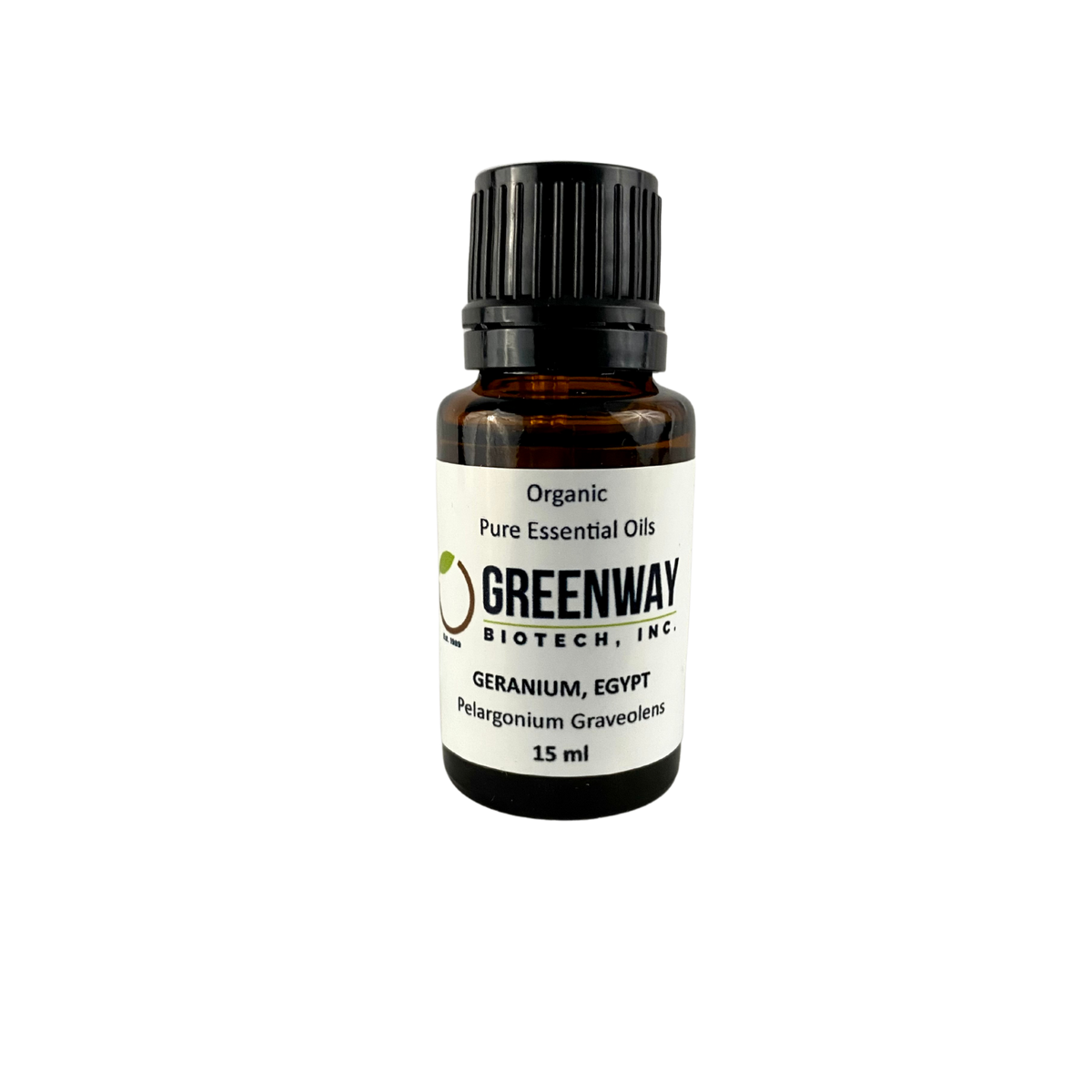
100% pure organic Pelargonium graveolens oil, steam-distilled from whole geranium plants grown in Egypt's Nile Valley. A rosy-floral middle note prized for skincare blends, natural perfumery, and balanced diffuser combinations — sometimes called "rose geranium" for its rose-adjacent character at a fraction of rose oil's cost.
Find your size → See how to use itShips from California · 90-day guarantee · GC/MS available on request
100%
Pure organic Pelargonium graveolens
15ml
≈ 300 drops per bottle
22-32%
Citronellol (the headline compound)
1.5%
Max topical dilution per Tisserand & Young
Geranium is used in small amounts — 4 to 7 drops per tablespoon of carrier for skincare and massage, 3 to 5 drops in a diffuser — so a 15 ml bottle stretches across many blends. Stored properly, the oil keeps its character for two to three years.
| Size | Typical Duration | Uses per Bottle | Best For |
|---|---|---|---|
| 15 ml dark amber glass | ~1 year (typical home use) | ~300 drops | Best starter size |
| Product Type | Single-origin essential oil |
|---|---|
| Size | 15 ml (≈ 300 drops) dark amber glass with euro dropper cap |
| Key Ingredient | Egyptian Geranium Oil (Pelargonium graveolens) — sometimes called rose geranium |
| Source / Origin | Certified-organic geranium farms in Egypt's Nile Valley |
| Grade / Purity | 100% pure, certified organic, GC/MS verified — no fillers, no carrier oils, no synthetic fragrance |
| Aroma | Rich, rosy-floral with green-herbaceous undertones and a subtle citrus-sweet finish |
| Aromatic Note | Middle note — provides floral body and bridges top and base notes in blends |
| Extraction | Whole-plant steam distillation (leaves, stems, and flowers) |
| Phototoxic | No — no UV avoidance window required after topical use |
| Max Topical Dilution | 1.5% (~6-7 drops per tablespoon of carrier oil) — lower than many EOs |
| Safety | External use only; patch test before first use; rotate with other oils rather than daily prolonged use. See Safety section below for full guidance. |
Geranium earns its place in the cabinet through skincare blending, natural perfumery, and balanced diffuser combinations — anywhere a rose-adjacent floral note adds depth without rose oil's price tag.
Four to five drops per tablespoon of carrier oil for facial blends, six to seven for body. A popular staple in DIY facial serums and balancing body oils.
Two to four drops in a 10 ml roller bottle. Geranium acts as a natural fixative, helping lighter top notes linger — a perfumer's middle-note workhorse.
Three to five drops in a diffuser. The rosy-floral character bridges citrus brightness and woody depth — versatile in evening and daytime blends alike.
Six to seven drops per tablespoon of carrier oil. Commonly used to create a sense of relaxation during massage. Rotate with other oils rather than daily use.
A staple ingredient for DIY skincare crafters and small-batch cosmetic makers — its rose-adjacent character lifts soaps, balms, and bath products.
Rose otto sits on a shelf most people can't afford. Egyptian geranium shares the same headline aromatic compounds — citronellol and geraniol — in a profile that delivers much of the rosy character at a tenth of the cost.
Sourced from certified-organic geranium farms in Egypt's Nile Valley, where alluvial soils, intense sunshine, and a hot dry climate produce an oil with exceptional depth and complexity. Egyptian geranium is widely regarded among perfumers as the premium origin for P. graveolens — richer and rounder than Chinese or Réunion-island variants.
Distilled from leaves, stems, and flowers — not just blossoms. Whole-plant extraction captures the full spectrum of aromatic compounds, giving Egyptian geranium its characteristic depth: not just the rosy top note, but the green herbaceous body and the sweet citrus finish underneath.
Citronellol (22-32%) is the dominant aromatic compound — the same monoterpenol that gives rose oil much of its rosy character. Pair that with geraniol (12-18%) and linalool (4-10%) and you have a profile chemically adjacent to rose otto without rose's harvest economics.
Pure rose essential oil (Rosa damascena) costs ten to twenty times what geranium does — because rose otto requires thousands of pounds of petals per ounce of oil. Egyptian geranium delivers a rich, complex rose-adjacent character at home-user prices, which is why perfumers and natural-skincare crafters reach for it constantly.
Each batch is independently analyzed by GC/MS to verify the constituent profile (citronellol, geraniol, linalool, citronellyl formate) and screen for adulterants. Geranium is one of the most commonly adulterated essential oils in the global market — third-party verification matters here more than for most oils. Lot-coded for traceability.
Distilled in Egypt, hand-filled and inspected at our family-owned facility in Madera, California. Two to three year shelf life sealed in dark amber glass. Backed by a 90-day money-back guarantee on every bottle.
34-50% citronellol + geraniol
The monoterpenol pair responsible for the rosy-floral character
What makes Egyptian geranium read as "rose-like" is chemistry, not coincidence. The two dominant aromatic compounds are citronellol (22-32%) and geraniol (12-18%) — two monoterpenols that together account for roughly a third to a half of the entire oil and that also appear as major constituents in rose otto. When you smell rose in geranium, you're smelling the same molecules.
The profile diverges from there. Rose otto carries higher levels of phenethyl alcohol and 2-phenylethanol (the "lush wet-rose" character). Egyptian geranium has more linalool (4-10%, a soft floral background note also found in lavender), more citronellyl formate (a fruity ester), and more isomenthone and guaia-6,9-diene from the leaves and stems. The result: less of the pure-blossom velvet of rose, more green herbaceous body and a subtle citrus-sweet finish. Different oils, overlapping vocabulary.
That same chemistry sets the topical safety limit. High geraniol and citronellol content can sensitize skin with frequent prolonged exposure on the same area — Tisserand & Young set the recommended maximum at 1.5%. Translation: keep facial blends under 1%, body massage blends under 1.5%, rotate with other oils rather than using geranium daily on the same patch of skin, and patch test before first use.
Constituent ranges below reflect typical batch profiles for steam-distilled Egyptian Pelargonium graveolens. The current-batch GC/MS report is available on request.
The dominant monoterpenol — responsible for the soft, rosy character. Also a major component of rose otto. Contributes to the 1.5% topical-dilution ceiling because of skin-sensitization potential at higher cumulative exposures.
The second monoterpenol that gives rose its rosy character; also found here. Sweet, slightly fruity, deeply floral. Co-responsible (with citronellol) for the rose-adjacent profile and for the topical dilution limit.
A soft, floral terpene alcohol also dominant in lavender. Rounds out the headline monoterpenols with a gentle floral background.
A fruity-floral ester. Adds the subtle sweet-citrus finish at the back of the aroma profile.
A minty-floral ketone from the leaves and stems. Contributes to the slight green herbaceous quality that distinguishes geranium from pure rose.
A sesquiterpene from the leaf material. Adds soft woody depth to the lower-volatility tail of the aromatic profile.
Sensitizer note: the high geraniol and citronellol content makes Egyptian geranium a known potential skin sensitizer with frequent prolonged exposure. Keep topical use under 1.5%, rotate with other oils, and discontinue if redness or itching develops. Consult a healthcare provider before topical or diffused use during pregnancy or while nursing. Cats lack the liver enzymes to metabolize many essential-oil constituents — do not apply to pets.
| Botanical Name | Pelargonium graveolens L'Hér. |
|---|---|
| Common Names | Egyptian Geranium, Rose Geranium, Sweet-Scented Geranium |
| Plant Part Used | Whole plant — leaves, stems, and flowers |
| Extraction Method | Steam distillation |
| Country of Origin | Egypt — Nile Valley (certified organic) |
| Grade | 100% pure, certified organic, GC/MS verified |
| Color & Appearance | Yellow-green to amber, mobile liquid |
| Aroma Profile | Rich, rosy-floral with green-herbaceous undertones and a subtle citrus-sweet finish |
| Aromatic Note | Middle note (with natural-fixative properties) |
| Primary Constituents | Citronellol (22-32%) and geraniol (12-18%) |
| Net Volume | 15 ml (≈ 300 drops) |
| Container | Dark amber glass bottle with euro dropper cap and tamper-evident seal |
| Phototoxicity | Non-phototoxic — no UV avoidance window required |
| Maximum Topical Dilution | 1.5% (Tisserand & Young, 2014) |
| Shelf Life | 2-3 years when stored sealed in a cool, dark place |
| Packaged At | Greenway Biotech facility, Madera, California |
| Testing | Third-party GC/MS verification per batch; lot-coded for traceability |
Three primary use methods. Every drop count below is consistent with the 1.5% maximum topical dilution from Tisserand & Young (2014). When in doubt, use less.
Quick answer: 4-5 drops per tablespoon (15 ml) of carrier oil for face (~0.8-1%); 6-7 drops for body (~1.2-1.5%). Patch test first; rotate with other oils.
| Use | Geranium Drops | Carrier Volume | Approx. Dilution |
|---|---|---|---|
| Facial serum (gentle) | 4-5 drops | 1 tbsp (15 ml) | ~0.8-1% |
| Body oil / facial daily use | 5-6 drops | 1 tbsp (15 ml) | ~1% |
| Body massage blend | 6-7 drops | 1 tbsp (15 ml) | ~1.2-1.5% |
| Add to existing moisturizer | 2-3 drops | 1 oz cream/lotion | ~0.3-0.5% |
Suitable carriers: jojoba (excellent for face — lightweight, non-comedogenic), rosehip seed (popular in artisan facial serums), sweet almond (body massage), fractionated coconut (roller bottles). Avoid: damaged, sensitive, or irritated skin. Rotate with other oils rather than using daily on the same skin area — high geraniol and citronellol can sensitize with prolonged repeated exposure. Patch test on the inner forearm and wait 24 hours before broader use.
Quick answer: 2-4 drops in a 10 ml roller bottle for perfume; 3-5 drops in a diffuser for medium rooms. Geranium acts as a natural fixative.
| Use | Geranium Drops | Base | Notes |
|---|---|---|---|
| Roller-bottle perfume | 2-4 drops | 10 ml jojoba/fractionated coconut | Combine with 1-2 top + 1-2 base note drops; let mellow 48 hrs |
| Solid perfume balm | 4-6 drops | 1 oz balm base | Geranium acts as a natural fixative for lighter top notes |
| Small-room diffuser | 2-3 drops | Water reservoir | 20-30 minutes; bathroom, closet, small office |
| Medium-room diffuser | 3-5 drops | Water reservoir | 30-40 minutes; bedroom, office |
| Large-room diffuser | 5-7 drops | Water reservoir | 40-60 minutes; living room, open kitchen |
Starter perfume blend: 3 drops Geranium (middle) + 2 drops Sweet Orange (top) + 1 drop Patchouli (base) in a 10 ml roller filled with jojoba. Let the bottle rest 48 hours before first use — the aroma rounds out and integrates as it mellows.
Massage blend: 6-7 drops geranium per tablespoon of carrier oil (jojoba, sweet almond, or coconut). Massage blends are commonly used to create a sense of relaxation; rotate with other oils rather than daily prolonged use on the same area.
Essential oils don't mix with bathwater, so we don't recommend adding them to a bath or to bath salts.
Geranium is a beautiful skincare oil with a real sensitization profile. Four habits separate a pleasant year-long experience from a sudden reaction six months in.
Mix 1 drop of geranium in 1 tablespoon of carrier oil. Apply a small amount to the inner forearm and wait 24 hours. If no redness, itching, or burning appears, the dilution is workable for you. Re-test if you take an extended break from the oil and return to it.
For facial blends, stay at or below 1% (4-5 drops per tablespoon of carrier). For body, stay at or below 1.5% (6-7 drops per tablespoon). The high geraniol and citronellol content can sensitize skin at higher concentrations — using more is not better.
Even within the 1.5% ceiling, daily prolonged use on the same skin area can lead to gradual sensitization. The fix is rotation: alternate geranium blends with non-geranium blends, or use the same blend a few days a week rather than every day. Skin sensitization develops over time, not on day one.
Skip geranium entirely on broken, sunburned, infected, or actively irritated skin. The sensitization risk is higher on compromised skin, and the oil is not a treatment — it's a fragrance and skincare ingredient. Wait until skin has fully recovered before resuming use.
Geranium is a middle note with natural-fixative properties — it gives floral body to a blend and helps lighter top notes (citrus, eucalyptus) linger longer than they would alone. For perfume building, a common ratio is 1 top + 1 middle (geranium) + 1 base, adjusted to taste.
Stored properly, geranium keeps its character 2-3 years. Heat and UV are the main enemies — keep the cap tight and the bottle in a cool dark cabinet. Write the open-date on the label to track freshness.
For aromatherapy use. Dilute before topical application. Keep out of reach of children. Essential oils are not intended to diagnose, treat, cure, or prevent disease.
Egyptian geranium is the practical floral middle note. Rose otto is the splurge. These are the rest of the cabinet for skincare and perfumery blends.
| Oil | Primary Compounds | Aroma Character | Max Topical | Relative Cost |
|---|---|---|---|---|
| Egyptian Geranium (this product) | Citronellol + geraniol 34-50% | Rich rosy-floral, green herbaceous, citrus-sweet finish | 1.5% | $$ — home-user accessible |
| Rose Otto (Rosa damascena) | Citronellol + geraniol + phenethyl alcohol | Pure, deep, velvety rose | 0.6% | $$$$$ — 10-20x geranium |
| Lavender | Linalool + linalyl acetate | Soft floral, herbaceous, calming | 2-3% | $$ — comparable |
| Patchouli | Patchoulol & sesquiterpenes | Earthy, woody, base note | 3%+ | $$ — comparable; pairs with geranium |
| Pink Grapefruit | Limonene >90% | Bright, tangy, sparkling citrus top note | 4% | $$ — comparable; lifts geranium blends |
Honest sorting — geranium does some things very well and isn't the right pick for every routine.
A middle note works best alongside a bright top and a grounding base. These four make the most-reached-for partners for geranium across skincare, perfumery, and diffusing.
The quintessential geranium pairing — two floral middle notes that create a beautifully balanced, sophisticated blend for skincare serums and relaxation routines.
Essential OilAn earthy base note that grounds geranium's floral brightness. Together they make a rich, complex blend for natural perfume and grounding diffuser combinations.
Essential OilWarm, sweet citrus top note lifts geranium's floral body. A cheerful, inviting blend for diffusing or daytime perfume.
Essential OilA bright, sparkling citrus that adds freshness to geranium's rosy warmth — lovely in skincare blends and uplifting morning routines.
Geranium is gentler than many oils on first contact, but has a real long-term sensitization profile that rewards a careful approach.
If your question isn't here, contact our team at questions@greenwaybiotech.com.
Yes. Our Egyptian geranium essential oil is 100% pure, certified-organic Pelargonium graveolens. It contains no synthetic additives, fillers, fragrance oils, or carrier oils. It is steam-distilled from organically-grown geranium plants in Egypt's Nile Valley and hand-bottled at our family-owned Madera, California facility.
Rich, rosy-floral with green herbaceous undertones and a subtle citrus-sweet finish. Often compared to rose oil — and chemically, the comparison holds: geranium and rose share their two dominant compounds (citronellol and geraniol). Geranium reads as less pure-velvet-rose, more herbal-floral with a green leafy quality from the whole-plant distillation. The Egyptian origin produces a particularly rich, full-bodied version.
Same headline aromatic compounds (citronellol and geraniol), different overall profiles. Rose otto (Rosa damascena) carries higher levels of phenethyl alcohol — the "lush wet-rose" character — and is far purer-floral. Geranium has more linalool, more leaf-derived compounds (isomenthone, guaia-6,9-diene), and reads more herbal-floral. The economic difference is enormous: rose otto runs 10-20 times the cost of geranium because thousands of pounds of petals yield only an ounce of oil. Geranium is the working perfumer's accessible rose adjacent for skincare and natural perfume.
The high citronellol (22-32%) and geraniol (12-18%) content can sensitize skin with frequent prolonged exposure on the same area. Tisserand & Young set the recommended maximum at 1.5% — lower than the 2.5-5% range typical for many other essential oils. This doesn't mean geranium is unsafe; it means it benefits from lower concentrations and rotation rather than daily prolonged use on the same patch of skin. Always patch test before first use.
Keep topical dilutions at or below 1.5%. For face and neck, use 4-5 drops per tablespoon of carrier oil (around 0.8-1%). For body and massage, use 6-7 drops per tablespoon (around 1.2-1.5%). Add 2-3 drops to one ounce of existing moisturizer or lotion for a much lower (~0.3-0.5%) blend. Avoid use on damaged, sensitive, or irritated skin, and rotate with other oils rather than using daily on the same area.
No. Egyptian geranium is non-phototoxic, meaning you do not need to avoid sunlight after topical application. It is safe for daytime use within the 1.5% topical limit.
Geranium is one of the most popular essential oils in natural skincare blends. It is commonly included in facial serums, body oils, and balancing skincare formulations across skin types — often paired with jojoba or rosehip carrier oils. Use at 1% or below for facial blends, do a patch test before first use, and rotate with other oils rather than using daily on the same area to avoid gradual sensitization.
The Nile Valley's combination of rich alluvial soils, intense sunshine, and hot dry climate produces a P. graveolens oil with deeper, more complex aromatics than the same species grown in cooler or wetter regions. Egyptian geranium is widely regarded among perfumers as the premium origin — richer and rounder than the Chinese or Réunion-island variants. Our oil is sourced from certified-organic farms in this region.
For facial skincare, jojoba is the go-to choice — lightweight, non-comedogenic, and a popular pairing with geranium in natural skincare. Rosehip seed oil is another popular choice for facial serums. Sweet almond oil works well for body massage. Fractionated coconut oil is ideal for roller-bottle perfumes (long shelf life, smooth absorption).
Cats lack the liver enzymes to metabolize many essential-oil constituents and are particularly sensitive. Do not apply essential oils directly to pets. When diffusing, keep the area well-ventilated and ensure animals have a clear exit route. Consult your veterinarian before any essential-oil use around pets, especially cats.
Approximately 300 drops using the standard euro dropper cap included with each bottle. Actual count varies slightly depending on oil viscosity and dispensing speed. Since geranium is used in small amounts (a few drops per blend), a single 15 ml bottle stretches across many skincare blends, perfumes, and diffuser sessions.
Store in a cool, dark place with the cap tightly sealed. The dark amber glass bottle protects against UV light, which is the leading cause of essential-oil oxidation. Geranium has a 2-3 year shelf life when stored properly. Refrigeration is not required but won't harm the oil. Write the open-date on the label to track freshness over time.
No. Our essential oils are formulated and labeled for external aromatherapy use only. Essential oils are extremely concentrated and not the same as the herbs they come from. For culinary geranium flavor in food and drinks, use fresh scented-geranium leaves instead. Essential oils are not intended to diagnose, treat, cure, or prevent disease.
One 15 ml dark amber glass bottle. Steam-distilled in Egypt's Nile Valley from certified-organic Pelargonium graveolens; hand-filled in Madera, California. Free shipping on orders over $100 in the continental US, and a 90-day money-back guarantee.
Choose your size →Ships from California · 90-day guarantee · GC/MS reports above