Potassium Sulfate Fertilizer 0-0-53
- Regular Price
- $ 21.99
- Sale Price
- $ 21.99
- Regular Price
- $ 21.99
Sold Out
- Unit Price
- per

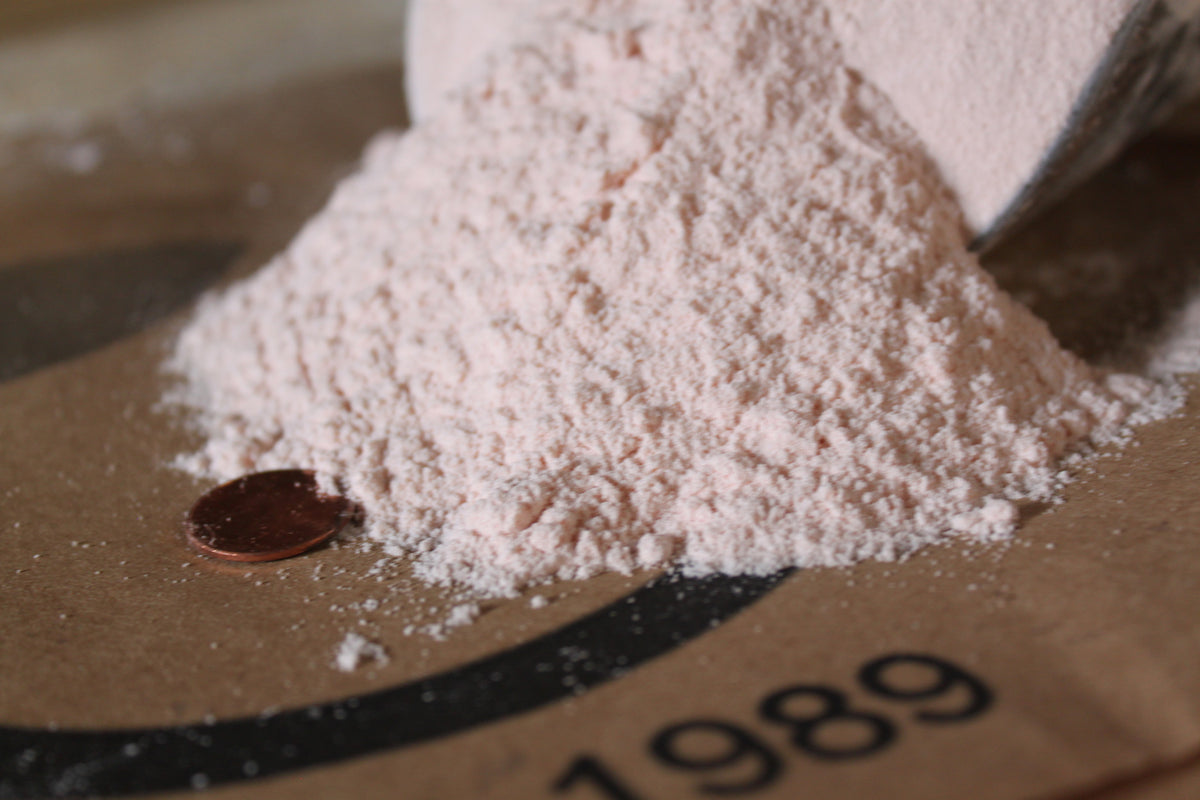

Solution-grade potassium sulfate (K₂SO₄) delivering 53% soluble potash (K₂O) and 17% sulfur in a single, fully water-soluble crystalline form. CDFA registered, independently lab tested for heavy metals, and built for the crops where chloride is a problem — tomatoes, peppers, berries, grapes, potatoes, citrus, and tobacco. Works in soil, foliar, fertigation, and hydroponic Tank B.
Find your size → Calculate how much I need53%
Soluble potash (K₂O) per pound
17%
Sulfur — the secondary nutrient most often missed
0%
Chloride — safe for sensitive fruit and quality crops
35+yrs
Family-owned, California-made fertilizer manufacturing
Coverage figures below assume a typical garden planning rate of 1.5 lbs per 100 sq ft (mid of the 1–2 lb range). For fruit trees, plan 1–3 lbs per tree per year. For field crops, base rates on a current soil test — the ranges in the Application section are general references only.
| Bag Size | Garden Coverage | Fruit Trees | Best For |
|---|---|---|---|
| 2 lb | ~130 sq ft | 1–2 trees | Small gardens, trial use, foliar batches |
| 5 lb | ~330 sq ft | 2–5 trees | Most popular |
| 10 lb | ~660 sq ft | 4–10 trees | Backyard orchards, full-season hydro reservoir refills |
| 25 lb | ~1,650 sq ft | 10–25 trees | Market growers, greenhouse fertigation |
| 55.1 lb | ~3,650 sq ft | 20–55 trees | Best value |
Solution-grade crystalline form dissolves cleanly for soil, foliar, drip, and reservoir use — and the chloride-free chemistry is what makes it suitable for the most quality-sensitive crops in your rotation.
Side-dress at flowering and fruit set. Brix, color, and firmness all benefit from adequate K when fruit demand peaks — without the chloride that can shorten storage life.
Apply under the drip line in split doses (early spring + during fruit development). Supports sugar accumulation, fruit size, and post-harvest shelf life across pome, stone, and citrus fruit.
From bloom through veraison, K demand spikes. Sulfate-form K avoids the chloride that can flatten flavor and reduce sugar in strawberries, blueberries, raspberries, and wine grapes.
Fully water-soluble and chloride-free — ideal for recirculating systems where chloride would otherwise accumulate. Keep in Tank B, separate from calcium nitrate.
Two crops where chloride is well known to lower specific gravity, processing quality, and leaf grade. Sulfate-form potassium is the long-standing preferred source.
Quick correction during peak fruit fill. Foliar at low concentration (see Application section), or injected weekly through fertigation lines at standard dilution.
Three reasons growers reach for sulfate-form potassium even when muriate of potash costs less per pound of K₂O.
Potassium sulfate sits just below muriate of potash (0-0-60/62) in K₂O concentration — but it's the highest-K product available that avoids chloride entirely. That means fewer pounds applied, less salt loading on the soil, and lower freight per unit of K₂O than lower-grade sulfate alternatives like K-Mag.
Crops such as tobacco, potatoes, many berries, grapes, tomatoes, and peppers may perform better with sulfate-based potassium sources. Sensitivity varies by crop, cultivar, irrigation water quality, and soil drainage. If you're running Potassium Chloride 0-0-62 on chloride-tolerant crops and need a separate source for the sensitive ones, K₂SO₄ is the standard companion.
Sulfur is a secondary macronutrient that's increasingly limiting as atmospheric sulfur deposition has declined. Each pound of K₂SO₄ carries 17% S as plant-available sulfate — supporting amino acid synthesis (cysteine, methionine), enzyme activity, and crop quality in sulfur-loving crops like alliums and brassicas. For deeper coverage, see What is the Function of Sulfur in Plants?
Salt index measures how much a fertilizer raises soil solution osmotic pressure relative to sodium nitrate. K₂SO₄ has a partial salt index near 0.85 per unit of K₂O, compared to roughly 1.94 for KCl. In practice, that means less risk of fertilizer burn on seedlings, in containers, and in low-rainfall regions where salts accumulate. Useful detail in our deeper comparison: What is the Best Potassium Fertilizer?
Solution-grade K₂SO₄ dissolves completely in warm water with no insoluble residue, making it suitable for drip irrigation, foliar spray, fertigation injection, and hydroponic reservoirs. Maximum solubility is about 120 g per liter of water at 25°C — lower than KCl, so dissolve fully before injecting and avoid over-concentrating stock tanks.
Registered with the California Department of Food and Agriculture and independently lab tested for heavy metal content — results consistently well below required limits. The current third-party analysis is published on our Heavy Metals Analysis page.
K₂SO₄solution grade
Potassium sulfate — 53% K₂O, 17% S, chloride-free
Potassium is a regulator more than a builder — it doesn't end up structurally embedded in plant tissue the way nitrogen, phosphorus, or calcium do. Instead, it works as the dominant cellular cation, activating more than 60 enzymes, driving stomatal opening and closing, controlling water movement, loading sugars into fruit, and stabilizing pH inside the cell. When K runs short during fruit development, the consequences are visible: smaller fruit, lower Brix, softer texture, shorter shelf life, and reduced tolerance to drought, heat, and cold.
The chemistry choice — sulfate vs chloride — matters because the accompanying anion stays in the soil and the plant. Potassium chloride delivers more K₂O per pound and per dollar, but the chloride that comes with it can accumulate in salt-sensitive crops, suppress sugar accumulation in fruit, and shorten storage life. Sulfate-form potassium — K₂SO₄ — sidesteps that entirely while contributing 17% sulfur as plant-available SO₄²⁻, which supports amino acid synthesis and enzyme activity in its own right.
Practically, that means K₂SO₄ is the standard choice when crop quality is part of the equation: premium fruit, sweet vegetables, alliums, brassicas, processing potatoes, wine grapes, and tobacco. It's also the standard potassium source for recirculating hydroponic systems, where chloride buildup would otherwise become phytotoxic over time. For deeper coverage on potassium's role and why fruit crops in particular demand so much of it, see What's the Function of Potassium (K) in Plants? and Improving Fruit Quality and Yield with Fertilizers.
All rates are reference figures for medium-testing soils at typical yield goals. Actual rates should be based on a current soil test, crop removal estimates, and local extension guidance. The Calculator below the table converts these rates to total product needed for your garden, field, or reservoir.
Quick answer: Broadcast 0.75–2 lbs per 100 sq ft (lower for maintenance, higher for K-deficient soils), worked into the top 4–6 inches, then water in deeply.
| Application | Rate | Timing & Notes |
|---|---|---|
| Maintenance (medium-K soils) | 0.75–1 lb per 100 sq ft | Pre-plant; work into top 4–6 inches |
| Pre-plant build-up (deficient soils) | 1.5–2 lbs per 100 sq ft | Per UConn Soil Lab recommendation for low-K soils |
| Side-dress at fruit set | 1 lb per 100 sq ft | Band 6–8 inches from row, water in |
| Tomatoes & peppers | 1–1.5 lbs per 100 sq ft total season | Split: at planting + at flowering |
| Potatoes (chloride-sensitive) | 1.5–2 lbs per 100 sq ft | Pre-plant or at tuber initiation |
Note: Garden rates assume soils testing in the medium range for K (about 100–200 ppm). If a soil test shows K below 100 ppm, rates may need to come up toward the high end; if it's already above 200 ppm, hold the rate down. Heavy clay soils tolerate higher single applications than sandy soils, where splitting the dose reduces leaching.
Quick answer: 1–5 lbs per tree per year depending on species and age, split into 2–3 applications, broadcast under the drip line.
| Tree Type | Annual Rate | Timing |
|---|---|---|
| Young trees (1–3 yrs) | 0.5–1 lb per tree | Early spring only |
| Mature stone & pome fruit | 1–3 lbs per tree | Split: early spring + during fruit development |
| Citrus (mature) | 2–5 lbs per tree | 2–3 split applications across the year |
| Almonds (backyard) | 3–7 lbs per tree | Fall maintenance band 4–5 ft from trunk; per UC research |
| Berries & grapes | 1–2 lbs per 100 sq ft | Pre-bud break + at veraison |
Note: Apply under the outer canopy edge (drip line), not against the trunk. Rake lightly into the surface or cover with a thin mulch layer, then water in deeply. For container-grown citrus and small fruit, reduce the rate by 30–50% and split into more frequent feedings. Commercial almond orchards (per UC research) commonly band 285–500 lbs per acre annually in the same location 4–5 feet out from the trunk on both sides of the row.
Quick answer: 200–500 lbs K₂SO₄ per acre, depending on crop, yield goal, and soil test. Field rates are not maintenance rates — soil test first.
| Crop | Reference Rate | Notes & Source |
|---|---|---|
| Tomatoes (processing/fresh) | 225–500 lbs per acre | UC Davis: 220–330 lb K₂O removed at 45 ton yield; Auburn trial up to 340 lb/ac |
| Potatoes | 225–450 lbs per acre | U. Maine Bull. #2251 (120–240 lb K₂O/ac); chloride-free essential |
| Almonds | 285–500 lbs per acre | UC research: 150–250 lb K₂O/ac removed; fall maintenance band |
| Tobacco | 200–400 lbs per acre | Sulfate form preferred for leaf quality |
| Grapes & berries | 200–500 lbs per acre | Lodi/UCCE: high-rate (>1000 lb/ac) build-up on K-fixing soils; fertigated season total |
| Citrus orchards | 2–5 lbs per tree per year | Convert by tree density |
📋 Field & Acreage Rates: The per-acre figures above are research-anchored references for medium-testing soils at typical yield goals. Actual rates should be based on a current soil test and local nutrient removal estimates. Even at the soil-test-recommended rate, peer-reviewed trials (e.g., Auburn tomato) have shown soil K can remain in the low-to-moderate range — recommended rates maximize yield, not always quality. Consult your local extension service for site-specific recommendations.
Quick answer: 1–4 tsp per gallon (1.3–5.3 g/L, 0.13–0.53% w/v) for home sprayers — well below the 1.2% K₂O burn ceiling. Apply early morning or late evening; never in direct sun above 85°F.
| Crop | Rate per Gallon | Timing & Source |
|---|---|---|
| Vegetables & fruiting crops | 1–3 tsp per gal (1.3–4 g/L) | Every 2–3 weeks at fruit set; U. Delaware recommends 4 lb K/ac per pass on fruiting veg |
| Fruit trees & citrus | 2–4 tsp per gal (2.6–5.3 g/L) | UF/IFAS: 8 lb K₂O/ac per pass on mature citrus; peer-reviewed citrus optimum 0.56% w/v |
| Peaches (fruit sizing) | 3–4 tsp per gal (4–5 g/L) | Kasetsart 2024: 1.5% w/v (15 g/L) at 30/45/60 DAFB gave largest fruit size in pro sprayers |
| Grapes & berries | 1.5–3.5 tsp per gal (2–4.7 g/L) | WVU: 6–10 lb per 100 gal carrier, 200 gal/ac at veraison |
| Potatoes (chloride-sensitive) | 1–2 tsp per gal (1.3–2.7 g/L) | Keep below 1.2% K₂O to avoid leaf burn (Laughlin, Am. Potato J.) |
| Field crops (pro sprayer) | 9–19 lbs per acre per pass | 2–3 applications per season in 20–30 gal carrier |
Foliar safety check: Peer-reviewed work places the leaf-burn ceiling at about 1.2% K₂O (~22 g/L) on chloride-sensitive crops; commercial optimums cluster at 0.56–2% w/v. The home-sprayer range above stays well below that. Always test on a small area first, spray in early morning or late afternoon, and avoid spraying in temperatures above 85°F. Do not foliar-spray K₂SO₄ together with calcium-containing tank-mix partners — sulfate and calcium can form insoluble gypsum on the leaf.
Quick answer: 0.45–1.10 g per liter (about 1.5–4 tsp per gallon) in Tank B, targeting ~150–290 ppm K. Pre-dissolve in warm water; never combine with calcium nitrate in concentrate.
| System | Concentration | Notes |
|---|---|---|
| Recirculating hydroponics (low end) | 0.45 g per liter (~117 ppm K) | U. Delaware strawberry trial baseline |
| Recirculating hydroponics (typical) | 0.75 g per liter (~196 ppm K) | Common target for fruiting crops |
| Recirculating hydroponics (high end) | 1.10 g per liter (~288 ppm K) | Upper end of U. Delaware tested range |
| Fertigation (injected weekly) | 1–2 lbs per 100 gal carrier | Inject Tank B alternately with Tank A |
| Stock solution (Tank B) | up to 80 g per liter (cold) or 120 g/L (warm) | Stay below max solubility; dilute 1:100 into main line |
| EC contribution (reference) | ~0.7–1.0 mS/cm at standard rates | Verify against your meter; salt index 46 (vs. 116 for MOP) |
⚠️ Tank compatibility: Keep potassium sulfate in Tank B, separate from calcium-containing fertilizers like Calcium Nitrate 15.5-0-0 and Cal-Mag Plus. In concentrated form, sulfate and calcium react to form insoluble calcium sulfate (gypsum), which clogs drippers and locks up both nutrients. At normal dilution in soil application, this is not a concern. Solubility drops sharply in cold water (only ~85 g/L at 10°C/50°F) — always dissolve stock concentrates in warm water and flush lines after injection.
Four steps cover almost every use case. The calculator on the right turns your area, tree count, or reservoir size into product needed.
Square feet for gardens, tree count for orchards, gallons for hydroponics. Soil test results, if you have them, calibrate the rate — especially for field-scale applications.
K₂SO₄ dissolves cleanly in warm water (max ~120 g/L at 25°C). Stir until completely clear — no visible crystals — before adding to your hose-end sprayer, foliar tank, drip injector, or hydroponic reservoir.
Broadcast applications need to be watered into the root zone within 24 hours. Foliar sprays go on in early morning or evening. Hydroponic adds should be circulated and the EC verified after dosing.
In any concentrated mix — foliar tank, stock solution, drip injector — potassium sulfate goes in Tank B and calcium nitrate (or any soluble calcium source) goes in Tank A. They can combine downstream in the diluted main line, just not in concentrate.
Potassium sulfate fits a specific slot in the lineup — chloride-free, high K, with sulfur. The table shows where each potassium source earns its keep. For deeper coverage see What is the Best Potassium Fertilizer?
| Product | K₂O | Co-nutrient | Chloride | Best For |
|---|---|---|---|---|
| Potassium Sulfate 0-0-53 (this product) | 53% | 17% S | None | Chloride-sensitive crops, hydroponics, premium fruit, foliar |
| Potassium Chloride 0-0-62 | 60–62% | None | ~47% | Chloride-tolerant field crops where K cost matters most |
| K-Mag 0-0-22 (langbeinite) | 22% | 11% Mg, 22% S | <2.5% | K + Mg + S in one product; soil application |
| MKP 0-52-34 | 34% | 52% P₂O₅ | None | Bloom-boost programs where P + K are both needed |
Use this list to confirm fit before buying. If two or three of the “consider another product” conditions apply, the alternative is probably a better starting point.
K₂SO₄ covers potassium and sulfur. Most fertility programs need calcium, magnesium, phosphorus, and iron alongside. Four standard companions:
The Tank A partner for K₂SO₄'s Tank B. Provides immediately available calcium (19%) plus nitrate nitrogen — the standard hydroponic and fertigation combination.
Phosphate + PotassiumAdds the phosphorus K₂SO₄ lacks — ideal during bloom and early fruit set when P + K both matter most. Compatible in Tank B with K₂SO₄.
MagnesiumAdds magnesium for chlorophyll production and enzyme function — especially valuable on light, leached soils or in coco coir, where Mg supplementation is routine.
Iron MicronutrientPairs with K₂SO₄ in pH 4.0–7.0 systems where iron chlorosis on new growth needs correction alongside the K program.
K₂SO₄ is a low-toxicity crystalline fertilizer salt, but standard handling and tank-mix rules still apply.
If your question isn't here, contact our team at questions@greenwaybiotech.com or check the full FAQ page.
Potassium sulfate (0-0-53) and muriate of potash (potassium chloride, 0-0-60/62) both supply potassium, but the accompanying anion is different. K₂SO₄ carries sulfate (which contributes 17% S as plant-available sulfur), while KCl carries about 47% chloride. For chloride-tolerant field crops where unit-K₂O cost matters most, KCl is hard to beat. For chloride-sensitive or quality-sensitive crops — tomatoes, peppers, berries, grapes, potatoes, tobacco, citrus — sulfate-form K is the standard choice, and the cost premium is usually justified by improved fruit quality, sugar content, and storage life. For a deeper comparison see What is the Best Potassium Fertilizer?
Timing depends on the crop, but a few patterns hold consistently:
Because K₂SO₄ carries zero nitrogen, late-season applications can support fruit quality without triggering the unwanted vegetative growth that nitrogen-bearing K sources would.
Yes — in fact, K₂SO₄ is the standard potassium source for recirculating hydroponics specifically because it adds no chloride. In closed systems, chloride accumulates over weeks and eventually becomes phytotoxic; sulfate-form K avoids that entirely. Typical reservoir rates are about 0.45–1.10 g per liter (roughly 1.5–4 tsp per gallon), targeting ~117–288 ppm K — the range used in University of Delaware strawberry trials. This contributes approximately 0.7–1.0 mS/cm to total EC. Pre-dissolve in warm water before adding to the reservoir, and keep K₂SO₄ in Tank B, separate from Calcium Nitrate in Tank A. After hydroponic disease events, K₂SO₄ is often part of the post-treatment nutrient solution — see How to Treat Root Rot in Hydroponic Plants.
Potassium acts as a regulator more than a structural element: it controls stomatal function (water use efficiency), activates 60+ enzymes, drives sugar loading into fruit, and stabilizes cellular osmotic balance. Plants with adequate K may show improved tolerance to drought, heat, cold, and salt stress, and research suggests that K-sufficient plants can be more resilient under disease pressure — though K is not a treatment for any specific disease. The full picture is in What's the Function of Potassium (K) in Plants?
Sulfur is a secondary macronutrient required for amino acid synthesis (specifically cysteine and methionine), enzyme activation, and vitamin formation. Atmospheric sulfur deposition has declined over the last several decades, so sulfur deficiency is increasingly common on intensively cropped soils. The 17% S in potassium sulfate is delivered as plant-available sulfate (SO₄²⁻) — no separate amendment needed. Sulfate also has a mild soil-acidifying effect over time, which can help improve micronutrient availability in alkaline soils. For deeper coverage see What is the Function of Sulfur in Plants?
In concentrated stock solutions, the sulfate ion (SO₄²⁻) and the calcium ion (Ca²⁺) combine to form calcium sulfate — gypsum — which has limited solubility and precipitates out. The result clogs drippers, lines, and injectors, and locks up both the calcium and the sulfate so plants can't use either. The fix is straightforward: keep K₂SO₄ in Tank B and put Calcium Nitrate in Tank A. The two tanks can be injected alternately, and at normal field dilution downstream the reaction does not occur. In soil applications at full dilution, this is also not a concern — the rule applies specifically to concentrated stock solutions and foliar tanks.
K deficiency shows on older leaves first — marginal chlorosis (yellowing along leaf edges) progressing to necrotic scorching, weak or lodging-prone stems, poor fruit quality (small size, dull color, low sugar), and reduced tolerance to drought and cold. It is most common in sandy or leached soils, after heavy rainfall, and where high nitrogen rates have been applied without balanced K. A soil test result below about 100–120 ppm K typically indicates supplementation is needed. Plant tissue tests, where available, are more diagnostic than soil tests for confirming K status during the growing season.
No — Greenway Biotech's Potassium Sulfate 0-0-53 is a synthetic, solution-grade product and is not OMRI Listed. Growers in certified organic production should consult their certifier for approved potassium sources — K-Mag (langbeinite) is a naturally mined mineral that is allowed in organic production under many programs, depending on certifier and use.
Yes, particularly as a fall application to support winter hardiness, or where a soil test shows K is below the target range. A typical maintenance rate is about 2 lbs per 100 sq ft, watered in deeply. Because K₂SO₄ carries no nitrogen, it won't drive the flush of top growth that a complete lawn fertilizer would — useful when you want K without N. For nitrogen, pair it with a separate source like Urea 46-0-0 or an ammonium sulfate, applied at a different time.
Available in 2, 5, 10, 25, and 55.1-pound bags — free shipping on orders over $100 within the continental US. Backed by our 90-day money-back guarantee: if it doesn't perform, return the unused portion for a full refund.
Choose your size →