Calcium Carbonate Powder, 200 Mesh Chalk Paint Additive
- Regular Price
- $ 19.99
- Sale Price
- $ 19.99
- Regular Price
- $ 16.99
Sold Out
- Unit Price
- per
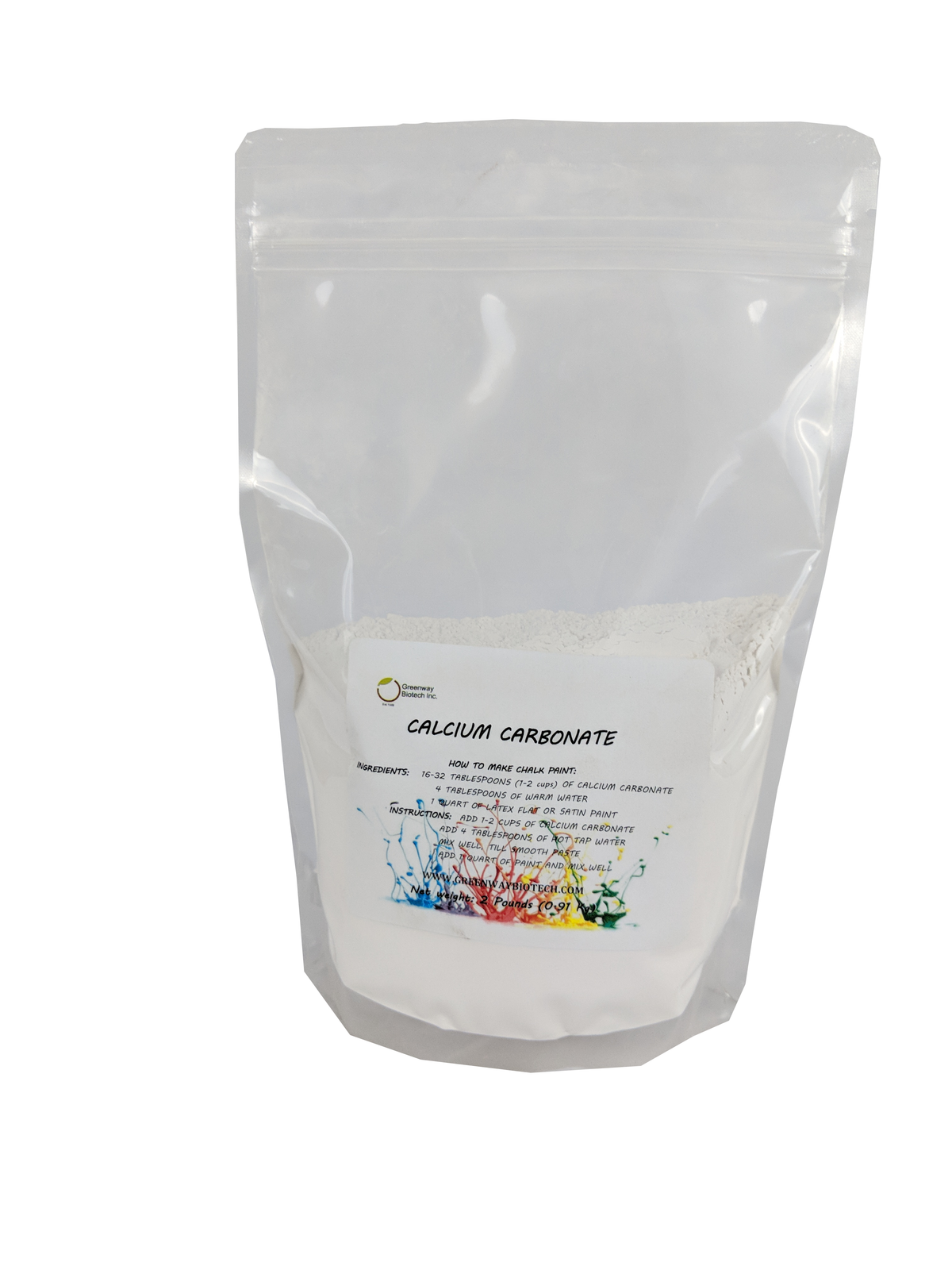
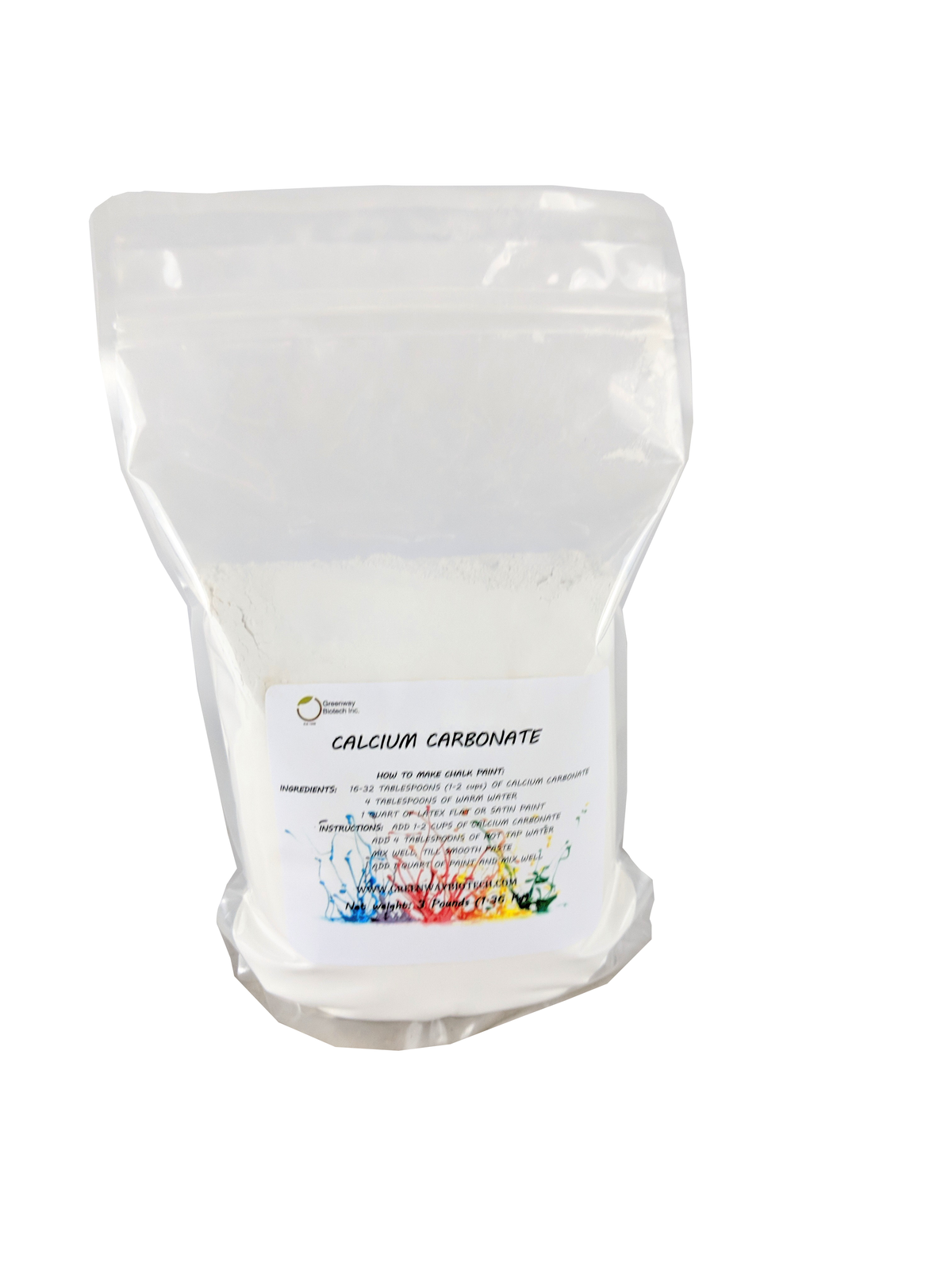
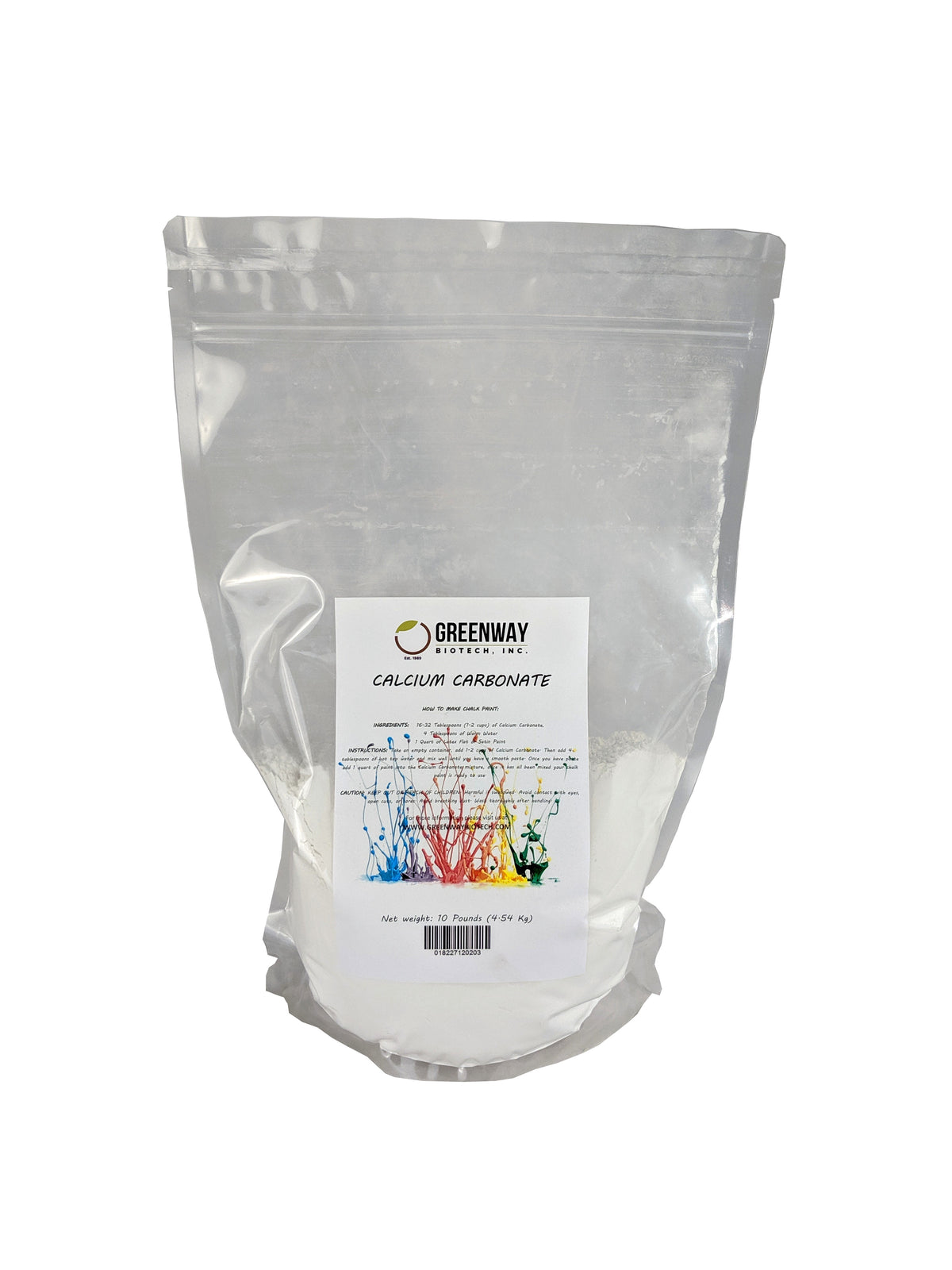
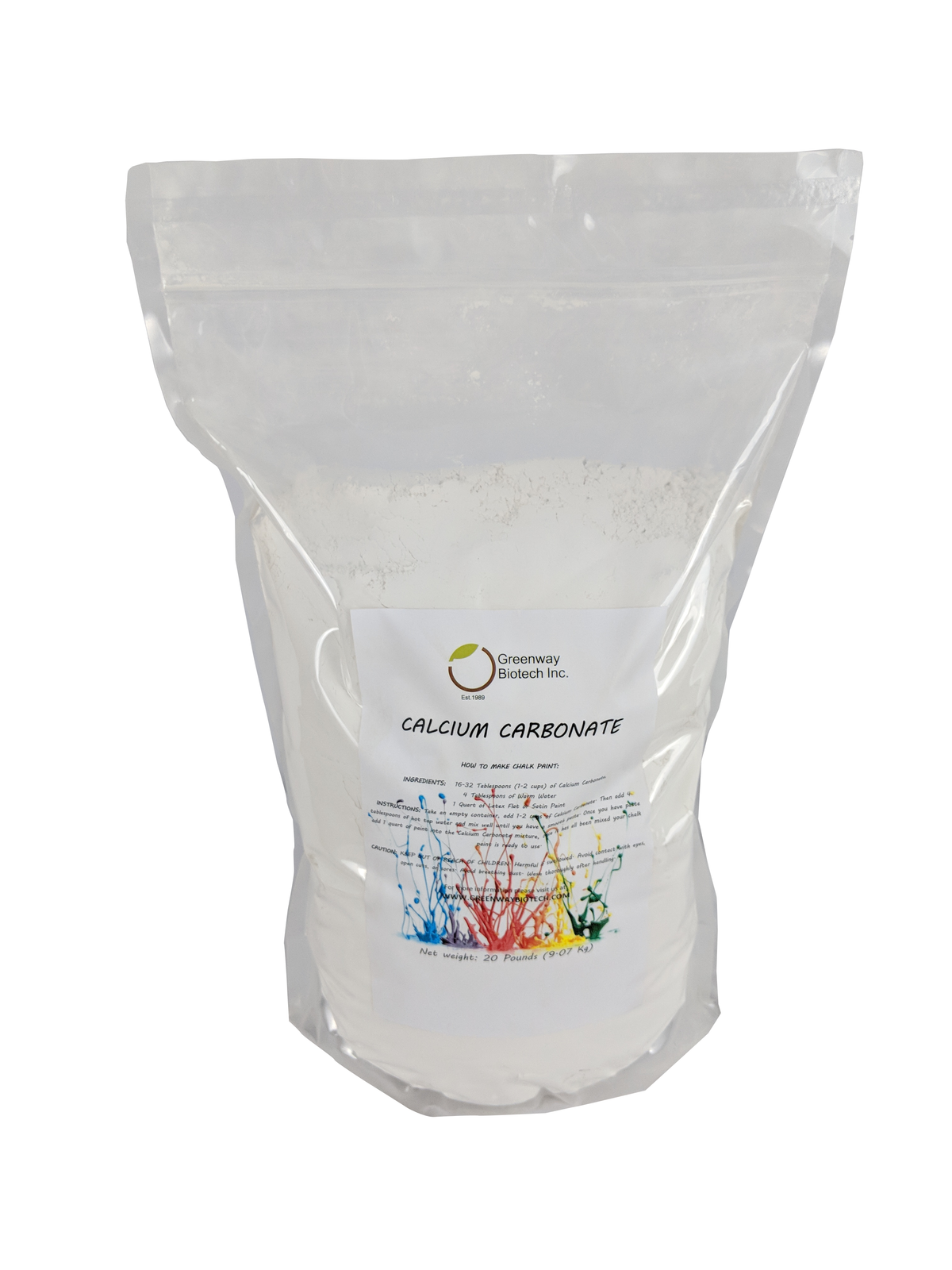
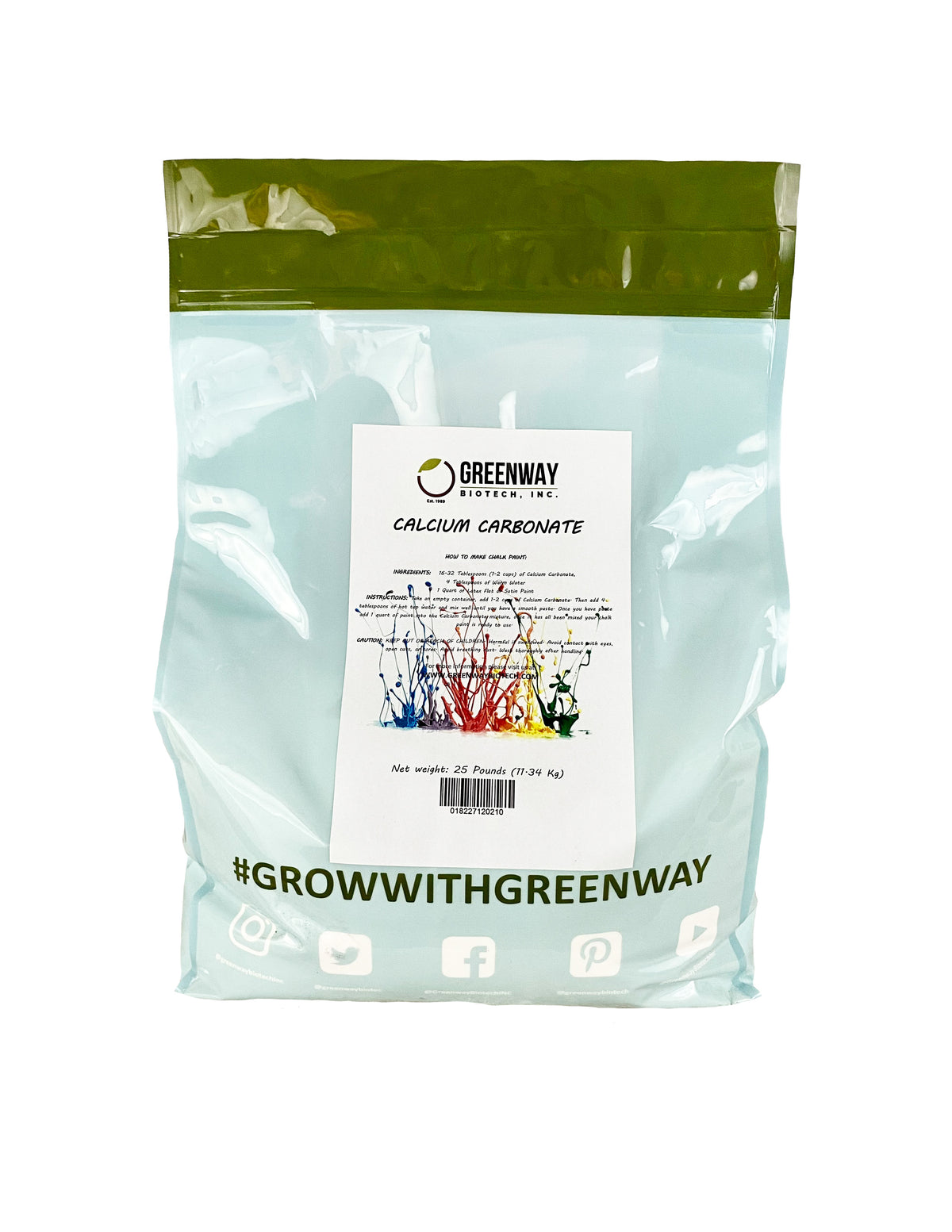
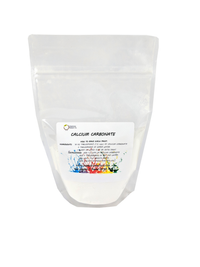
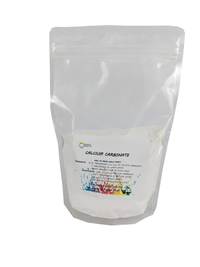
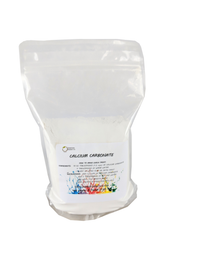
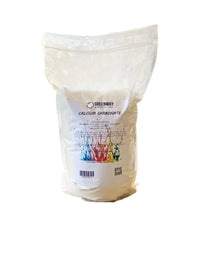
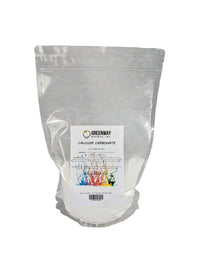
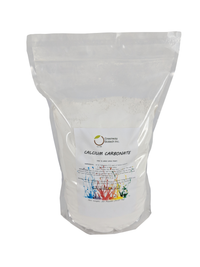
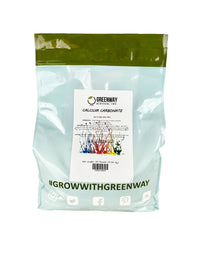
Paint additive · 200 mesh calcium carbonate powder · For latex paint
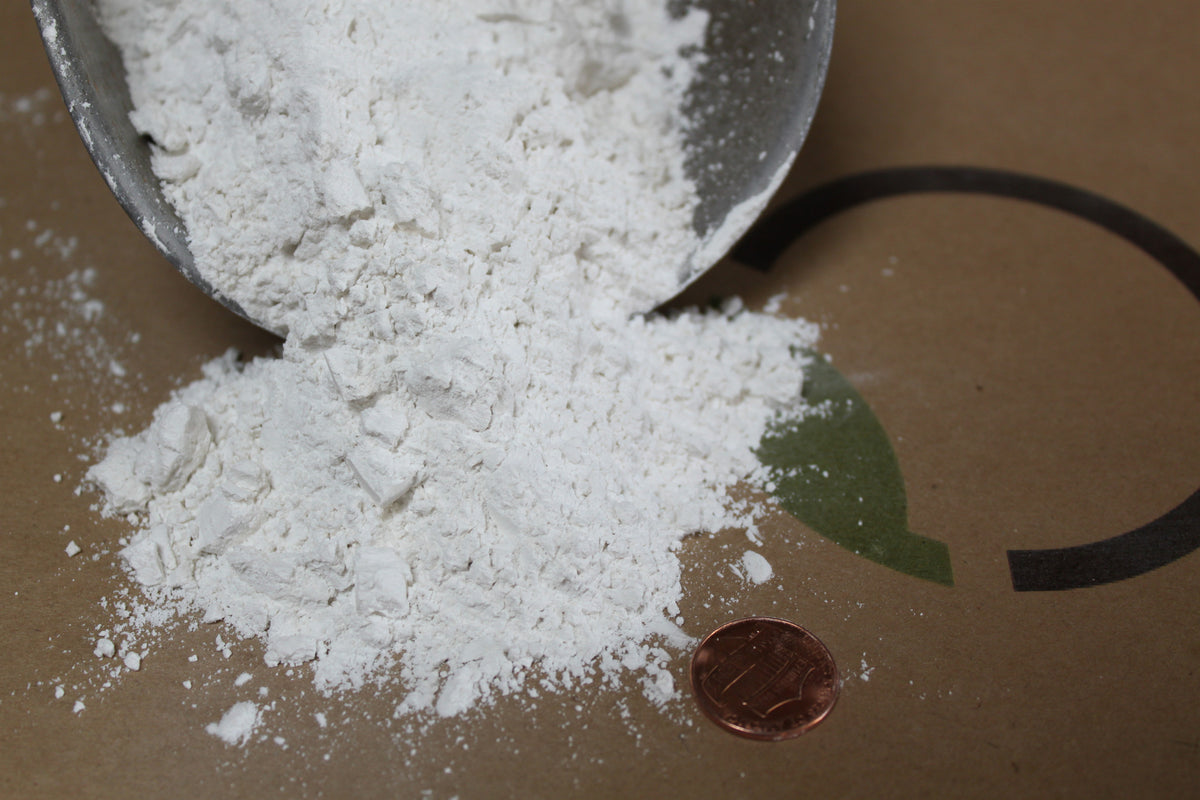
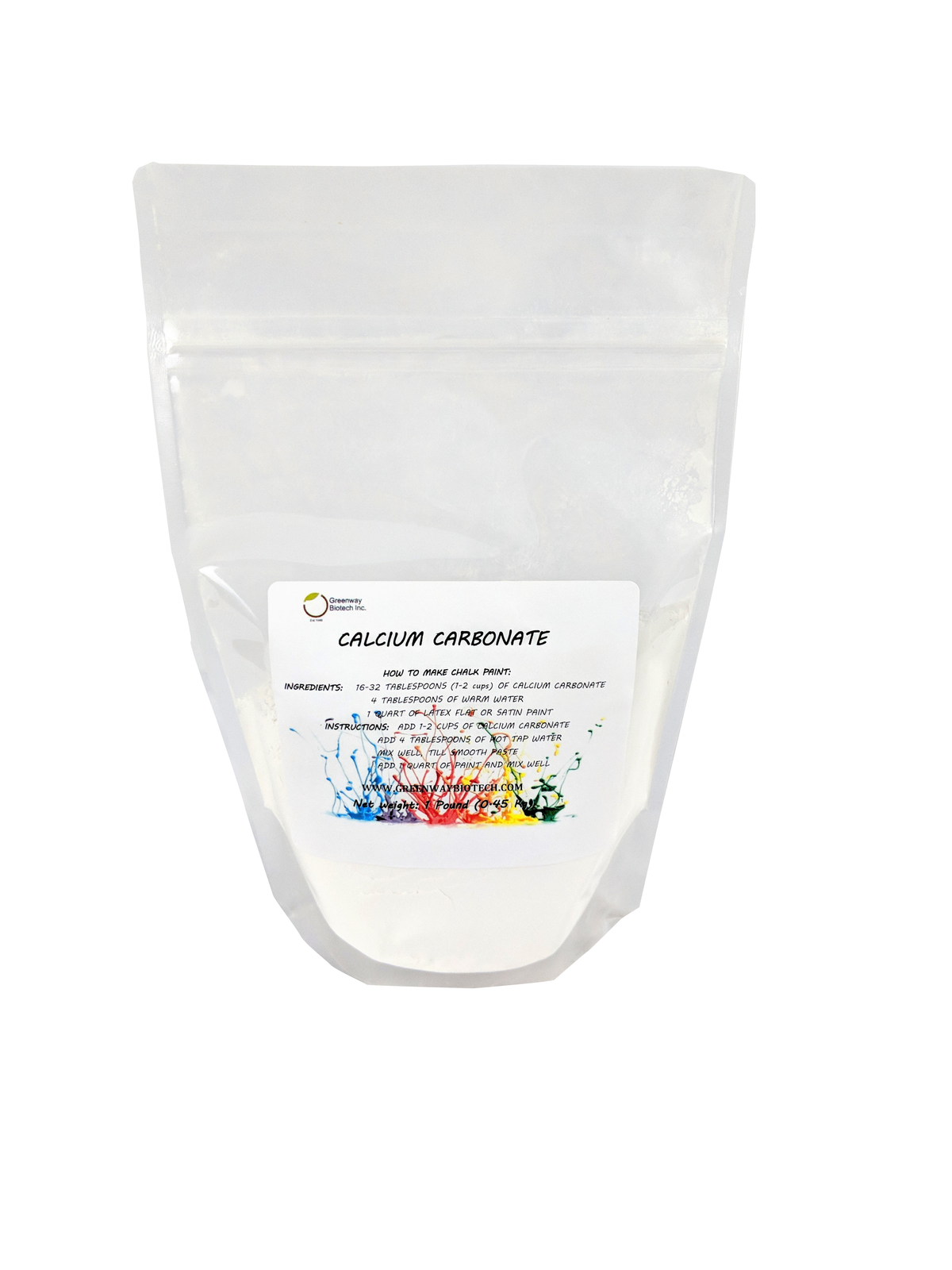
Greenway Biotech Calcium Carbonate is a white, 200 mesh calcium carbonate (CaCO₃) powder for mixing into latex paint. Use 4 to 8 cups of powder per gallon to make chalk paint from the latex paint and color you choose, or a much smaller amount, starting at ¼ cup per quart, to flatten the sheen of a paint you already have. Either way, you mix the powder into a paste with water first, stir it into the paint, and check a test piece or patch before painting the whole project.
It is a paint and craft powder: not food, feed, or pharmaceutical grade, and not a fertilizer or liming product. Adding powder typically makes a paint less scrub-resistant than it was in the can, so seal chalk-painted furniture and test walls before you commit.
| Specification | Detail |
|---|---|
| Ingredient | Calcium carbonate (CaCO₃), sold as a dry powder |
| Particle size | 200 mesh. A No. 200 screen has openings of 75 microns (0.075 mm). |
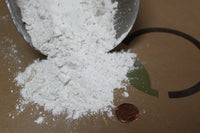
| Appearance | White powder |
| In water | Practically insoluble; NIOSH lists the water solubility of calcium carbonate as 0.001%. It forms a paste, not a solution, which is why it is mixed smooth before it goes into paint. |
| Grade and scope | Sold as a paint and craft additive. Not food, feed, or pharmaceutical grade. Carries no fertilizer guarantee and no liming (neutralizing value) analysis. |
| How amounts are measured | Level US measuring cups and tablespoons of powder, added to latex paint by volume. This page does not convert cups to pounds, because the weight of a cup of powder depends on how loosely it settles. |
| Package sizes | 1, 2, 3, 5, 10, 20, and 25 lb bags |
| Packed by | Greenway Biotech, Inc., 17861 Road 24, Madera, California 93638 |
Choose this powder when you want to control the finish of a latex paint yourself: a full chalk finish in any color, or a flatter version of a paint you already own. It also serves as the chalk in traditional linseed-oil putty.
4 to 8 cups of powder per gallon of latex paint (1 to 2 cups per quart) makes chalk paint from the latex paint and color you choose. Less powder gives a smoother finish; more gives a heavier, more textured vintage look. Distress it with fine sandpaper if you like, then seal it with wax or a clear topcoat.
When a custom-tinted paint has a slight sheen and the walls it needs to match are flat, a small amount of powder, starting at ¼ cup per quart, is used to bring the sheen down. You test a patch, let it dry, compare, and adjust. See the sheen reduction table.
Traditional glazing putty is a mixture of chalk and linseed oil. This powder can serve as the chalk: start with the oil and work the powder in until the mix reaches the consistency of soft putty. There is no fixed ratio; mix by feel.
Used dry in a line marking machine, or poured by hand along a guide string. Calcium carbonate is not quicklime or hydrated lime, the caustic forms of lime; see Compare your options.
The chalk paint and sheen reduction amounts below are Greenway Biotech's mixing directions for this powder, in level US measuring cups and tablespoons, added to latex paint by volume. Amounts marked as one customer's result are a report, not a direction. Always mix the powder into a paste with water first, test before you paint the whole piece or wall, and use measuring cups and spoons that you do not use for food.
Use 4 to 8 cups of powder and ½ to 1 cup of water per gallon of latex paint. That is 1 to 2 cups of powder per quart, with 2 tablespoons of water for each cup of powder.
| Latex paint | Powder | Water |
|---|---|---|
| 1 pint | ½ to 1 cup | 1 to 2 tablespoons |
| 1 quart | 1 to 2 cups | 2 to 4 tablespoons |
| 2 quarts (½ gallon) | 2 to 4 cups | ¼ to ½ cup |
| 1 gallon | 4 to 8 cups | ½ to 1 cup |
Use the low end of the range for a smoother finish and the high end for a heavier, more textured finish. At any point in the range, use 2 tablespoons of water for each cup of powder, and keep one ratio for the whole project so every coat matches.
Before you paint the whole piece: test on a scrap board or a hidden spot and let it dry to check texture and color. Chalk paint is typically less washable than the paint was in the can, so seal furniture with wax or a clear topcoat once it is dry.
To flatten a latex paint that has a slight sheen, such as a custom-tinted paint that needs to match existing flat walls, start with ¼ cup of powder per quart (1 cup per gallon). Mix the powder into a paste with a little warm water before adding it to the paint. Then paint a test patch, let it dry, compare, and adjust.
| Latex paint | Starting amount of powder | One customer's flat result |
|---|---|---|
| 1 quart | ¼ cup | ¾ cup |
| 1 gallon | 1 cup | 3 cups |
Before you paint the whole wall:
| Per gallon | Per quart | What it is | What to expect |
|---|---|---|---|
| 1 cup | ¼ cup | Sheen reduction starting point | Test a patch and add more only if the dried patch is still too shiny. |
| 3 cups | ¾ cup | One customer's flat result | A slightly glossy paint taken down to flat, with a slight chalk-like look at an angle. |
| 4 cups | 1 cup | Low end of the chalk paint range | A chalk finish on the smoother side, with less texture and less grit. |
| 8 cups | 2 cups | High end of the chalk paint range | A heavier, more textured vintage look that is more likely to need light sanding between coats. |
The bag label lists 10 to 12 tablespoons of powder per quart, which is 2½ to 3 cups per gallon. That is more than the sheen reduction starting amount and less than the chalk paint range. For a full chalk finish, follow the chalk paint table on this page; to flatten sheen, start at ¼ cup per quart and test. For questions about the directions on your bag, email questions@greenwaybiotech.com.
Pro tip: reduce grittiness. Always mix the powder into a smooth paste with water before adding it to paint. If you still notice slight texture after drying, lightly sand with 220-grit sandpaper between coats. Using less powder (closer to 4 cups per gallon) also gives a smoother finish.
The amounts on this page are cups of powder and the bags are sold by weight. How many cups a pound fills depends on how loosely the powder settles, so this page does not convert one to the other. Use the table to see how much powder your project needs.
| Project | Latex paint | Powder |
|---|---|---|
| Chalk paint | 1 quart | 1 to 2 cups |
| Chalk paint | 1 gallon | 4 to 8 cups |
| Chalk paint | 5 gallons | 20 to 40 cups |
| Sheen reduction | 1 gallon | 1 cup to start (3 cups in one customer's result) |
| Sheen reduction | 5 gallons | 5 cups to start (15 cups at one customer's ratio) |
How many cups are in your bag? Weigh one level cup of powder on a kitchen scale, using a cup and scale that you do not use for food. Cups in the bag = bag weight in ounces ÷ the weight of one level cup in ounces (1 lb = 16 oz).
Bags come in 1, 2, 3, 5, 10, 20, and 25 lb. Select a size from the options at the top of this page; prices, tax, and shipping are shown at checkout. For help choosing, email questions@greenwaybiotech.com with your project and how much paint you are mixing.
A dried paint film is binder, the resin that holds it together, plus pigment particles. Paint makers describe that balance with pigment volume concentration (PVC): the volume, not the weight, of pigment in the paint film. PPG gives typical ranges of 0 to 15% for gloss paints, 30 to 40% for satin, 35 to 45% for eggshell, and 40 to 80% for flat paints.
Calcium carbonate is a white mineral powder that does not dissolve in water; NIOSH lists its water solubility as 0.001%. Stirred into latex paint as a paste, it adds pigment volume without adding binder, so the paint's PVC rises and the finish moves toward the flat end of those ranges. A small amount brings down a slight sheen; chalk paint amounts go much further.
The same shift has a cost. PPG notes that as PVC increases, durability, scrubbability, and stain resistance typically decrease. It defines the critical PVC as the point where there is just enough binder to fill the space between the pigment particles. That is why chalk paint is sealed with wax or a clear topcoat, and why flattened wall paint should be tested for washability as well as sheen.
Why check sheen at an angle: ASTM D523, a standard gloss test used for paint, uses an 85° near-grazing geometry to compare sheen or near-grazing shininess, most often on surfaces that measure below 10 at the usual 60° angle. Two flat finishes can look alike straight on and still differ when light rakes across them. That fits one customer's result: at 3 cups per gallon the paint matched the wall straight on and showed a slight chalk-like look at an angle.
Fineness matters for texture. 200 mesh refers to a No. 200 screen, which has 75-micron openings. Work the powder into a lump-free paste so it mixes in evenly. Some slight texture is still normal in homemade chalk paint, and it increases with the amount of powder.
Match the product to the job. The first table covers paint finishes; the second covers the other jobs people ask about.
| Option | What it is | Choose it when | Limitation |
|---|---|---|---|
| This powder, chalk paint amounts (4 to 8 cups per gallon) | Latex paint of your choice, plus powder and water | You want a chalk finish in a color you pick | Slight grit is normal; less washable than the original paint; seal furniture |
| This powder, sheen reduction amounts (from 1 cup per gallon) | Your existing latex paint, plus a small amount of powder | You already have the paint and need it flatter to match | Needs a test patch; more powder can look chalky at an angle; less scrub-resistant |
| Paint mixed in a flat finish | Paint formulated flat by its maker | You can still have the color mixed in a flat base | Means buying the color again in the new finish |
| Chalkboard paint | A paint made to be written on with chalk | You want a writable surface | A different product; this powder does not make it |
| Job | Use | Why |
|---|---|---|
| Marking lines on grass | This powder, dry | This powder is calcium carbonate, not quicklime or hydrated lime. NIOSH lists irritation of the eyes, skin, and airways as its hazards, so follow the dust precautions under Handling. A 2000 case report in Burns describes a lime burn that needed surgery in a professional football goalkeeper. |
| Raising soil pH | Dolomite Lime | A liming product with its own garden directions; this powder has no neutralizing-value analysis. |
| Calcium for plants without changing pH | Gypsum or Calcium Nitrate | Plant nutrients sold with their own rates; this powder carries no fertilizer guarantee. |
| Food, supplements, pets, aquariums, water filters | A calcium carbonate sold and labeled for that use | This powder is not food, feed, or pharmaceutical grade. |
Use 4 to 8 cups of powder and ½ to 1 cup of water per gallon of latex paint (1 to 2 cups of powder per quart). Stir the powder and water into a smooth paste, then stir the paste into the paint. That is all you need: powder, water, and paint.
4 cups per gallon (1 cup per quart) is the smoother end of the chalk paint range, with less texture and less grit. 8 cups per gallon (2 cups per quart) is the heavier end, with a more textured vintage look that is more likely to need light sanding between coats. Choose one amount and keep it for the whole project so every coat matches. Below 4 cups per gallon, the powder is used to flatten a paint's sheen rather than to make chalk paint.
Yes, with latex paint. Start with ¼ cup of powder per quart (1 cup per gallon). Mix the powder into a paste with a little warm water, stir the paste into the paint, and paint a test patch. Let the patch dry, compare it with the surface you are matching, and adjust the amount from there. Use it, for example, to flatten a custom-tinted paint so it matches existing flat walls.
Start with ¼ cup of powder per quart (1 cup per gallon), test a patch, and add more only if the dried patch is still too shiny. One customer used 3 cups per gallon (¾ cup per quart) to take a custom-tinted paint with a slight gloss down to flat. Straight on it matched the wall, but at an angle it showed a slight chalk-like look. That is one customer's result, not a guarantee. Chalk paint starts at 4 cups per gallon, so for a flat finish, use only as much powder as your test patch needs.
Sheen shows most when light rakes across a surface. ASTM D523, a standard gloss test used for paint, uses a near-grazing 85° angle to compare sheen on low-gloss finishes, so two flat finishes can look the same straight on and differ at a low angle. If the dried patch looks shinier than the wall at an angle, add a little more powder; if it looks chalky at an angle, try a little less powder in the next test and check that it still matches straight on. Compare at both angles before you paint the wall.
The powder is white and is not a tint. Judge color the same way you judge sheen: on a dried test piece or patch, next to the surface you are matching, before you paint the whole project.
Yes, some slight texture is normal with homemade chalk paint. To keep it down, mix the powder into a smooth, lump-free paste with water before adding it to paint, use less powder (closer to 4 cups per gallon), and lightly sand with fine-grit sandpaper between coats.
Usually not. The paint maker PPG notes that as the share of pigment in a paint rises, durability, scrubbability, and stain resistance typically fall, and adding powder raises that share. Seal chalk-painted furniture with wax or a clear topcoat. On walls, check how the dried test patch holds up to gentle cleaning before you paint the whole room.
Chalk paint is a very matte, vintage-style finish for furniture and other surfaces. Chalkboard paint makes a surface you can write on with chalk. They are different products. This powder is used to make chalk paint, not chalkboard paint.
No. It is not food, feed, or pharmaceutical grade, so do not use it in food, supplements, toothpaste, pet food, aquariums, or drinking-water filters; use a calcium carbonate sold and labeled for that purpose. It also carries no fertilizer guarantee or liming analysis, so this page gives no garden directions. To raise soil pH, use Dolomite Lime; for calcium without a pH change, use Gypsum.
There is no separate Greenway article for this powder. The mixing tables, steps, and answers on this page are Greenway's complete guidance for chalk paint and sheen reduction. If your project is not covered here, email questions@greenwaybiotech.com.
The mixing amounts are Greenway Biotech's directions for this product, and the 3 cups per gallon sheen result is one customer's report. The statements about calcium carbonate, paint finishes, and safety come from the public sources below. None of them evaluates or endorses this product.
Statements and sources reviewed September 23, 2026.
Not sure how much powder your project needs, or whether flattening your paint or remixing it in a flat finish is the better route? Email questions@greenwaybiotech.com or call (562) 351-5168, Monday to Friday, 7 AM to 5 PM Pacific. Tell us the paint, its sheen, and how much you are mixing.
Ready to buy? Check how much powder you need
Every order carries a 90-day satisfaction guarantee. Greenway Biotech, Inc. packs and ships from Madera, California, and the family-owned company has operated in California since 1989.