Urea Fertilizer 46-0-0
- Regular Price
- $ 18.99
- Sale Price
- $ 18.99
- Regular Price
- $ 18.99
Sold Out
- Unit Price
- per
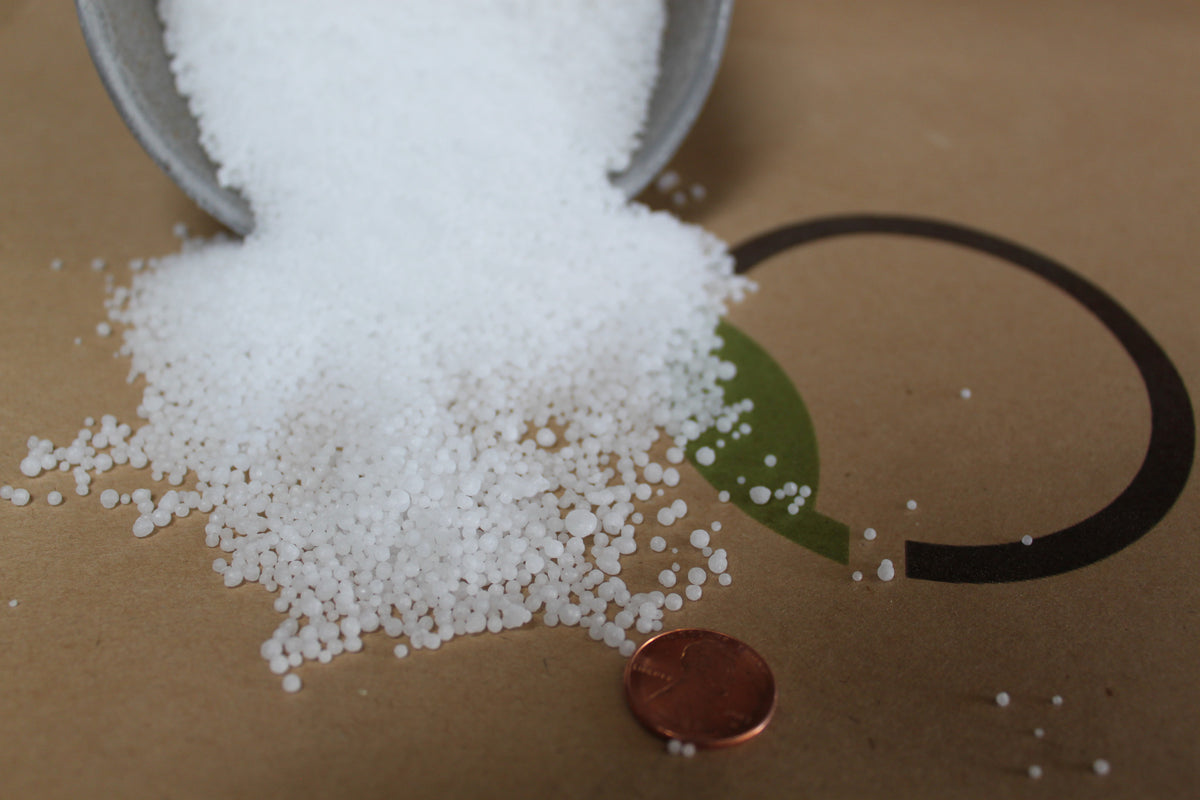
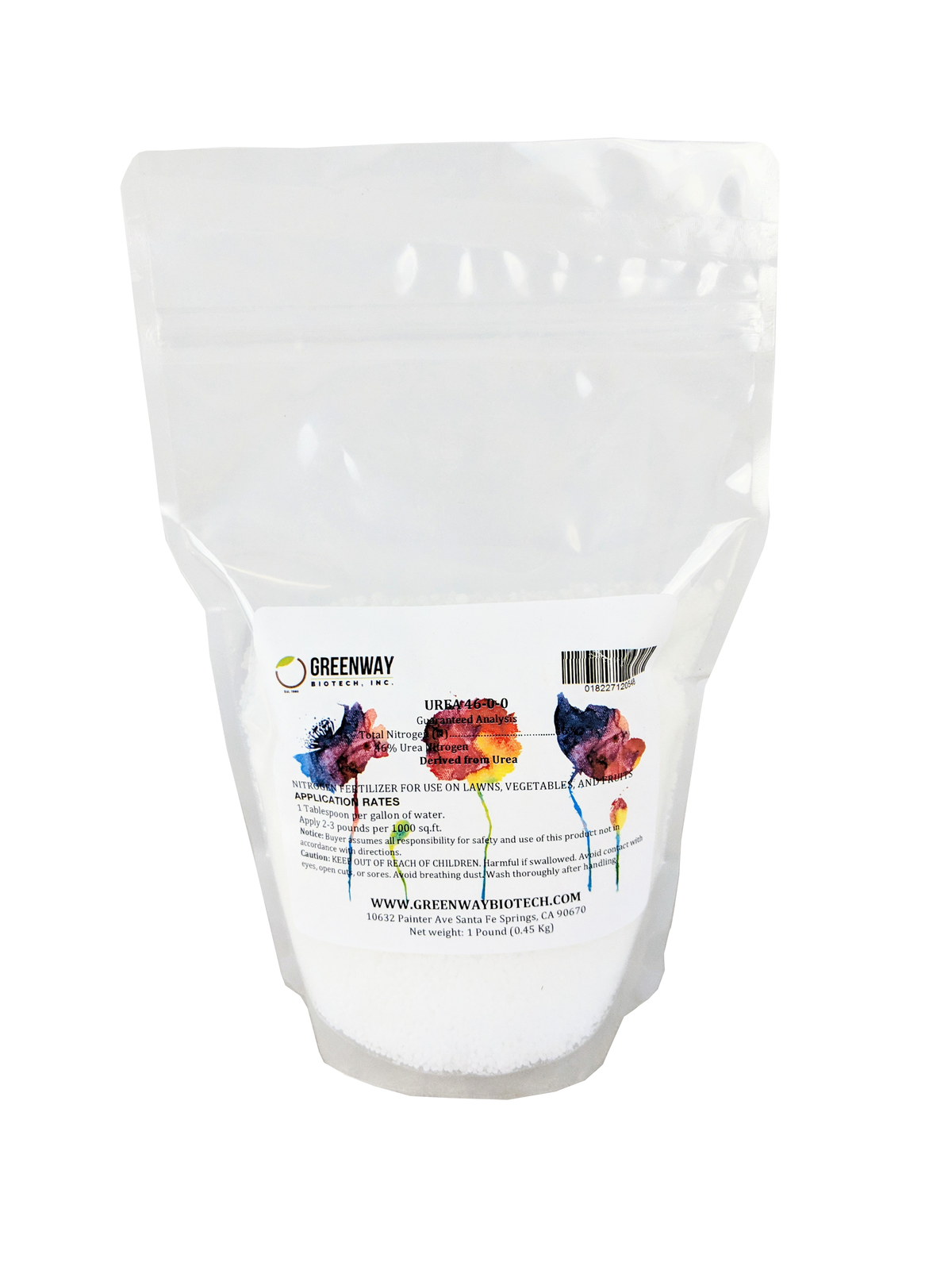
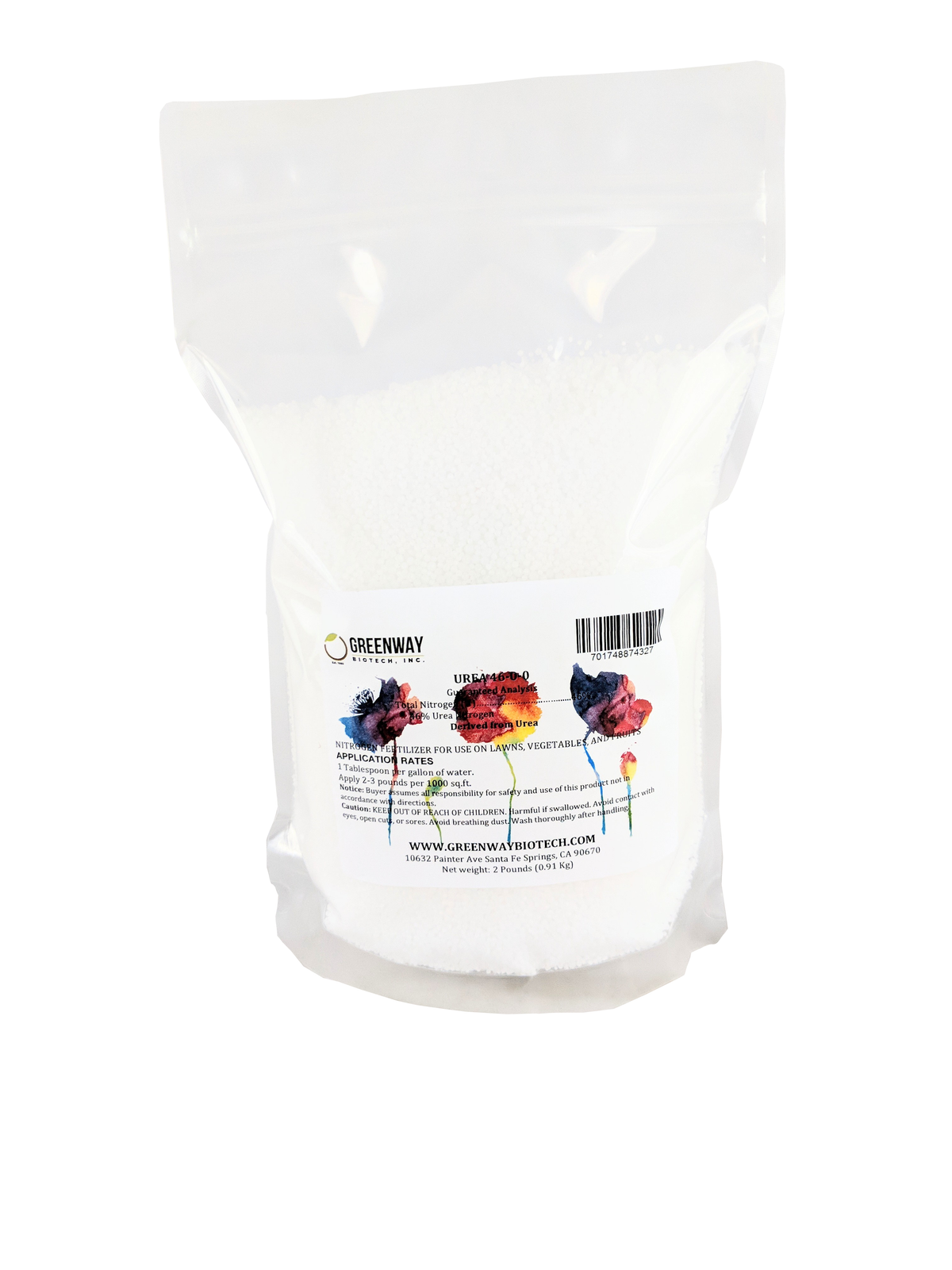
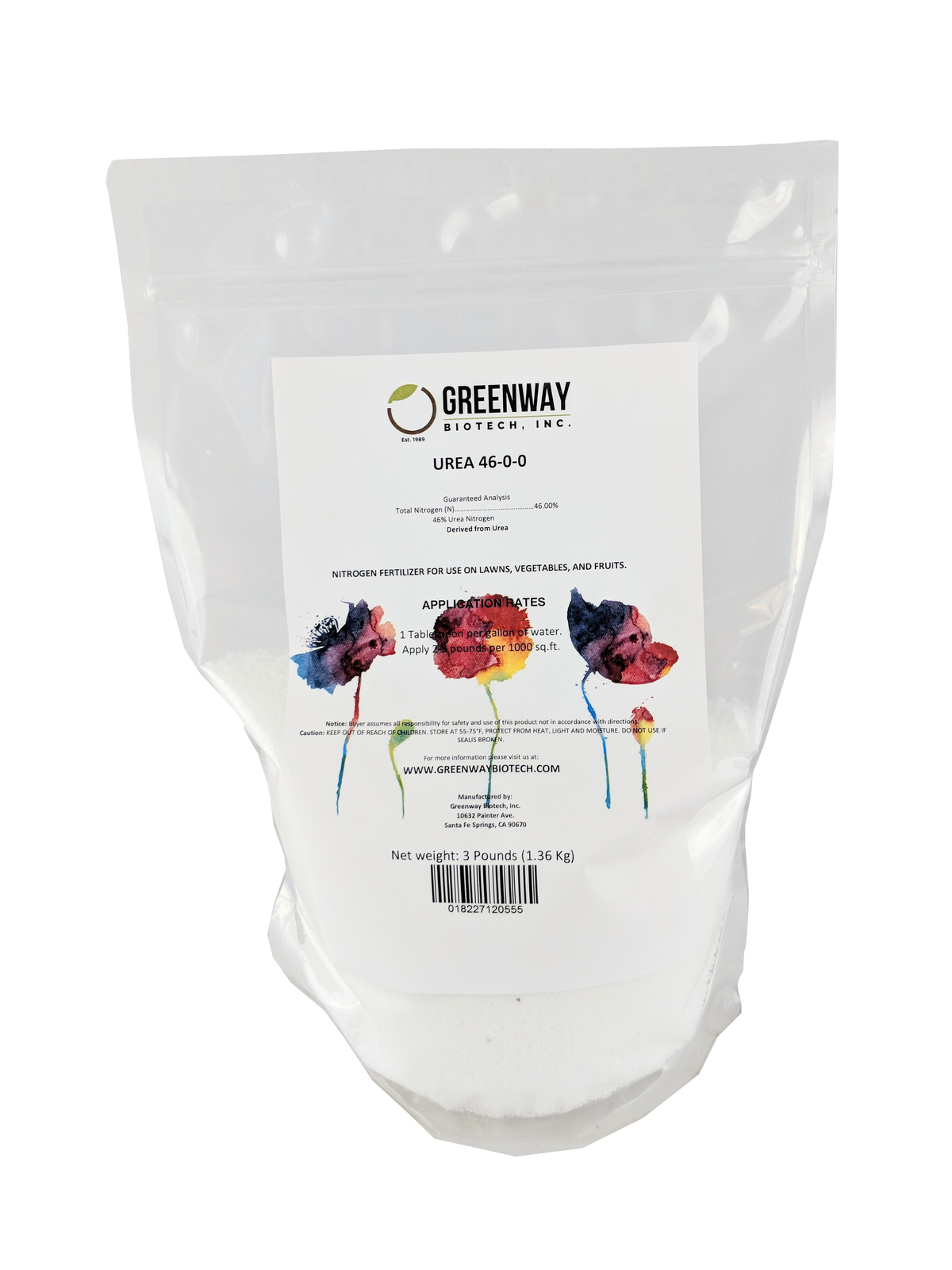
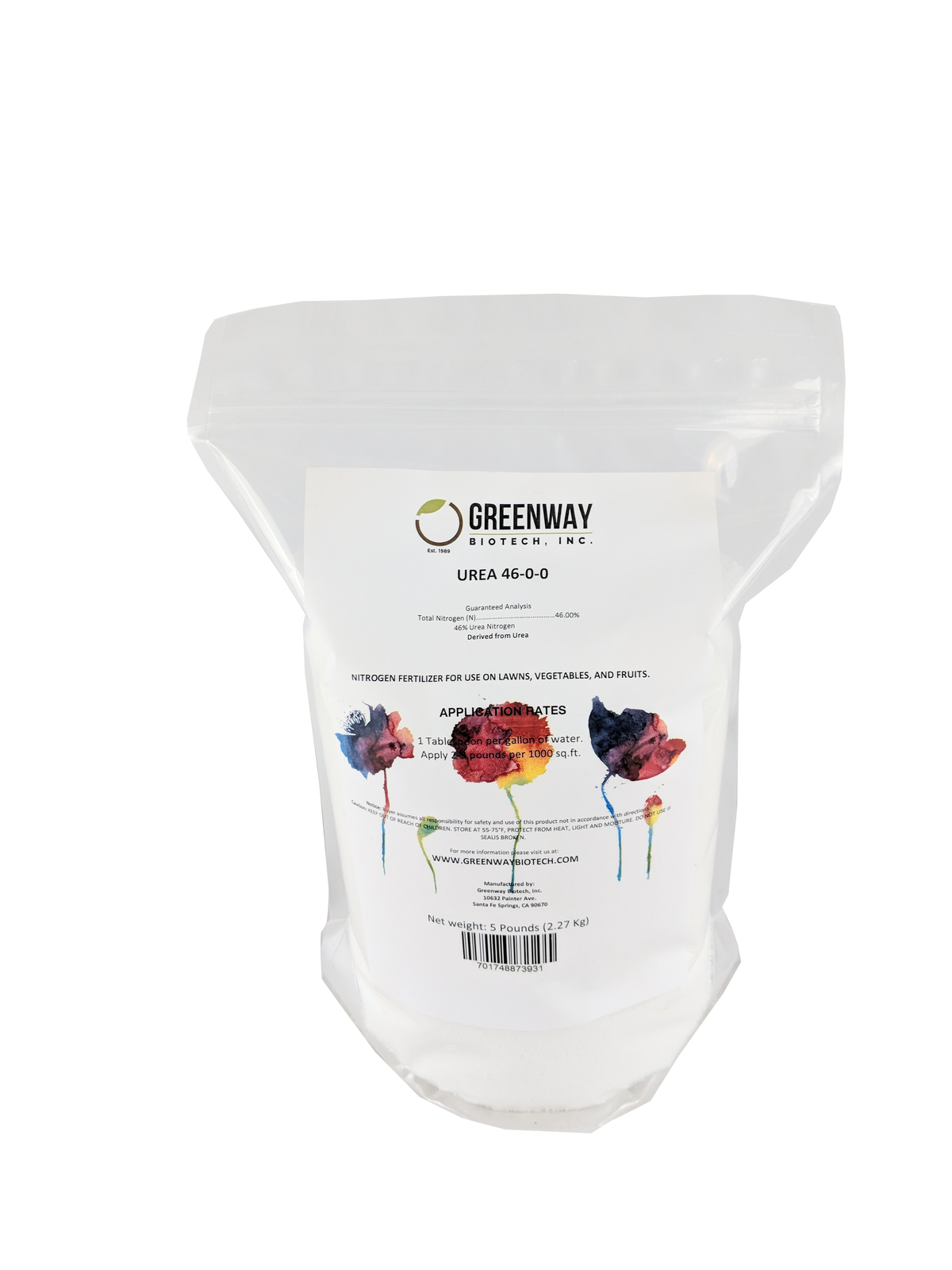
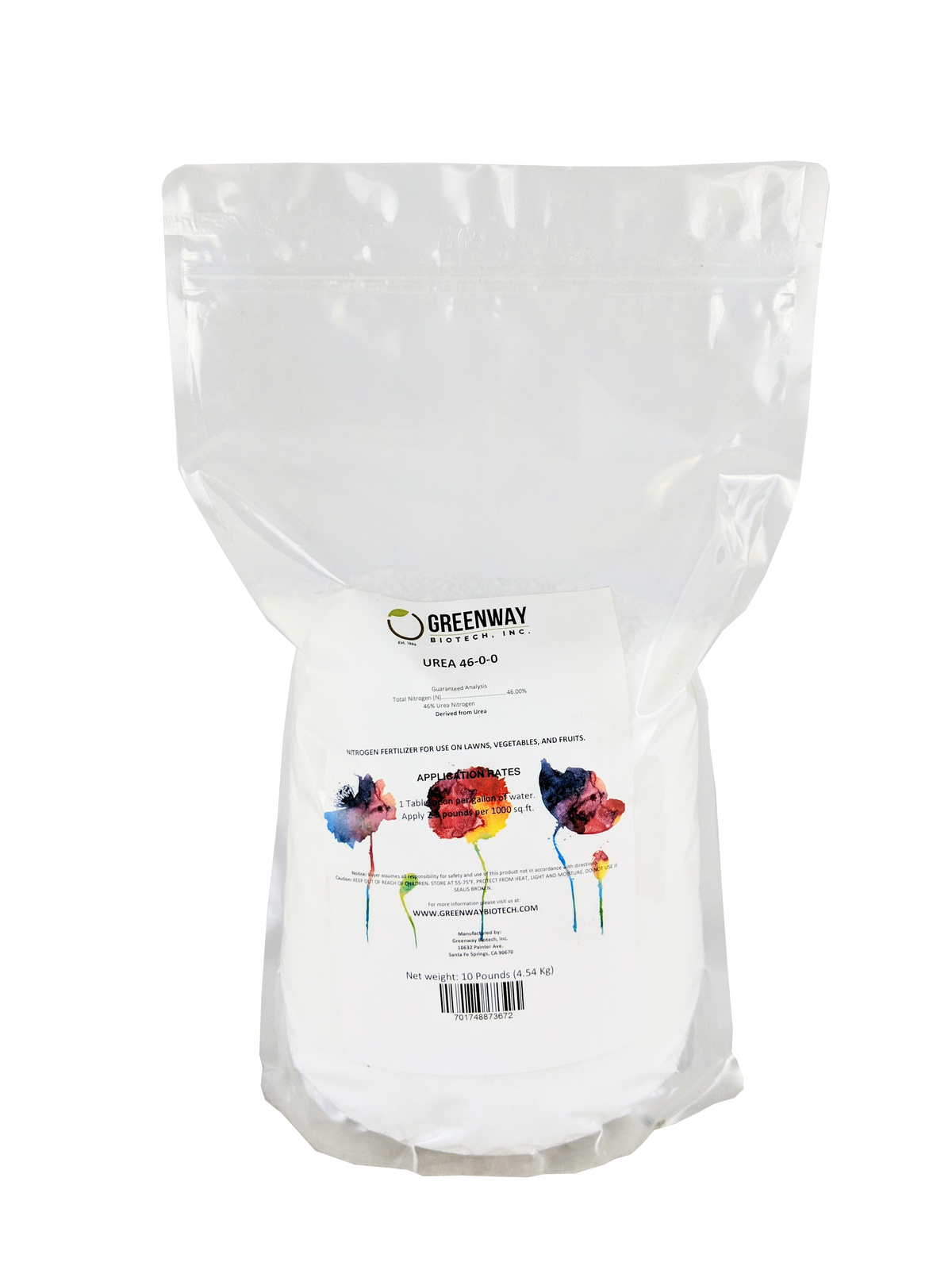
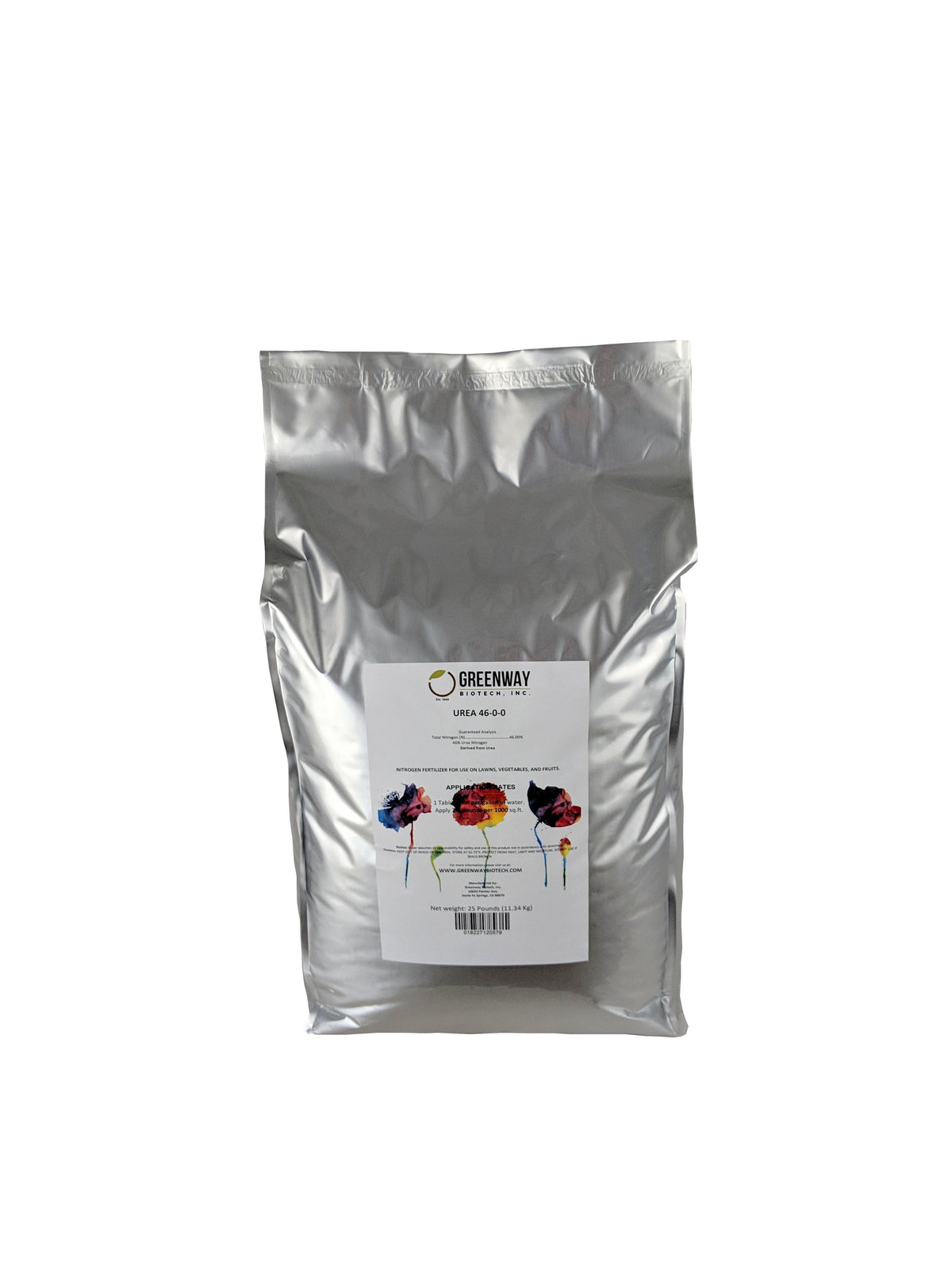
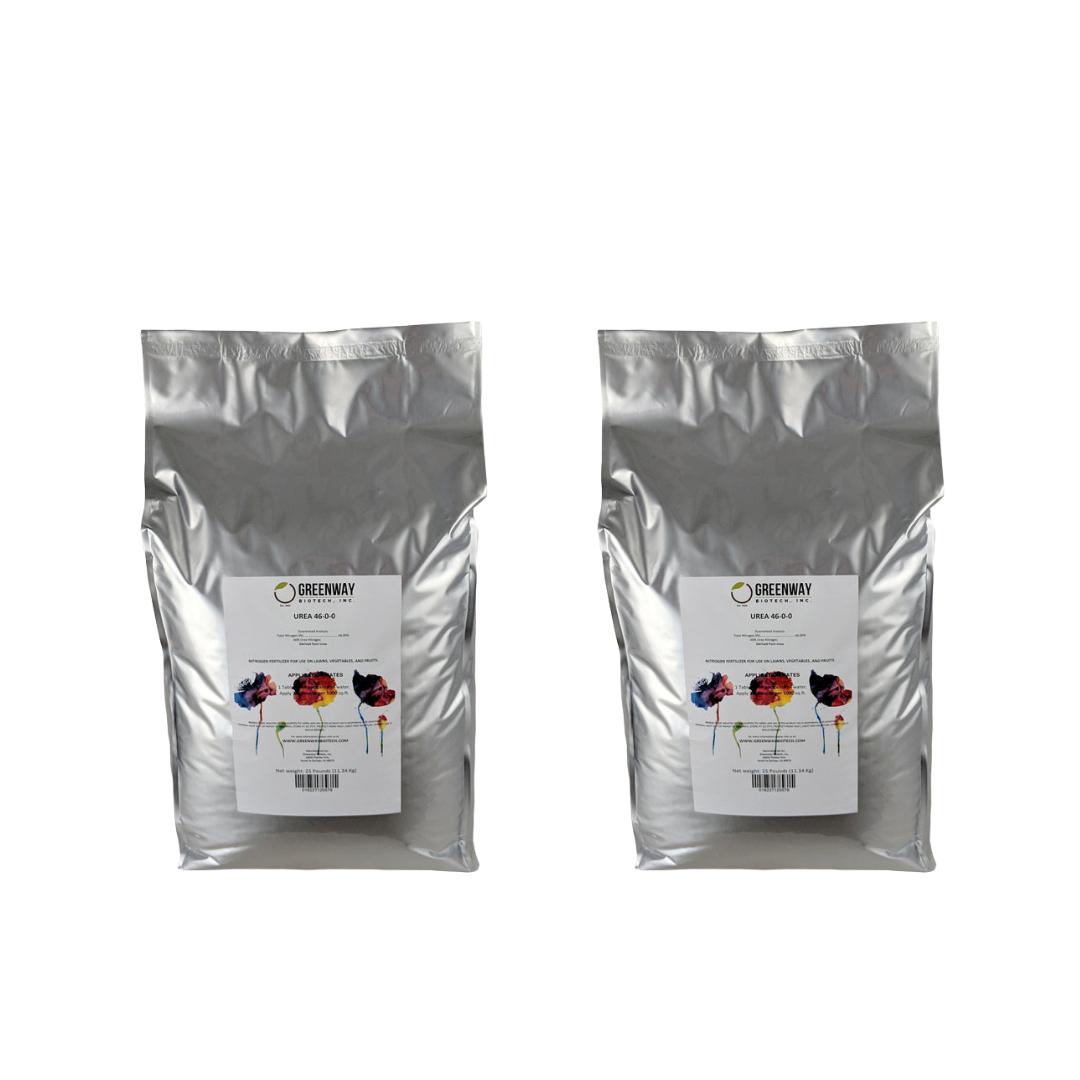
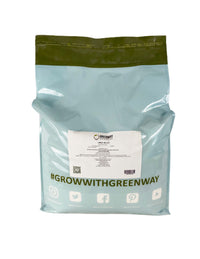
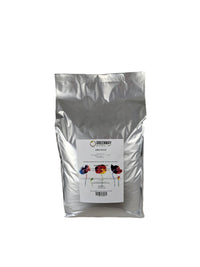
Greenway Biotech Urea 46-0-0 is a concentrated prilled nitrogen fertilizer for soil application across lawns, vegetable gardens, fruit trees, and field crops. Each pound delivers 7.4 oz of actual nitrogen, making it one of the most efficient dry nitrogen sources for growers who need reliable green-up and vegetative growth.
Find your size → Calculate how much I need46%
Actual nitrogen by weight — among the highest concentrations available
7.4oz/lb
Actual N delivered per pound of urea applied
5,000sq ft
Lawn coverage from a single 5 lb bag at the standard rate
35+yrs
Family-owned California fertilizer manufacturing experience
Urea is available in seven bag sizes from 1 lb (small lawn or single tree) to 50 lb (large lawn, vegetable plots, or split farm applications). Coverage estimates use a simple planning rate of 1 lb urea per 1,000 sq ft. Actual application rates vary by crop, turf type, soil test, and seasonal nitrogen target — see the Application Rates section below for crop-specific rates.
| Bag Size | Lawn Coverage (Standard Rate) | Garden Coverage | Best For |
|---|---|---|---|
| 1 lb | ~1,000 sq ft | ~400 sq ft veg | Small lawn patch, single tree, sample run |
| 2 lb | ~2,000 sq ft | ~800 sq ft veg | Townhouse lawn, raised beds |
| 5 lb | ~5,000 sq ft | ~2,000 sq ft veg | Most popular |
| 10 lb | ~10,000 sq ft | ~4,000 sq ft veg | Average suburban lawn |
| 20 lb | ~20,000 sq ft | Large vegetable plot | Large lot, split applications |
| 25 lb | ~25,000 sq ft | Orchard or row crops | Small farm operation |
| 50 lb | ~50,000 sq ft | Field application | Best value |
Urea works wherever you need concentrated nitrogen on soil — from a single houseplant to acres of corn. Each application has its own rate; the calculator below figures it for you.
Cool-season, warm-season, centipede, bahia. Standard rate 1 lb per 1,000 sq ft. Water in immediately.
Pre-plant broadcast or side-dress. Rates vary by crop family — leafy greens through heavy-feeding corn.
Citrus, almond, walnut, pomegranate, fig. Annual rates from 1.5 oz for young trees to 6 lbs for mature pecans.
Foliage and herbs only. Dilute drench at ⅛ tsp per gallon. Skip flowering plants, cacti, succulents.
Corn, wheat, rice, sorghum, sugarcane. Soil-test driven; rates from 80 to 545 lbs urea per acre.
Fully water-soluble for drip, sprinkler, and pivot systems. Pre-dissolve completely before injection.
The case for urea over every other dry nitrogen fertilizer comes down to concentration, solubility, versatility, and cost per pound of N.
Each pound delivers 7.4 oz of actual nitrogen — more than double ammonium sulfate (21%) and triple calcium nitrate (15.5%). Less product to spread, store, and ship for the same nutritional outcome.
Use as a dry broadcast, dissolve as a soil drench, or inject through fertigation systems. Dissolves cleanly in cold water with no residue. (For recirculating hydroponic systems, see Calcium Nitrate 15.5-0-0 instead.)
For most growers running soil-applied programs, urea has one of the most efficient cost-per-unit-N profiles of any common dry fertilizer. Higher concentration plus easier handling drives lower delivered cost on multi-acre operations.
Lawn green-up, vegetable side-dress, tree spring feeding, fertigation top-up, and field broadcast — all from the same product. Specialty crops get specialty fertilizers; everything else can run on urea.
Registered with the California Department of Food and Agriculture. Independently tested for heavy metals — results consistently well below required limits. Manufactured in Madera, California by a family-owned operation since 1989.
If you're not satisfied with your results, return the unused portion within 90 days for a full refund. No questions asked. Every Greenway product carries the same guarantee.
46%
Nitrogen by Weight (CO(NH₂)₂)
Among essential mineral nutrients, nitrogen is the one plants need in the largest quantity. It's the backbone of chlorophyll, the green pigment that drives photosynthesis. Without enough of it, leaves yellow, growth stalls, and yields drop. With too much in the wrong window, plants grow lush foliage at the expense of fruit and become more susceptible to environmental stress.
Urea (CO(NH₂)₂) is a synthetic compound first produced in 1828 — a milestone in chemistry as the first organic compound made from purely inorganic precursors. Once applied to moist soil, the enzyme urease converts it to ammonium (NH₄⁺) within 24-72 hours, which soil microbes then nitrify into nitrate (NO₃⁻). Both forms are plant-available; nitrate is more mobile in the soil profile, ammonium binds to soil particles and resists leaching.
The 46% concentration is what makes urea the workhorse of global nitrogen agriculture. Compared to ammonium sulfate (21% N) or calcium nitrate (15.5% N), every pound of urea delivers more than double the actual nitrogen — meaning less product to spread, less weight to ship, and lower cost per unit of N delivered to the plant.
For deeper coverage of how plants use nitrogen, see our guide on What's the Function of Nitrogen in Plants? and our comparison of the seven best nitrogen fertilizers compared.
Five distinct rate tables for the most common urea applications. Click a tab to switch — quick-answer summaries above each table for the most common case, full table below for everything else.
Quick answer: For most lawns, apply 1 lb of urea per 1,000 sq ft, then water in immediately with at least 0.25" of irrigation. The table below has rates for specific grass types.
| Turf Type | Annual Nitrogen | Urea per Application | Apps / Year |
|---|---|---|---|
| Cool-season (KBG, fescue, rye) — Light | 2-3 lbs N / 1,000 sq ft | 1.1 lbs / 1,000 sq ft | 4 |
| Cool-season — Standard | 3-4 lbs N / 1,000 sq ft | 1.5 lbs / 1,000 sq ft | 4 |
| Warm-season (Bermuda, Zoysia) — Light | 3-4 lbs N / 1,000 sq ft | 1.5 lbs / 1,000 sq ft | 4 |
| Warm-season — Heavy | 4-6 lbs N / 1,000 sq ft | 2.0 lbs / 1,000 sq ft | 5 |
| Centipede / Bahia (low-maintenance) | 1-2 lbs N / 1,000 sq ft | 1.0 lbs / 1,000 sq ft | 2 |
Quick answer: For vegetable beds, broadcast 2-3 lbs per 1,000 sq ft before planting, then side-dress at half that rate during active growth. Keep prills 2-3 inches away from seeds and stems.
| Crop Group | Pre-Plant Rate | Side-Dress Rate |
|---|---|---|
| Beans / peas (legumes) | 12 oz / 1,000 sq ft | Skip — legumes fix their own N |
| Root crops (carrot, beet, radish) | 1.75 lbs / 1,000 sq ft | Half rate at thinning |
| Leafy greens (lettuce, spinach, kale) | 2.5 lbs / 1,000 sq ft | Half rate every 3-4 weeks |
| Tomatoes / peppers / eggplant | 2.5 lbs / 1,000 sq ft | Half rate at first fruit set |
| Cucurbits (cucumber, squash, melon) | 2.5 lbs / 1,000 sq ft | Half rate at first vine run |
| Brassicas (broccoli, cabbage) | 3.5 lbs / 1,000 sq ft | Half rate at heading |
| Potato | 3.5 lbs / 1,000 sq ft | Half rate at hilling |
| Sweet corn | 4.5 lbs / 1,000 sq ft | Half rate at knee-high |
Quick answer: Annual urea ranges from 1.5 oz for young trees to 4+ lbs for mature citrus, walnut, and pecan. Apply at bud break in early spring, split into 2-3 applications, and stop nitrogen by mid-summer.
Apply in late winter or early spring at bud swell, with an optional second application 6 weeks later. Stop nitrogen by mid-summer to allow hardening before dormancy.
| Tree Type | Young (1-3 yr) | Bearing (4-8 yr) | Mature (9+ yr) |
|---|---|---|---|
| Apple / Pear | 1.5-3 oz | 6-13 oz | 1-2 lbs |
| Peach / Plum / Apricot | 1.5-4 oz | 8-16 oz | 1.5-2.5 lbs |
| Citrus | 1.5-5 oz | 8-24 oz | 2-4 lbs |
| Avocado | 1.5-4 oz | 8-16 oz | 1.5-3 lbs |
| Almond | 3-5 oz | 16-24 oz | 2-4 lbs |
| Walnut / Pecan | 3-6 oz | 16 oz - 2 lbs | 3-6 lbs |
| Cherry | 1.5-3 oz | 6-13 oz | 1-1.5 lbs |
| Olive | 1.5-3 oz | 6-16 oz | 1.5-3 lbs |
Quick answer: For most foliage houseplants, dissolve ⅛ tsp urea per gallon of water and apply as a soil drench every 4-6 weeks during spring and summer growth only. Skip flowering houseplants, cacti, and succulents.
Urea is a supplemental nitrogen source — not a complete houseplant fertilizer. Use it to push leafy growth on foliage plants, then return to a balanced houseplant fertilizer for everyday feeding. Do not apply October through February.
| Plant / Container Type | Rate | Frequency |
|---|---|---|
| Foliage houseplants | ⅛ tsp / gallon water | Every 4-6 weeks (spring/summer only) |
| Indoor herbs | ⅛ tsp / gallon water | Every 3-4 weeks |
| Outdoor container — small (under 2 gal) | ¼ tsp / gallon water | Every 3-4 weeks |
| Outdoor container — medium (2-7 gal) | ½ tsp / gallon water | Every 3-4 weeks |
| Outdoor container — large (7-15 gal) | 1 tsp / gallon water | Every 3 weeks |
| Outdoor container — patio tree (15+ gal) | 1¾ tsp / gallon water | Every 3 weeks |
Quick answer: Field crop rates range from about 22 lbs urea/acre for legume starter nitrogen to about 461 lbs/acre for high-nitrogen silage corn programs. Always confirm with a current soil test, crop need, and local extension recommendations.
📋 Field & Acreage Rates: The per-acre figures below are general references for medium-testing soils at typical yield goals. Actual rates should be based on a current soil test and local nitrogen removal estimates. Consult your local extension service for site-specific recommendations.
| Crop | Total N (lbs/acre) | Urea Equivalent (lbs/acre) |
|---|---|---|
| Soybean / peanut / alfalfa (legume starter) | ~10 | ~22 |
| Barley / oats | ~80 | ~175 |
| Sunflower | ~80 | ~175 |
| Tobacco | ~80 | ~175 |
| Sorghum | ~100 | ~218 |
| Wheat — spring | ~100 | ~218 |
| Cotton | ~100 | ~218 |
| Wheat — winter | ~115 | ~250 |
| Sugar beet | ~120 | ~261 |
| Rice (paddy) | ~125 | ~272 |
| Canola | ~125 | ~272 |
| Corn — grain | ~185 | ~402 |
| Sugarcane | ~200 | ~435 |
| Corn — silage | ~212 | ~461 |
Three application methods cover everything urea is good for. The calculator on the right does the math for whichever you pick.
Broadcast the calculated amount evenly over the application area. Keep prills 2-3 inches away from seeds, transplant roots, and tree trunks. Water in immediately with at least 0.25" of irrigation to drive nitrogen into the root zone and minimize volatilization.
Pre-dissolve the calculated amount completely in a small bucket of water before adding to the main reservoir or injection system. Apply to pre-moistened soil — never to dry soil — to prevent root burn. For drip systems, flush lines with plain water after application to prevent salt buildup.
Dissolve fully in water at the rate matched to your container size (see Application Rates → House Plants tab). Apply to moist soil, never dry. Avoid leaf contact when watering in. Flush containers with plain water every 4th feeding to prevent salt buildup.
Standard agricultural urea has under 1% biuret content — above the 0.25% foliar-safe threshold. Foliar application can burn leaves. For foliar nitrogen, use a low-biuret specialty urea or calcium nitrate instead.
Urea is one of seven main nitrogen fertilizers in our catalog. Use this side-by-side comparison to choose the right source for your situation. For a deeper dive, see our Best Nitrogen Fertilizer guide.
| Product | N % | Best For | Organic? | Notes |
|---|---|---|---|---|
| Urea 46-0-0 (this product) | 46% | Lawns, vegetables, trees, field crops, fertigation | No | Highest N concentration — lowest cost per lb of nitrogen for most growers |
| Ammonium Sulfate 21-0-0 | 21% | Acid-loving plants, alkaline soils | No | Adds 24% sulfur and gradually lowers soil pH — ideal for blueberries, azaleas, rhododendrons |
| Calcium Nitrate 15.5-0-0 | 15.5% | Hydroponics, blossom end rot prevention | No | Adds 19% calcium — the standard nitrogen source for hydroponic systems |
| Blood Meal 13-0-0 | 13% | Certified organic gardens, leafy greens | Yes (OMRI Listed®) | Slower release than urea but adds organic matter and feeds soil biology |
| Feather Meal 12-0-0 | 12% | Slow-release organic feeding, sandy soils | Yes (OMRI Listed®) | Releases over 4-6 months — good for season-long programs without re-application |
| Alfalfa Meal 2.5-0-2.5 | 2.5% | Compost activation, soil building, gentle feeding | Yes (OMRI Listed®) | Lowest N concentration but contains triacontanol — studied for plant growth stimulation |
Urea is the workhorse for most soil-applied nitrogen needs. For a few specific use cases, a different product is a better match — see the right column.
Urea provides nitrogen only. For a complete soil fertility program, pair it with these complementary products.
Water-soluble phosphate and potash for flowering and fruiting. The complement to urea's nitrogen-only profile.
Potassium + Mg + STriple-source potassium, magnesium, and sulfur. Soil-test driven for chloride-sensitive crops.
Magnesium boostMagnesium sulfate for chlorophyll production and rapid green-up alongside urea applications.
Calcium + Mg + FeCalcium and magnesium balance for fruiting crops, transplants, and high-fruit-load periods.
Urea is safe when used as directed. These five rules cover the most common mistakes.
If your question isn't here, contact our team. We'd rather over-explain on the front end than disappoint on the back end.
Visible green-up on lawns typically appears in 5-10 days under good conditions (warm soil, adequate moisture, healthy turf). Urea must first hydrolyze to ammonium via the urease enzyme, then nitrify to nitrate via soil microbes — both processes are temperature-dependent. Cooler soil, slower response. Hot soil with no moisture, faster volatilization losses instead.
Yes, but apply cautiously. Avoid applications when soil temperature exceeds 85°F. Apply early morning or evening, water in within 24-48 hours of application, and skip if temperatures are forecast to exceed 90°F for several days. Volatilization losses can be significant in hot, dry conditions.
No. Synthetic urea is not approved for certified organic production. Organic nitrogen alternatives include Blood Meal 13-0-0, Feather Meal 12-0-0, fish emulsion, composted manure, and Alfalfa Meal 2.5-0-2.5.
Urea is compatible with most water-soluble fertilizers when fully dissolved separately first. Avoid combining concentrated urea with calcium-containing products in the same stock tank — calcium urea can form. For drip fertigation, urea injects cleanly with most NPK programs.
Standard agricultural urea contains under 1% biuret — a contaminant formed during manufacturing. The foliar-safe threshold is 0.25% biuret. Standard urea applied as a foliar spray can burn leaves. For foliar nitrogen feeding, use a specialty low-biuret urea or calcium nitrate.
Indefinitely if stored in a cool, dry place in the original sealed container. Urea is highly hygroscopic — it absorbs moisture from the air and clumps. If clumping occurs, simply break it up before use; nitrogen content is unchanged.
Once watered into the soil per label directions, the application area is generally safe for normal use. Keep pets and children away during dry application and until the area has been thoroughly watered in. Wash hands after handling. Refer to the SDS for full safety information.
Prilled urea (this product) is formed by spraying molten urea through a tower — produces small, uniform spherical pellets. Granular urea is formed by drum granulation — produces larger, harder granules. For lawn and garden use, prilled is easier to dissolve and spread evenly. Both deliver the same 46% nitrogen.
From a 1 lb test run to a 50 lb season supply, we've shipped urea from Madera, California to growers in all 50 states. Free shipping on orders over $100. 90-day money-back guarantee on every order.
Choose your size →