Organic Tea Tree Essential Oil — Steam Distilled, 15 ml
- Regular Price
- $ 21.99
- Sale Price
- $ 21.99
- Regular Price
Sold Out
- Unit Price
- per
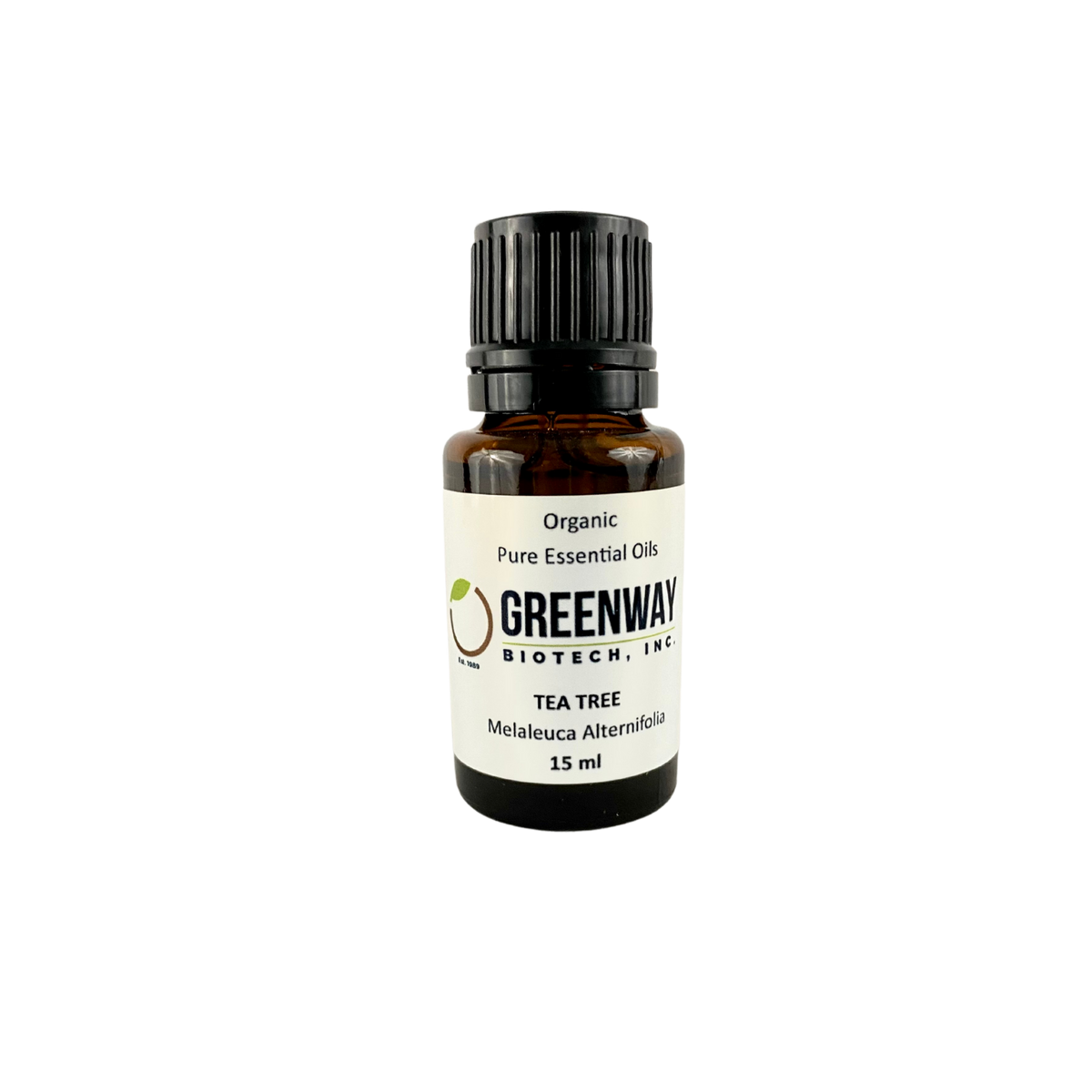
100% pure organic Melaleuca alternifolia, steam-distilled from Australian tea tree leaves and hand-bottled in a dark amber glass bottle. A fresh, herbaceous middle note rich in terpinen-4-ol (30-48%) and meeting the ISO 4730 quality standard — a favourite for blemish-prone skin, scalp care, natural cleaning, and clean-feeling diffuser blends.
See the details → How to use itHand-bottled in the USA · 90-day guarantee · For external use only
30-48%
Terpinen-4-ol content
15ml
~300 drops, amber glass
2.5%
Max skin dilution
35+yrs
Family-owned in California
One 15 ml bottle holds roughly 300 drops. Smells fresh, herbaceous, and slightly medicinal — camphoraceous and clean, sometimes described as a cleaner, greener eucalyptus.
| Botanical Name | Melaleuca alternifolia |
|---|---|
| Key Constituents | Terpinen-4-ol (30-48%), γ-terpinene (10-28%), α-terpinene (5-13%), 1,8-cineole (0-15%), α-terpineol |
| Extraction | Steam distilled from leaves and terminal branchlets |
| Origin | Australia — certified organic |
| Quality Standard | Meets ISO 4730 for tea tree oil composition |
| Aroma | Fresh, herbaceous, slightly medicinal — camphoraceous, clean and sharp, with subtle green undertones |
| Aromatic Note | Middle note — provides body and longevity, bridging fresh tops and deeper bases |
| Bottle | 15 ml (~300 drops) in dark amber glass with euro dropper cap |
| Skin Safety | Non-phototoxic; max skin dilution 2.5%. May sensitize some skin — oxidized oil is more irritating |
| Shelf Life | 1-2 years; refrigerate after opening to slow oxidation |
| Use | For external use only — toxic if swallowed. Topical (diluted), scalp, cleaning, aromatherapy |
Tea tree is one of the most useful oils to keep on hand. These are common reasons shoppers reach for it — general uses, not medical claims.
One of the most popular oils in natural skincare routines. Commonly used, well diluted, to help maintain a clear, healthy-looking complexion.
Widely used in shampoos and scalp blends. May help support a clean, balanced-feeling scalp and the look of a flake-free scalp with regular use.
A go-to for DIY household sprays — its fresh, clean aroma is popular for countertops, bathrooms, and freshening surfaces.
A clean, fresh diffuser oil — 3-5 drops freshens a room and pairs well with eucalyptus and citrus.
For anyone who wants a single, pure, well-researched oil with a clean, recognizable profile and no synthetic additives.
Origin, terpinen-4-ol level, and freshness all shape a tea tree oil. Here is what sets this one apart.
Terpinen-4-ol is the constituent most associated with tea tree's character, and higher levels are generally linked to higher-quality oil. This oil sits in the 30-48% range and meets ISO 4730, the international standard for tea tree composition.
Sourced from certified organic tea tree plantations in Australia, where the plant is native. Australian tea tree is the global benchmark, with strict quality standards and the highest typical terpinen-4-ol content.
Pure organic Melaleuca alternifolia — no synthetic additives, fillers, fragrance oils, or carrier oils. Every bottle is steam-distilled tea tree leaf oil and nothing else.
Tea tree is more prone to oxidation than most oils, and oxidized oil is more irritating to skin. The dark amber glass shields it from UV; for best freshness, refrigerate after opening and replace within 1-2 years.
Gentle steam distillation from the leaves and terminal branchlets preserves the full spectrum of aromatic compounds that give tea tree its fresh, clean, slightly medicinal character.
Every bottle is hand-filled and inspected at our US facility and lot-coded for traceability, so each batch can be tracked back to its source.
30-48% terpinen-4-ol
Steam-distilled Melaleuca alternifolia, ISO 4730
Tea tree is a small tree native to Australia's New South Wales, where Aboriginal Australians have used the leaves for centuries. The essential oil is steam-distilled from the leaves and is defined by its high terpinen-4-ol content (30-48%), alongside γ-terpinene, α-terpinene, 1,8-cineole, and α-terpineol. It is one of the most extensively researched essential oils, and its composition is governed by an international standard, ISO 4730, which sets the quality criteria for genuine tea tree oil.
The single most important practical thing to understand about tea tree is oxidation. Tea tree oil breaks down faster than most oils when exposed to air, heat, and light, and as it oxidizes it forms peroxides and other compounds that are noticeably more irritating and sensitizing to skin than fresh oil. This is why storage is not an afterthought with tea tree: refrigerate after opening, keep the cap sealed, and replace within 1-2 years. If the aroma turns harsh or chemical, retire it from skin use (it is still fine for cleaning).
Tea tree also carries a small risk of skin sensitization even when fresh, so a patch test before first use matters more here than with gentler oils. And unlike some oils, tea tree is toxic if swallowed — it is strictly an external-use oil, and accidental ingestion is a poison-control matter.
As a middle note, tea tree brings body and longevity to a blend, bridging fresh top notes and deeper bases. It is non-phototoxic, so there is no UV-avoidance window after diluted topical use.
One ingredient — pure steam-distilled tea tree oil. Its character comes from the natural constituent profile below.
The dominant constituent and the marker of quality tea tree oil; the focus of most tea tree research and its fresh character.
γ-terpinene (10-28%) and α-terpinene (5-13%) contribute the fresh, sharp, herbaceous facets of the aroma.
1,8-cineole (0-15%) adds a fresh, camphoraceous note; ISO 4730 caps cineole because high levels can be more irritating.
Safety note: non-phototoxic, but a potential skin sensitizer (more so when oxidized), and toxic if swallowed. Always dilute (max 2.5%), use fresh oil, patch test, and store refrigerated after opening. For external use only. See the Safety band for the full list.
| Botanical Name | Melaleuca alternifolia |
|---|---|
| Plant Part | Leaves and terminal branchlets |
| Extraction | Steam distilled |
| Primary Constituent | Terpinen-4-ol, 30-48% |
| Secondary Constituents | γ-terpinene (10-28%), α-terpinene (5-13%), 1,8-cineole (0-15%), α-terpineol |
| Quality Standard | Meets ISO 4730 |
| Aromatic Note | Middle note |
| Origin | Australia — certified organic |
| Phototoxic | No |
| Max Skin Dilution | 2.5% |
| Sensitization | Possible, esp. when oxidized — use fresh, patch test |
| Ingestion | Toxic if swallowed — external use only |
| Net Volume | 15 ml (~300 drops) |
| Shelf Life | 1-2 years; refrigerate after opening |
| Bottled At | Greenway Biotech facility, USA — lot-coded |
First impression: Fresh, sharp, herbaceous, and a little medicinal — clean and camphoraceous, like a cleaner, greener eucalyptus.
On skin (diluted): Best used fresh and well diluted. Patch test first — tea tree can sensitize some skin, and oxidized oil more so.
Storage: the one oil where refrigeration genuinely matters. Keep it cold and sealed, and replace it on schedule.
Tea tree is versatile but can sensitize — always dilute, use fresh oil, and patch test first. For external use only; never ingest.
Quick answer: 1-2 drops per tsp carrier for spot use on blemish-prone skin; 5-8 drops per 2 tbsp carrier for a pre-wash scalp blend.
| Application | Drops | Carrier | Notes |
|---|---|---|---|
| Spot use (blemish-prone) | 1-2 drops | 1 tsp (5 ml) | ~1% — dab on with a cotton swab; jojoba suits blemish-prone skin |
| Face & neck | 5-6 drops | 1 tbsp (15 ml) | ~1% — gentle for blemish-prone or oily skin |
| Body | 10-12 drops | 1 tbsp (15 ml) | 2-2.5% — maximum skin dilution |
| Scalp blend | 5-8 drops | 2 tbsp (30 ml) | Massage in; leave 30 min, then shampoo |
Quick answer: 3-5 drops in the diffuser to freshen a room.
| Room Size | Drops | Duration |
|---|---|---|
| Small (bathroom, closet) | 2-3 drops | 20-30 minutes |
| Medium (bedroom, office) | 3-5 drops | 30-40 minutes |
| Large (living room, kitchen) | 5-7 drops | 40-60 minutes |
Quick answer: 15-20 drops per 16 oz water + an emulsifier for a fresh-scented all-purpose spray.
Pairs well: with Lemon and Eucalyptus for a crisp, fresh household blend.
Tea tree rewards careful handling. A few principles keep it gentle and effective.
Stay at or below 2.5% on the body (about 10-12 drops per tablespoon of carrier) and ~1% on the face. Tea tree can sensitize some skin, so always patch test on the inner forearm before broader use.
Oxidized tea tree is the main cause of irritation. Refrigerate after opening, keep the cap sealed, and replace within 1-2 years. If the smell turns harsh, retire it from skin use.
Tea tree is toxic if swallowed. Keep it well away from children and pets, and treat any accidental ingestion as a poison-control matter (1-800-222-1222).
Tea tree brings body and a clean, purifying character. Pair with eucalyptus, citrus, rosemary, or lavender — bright and floral partners soften its medicinal edge.
Clear & Balanced (skin): 3 drops Tea Tree + 2 drops Lavender + 2 drops Geranium in carrier oil.
Scalp Blend: 3 drops Tea Tree + 3 drops Rosemary + 2 drops Lavender in 2 tbsp carrier.
Fresh Clean (cleaning/diffuse): 3 drops Tea Tree + 2 drops Lemon + 2 drops Eucalyptus.
Essential oils are not intended to diagnose, treat, cure, or prevent any disease. For external use only.
How tea tree sits alongside the other fresh, clean-profile oils people reach for in skincare and cleaning blends.
| Attribute | Tea Tree (this oil) | Eucalyptus | Rosemary | Lavender |
|---|---|---|---|---|
| Dominant Compound | Terpinen-4-ol (30-48%) | 1,8-cineole | 1,8-cineole / camphor | Linalool / linalyl acetate |
| Aroma | Fresh, medicinal, camphoraceous | Sharp, fresh, camphoraceous | Herbaceous, woody | Soft, floral, sweet |
| Signature Use | Blemish-prone skin, cleaning | Fresh-feeling, muscle | Hair/scalp, focus | Calming, skin |
| Phototoxic | No | No | No | No |
| Shelf Life | 1-2 yr (refrigerate) | 1-2 yr | 2-3 yr | 3-5 yr |
| Key Caution | Sensitizer; toxic if swallowed | Under-10; cineole-rich | Epilepsy; under-5 | Generally gentle |
A short fit-check so you can decide quickly.
Tea tree is a clean, purifying middle note that pairs well with florals, other fresh oils, and citrus.
The classic tea tree pairing — lavender softens tea tree's medicinal edge and adds calming floral depth; popular together in skin and scalp blends.
Essential OilBoth share fresh, camphoraceous profiles. Combined, they make a popular fresh, clean blend for diffusing and freshening rooms.
Essential OilA fresh, herbaceous partner for tea tree in scalp-care and natural-cleaning blends — both clean and invigorating.
A "carrier oil" is any vegetable-based oil used to dilute essential oils before skin application — jojoba (great for blemish-prone skin), sweet almond, and fractionated coconut are popular options. Browse the full Essential Oils Collection for more.
For external use only and toxic if swallowed. Tea tree needs careful storage and a patch test. Keep out of reach of children and pets.
If your question is not here, contact our team at questions@greenwaybiotech.com.
Yes. It is 100% pure, certified organic Melaleuca alternifolia from Australia — no synthetic additives, fillers, fragrance oils, or carrier oils. It is steam-distilled from organically grown tea tree leaves and hand-bottled at our US facility, and it meets the ISO 4730 quality standard.
Fresh, herbaceous, and slightly medicinal — camphoraceous with a clean, sharp quality and subtle green undertones. It is sometimes described as a cleaner, greener eucalyptus. As a middle note, it gives body and longevity to blends.
Tea tree is one of the most popular essential oils in natural skincare routines for blemish-prone skin. Used well diluted and consistently, it is widely chosen to help maintain a clear, healthy-looking complexion. Dilute 1-2 drops in 1 teaspoon of jojoba oil and dab onto individual blemishes with a cotton swab, or add 2-3 drops to your usual cleanser. It is a cosmetic skincare ingredient, not a treatment for a skin condition — for persistent or severe concerns, see a dermatologist.
The maximum safe skin dilution is 2.5%. For spot use, dilute 1-2 drops per teaspoon of carrier (about 1%); for full-face use, 5-6 drops per tablespoon (about 1%); for body, 10-12 drops per tablespoon (2-2.5%). Use fresh oil and always patch test, especially if you have sensitive skin.
As tea tree oil oxidizes — breaking down from exposure to air, heat, and light — it forms peroxides and other compounds that are significantly more irritating and sensitizing than fresh oil. That is why storage matters so much with tea tree: refrigerate after opening, keep the cap tightly sealed, and replace within 1-2 years. If the aroma changes noticeably, stop using it on skin; you can still use it for cleaning.
No. Tea tree is non-phototoxic, so you do not need to avoid sunlight after applying it (diluted) to skin. It is fine for daytime topical use with no UV restrictions.
Tea tree is widely used in shampoos and scalp blends. Used regularly, it may help support a clean, balanced-feeling scalp and the look of a flake-free scalp. Dilute 5-8 drops in 2 tablespoons of carrier oil for a pre-wash scalp blend, or add 3-5 drops to your shampoo bottle. For a persistent scalp condition, see a clinician rather than relying on an essential oil.
For blemish-prone skin, jojoba is excellent — lightweight, non-comedogenic, and close to the skin's natural sebum. Fractionated coconut works well for the body; coconut or jojoba for the scalp.
No — tea tree is toxic to cats and dogs if ingested or applied undiluted, and cats are especially sensitive because they lack the liver enzymes to metabolize terpenes. Do not apply tea tree to pets. If diffusing, ensure the area is well-ventilated with an exit route for animals, and consult your veterinarian before using any essential oil around pets.
Not directly. Essential oils don't mix with water, so drops added to a bath float on the surface undiluted and can irritate skin, and bath salts, Epsom salt and milk don't disperse them. Enjoy Tea Tree in a diffuser instead.
Refrigerate after opening — this matters more for tea tree than for most oils because of its oxidation sensitivity. Keep the cap tightly sealed to limit air exposure. Expected shelf life is 1-2 years when refrigerated. If the aroma becomes harsh or significantly different, stop using it on skin (it is still fine for cleaning).
No — and this matters especially for tea tree. Tea tree oil is toxic if swallowed and can cause serious effects including confusion, loss of coordination, and breathing difficulty. Our oils are formulated, tested, and labeled for external use only. If accidental ingestion occurs, contact Poison Control (1-800-222-1222) immediately and do not induce vomiting.
A 15 ml dark amber glass bottle of pure organic Australian tea tree, ISO 4730 quality, hand-bottled in the USA. Backed by our 90-day money-back guarantee — if it is not the right fit, we will make it right.
Add to cart →Hand-bottled in the USA · 90-day guarantee · For external use only