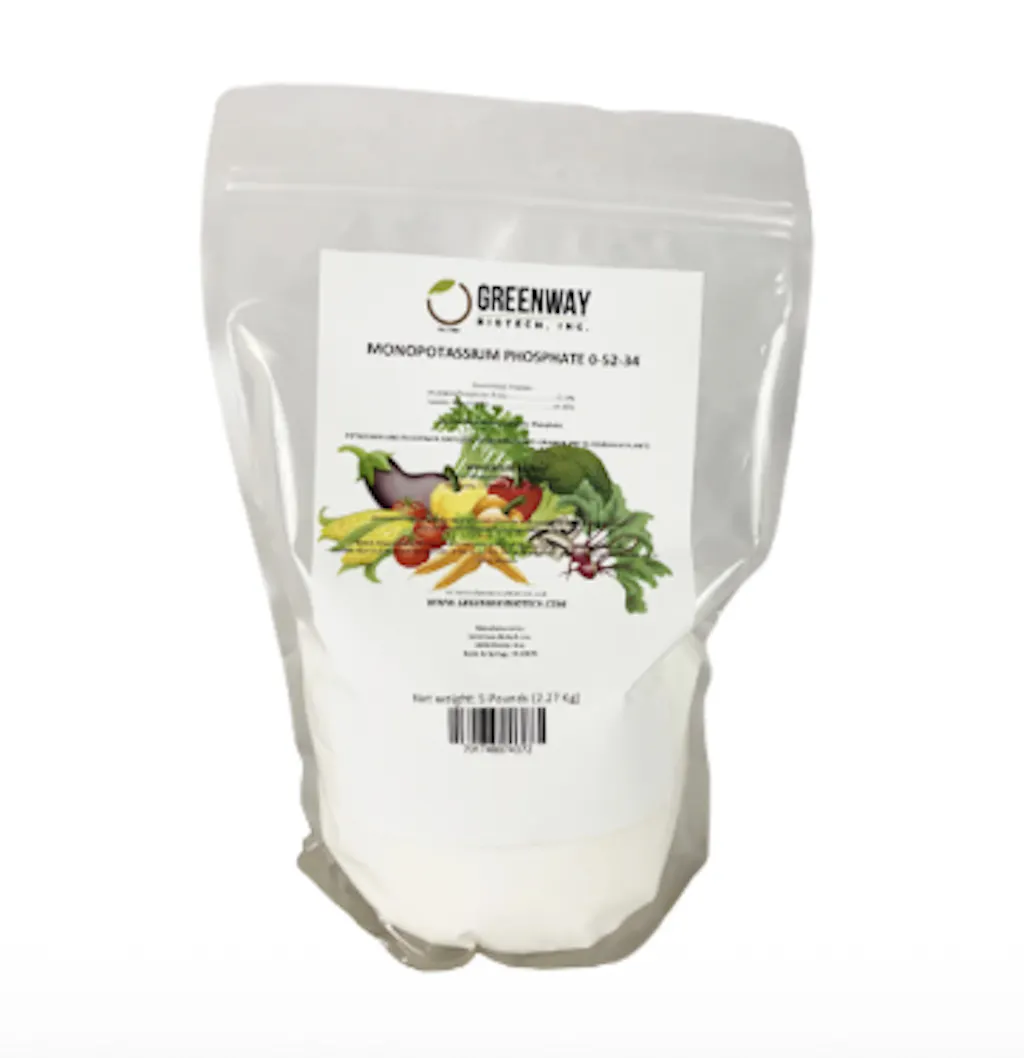
Monopotassium Phosphate 0-52-34
- Regular Price
- $ 29.99
- Sale Price
- $ 29.99
- Regular Price
- $ 33.99
Sold Out
- Unit Price
- per
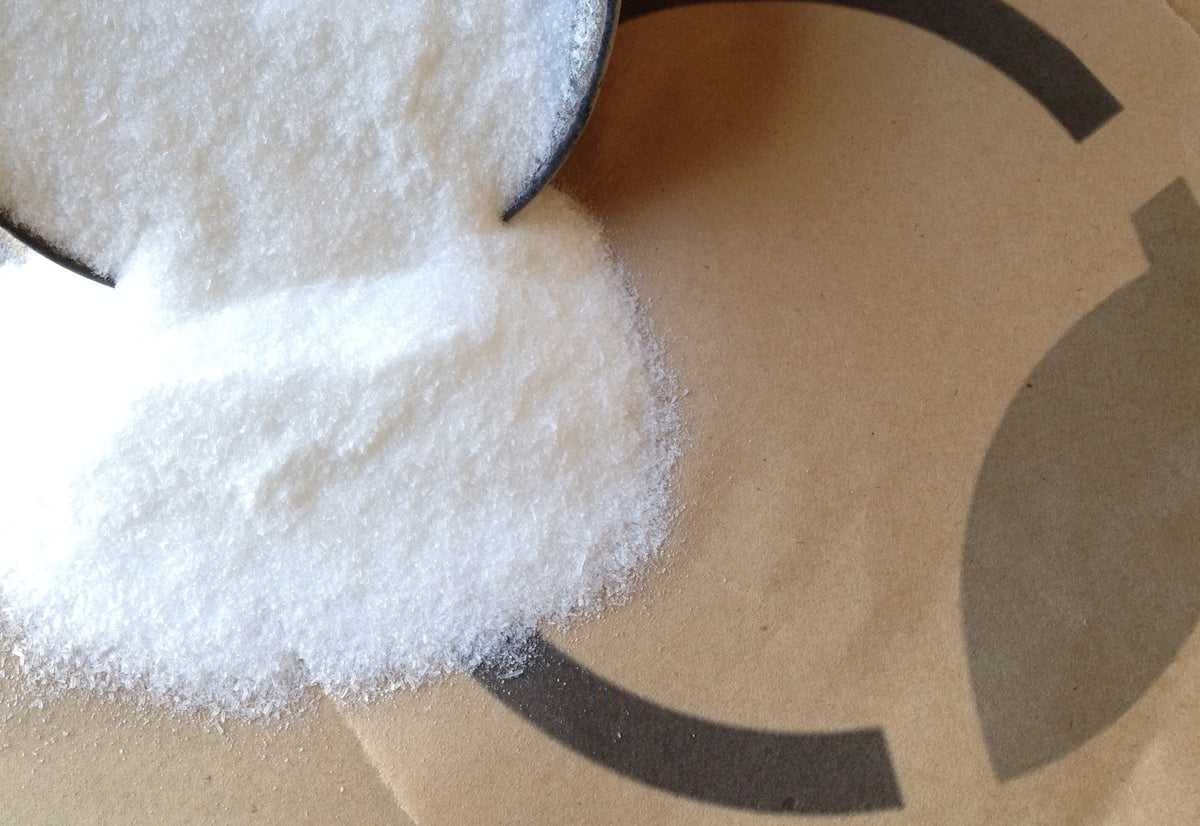
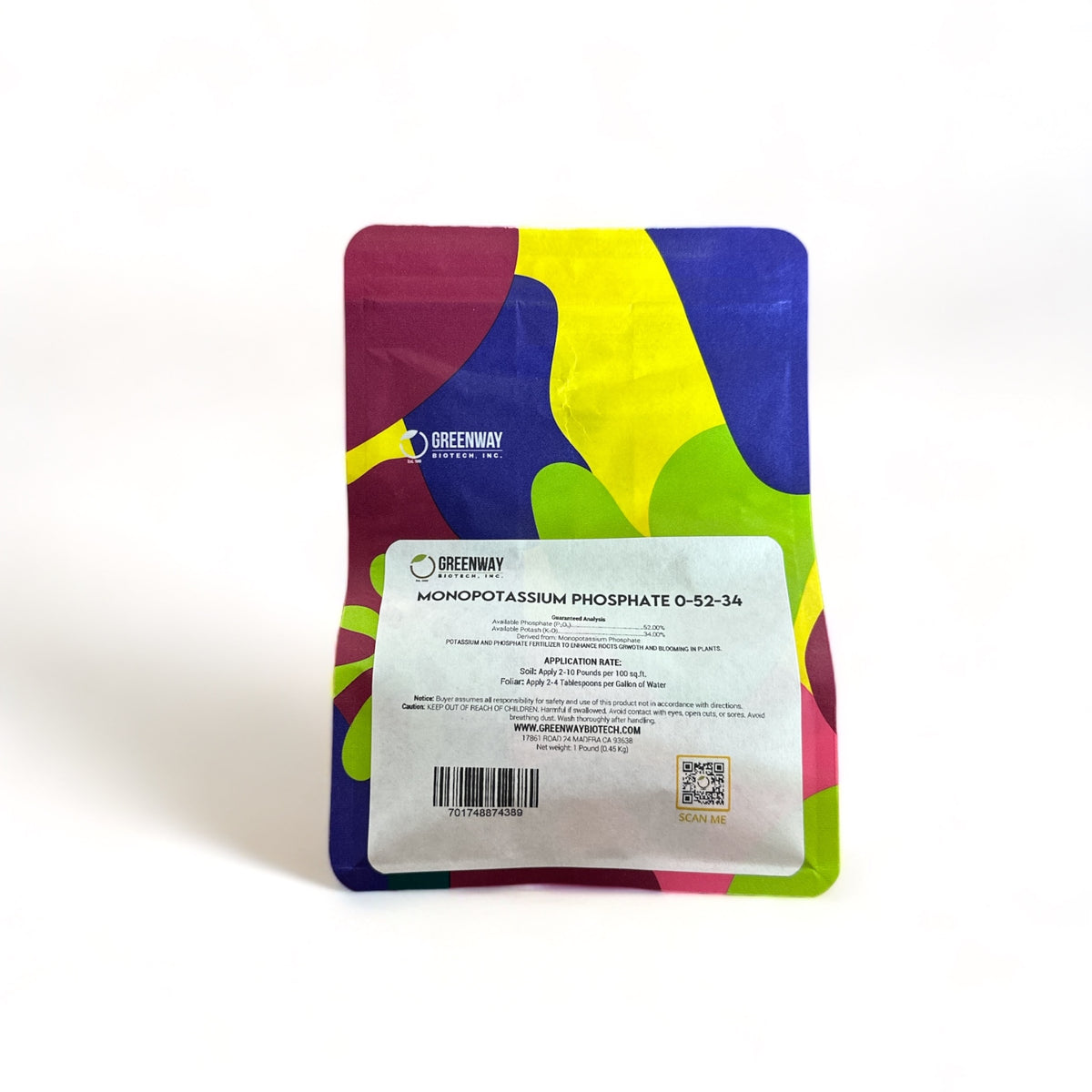
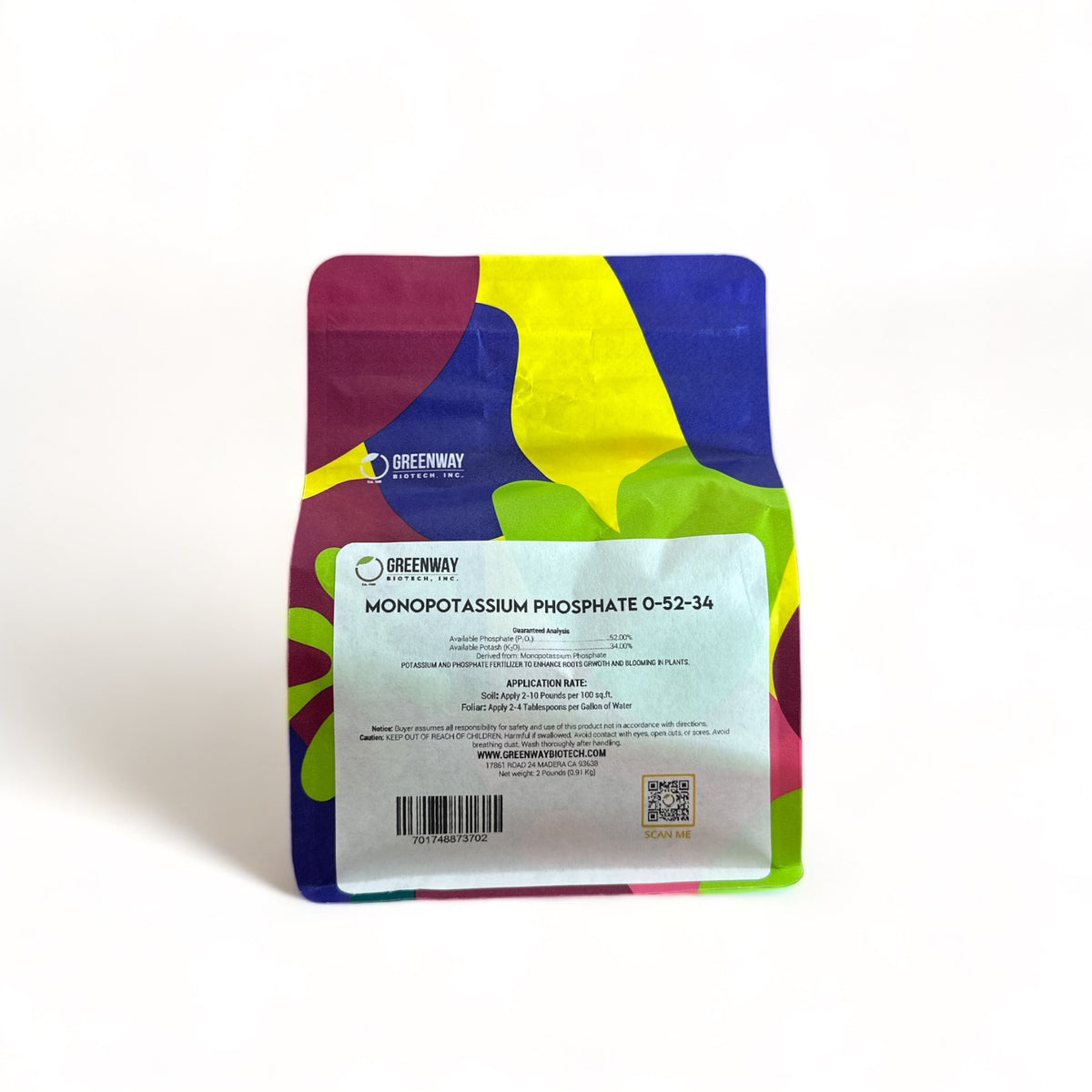
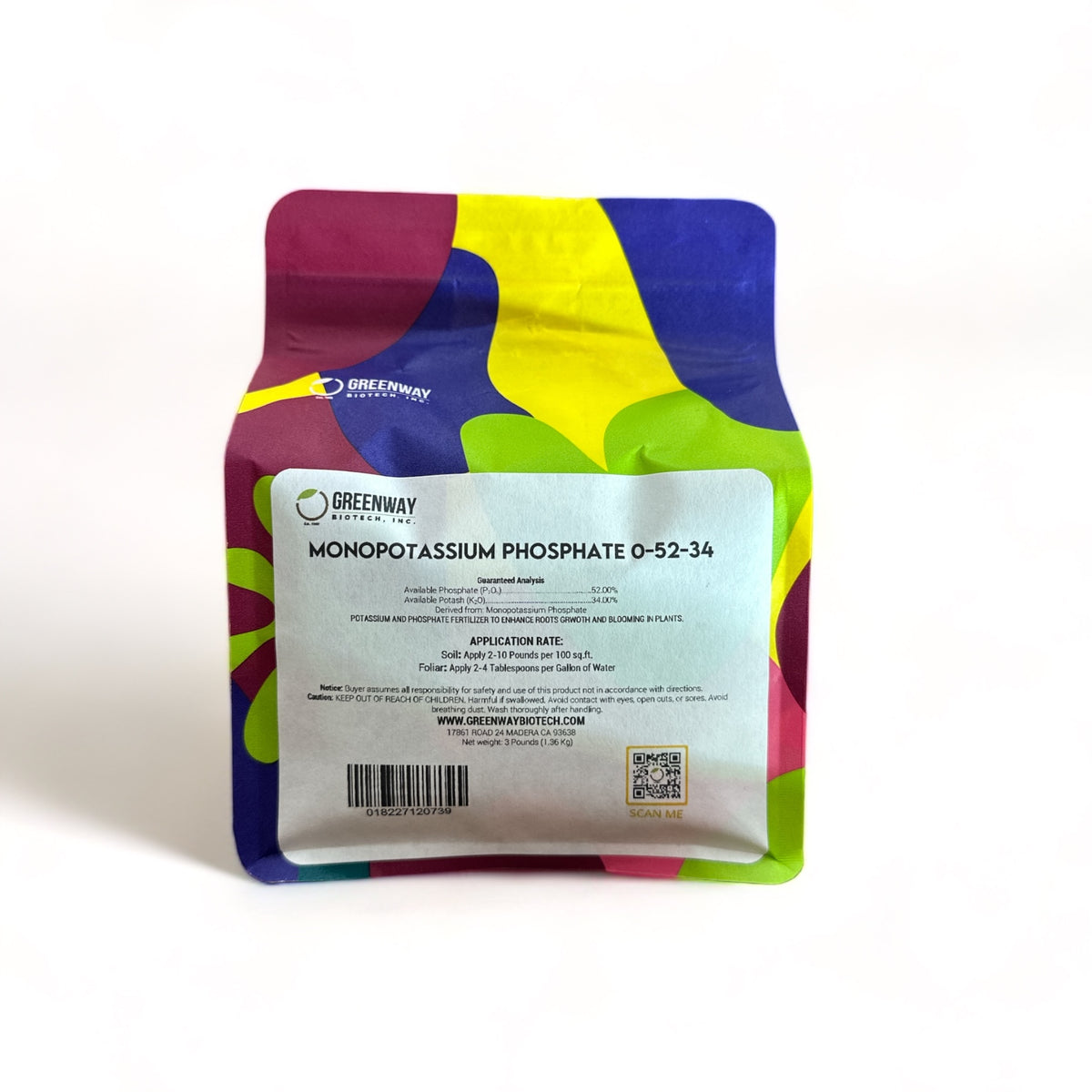
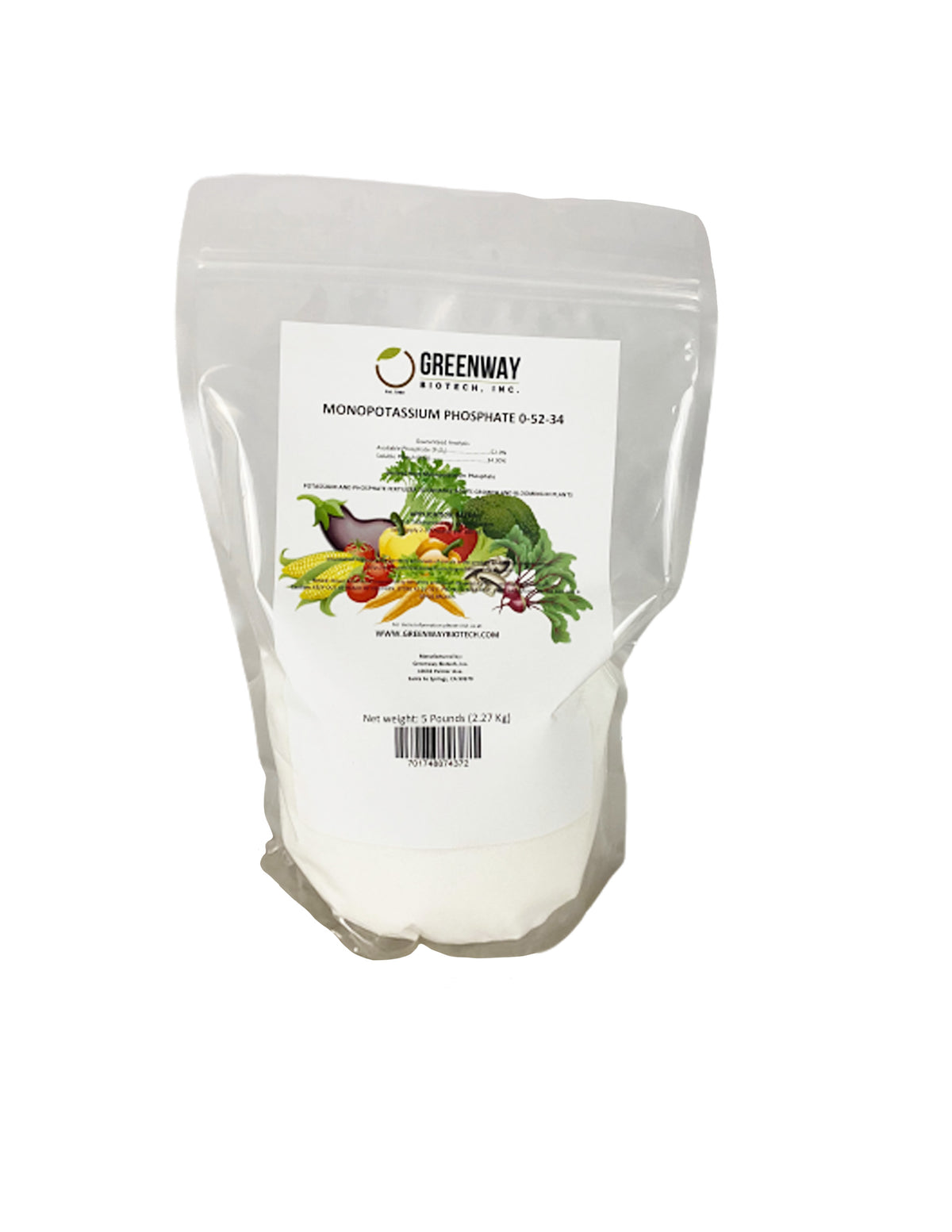
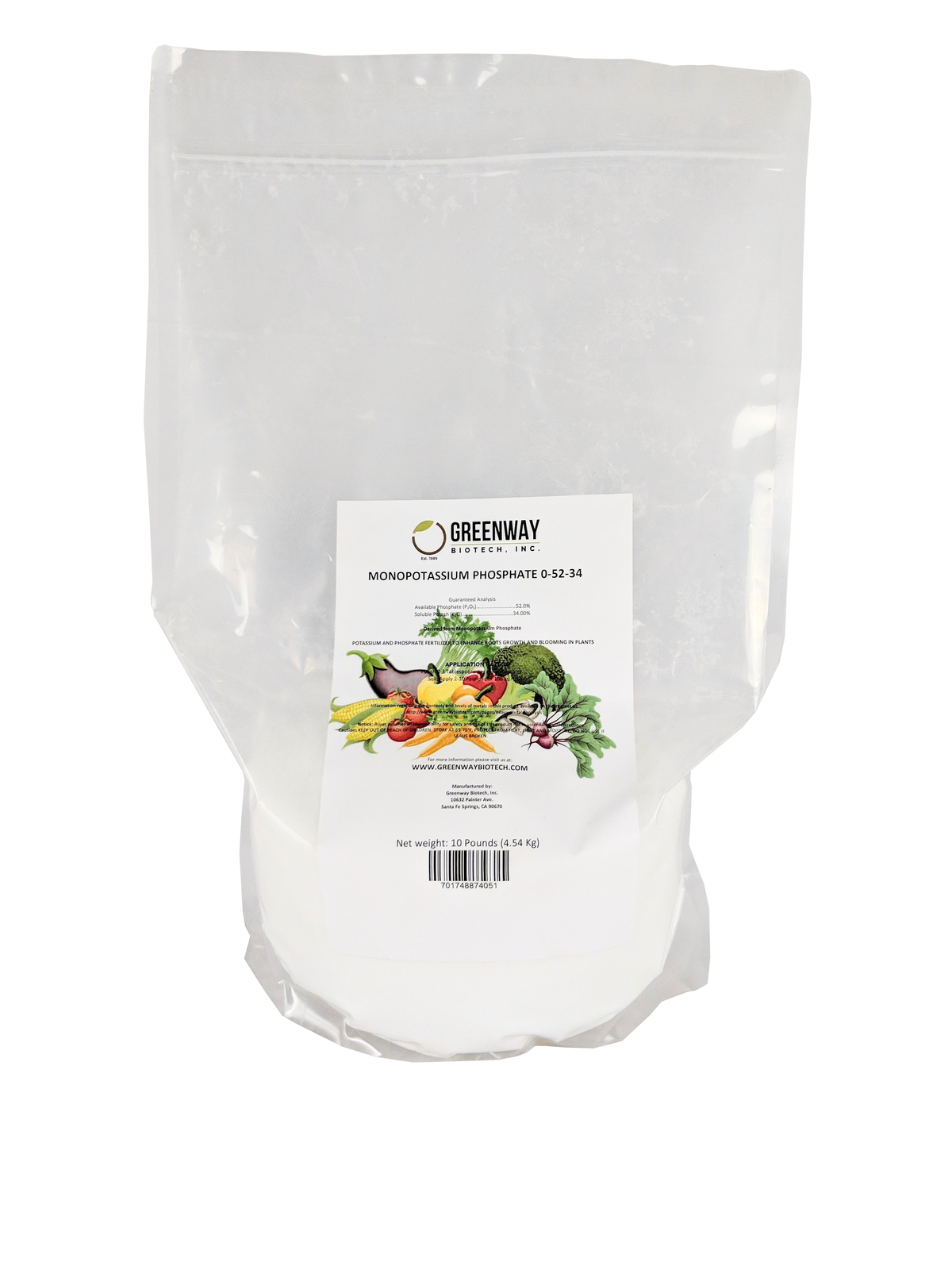
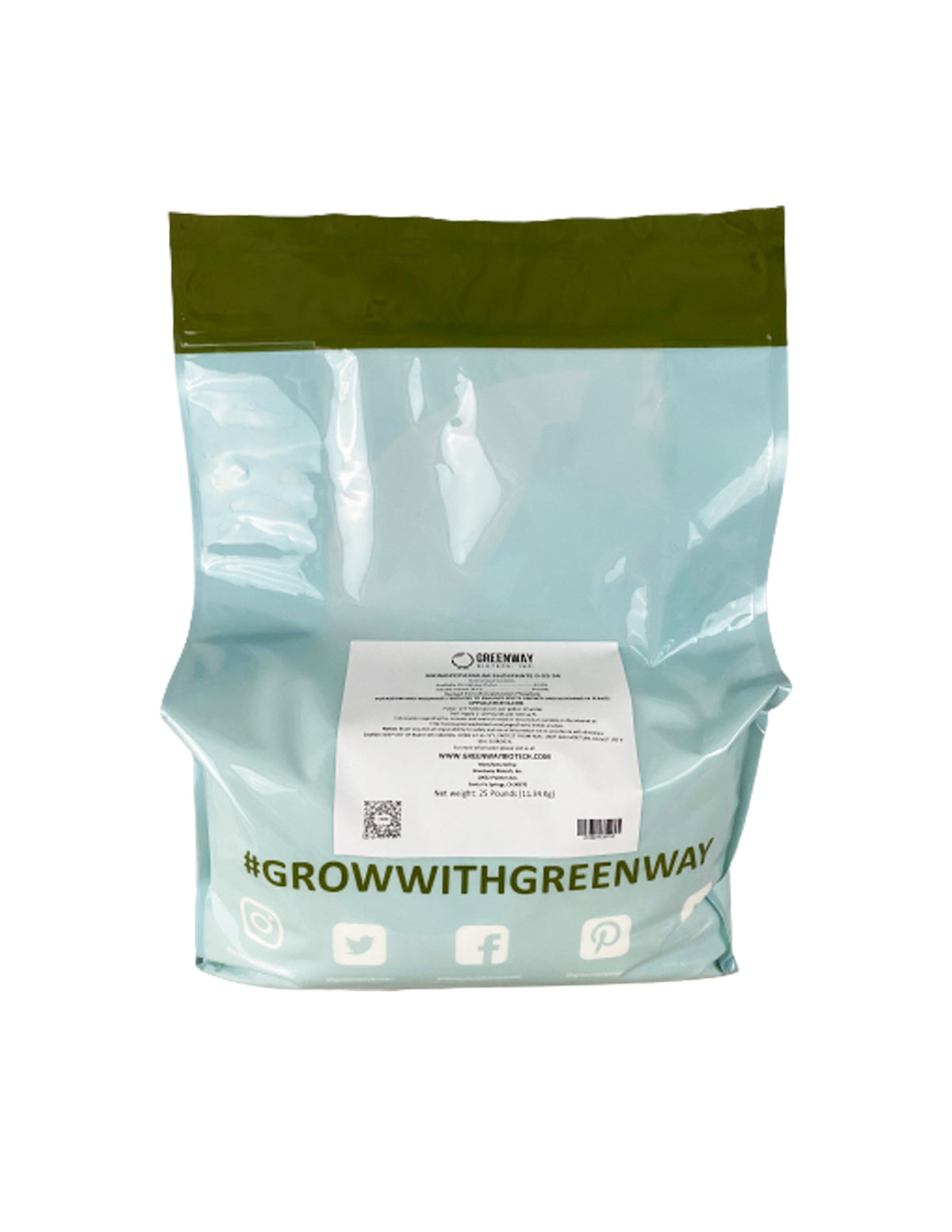
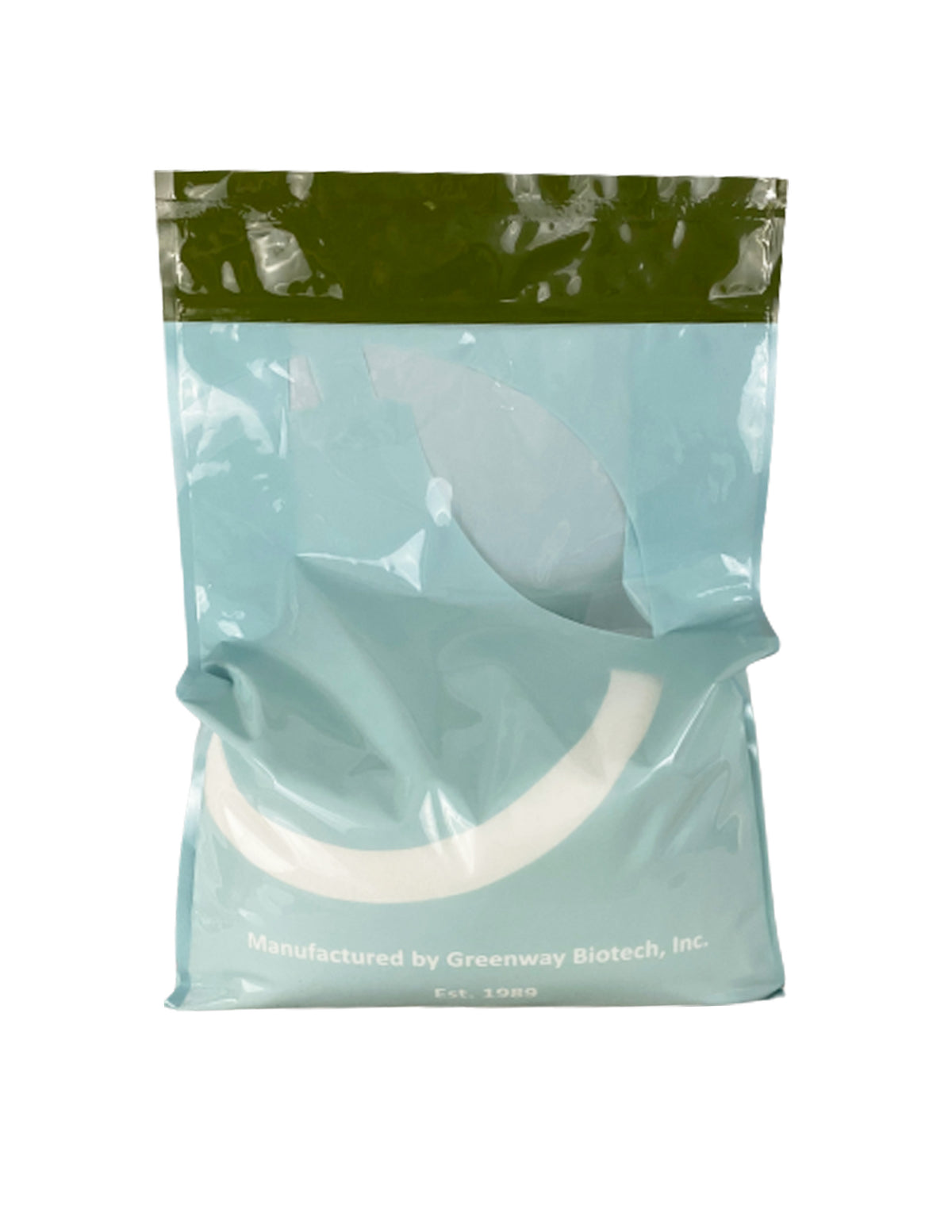
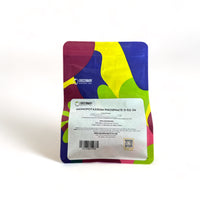
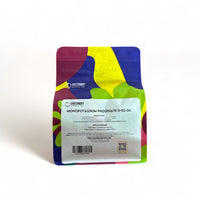
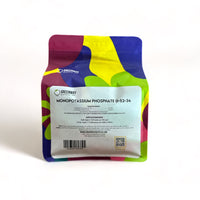
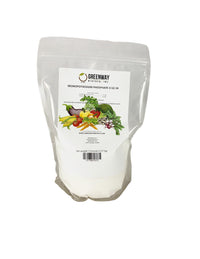
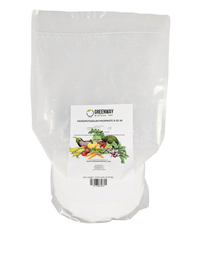
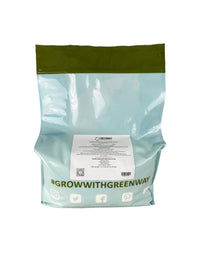
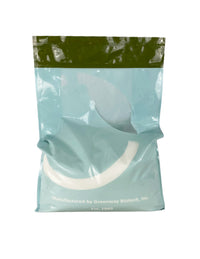
A nitrogen-free, 100% water-soluble P-K salt. 52% available phosphate (P₂O₅) and 34% soluble potash (K₂O) in a single technical-grade crystal — built for flowering, fruit set, and hydroponic bloom phase without pushing vegetative growth.
Find your size → Calculate how much I need52%
available phosphate (P₂O₅) for root and bloom
34%
soluble potash (K₂O) for fruit size and quality
0%N
zero nitrogen — no vegetative push at bloom
8.4SI
low salt index among water-soluble P-K sources
Coverage based on a planning rate of 3 lbs per 100 gallons foliar spray and 1 lb per 100 gallons fertigation. Actual coverage varies by crop and concentration.
| Bag Size | Foliar Coverage | Fertigation Coverage | Best For |
|---|---|---|---|
| 1 lb | ~33 gal spray solution | ~100 gal drip solution | Trial size, single garden |
| 5 lb | ~165 gal spray solution | ~500 gal drip solution | Most popular |
| 25 lb | ~830 gal spray solution | ~2,500 gal drip solution | Small orchard, hydro grow room |
| 50 lb | ~1,650 gal spray solution | ~5,000 gal drip solution | Best value |
MKP earns its place when phosphorus and potassium demand peaks — bloom initiation, fruit set, ripening — and you do not want nitrogen pushing new leaf growth.
Apply foliar or fertigation at pre-bloom through full bloom. Zero nitrogen keeps the plant focused on flowers rather than vegetative growth.
Tomatoes, peppers, cucumbers, melons. Repeat applications every 2-3 weeks during fruit set and development for size and Brix support.
Pre-bloom, post-bloom, and a quality-focused application 30 days before harvest. Foliar program may also help suppress powdery mildew.
Adds 30-60 ppm elemental P to bloom-stage nutrient solution. Keep separate from calcium-containing concentrates — never combine in the same stock tank.
Drip and overhead injection through bloom and fruiting. Fully water-soluble crystalline form dissolves cleanly with no emitter residue.
Spring and fall P-K boost on cool-season grasses, plus rose and ornamental rotations. Low salt index makes it gentler on sensitive foliage than most P sources.
MKP is a single-salt fertilizer — potassium dihydrogen phosphate (KH₂PO₄). No fillers, no nitrogen, no carrier ions to balance against. What the label says is what dissolves into your tank.
The defining advantage of MKP versus MAP or DAP. At flowering and fruit set, additional nitrogen extends the vegetative phase, dilutes flower initiation, and can soften fruit quality. MKP delivers P and K with no nitrogen stimulus — making it the standard bloom-phase P source in commercial hydroponic and fertigation programs.
At 52% P₂O₅, MKP delivers a concentrated dose of phosphorus exactly when demand peaks — ATP energy production, root cell division, flower bud initiation, and early fruit set. Compare with MAP 12-61-0 for vegetative phases when nitrogen is also needed.
Potassium regulates stomatal opening, sugar translocation into fruit, and enzyme activation throughout the plant. Research links adequate K nutrition during ripening to higher Brix, firmer fruit, and longer post-harvest shelf life. MKP combines this with phosphate in a single salt — useful when you do not want to layer in a separate K source.
MKP has a salt index of approximately 8.4 — among the lowest of common water-soluble fertilizers. That makes it usable as a foliar spray at concentrations that would burn most other P-K sources, and gentler in starter applications near sensitive seedlings.
Dissolves completely in water at standard rates with no insoluble residue. Compatible with drip emitters, foliar sprayers, fertigation lines, and recirculating hydroponic reservoirs — provided the standard calcium-versus-phosphate separation rule is observed (see safety section below).
CDFA-registered fertilizer with guaranteed nutrient analysis. Independently tested for heavy metals — results consistently well below required limits. Manufactured to technical-grade purity in our Madera facility, with consistent crystalline form batch to batch.
KH₂PO₄
Potassium dihydrogen phosphate — CAS 7778-77-0
MKP dissociates in water into potassium ions (K⁺) and dihydrogen phosphate ions (H₂PO₄⁻). Both are the directly plant-available forms of their respective nutrients — no soil microbial conversion, no chelation chemistry, no carrier salts to balance. The phosphate form is dominant at the slightly acidic pH found at most plant root surfaces, which is why MKP behaves so well in both soil and hydroponic systems.
Because MKP is a single-compound fertilizer (rather than a blend), there are no internal incompatibilities. In dilute solution, MKP has minimal impact on growing-medium pH — a meaningful contrast with ammonium-based phosphates like MAP and DAP, which acidify the root zone over time as the ammonium nitrifies. That makes MKP the safer P source for crops sensitive to root-zone pH swings, including many ornamentals and acid-sensitive vegetables.
The other defining trait is the salt index of 8.4 — the lowest of any common high-P fertilizer. Salt index measures the osmotic stress a fertilizer imposes per unit of nutrient delivered. The lower the index, the safer the fertilizer is at high concentrations in foliar sprays and starter applications. This is why peer-reviewed studies of foliar P-K nutrition almost universally use MKP rather than MAP or DAP for high-concentration leaf applications.
For more on the underlying nutrient roles, see What Does Phosphorus Do for Plants? and What Does Potassium Do for Plants?.
Rates below are anchored to commercial labels (Brandt MKP, Haifa MKP / Nova PeaK, ICL) and the peer-reviewed studies they cite. Salt index of 8.4 makes MKP unusually foliar-tolerant — but always start at the lower end on a small area first.
Quick answer: For most fruiting and flowering crops, 0.5-1% solution (5-10 g/L, or about 1-2 tbsp/gallon) sprayed pre-bloom and at fruit set. Stop at 84°F on a rising temperature curve.
| Crop | Field Rate (lb/acre) | Concentration | Source | Timing |
|---|---|---|---|---|
| Tomatoes (field) | 2-10 | 1-3% solution | Williams & Kafkafi 1998 | Pre-bloom; repeat 2-3× at 2-3 week intervals |
| Peppers | 2-10 | 0.5-1% (1% for mildew) | Reuveni et al. 1998 | Pre-bloom and through fruit set |
| Cucumbers (field) | 2-10 | 0.5-1% solution | Reuveni et al. 1996 | Pre-bloom; effective vs. powdery mildew at 0.5-1% |
| Strawberries | 3-10 | 0.2% pre-flowering | Egyptian sandy-soil trials (peer-reviewed) | After first blooms; pre-flowering for fruit set |
| Grapes (nutrition) | 3-10 | 0.5-1% solution | Haifa / ICL labels | Pre-bloom, post-bloom, 30 days before harvest |
| Grapes (mildew suppression) | 3-10 | 0.5-1% solution | Reuveni & Reuveni 1995, 2002 | 7-14 day intervals during pressure window |
| Apples, pears, stone fruits | 5-10 | 0.5-1% solution | Brandt MKP label | Pre-bloom and post-bloom; avoid Golden Delicious / pears in slow-drying conditions |
| Nectarines (powdery mildew) | 5-10 | 1% + 0.025% non-ionic surfactant | Reuveni & Reuveni 1998 | Alternate with SI fungicide; reduced fungicide load 50% over 3 years |
| Almonds, walnuts, pistachios | 5-10 | 0.5-1% solution | Brandt MKP label | 3-4 applications: petal fall through hull split |
| Mango (powdery mildew) | 3-10 | 0.5-1% solution | Reuveni & Reuveni 1995 | During pressure window |
| Olives | 5-10 | 3% MKP + urea + surfactant | Sanchez-Zamora & Fernandez-Escobar 2008 | July application most effective |
| Potatoes | 2-10 | 3% foliar (80 gal/ac) | UF/IFAS Hochmuth 1996 | Two applications improved Size A yields on reduced-fertilizer plots |
| Leafy vegetables, cole crops | 1-5 | 0.5% solution (low end) | Haifa MKP label | Every 10-14 days; lower end to avoid leaf marking |
| Small grains (wheat, barley) | 2-10 | 0.5-1% solution | Haifa MKP label | At tillering, before boot stage |
| Roses (powdery mildew) | n/a | ~0.34% (3.4 g/L) every 7-14 days | Pasini et al. (peer-reviewed) | Greenhouse trial — reduced disease pressure |
Foliar safety check: MKP is unusually foliar-tolerant due to its low salt index (8.4), but rates above 1% (~10 g/L) should be reserved for mature foliage on tolerant crops (tomato, olive, potato). For tender foliage and most home-garden crops, stay in the 0.5-1% range (5-10 g/L, about 1-2 tbsp/gallon). Spray in early morning or late afternoon. Stop spraying at 84°F on a rising curve; resume only after temperatures drop below 90°F on a falling curve. Always test on a small area first.
Sources: Reuveni & Reuveni 1995, 1998, 2002 (Crop Protection, Canadian Journal of Plant Pathology, Acta Horticulturae); Williams & Kafkafi 1998; Sanchez-Zamora & Fernandez-Escobar 2008; UF/IFAS Hochmuth 1996; Brandt MKP, Haifa MKP / ICL Nova PeaK commercial labels.
Quick answer: 1-2 lbs per 100 gallons through bloom and fruiting. Never combine in the same stock tank as calcium nitrate — use separate A and B tanks.
| Stage / Use | Rate | Source | Notes |
|---|---|---|---|
| Drip irrigation — bloom & fruiting | 1-2 lbs per 100 gallons | Haifa MKP / ICL labels | Weekly during bloom; reduce to 0.5 lb/100 gal during vegetative phase |
| Soil drench (home garden) | 1 tbsp per gallon (~15 g/gal) | Greenway product guidance | Every 2 weeks during flowering and fruiting |
| Field fertigation | 25-500 lbs per acre per season | Brandt MKP label | Total seasonal rate split across crop program |
| Starter band (transplant) | 2-4 lbs per acre | Brandt MKP label | Dissolved in minimum 5 gal water per acre, banded near transplant |
| Sidedress fertigation | 5-20 lbs per acre | Brandt MKP label | Mix 1 lb MKP per gallon stock; apply 5-20 gal/ac |
Critical mixing rule: Never combine MKP and calcium-containing fertilizers (calcium nitrate, gypsum, calcium chloride) in the same concentrated stock tank. Phosphate and calcium ions react to form insoluble calcium phosphate — a white precipitate that clogs emitters and locks up both nutrients. Use a two-tank A/B injector system: calcium and magnesium fertilizers in Tank A, MKP and other phosphate / sulfate sources in Tank B. They combine only in the dilute irrigation stream.
Sources: Brandt MKP commercial label; Haifa MKP / ICL Nova PeaK technical literature.
Quick answer: Target 30-60 ppm elemental P added by MKP during bloom phase. About 1 gram of MKP per liter adds ~227 ppm elemental P, so 0.13-0.26 g/L (roughly 0.5-1 g/gallon) gets you into the bloom-phase range.
| Recipe / Setting | Target Concentration | MKP Rate | Source |
|---|---|---|---|
| Light feeding / leafy greens | 30-50 ppm P / 20-35 ppm K | ~0.13-0.16 g/L (0.5-0.6 g/gal) | UF/IFAS Hochmuth |
| Standard hydroponic fruiting | 50 ppm P / 30-35 ppm K (from MKP) | ~0.22 g/L (~0.8 g/gal) | Haifa technical literature |
| Heavy feeding / deficiency correction | 100-260 ppm P / 65-170 ppm K | ~0.44-1.15 g/L (~1.7-4.3 g/gal) | UF/IFAS Hochmuth |
| UF/IFAS hydroponic tomato (Formula 3) | 50 ppm P across all 5 growth stages | 5.5 lb MKP in 30-gal A-stock (1:100) | UF/IFAS EDIS HS796 |
| Penn State Extension (100-gal nutrient solution) | 31 ppm P; supplemental K from KNO₃ | 262 g MKP per 100-gal stock | Penn State Extension |
| Resh, Hydroponic Food Production (20-gal tank, fruiting) | 50 ppm P / 352 ppm K total | 17 g MKP + K₂SO₄ + KNO₃ + Ca(NO₃)₂ | Resh, Hydroponic Food Production |
Tank separation rule: In hydroponic systems, MKP goes in Tank B with other phosphate, sulfate, and potassium sources. Calcium Nitrate and other calcium sources go in Tank A. They never mix in concentrate — only in the dilute reservoir or irrigation stream. When adding to an existing reservoir that already contains calcium, dissolve MKP separately first and add slowly with circulation running.
EC and pH: MKP in dilute solution has minimal pH impact, but verify EC and pH after addition and adjust as needed. Monitor plant response over 7-10 days before changing rates.
Sources: UF/IFAS EDIS HS796/CV216 (Hochmuth, rev. 2025); Penn State Extension (Sanchez); Haifa MKP technical literature; Resh, Hydroponic Food Production.
Quick answer: Field application rates vary 1-10 lbs per acre by crop. Always confirm with a current soil test — published ranges below are starting points, not normative values.
| Crop | Rate per acre | Source | Timing |
|---|---|---|---|
| Alfalfa, clover | 2-8 lbs per application | Brandt MKP label | First at 6-8" growth; repeat after each cutting |
| Beans, peas | 2-10 lbs | Brandt MKP label | When plants 3-4 weeks old; repeat as needed |
| Broccoli, cauliflower, cabbage | 1-5 lbs | Brandt MKP label | Apply at 3-4 weeks; repeat at 2-4 week intervals |
| Carrots, onions, root vegetables | 2-10 lbs | Brandt MKP label | Begin at 3-4 weeks; mid-season applications |
| Celery & leafy vegetables | 1-5 lbs | Brandt MKP label | Begin at 3-4 weeks; repeat as needed |
| Corn, sorghum, wheat, small grains | 2-10 lbs | Brandt MKP label | At 3-4 weeks old; tillering through boot stage for wheat |
| Cotton | 2-10 lbs | Brandt MKP label | At 3-4 weeks old; repeat as needed |
| Lettuce | 2-10 lbs | Brandt MKP label | Use lower end to avoid leaf marking |
| Sugarbeets | 2-10 lbs | Brandt MKP label | When plants 3-4 weeks old; repeat as needed |
| Bushberries, caneberries | 3-10 lbs | Brandt MKP label | Early spring or at first deficiency symptoms |
| Hops | 3-10 lbs | Brandt MKP label | Early spring; repeat as needed |
📋 Soil Test First: Field crop application rates above are general guidelines based on commercial label recommendations and typical soil-test levels. Actual rates should be confirmed by a current soil test and consultation with your local cooperative extension service, as needs vary significantly by soil type, crop variety, irrigation water quality, and regional conditions. On alkaline soils (pH > 7.5), soil application is less efficient than foliar or fertigation because phosphate fixes rapidly as calcium phosphate.
Sources: Brandt MKP commercial label; Haifa MKP / ICL Nova PeaK technical literature; supplemental rate calibration from UF/IFAS, Penn State Extension, and OSU Extension cooperative resources.
Quick answer: For ornamentals, dissolve about 1 lb per 10 gallons water (~1.2% solution) and spray to wet. Turf at 2-4 oz per 1,000 sq ft. Always check current label before applying to home lawns.
| Use | Rate | Source | Notes |
|---|---|---|---|
| Ornamentals (spray to wet) | ~1 lb per 10 gallons (~1.2% solution) | Brandt MKP label | Spray to wet, do not run off |
| Trees, shrubs, roses, bedding plants | 1 lb per 10 gallons water | Brandt MKP label | At bloom, spring push, or after transplanting |
| Cool-season turf (bentgrass, fescue, bluegrass) | 2-4 oz per 1,000 sq ft | Brandt MKP label | Spring & fall; up to weekly during growth flush |
| Warm-season turf (bermuda) | 2-4 oz per 1,000 sq ft | Brandt MKP label | Late spring to early fall |
| Greenhouse foliar — young leaves | 0.5-1% solution | Haifa MKP / Nova PeaK | Test on small area first; tender tissue is more sensitive |
| Greenhouse foliar — mature foliage, tolerant crops | up to 2% solution | Haifa MKP / Nova PeaK | Mature tomato, pepper, olive; verify on small area first |
| Roses (powdery mildew program) | ~0.34% (3.4 g/L) every 7-14 days | Pasini et al. (peer-reviewed) | Foliar program; rotate with other tools |
Turf safety check: Foliar applications to turf should follow the same temperature rules as other crops — stop at 84°F on a rising curve and resume only after temperatures drop below 90°F on a falling curve. Water in lightly after granular or drench applications to prevent surface concentration. For professional turf use only.
Sources: Brandt MKP commercial label; Haifa MKP / ICL Nova PeaK technical literature; Pasini et al. (greenhouse rose trials).
MKP dissolves in water at room temperature with no special preparation. The non-negotiable rule is the calcium separation — everything else is technique.
Add MKP to about half the final water volume with agitation. Warm water (40-60°C) speeds dissolution — useful for high-concentration foliar tank mixes. Then top off with the remaining water.
Apply in early morning or late afternoon. Stop spraying at 84°F on a rising temperature curve, and wait until temperatures fall below 90°F before resuming. Use sufficient water volume — aim for ~350 gal/acre for full canopy coverage on mature trees.
MKP and any calcium-containing fertilizer (calcium nitrate, gypsum, calcium chloride) must stay in separate stock tanks. They react to form insoluble calcium phosphate that clogs emitters and lines. Always dilute each independently before combining in the main tank, and jar-test unfamiliar combinations before scaling up.
Many commercial fruit programs use three coordinated foliar applications: 7-10 days before first bloom, at full bloom, and at early fruit set. A fourth application 30 days before harvest can support Brix and color in grapes and tree fruits. Allow a minimum of 7 days between foliar applications.
The right phosphorus source depends on growth stage, nitrogen status, and whether you need calcium with it. Here is how MKP compares with the most common alternatives.
| Product | NPK | Solubility | Best For | Notes |
|---|---|---|---|---|
| MKP 0-52-34 (this product) | 0-52-34 | 100% water-soluble | Bloom, fruit set, hydroponic Tank B | Zero nitrogen; lowest salt index of P-K sources; foliar-tolerant |
| MAP 12-61-0 | 12-61-0 | 100% water-soluble | Early growth, root establishment, transplant | Adds ammoniacal N alongside P; no K; acidifies root zone over time |
| Calcium Nitrate 15.5-0-0 | 15.5-0-0 + 19% Ca | 100% water-soluble | Cell wall strength, BER calcium support, hydroponic Tank A | Provides N and Ca; never tank-mix with MKP — precipitates |
| Fish Bone Meal 4-17-0 | 4-17-0 + Ca | Slow-release organic | Pre-plant soil amendment, organic programs | Adds Ca; not for hydroponics; not for acid-loving crops at repeated use |
| Potassium Sulfate 0-0-53 | 0-0-53 + 17% S | Water-soluble | Chloride-sensitive crops needing K (no P) | K + S only; pair with MKP or MAP when P is also needed |
MKP is the standard bloom-phase P-K source in commercial programs, but it is not the right answer for every stage or every crop.
MKP delivers two of the three macros. Pair it with the right N source and calcium / Mg / micro support for a complete fertility program through the season.
Supplies the nitrogen and calcium MKP intentionally omits. Apply on separate fertigation days — never tank-mix calcium with phosphate.
Nitrogen + Sulfur21% N plus sulfur for vegetative growth phases. Use before transitioning to MKP at the bloom switch — especially on acid-loving crops.
MagnesiumSupplies magnesium for chlorophyll production and sulfur for enzyme function. Compatible with MKP in the same tank.
Iron ChelateCorrects iron deficiency in bloom-stage crops without interfering with MKP. EDTA chelation keeps iron plant-available across a wide pH range.
MKP itself is not classified as hazardous, but two practical rules matter: keep it away from calcium in concentrate, and avoid creating dust in confined spaces.
If your question isn't here, contact our team at questions@greenwaybiotech.com.
Phosphate ions (from MKP) react with calcium ions to form calcium phosphate — an insoluble white precipitate that clogs drip emitters, spray nozzles, and pump filters, and locks up both nutrients before plants can use them. The fix is a two-tank A/B injector system: calcium nitrate and other calcium sources in Tank A, MKP and other phosphate / sulfate sources in Tank B. They mix only in the dilute irrigation stream where precipitation does not occur. In home settings, a 24-hour gap between separate calcium and MKP applications is generally sufficient.
MAP (monoammonium phosphate) contains 11-12% nitrogen alongside high phosphorus and no potassium. MKP contains zero nitrogen and adds 34% soluble potash (K₂O). Choose MKP when you are at the flowering or fruiting stage and want to boost P and K without stimulating new vegetative growth. Choose MAP 12-61-0 when you need phosphorus along with some nitrogen during early growth or root establishment. For deeper coverage, see What Does Phosphorus Do for Plants?.
Peer-reviewed research (Reuveni & Reuveni 1995, 1998, 2002 in Crop Protection, Canadian Journal of Plant Pathology, and Acta Horticulturae) suggests that MKP solutions applied as a foliar spray may help suppress powdery mildew on susceptible crops including grapes, cucumbers, melons, nectarines, mango, and roses. The phosphorus-potassium combination can strengthen plant cell walls and support secondary metabolite production. MKP is typically used alongside or alternating with conventional fungicides as part of an integrated program — results vary by crop, environment, and disease pressure. Adding a non-ionic surfactant (e.g., 0.025% Triton X-100) improved efficacy in the cited trials.
MKP has a low salt index (8.4) and is unusually foliar-tolerant, but the rules still apply. Stop foliar spraying when air temperature reaches 84°F on a rising curve (typically mid-morning), or wait until temperatures fall to 90°F on a falling curve (late afternoon). Always maintain a minimum 7 days between foliar applications and never spray stressed plants. Use sufficient water volume — targeting ~350 gallons per acre on full-canopy mature trees helps prevent excessive concentration on leaf surfaces. For tender foliage and most home-garden crops, stay in the 0.5-1% concentration range (5-10 g/L). Adding a non-ionic surfactant can improve coverage and reduce localized concentration.
MKP is typically most valuable from bud break through early fruit set — specifically the 2-week window before first bloom, during active flowering, and at fruit set when phosphorus demand is highest. For quality enhancement, a final application 30 days before harvest can support Brix and color development in grapes and stone fruits. MKP is generally less useful during the purely vegetative stage, when nitrogen and micronutrients take priority over P-K loading; many growers use MAP 12-61-0 or a balanced N-P-K program early, then transition to MKP at the bloom switch.
MKP is compatible with most water-soluble fertilizers (except calcium sources), micronutrient chelates, most fungicides, and many insecticides. Its slightly acidic character in concentrated solution can actually enhance the efficacy of some pH-sensitive pesticides. Do not mix with basic metal sulfates, hydrated lime, lime sulfur, or spray oils — copper tank mixes can become phytotoxic. Always perform a jar test before full-scale tank mixing: combine small amounts of each product, wait 15 minutes, and check for precipitation, gelling, color change, or heat generation before scaling up.
The label notation uses oxide forms: 52% P₂O₅ (available phosphate) and 34% K₂O (soluble potash). Converting to elemental, that is approximately 22.7% elemental P and 28.2% elemental K. For hydroponic calculations: about 1 gram of MKP per liter contributes ~227 ppm elemental P and ~282 ppm elemental K. Most bloom-phase programs target an additional 30-60 ppm elemental P from MKP — about 0.13-0.26 g/L (roughly 0.5-1 g/gallon). Verify EC and pH after addition.
Yes — MKP is one of the standard P-K sources for both recirculating and run-to-waste hydroponic systems. It dissolves completely with no insoluble residue, has a low salt index, and contributes minimal pH drift in dilute solution. The only rule is the calcium separation: dose MKP into your Tank B (with other phosphate, sulfate, and potassium sources), and keep calcium nitrate and other calcium sources in Tank A. When adding MKP to a reservoir that already contains calcium, dissolve it separately first and add slowly with circulation running. For comprehensive hydroponic guidance, see Best Fertilizers for Hydroponics.
MKP 0-52-34 ships in 1 lb, 5 lb, 25 lb, and 50 lb resealable bags from our Madera, California facility. Free shipping on orders over $100. Backed by our 90-day money-back guarantee.
Choose your size →