Chelated Zinc EDTA Fertilizer
- Regular Price
- $ 29.99
- Sale Price
- $ 29.99
- Regular Price
- $ 28.99
Sold Out
- Unit Price
- per
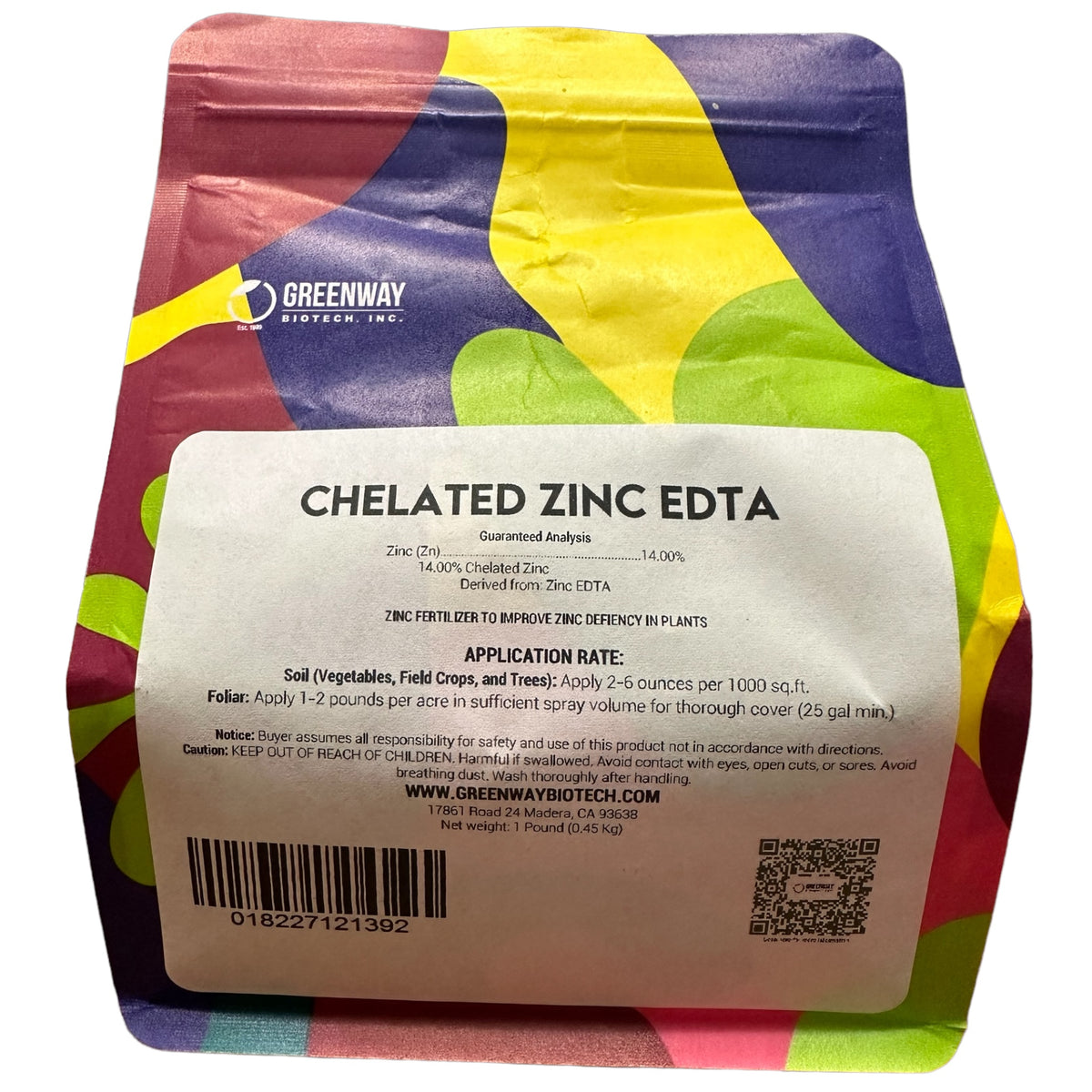
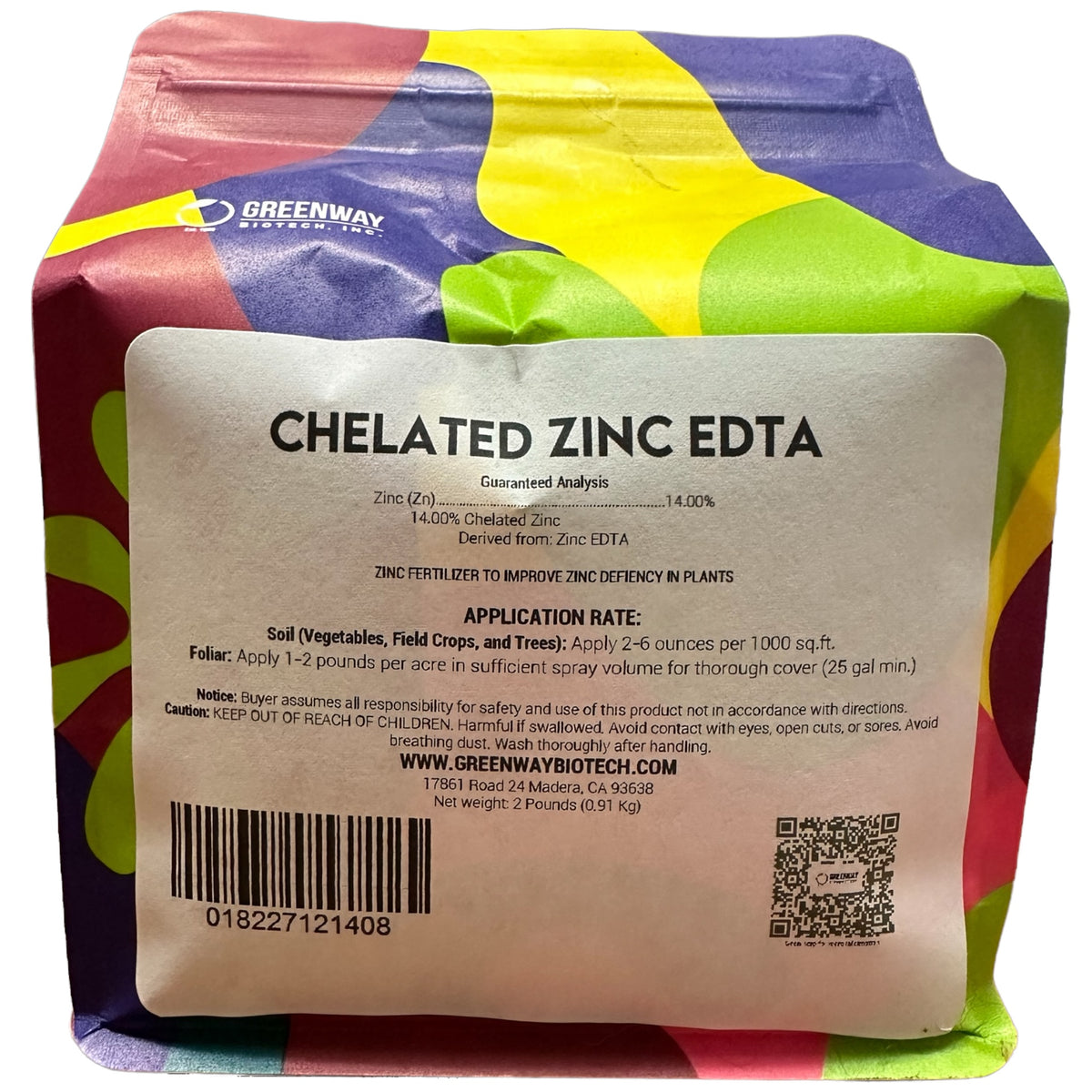
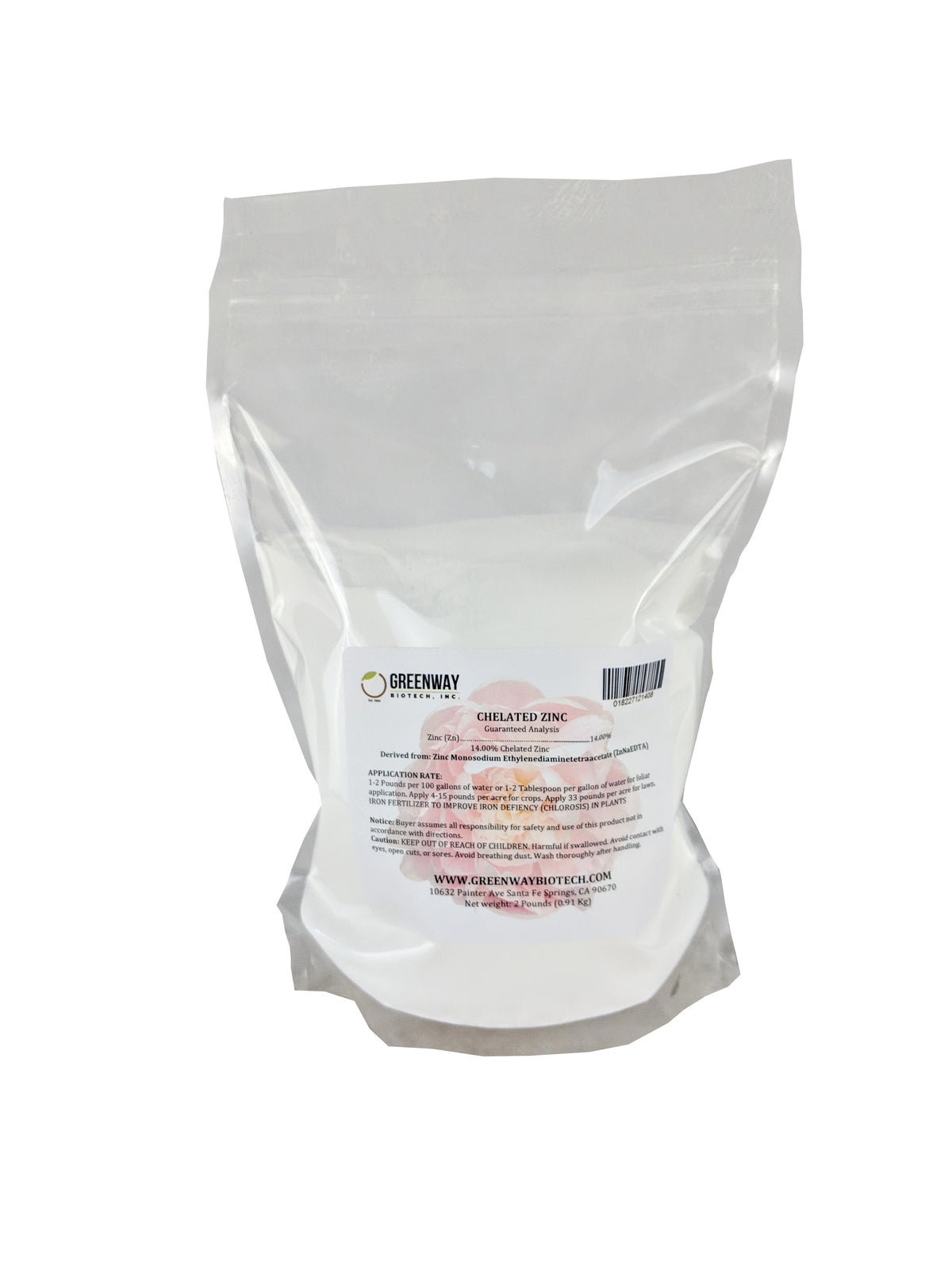
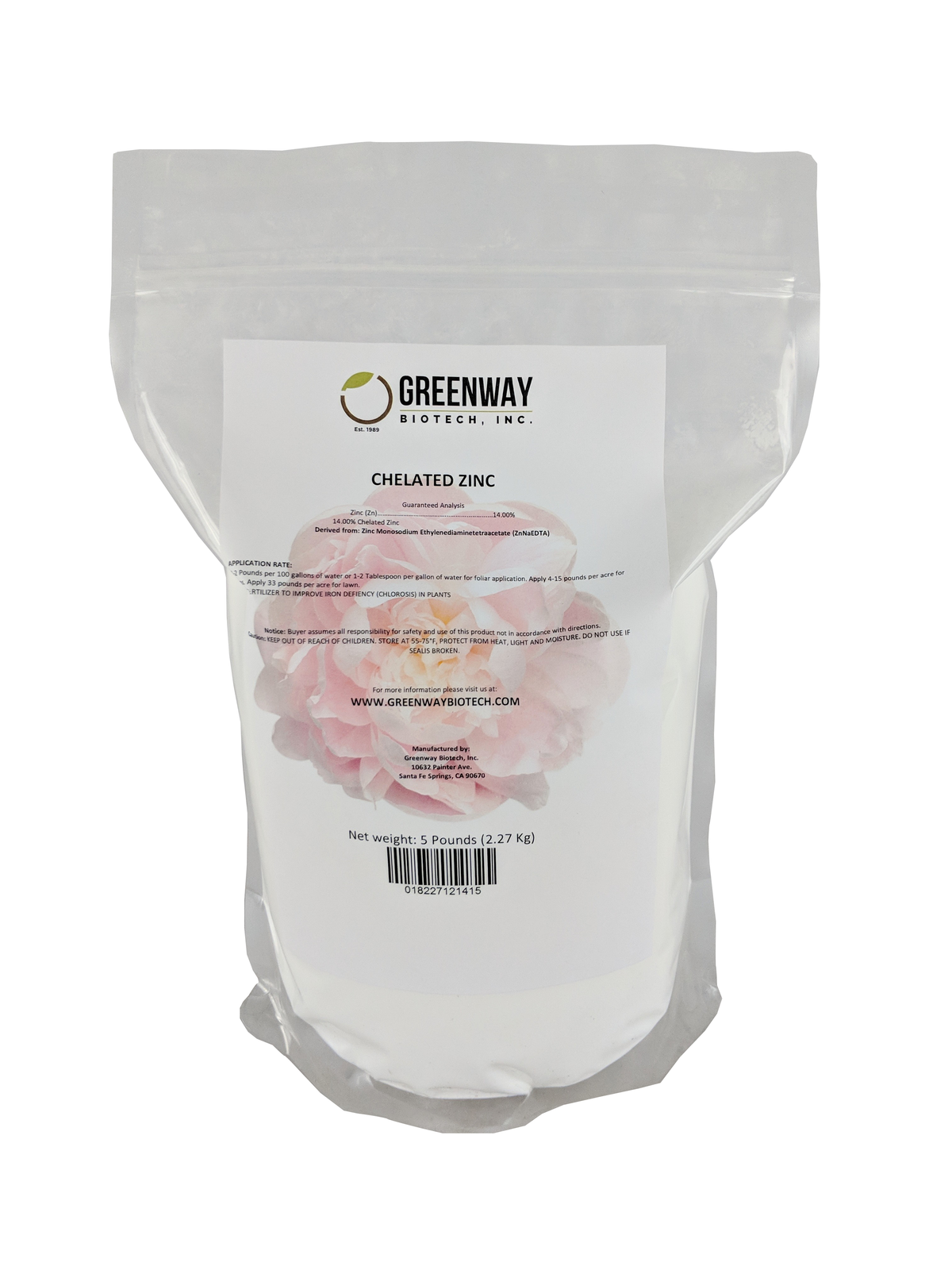
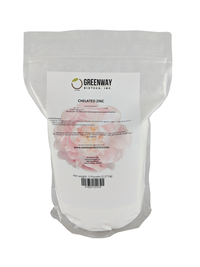
A professional-grade chelated zinc micronutrient for growers fighting zinc deficiency in alkaline and calcareous soils. The EDTA chelate keeps zinc plant-available through roughly pH 7.0 - well past the point where zinc sulfate locks up - so it works for soil, foliar, fertigation, and hydroponic feeding. CDFA registered and third-party lab tested for heavy metals.
Find your size → Calculate how much I need14%
Chelated zinc by weight, as a stable EDTA complex
7.0pH
Stays plant-available up to roughly pH 7.0
300+
Enzyme systems that depend on zinc as a cofactor
100%
Water soluble for drip, foliar, and hydroponic use
Because chelated zinc is used at low rates, a little goes a long way. Coverage figures below are planning estimates for a banded field-crop rate of roughly 5 lbs of product per acre; foliar, garden, and hydroponic use will stretch each bag much further. Confirm your own rate with a soil test.
| Bag Size | Banded Field Crop | Garden Beds (approx.) | Best For |
|---|---|---|---|
| 1 lb | Spot use / trials | ~4,500 sq ft | Home gardeners |
| 2 lb | Small banded plot | ~9,000 sq ft | Raised beds, trials |
| 5 lb | ~1 acre banded | Large gardens | Most popular |
| 10 lb | ~2 acres banded | Small orchards | Hobby farms |
| 25 lb | ~5 acres banded | Commercial blocks | Best value |
Chelated Zinc EDTA suits any system where zinc needs to stay dissolved and available - especially alkaline soils, high-pH irrigation water, and soilless culture. It is most useful where zinc sulfate has given disappointing results.
Corn is among the most zinc-responsive field crops. A low banded starter rate places zinc near developing roots during early growth stages when demand is highest.
Pecans, citrus, and stone fruit are prone to zinc deficiency on high-pH soils. Fertigated zinc EDTA can raise leaf zinc steadily over the season.
Useful for correcting zinc deficiency in beans, sweet corn, and other garden vegetables. Apply at or before planting and confirm need with a soil test first.
Fully water soluble and stable in solution. Always dose with the stock-solution method - the zinc requirement is very small and easy to overshoot.
When deficiency symptoms appear on new growth, a dilute foliar spray is the fastest way to get zinc into the plant. Keep rates well below soil rates.
This is where chelation earns its keep. On alkaline or calcareous ground where zinc sulfate ties up quickly, the EDTA chelate keeps zinc in solution.
Zinc is one of the most commonly deficient micronutrients in high-pH soils. The form you choose decides how much of it the plant actually gets.
The EDTA ligand wraps zinc in a stable ring structure that resists reaction with soil carbonates and phosphates. Zinc sulfate begins losing availability above roughly pH 5.5; chelated zinc EDTA remains plant-available up to about pH 7.0 - the range covering most agricultural soils. For high-pH alternatives in iron correction, see Chelated Iron DTPA 11%.
Dissolves completely for drip irrigation, foliar sprayers, fertigation, and hydroponic reservoirs - with no insoluble residue to clog lines or emitters. That solubility is what makes precise, low-rate dosing practical.
Because chelated zinc is not lost to soil fixation as readily as sulfate forms, lower rates can achieve the same correction - especially valuable in calcareous and high-pH soils. University research notes the availability of chelated zinc can be at least double that of zinc sulfate, though it typically costs more per pound.
Zinc is a required cofactor for hundreds of enzyme systems that govern protein synthesis, carbohydrate metabolism, and growth-hormone (auxin) regulation. Adequate zinc supports normal internode elongation and leaf expansion - which is why deficiency shows as stunted, clustered new growth.
Manufactured in Madera, California and registered with the California Department of Food and Agriculture. Every batch is tested for heavy metals, with results consistently well below required limits. Browse the full chelated micronutrient collection to build a complete program.
14% Zn
Zinc ethylenediaminetetraacetate (Zn-EDTA)
Zinc is an essential micronutrient: a structural and catalytic component of enzymes involved in protein synthesis, carbohydrate metabolism, and the production of auxin, the growth hormone that drives shoot elongation. Because zinc is immobile in the plant, it cannot move from old tissue to new - so deficiency always appears on the youngest growth first, as interveinal yellowing, small "little leaf," and shortened internodes that cluster leaves into a rosette.
The problem in most soils is not total zinc but available zinc. Above roughly pH 6.0, zinc availability falls sharply as zinc ions react with carbonates, phosphates, and hydroxides to form compounds roots cannot absorb. Zinc sulfate, an ionic salt, is exposed to those reactions directly. EDTA chelation changes that: the EDTA molecule binds the zinc ion at multiple points, forming a stable ring complex that shields it from soil reactions while still releasing it for root and leaf uptake.
The practical result is a wider working pH range. Where zinc sulfate is most effective in acidic to neutral soils, chelated zinc EDTA holds zinc available into the neutral-to-slightly-alkaline range common across the American West and any region with limestone-influenced or alkaline irrigation water. In hydroponics and fertigation, that same stability prevents zinc from dropping out of concentrated nutrient solutions.
For a deeper comparison of the two forms, see Sulfate vs. Chelated Fertilizers: Key Differences Explained, and for zinc's role in plant health, What's the Function of Zinc in Plants?
Nearly all research-based zinc recommendations are stated as actual (elemental) zinc per acre. Because this product is 14% zinc, convert with: product (lb) = actual Zn (lb) ÷ 0.14 - roughly 7.1 lbs of product per 1 lb of actual zinc. The calculator below does this for you.
Zinc is immobile in plants, so deficiency always shows on new growth first - apply when early symptoms appear for the fastest correction. The calculator turns research-based zinc rates into pounds of product for your situation.
Confirm the deficiency with a soil test. A response to zinc is likely when DTPA-extractable zinc is roughly 0.5 ppm or lower. Testing first avoids compounding existing zinc and wasting product.
For annual crops, band a low rate near the seed at planting. For perennials, apply to the root zone in early spring. When symptoms are already visible, a dilute foliar spray gives the fastest response.
Dissolve about 10 g of product in 1 litre of water to make a concentrated stock, then add that stock by the millilitre to your reservoir - roughly 36 mL per 1,000 litres reaches the 0.05 ppm baseline. Verify the final concentration with a ppm meter and keep zinc within the 0.05-0.13 ppm working range.
Water soil applications in thoroughly. Existing affected leaves will not recover - judge success by healthy new growth over the following two to four weeks.
Chelated zinc EDTA is not the only way to supply zinc - it is the right way for high-pH soils and soilless systems. For a full breakdown of the two families, see Sulfate vs. Chelated Fertilizers.
| Product | Nutrient | Effective pH Range | Best For | Notes |
|---|---|---|---|---|
| Chelated Zinc EDTA (this product) | 14% Zn | Up to ~7.0 | Alkaline soils, fertigation, hydroponics | Stays soluble where sulfate ties up; low rates; higher cost per lb |
| Zinc Sulfate 35.5% | 35.5% Zn, 16.5% S | ~4.5-6.5 | Acidic to neutral soils; sulfur supply | High zinc concentration, lower cost; locks up above pH 5.5-6.5 |
| Chelated Iron EDTA 13% | 13% Fe | ~4.0-7.0 | Iron chlorosis in moderate-pH soils | Iron deficiency often co-occurs with zinc deficiency in alkaline soil |
| Chelated Manganese EDTA | Mn as EDTA chelate | Up to ~7.0 | Manganese deficiency in calcareous soils | Manganese and zinc deficiencies frequently appear together |
| Chelated Copper EDTA 14% | 14% Cu | ~4.0-9.0 | Copper deficiency in sandy, organic soils | Completes a four-element chelated micronutrient program |
Chelated zinc EDTA is the practical choice for most high-pH situations, but it is not always the most economical option. Here is how to decide.
Zinc deficiency often appears alongside other micronutrient deficiencies, especially in high-pH soils. These chelated companions build a complete trace-element program.
Corrects interveinal chlorosis from iron deficiency, which frequently accompanies zinc deficiency in alkaline soils. EDTA-chelated for pH 4-7 stability.
ManganeseManganese and zinc deficiencies often co-occur in calcareous soils. Chelated manganese supports photosynthesis and nitrogen metabolism.
CopperCompletes a four-element trace program with chelated copper for enzyme activation and lignin synthesis in high-value crops.
Acidic-soil zincFor acidic soils below pH 5.5 where chelation is less necessary - high zinc concentration plus sulfur at a lower cost per pound.
Chelated Zinc EDTA is a concentrated micronutrient. Handle it with the same care you would give any fine-powder fertilizer.
If your question isn't here, contact our team at questions@greenwaybiotech.com.
Zinc deficiency always appears on new growth first because zinc is immobile in plants - it cannot move from older leaves to support emerging tissue. Common symptoms include interveinal chlorosis (yellowing between leaf veins on young leaves), small and narrow "little leaf" in trees, shortened internodes that cluster leaves into a rosette, bronze or necrotic spots (especially in beans), pale or white young leaves in corn, and delayed maturity with poor fruit or seed set. Deficiency is most common in soils above pH 7.0, sandy soils, high-phosphorus soils, and during cool, wet conditions. For more on zinc's role in the plant, see What's the Function of Zinc in Plants?
The two differ mainly in how they behave in soil. Zinc sulfate is inexpensive and effective in acidic to neutral soils, but above roughly pH 5.5 it begins reacting with phosphates and carbonates to form compounds that plants cannot absorb. Chelated zinc EDTA stays soluble and plant-available up to about pH 7.0, so it performs better in alkaline and calcareous soils, in fertigation, and in hydroponics. University research notes the availability of chelated zinc can be at least double that of zinc sulfate, though it typically costs more per pound. In acidic soils below pH 5.5, zinc sulfate is often sufficient and more economical. For a full comparison, see Sulfate vs. Chelated Fertilizers.
Research-based zinc rates are stated as actual (elemental) zinc per acre. Because this product is 14% zinc, convert with: product (lb) = actual Zn (lb) divided by 0.14. For a banded field-crop starter supplying 0.5 to 1 lb of actual zinc per acre, that works out to roughly 3.6 to 7.1 lbs of product per acre; a broadcast rate of 1 to 2 lb of actual zinc per acre is roughly 7.1 to 14.3 lbs of product. The calculator on this page does the conversion for you and recommends a bag size. Always confirm the underlying rate with a current soil test.
Yes - but always use the stock-solution method and never add the powder directly to a reservoir. The zinc requirement is extremely small - roughly 0.36 g of product per 1,000 litres of solution - so direct addition makes overdose nearly unavoidable. Dissolve about 10 g of product in 1 litre of water to make a concentrated stock, then add that stock by the millilitre to your reservoir (around 36 mL per 1,000 litres for the standard target) and verify the final concentration with a ppm meter. Aim for about 0.05 ppm zinc - the Hoagland research baseline - within a typical working range of 0.05 to 0.13 ppm. Maintain solution pH between 5.5 and 6.0, which supports both nutrient uptake and the stability of the EDTA chelate.
For annual crops, apply zinc at or before planting - banding a low rate near the seed row is the most efficient method. For perennial trees and vines, apply to the root zone in early spring before bud break. When deficiency symptoms are already visible, a dilute foliar spray gives the fastest response because zinc is absorbed directly through the leaves; soil applications take longer to reach deficient tissue. A single application generally lasts the growing season for annual crops, while perennials may benefit from annual applications.
Zinc is beneficial at the right levels but can be toxic at elevated concentrations, particularly in sensitive crops such as beans and in hydroponic systems. Always soil test before applying, follow the rates on this page, and remember that zinc is a heavy metal that accumulates in soil - apply only what a deficiency warrants. In hydroponics, keep zinc within the typical working range of 0.05 to 0.13 ppm and start near the 0.05 ppm baseline; research has observed toxicity in solution only at far higher concentrations, around 20 ppm, so accuracy matters in both directions. Leaf-tissue testing is the most accurate way to monitor plant zinc; the optimal range for most crops is roughly 20 to 60 ppm in leaf tissue. For broader context, see our guide to Essential Micronutrients.
Corn is among the most zinc-responsive field crops and often shows pale young leaves when deficient. Citrus, pecans, grapes, beans, rice, and sorghum are also commonly susceptible. Deficiency risk rises on sandy soils, soils above pH 7.0, recently limed or high-phosphorus soils, and in cold, wet conditions that slow root activity. Ground that has been graded or had its topsoil removed - common on new home sites - is also prone to zinc deficiency because surface zinc is lost in grading.
Foliar application delivers the fastest response, with improvement often visible in new growth within one to two weeks. Soil applications take longer - typically two to four weeks - but provide more sustained correction. Because zinc is immobile in the plant, existing affected leaves will not fully recover; judge success by the health of new growth. Results vary with soil temperature, moisture, application method, and the severity of the deficiency.
Chelated Zinc EDTA ships in 1, 2, 5, 10, and 25 lb sizes, with free shipping on orders over $100. Every order is backed by our 90-day money-back guarantee - if it isn't right for your soil, return the unused portion for a full refund.
Choose your size →