Organic Blood Meal Fertilizer 13-0-0
- Regular Price
- $ 19.99
- Sale Price
- $ 19.99
- Regular Price
- $ 19.99
Sold Out
- Unit Price
- per
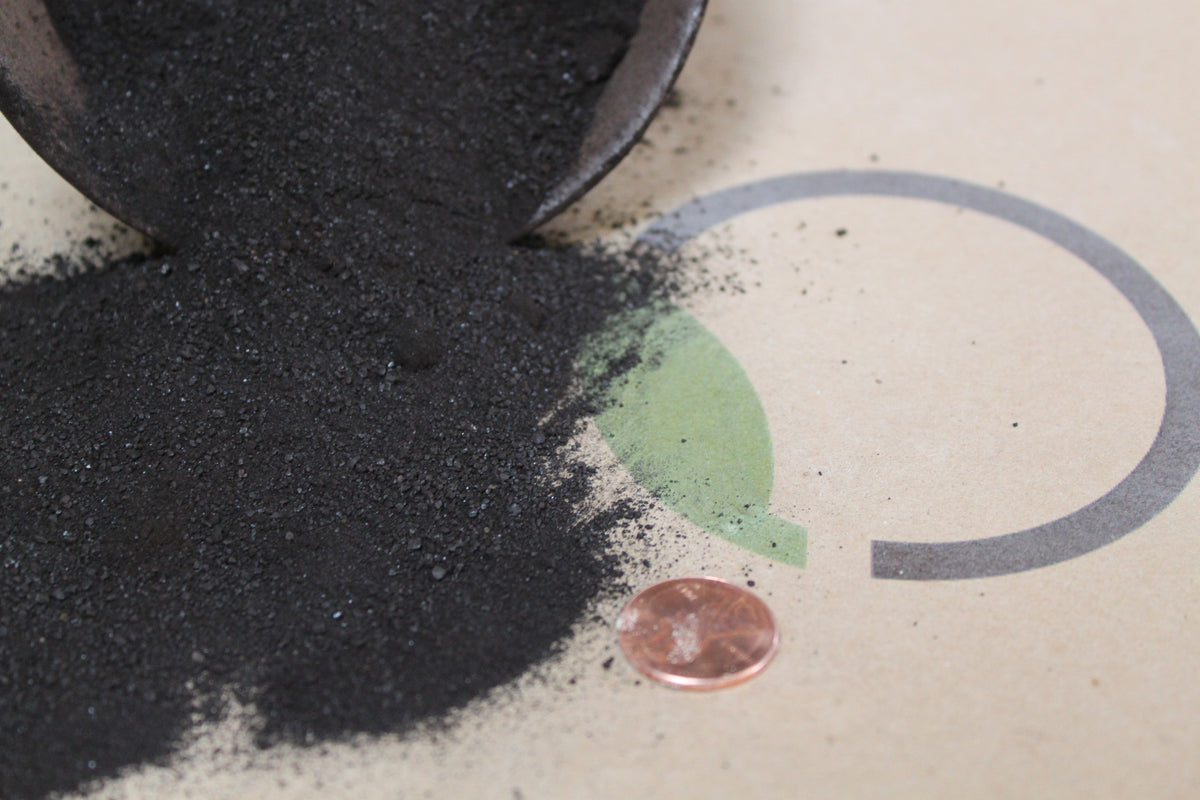




Dried bovine blood from USDA-inspected processing facilities, milled to a fine powder and lab-tested for heavy metals. At 13% nitrogen, it is one of the more concentrated organic nitrogen sources commonly used in gardens — with the fastest release profile of any organic meal. The 40 lb bag is repackaged from OMRI Listed® material.
Find your size → Calculate how much I need13%
Organic nitrogen by weight — among the highest in any organic meal
~60%
Plant-available N released in 4 weeks per OSU Extension lab incubations
1–3wks
Typical response window in warm, moist, biologically active soil
35+yrs
Family-owned California fertilizer manufacturer
Coverage shown at a new-bed prep rate of 1.5–2 lb per 100 sq ft (OSU Extension EC 1503). Maintenance broadcasting uses substantially less — see the Application Rates section below.
| Bag Size | New-Bed Prep Coverage | Lawn Coverage (1 lb N / 1,000 sq ft) | Best For |
|---|---|---|---|
| 2 lb | ~100 sq ft | ~260 sq ft | Single raised bed or container garden |
| 5 lb | ~250 sq ft | ~650 sq ft | Small vegetable garden |
| 10 lb | ~500 sq ft | ~1,300 sq ft | Most popular |
| 25 lb | ~1,250 sq ft | ~3,250 sq ft | Established gardens or small lawn |
| 40 lb (OMRI Listed® repack) | ~2,000 sq ft | ~5,200 sq ft | Best value · certified organic |
Blood meal is a targeted nitrogen amendment — it shines on crops with high N demand during vegetative growth, and it activates a carbon-heavy compost pile fast.
Lettuce, spinach, kale, chard, herbs. Nitrogen drives lush, dark-green foliage — the part you actually eat.
Heavy feeders in the vegetative stage. Side-dress at V6 for steady supply through tasseling.
Organic spring or fall feeding. Microbial release means lower burn risk than fast-release synthetics, but still water in promptly.
1–2 tsp per plant during leafy growth only. Stop nitrogen at first flower — switch to a phosphorus source like Bone Meal.
Carbon-heavy pile not heating? A small dose of blood meal jump-starts microbial decomposition. Keep starting C/N around 30:1; do not push below ~16:1.
1–2 tsp per gallon of potting mix at planting, then 1–2 tsp side-dress monthly during the growing season.
Most organic amendments release nitrogen slowly over months. Blood meal is the exception — mineralization is rapid and largely complete in warm, active soil.
At 13% N, blood meal delivers more usable nitrogen per pound than feather meal (12%), alfalfa meal (2.5%), or finished compost. That concentration matters when you need to correct a real nitrogen deficiency rather than gently feed an already-healthy bed.
Oregon State University Extension lab incubations of specialty organic fertilizers (8–14% total N, including blood meal) found that approximately 60% of total N released as plant-available N in 4 weeks at 72°F — thanks to a low C/N ratio and protein-rich substrate that soil bacteria mineralize rapidly. Most organic meals release a smaller fraction in the first growing season.
In warm, evenly moist soil (consistently above ~50°F), plants commonly begin responding within 1–3 weeks of application, with deeper-green new growth following over the next several weeks. Cold soil dramatically slows microbial release — for cold conditions, consider Ammonium Sulfate 21-0-0.
Just dried bovine blood, milled fine. No binders, no synthetic carriers, no blended micronutrients. Pair it with sources of phosphorus and potassium — Bone Meal 3-15-0 and Potassium Sulfate 0-0-53 — to build a complete program.
Suitable for use in certified organic production systems when applied according to label directions. Sourced from USDA-inspected meat processing facilities — an existing byproduct put to productive agricultural use.
Every batch is tested for heavy metal content with results consistently well below required limits for garden and food-crop use.
~80% crude protein
Hemoglobin-derived dry powder · ~13% N
Blood meal is concentrated animal protein. By dry weight, it is roughly 80% crude protein, with nitrogen locked in peptide bonds and amino acid side chains. Plants cannot absorb that nitrogen directly — it must first be mineralized into ammonium (NH4+) and then nitrate (NO3−) by soil bacteria.
What makes blood meal different from other organic meals is the speed of that mineralization. Its low carbon-to-nitrogen ratio (C/N around 3:1) and protein-rich substrate are exactly what soil bacteria need to multiply rapidly. Oregon State University Extension lab incubations of organic fertilizers (8–14% N, including blood meal) measured approximately 60% of total nitrogen released as plant-available N in 4 weeks at 72°F — faster and at a higher fraction than feather meal, alfalfa meal, or composted manure, and slower (but lower-burn-risk) than water-soluble synthetics like urea.
Practically, that means blood meal sits in a useful middle ground: organic and OMRI-listable (for the 40 lb repack), but fast enough to actually correct a nitrogen deficiency mid-season rather than just feed next year's soil. The trade-off is that release is temperature-driven — below ~50°F microbial activity drops sharply and blood meal essentially waits for spring.
For deeper coverage on nitrogen in plant nutrition, see What Is the Function of Nitrogen in Plants? and our comparison of organic vs synthetic nitrogen sources in Best Nitrogen Fertilizer.
Every rate below is traceable to a university extension service or peer-reviewed research. Soil-test results from your local cooperative extension are still the most reliable way to set a final rate for your specific site.
Quick answer: 1.5–2 lb per 100 sq ft incorporated into the top 2–3" of soil at new-bed prep, then 1–2 tsp per plant side-dressed monthly during active vegetative growth.
| Crop / Stage | Rate | Source | Notes |
|---|---|---|---|
| New bed preparation (any crop) | 1.5–2 lb per 100 sq ft | OSU Extension EC 1503 | Mix into top 2–3" of soil before planting |
| Transplant hole | 1 tsp per hole | OSU Extension EC 1503 (per-transplant guidance) | Mix into backfill; water in well |
| Side-dress established plants | 1–2 tsp per plant | OSU Extension EC 1503 | Monthly during vegetative growth |
| Leafy greens broadcast feed (lettuce, spinach, kale) | ~3⅓ lb per 1,000 sq ft | Colorado State University Extension CMG #717 | Equivalent to ~1 lb N per 1,000 sq ft for a 15-0-0 product; scale slightly higher (~4 lb) for 12–13% N material |
| Tomato / pepper vegetative phase | 1–2 tsp per plant | OSU Extension EC 1503 | Stop at first flower bud; switch to phosphorus source |
| Brassicas, corn (heavy N feeders) | Side-dress 1–2 tsp per plant at V6 / heading | OSU Extension EC 1503 (side-dress guidance) | Combine with new-bed prep rate above |
📋 Note: Vegetable garden nitrogen needs vary substantially by crop and soil organic matter. A soil test from your local cooperative extension is the most reliable way to set a final rate. The "new bed" rate is a one-time-per-season figure; the side-dress rates are for ongoing maintenance during vegetative growth.
Sources: Oregon State University Extension (EC 1503 — Fertilizing Your Garden: Vegetables, Fruits, and Ornamentals); Colorado State University Extension (CMG GardenNotes #717 — Fertilizers).
Quick answer: ~7.7 lb per 1,000 sq ft delivers 1 lb of actual nitrogen — the standard turf reference rate. Round to 7–8 lb. Always water in.
| Use | Rate | Source | Timing |
|---|---|---|---|
| Standard turf feed (1 lb N / 1,000 sq ft) | ~7–8 lb per 1,000 sq ft | Colorado State University Extension (scaled from 15-0-0 reference rate of 3⅓ lb) | Early spring or fall |
| Maintenance feed (~0.65 lb N / 1,000 sq ft) | ~5 lb per 1,000 sq ft | CSU Extension (reduced rate) | Mid-season top-up if needed |
| Poor / patchy lawn boost | Split application: 5 lb spring + 5 lb fall | CSU Extension (split-app guidance) | Spring + fall |
📋 Note: Standard lawn rate is 1 lb of actual N per 1,000 sq ft per application. At 13% N, that's ~7.7 lb of product. Excessive single applications can cause burn, particularly in summer or on dry soil — split heavy feedings between spring and fall, and always water in immediately. Do not apply to dormant or stressed turf.
Sources: Colorado State University Extension (CMG GardenNotes #717 — Fertilizers); Oregon State University Extension (EM 9691 — The ABCs of NPK fertilizer guide) for the 3 lb actual N per 1,000 sq ft general garden reference.
Quick answer: 1–2 tsp per gallon of potting mix at planting, then 1–2 tsp per pot side-dressed monthly during the growing season.
| Pot Size | At Planting (mixed into soil) | Side-Dress (monthly) | Source |
|---|---|---|---|
| 6-inch pot (~1 gal soil) | 1–2 tsp | 1 tsp | OSU Extension EC 1503 (per-transplant guidance, scaled) |
| 10-inch pot (~3 gal soil) | 3–6 tsp (1–2 tbsp) | 1–2 tsp | OSU Extension EC 1503 (per-transplant guidance, scaled) |
| 14+ inch pot / grow bag (~5+ gal soil) | 5–10 tsp (~⅓–⅔ cup) | 2–3 tsp | OSU Extension EC 1503 (per-transplant guidance, scaled) |
📋 Note: Container plants concentrate nutrients faster than in-ground beds — err lower on the at-planting dose and side-dress more frequently. Always lightly scratch blood meal into the top inch of mix and water thoroughly.
Source: Oregon State University Extension (EC 1503 — per-transplant / per-plant blood meal guidance, scaled by container volume).
Quick answer: Calculate from your crop's nitrogen target. At 13% N, you need roughly 7.7 lb of product per pound of actual N delivered.
| Use | Rate | Source | Notes |
|---|---|---|---|
| Broccoli (organic production trial) | ~885 lb product/acre to deliver 115 lb N/acre | UGA Research Farm SARE trial | Single-source N program; adjust for your soil test |
| General formula | (lb N target ÷ 0.13) = lb product needed | Standard fertilizer calculation | 0.13 = decimal form of 13% N |
| Light field application (top-dress) | 200–400 lb/acre | OSU Extension EM 9691 (3 lb N / 1,000 sq ft general garden rate scaled to acreage) | Delivers ~25–50 lb N/acre |
📋 Soil Test First: Field crop rates above are general reference figures based on typical organic production trials. Actual rates should be confirmed by a current soil test, your crop's documented N requirement, and consultation with your local cooperative extension service, as needs vary significantly by soil type, crop variety, and regional conditions.
Sources: University of Georgia Research Farm SARE on-farm blood meal trials; Oregon State University Extension (EM 9691 — The ABCs of NPK fertilizer guide); Colorado State University Extension fertilizer rate guidance.
Quick answer: 1–2 cups of blood meal per cubic yard of carbon-heavy material, mixed evenly. Aim for a starting C/N around 30:1.
| Compost Material | Blood Meal Rate | Target C/N | Source |
|---|---|---|---|
| Carbon-heavy pile (straw, sawdust, leaves) | 1–2 cups per cubic yard | ~30:1 starting | In-vessel composting study (low-blood-meal treatment, C/N 32) |
| Mixed kitchen + yard waste | ½ cup per cubic yard | ~30:1 starting | Practitioner reference rate |
| Maximum safe rate (avoid) | Do NOT push C/N below ~16:1 | >16:1 floor | In-vessel composting study reported ~84% loss of initial ammoniacal-N at high blood-meal rate (C/N 16) |
📋 Note: Blood meal is one of the most effective organic compost activators for carbon-heavy piles. Overloading the pile by pushing the starting C/N below ~16:1 causes large ammonia volatilization losses and produces less stable compost — so add it in measured amounts rather than dumping a full bag.
Source: Peer-reviewed in-vessel co-composting research evaluating blood meal at C/N 32 vs. 16; practitioner reference rates.
Blood meal works through soil microbes — surface application is wasteful and attracts wildlife. Always work it into the top 2–3" of soil and water thoroughly.
Use the calculator to the right. Enter your garden size, pot count, or lawn area; the calculator returns the exact amount of blood meal and recommends the right bag size.
Broadcast over the soil surface or place per-plant doses around the drip line. Keep blood meal away from direct stem contact to avoid concentrated ammonium near sensitive tissue.
Use a rake, hand cultivator, or chopstick (containers) to mix blood meal into the top layer of soil. Surface-applied blood meal is wasteful, attracts wildlife, and releases more slowly. This step also speeds microbial activation.
Soak the soil immediately after application to start microbial breakdown. Blood meal does not fully dissolve in water and is not suitable as a foliar spray — it can clog sprayers and provides no leaf-uptake benefit. Reapply per crop schedule, typically every 4–6 weeks during vegetative growth.
Blood meal sits between gentle organic meals and fast-release synthetics. For a broader head-to-head, see Best Nitrogen Fertilizer.
| Product | N % | Release Speed | Organic / OMRI | Best For | Notes |
|---|---|---|---|---|---|
| Blood Meal 13-0-0 (this product) | 13% | Fast for organic (1–3 wks) | Organic; 40 lb bag OMRI repack | Leafy greens, corn, lawn green-up, compost activator | Animal-origin; attracts pets & wildlife if surface-applied |
| Feather Meal 12-0-0 | 12% | Slow (3–4 mo) | Organic | Season-long steady N release | Keratin requires extensive microbial breakdown; lower burn risk |
| Alfalfa Meal 2.5-0-2.5 | 2.5% | Medium (4–8 wks) | Organic | Roses, perennials, gentle feeding, soil-building | Provides triacontanol growth stimulant + light K |
| Urea 46-0-0 | 46% | Very fast (days) | Synthetic; not OMRI | Maximum N per pound; large-area lawns & field crops | Higher burn risk; must be watered in immediately |
| Ammonium Sulfate 21-0-0 | 21% | Fast (days) | Synthetic; not OMRI | Cold soils, acid-loving plants (blueberries, azaleas) | Acidifying; supplies 24% sulfur |
Blood meal is a targeted nitrogen amendment with a specific best-fit profile. Honest about when something else is the better tool.
Pair blood meal with phosphorus, potassium, and pH amendments based on your soil test.
The classic pairing. Blood meal supplies N; bone meal supplies the available phosphate and calcium needed for roots, flowering, and fruit.
Potassium + SulfurRounds out the macronutrient program with chloride-free potassium plus sulfur. Compatible with blood meal in soil applications.
Gentler N + KA slower secondary N source plus potassium and triacontanol. Excellent for roses, perennials, and any bed where gentle sustained feeding is preferred.
pH + Ca + MgIf your soil tests acidic (below pH 6.0), nitrogen mineralization slows. Dolomite raises pH and supplies calcium and magnesium — verify with a soil test first.
Blood meal is a fine dry powder — treat it like any concentrated dry input. Animal-origin product; secure away from pets.
If your question isn't here, contact our team at questions@greenwaybiotech.com.
Blood meal is dried, powdered bovine blood — a byproduct of USDA-inspected meat processing facilities. The blood is collected, spray-dried or flash-dried at high temperature, and milled into a fine powder. The drying process kills pathogens and concentrates the protein, yielding approximately 13% nitrogen by weight. It has been used as an organic nitrogen source for centuries and remains one of the more concentrated organic amendments available to gardeners.
Blood meal's nitrogen is bound in protein chains. Soil bacteria must break down these proteins into amino acids and then into ammonium before plants can absorb them. In warm, moist, biologically active soil, nitrogen often begins becoming available within 1–3 weeks, with benefits commonly extending for several weeks after that. Lab incubation studies show that more than 80% of the applied nitrogen mineralizes within a single growing season under favorable conditions — a much higher fraction than feather meal or alfalfa meal. Release slows significantly in cold soil. For more on how nitrogen functions in plants, see the function of nitrogen in plants.
For tomatoes during the vegetative phase, 1–2 teaspoons per plant worked into the top layer of soil is a typical rate (OSU Extension EC 1503 per-plant guidance). Do not apply once flower buds appear — excess nitrogen at that stage can push leafy growth at the expense of fruit set. Once flowering begins, transition to a phosphorus-supportive fertilizer like Bone Meal 3-15-0.
Yes — the scent of blood meal can attract dogs, cats, raccoons, and other animals. To minimize this, work blood meal thoroughly into the top 2–3 inches of soil rather than leaving it on the surface, and water it in immediately after application. Once incorporated and moistened, the scent dissipates more quickly. Store unused product in a sealed container away from pets. If animal access is a persistent issue, consider Alfalfa Meal 2.5-0-2.5 as a lower-odor nitrogen alternative.
Blood meal works best on nitrogen-hungry crops: leafy greens, corn, brassicas, and herbs in their vegetative growth phase. It is not recommended for legumes (beans, peas), which fix their own nitrogen and rarely benefit from added N. For fruiting crops like tomatoes and peppers, use blood meal only during the vegetative phase — reduce or stop applications at the first sign of flower buds. Because blood meal is an animal-origin soil amendment, incorporate it into soil and avoid direct contact with harvestable plant parts for edible crops. For a broader overview, see Best Fertilizers for a Vegetable Garden.
Yes — blood meal is one of the most effective organic compost activators when you have a carbon-heavy pile that won't heat up. Add 1–2 cups per cubic yard mixed evenly into the pile, aiming for a starting C/N ratio around 30:1. Peer-reviewed in-vessel composting research shows that pushing the starting C/N below ~16:1 with too much blood meal causes large ammonia volatilization losses (up to 84% of initial ammoniacal-N) and produces less stable compost — so add it in measured amounts rather than dumping a full bag.
Blood meal is not a pH management product, but the ammonium-N it releases is mildly acidifying as it nitrifies in soil — similar to other ammonium-form nitrogen sources but at a much smaller scale. If your soil is already acidic (below pH 6.0), nitrogen mineralization can slow, and periodic soil testing helps catch any drift. For acidic soils, Dolomite Lime raises pH and supplies calcium and magnesium. For more on building healthy soil, see our Organic Gardener's Guide to Soil Preparation.
Blood meal is commonly used in certified organic production systems. The 40 lb bag is repackaged from OMRI Listed® material. For food gardens, incorporate it into soil, avoid direct contact with harvestable plant parts, and follow good produce-safety practices for animal-origin soil amendments. Allow it to be watered in thoroughly before harvesting leafy greens. For a broader look at how organic and synthetic fertilizers differ, see our organic vs. synthetic fertilizer comparison.
Blood meal is derived from animal blood, which is naturally very high in protein (and therefore nitrogen) but contains no significant phosphorus or potassium. This is the natural nutrient profile of the source material. Rather than a limitation, use blood meal as a targeted nitrogen amendment and pair it with Bone Meal 3-15-0 for phosphorus and Potassium Sulfate 0-0-53 for potassium when a complete program is needed.
No. Blood meal does not fully dissolve in water — it forms a suspension that will clog sprayers and provides no meaningful leaf-uptake benefit. The nitrogen is protein-bound and requires soil microbial breakdown to become plant-available. For soluble nitrogen options that work well as foliar feeds, see Calcium Nitrate 15.5-0-0 or Urea 46-0-0 (note: not certified organic). For chlorosis on young growth, Chelated Iron EDTA addresses iron deficiency directly via foliar application.
Often yes. Nitrogen is a mobile nutrient in plants, so when a plant runs short of N, it shifts existing nitrogen from older lower leaves to support new growth — producing the classic pattern of yellowing lower leaves with green growing tips. But yellowing has multiple potential causes — iron deficiency yellows new growth (not old), overwatering damages roots and limits all uptake, and pH lockout can mimic deficiency even when N is present. For a full diagnostic walkthrough, see 8 Reasons Why Your Plant Leaves Are Turning Yellow.
Available in 2, 5, 10, 25, and 40 lb bags — the 40 lb is repackaged from OMRI Listed® material. Free shipping on orders over $100. Backed by our 90-day money-back guarantee.
Choose your size →