Monopotassium Phosphate 0-52-34 (MKP)
Frequently Asked Questions
MKP 0-52-34 is a premium, technical-grade, 100% water-soluble fertilizer providing 52% phosphorus and 34% potassium with zero nitrogen. Perfect for bloom enhancement, fruit development, and quality improvement in soil, hydroponics, and fertigation systems.
💧 Hydroponics & Irrigation
Is MKP safe for hydroponics and drip irrigation?
Yes! Technical-grade MKP like Greenway Biotech's is 100% water soluble with zero residue or insoluble particles. It will not clog:
- Drip emitters and micro-sprinklers
- Spray nozzles and foggers
- Hydroponic pumps and tubing
- Aeroponic misters
How does MKP affect the pH of my reservoir?
MKP is mildly acidic with a pH of 4.2-4.9 in 1% solution. It will slightly lower your reservoir pH, acting as a gentle pH-down buffer.
Typical impact: 0.1-0.3 pH points per application, depending on:
- MKP concentration used
- Your water's natural buffering capacity (alkalinity)
- Other nutrients in solution
Why is Technical Grade MKP better than standard agricultural grade?
Technical Grade MKP undergoes higher purification standards than agricultural grade:
- 100% solubility – No residue or sediment
- Lower heavy metals – Meets stricter purity standards
- No insoluble particles – Won't clog precision equipment
- Consistent quality – Batch-to-batch reliability
This is critical for hydroponics, drip irrigation, and foliar spraying where any residue can cause expensive equipment failure or leaf spotting.
Greenway Biotech's MKP is technical grade with heavy metal analysis certificates available.
⚗️ Mixing & Dosage
How much MKP should I use per gallon? (Home Garden Rates)
| Application | Rate per Gallon | Notes |
|---|---|---|
| Regular feeding | ½ – 1 teaspoon | Every 2-4 weeks during growth |
| Bloom boosting | 1 – 2 teaspoons | During flowering/fruiting stage |
| Foliar spray | ½ teaspoon | Apply to leaves early AM or late PM |
| Seedlings/sensitive plants | ¼ teaspoon | Start low, increase gradually |
Conversion: 1 teaspoon MKP ≈ 5 grams
What is the salt index of Monopotassium Phosphate?
MKP has a salt index of approximately 8.4, which is one of the lowest among common fertilizers.
Why this matters:
- Safe for frequent applications without salt buildup
- Won't burn roots even in concentrated solutions
- Ideal for salt-sensitive crops
- Can be used in arid climates where salinity is a concern
| Fertilizer | Salt Index |
|---|---|
| MKP 0-52-34 | 8.4 ✓ Lowest |
| MAP 11-52-0 | 29.9 |
| Potassium Sulfate 0-0-53 | 46.1 |
| Ammonium Sulfate 21-0-0 | 69.0 |
| Potassium Chloride 0-0-62 | 116.3 |
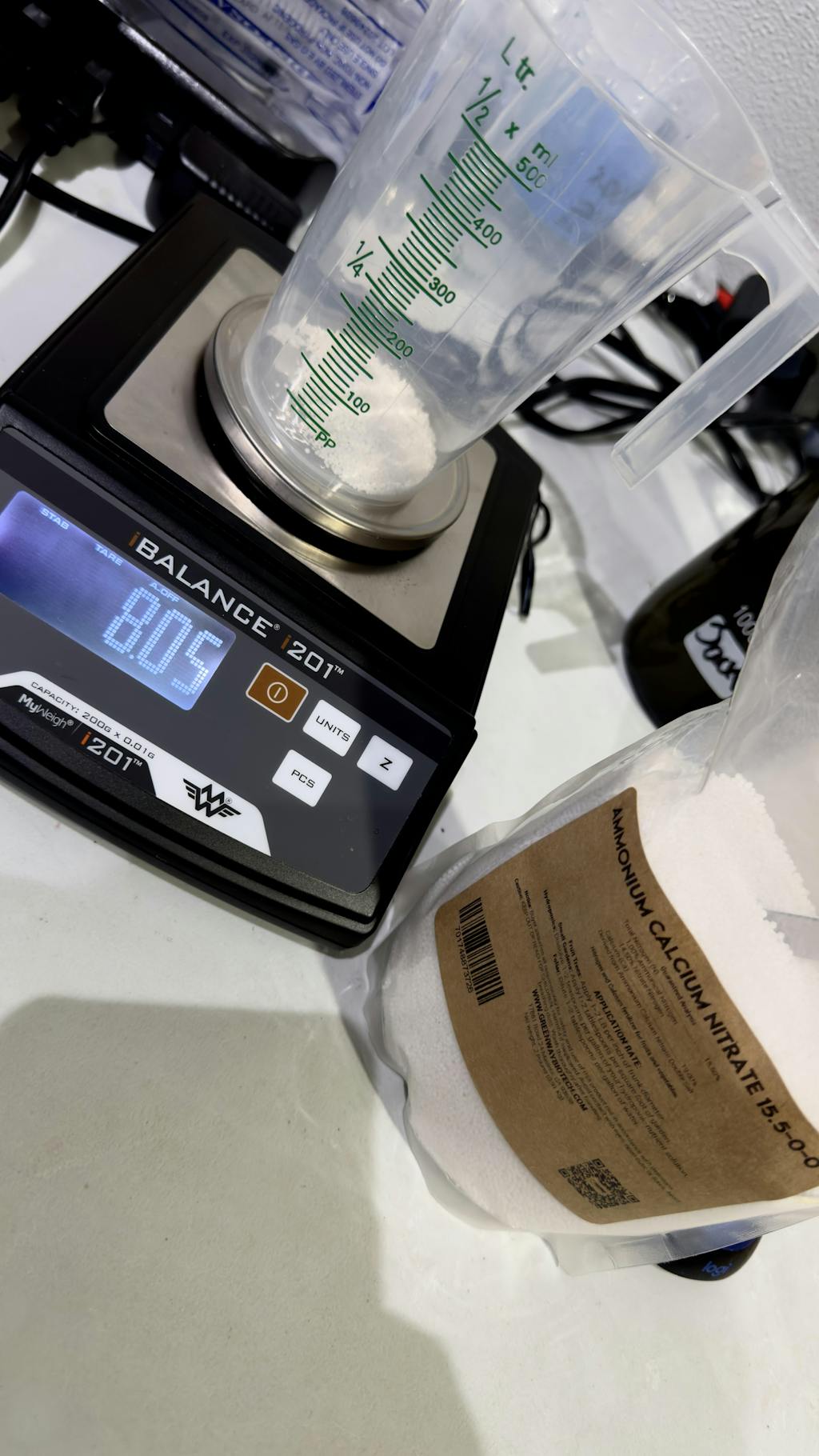
Can I mix MKP with Calcium Nitrate?
The solution: Use the A/B Tank Method
🅰️ Tank A
- ✓ Calcium Nitrate
- ✓ Iron chelate (Fe-DTPA)
- ✓ Other calcium products
🅱️ Tank B
- ✓ MKP (Monopotassium Phosphate)
- ✓ Magnesium Sulfate
- ✓ Potassium Sulfate
- ✓ Micronutrient blends
Both tanks feed into the irrigation line separately, mixing only in the dilute water stream where precipitation won't occur.
Can I add MKP to other liquid fertilizers or pesticides?
MKP is compatible with most water-soluble fertilizers and many pesticides.
✓ Generally compatible with:
- Most water-soluble NPK fertilizers (not calcium-based)
- Chelated micronutrients (iron, zinc, manganese)
- Magnesium sulfate (Epsom salt)
- Most insecticides and miticides
- Many fungicides (check label)
✗ Do NOT mix with:
- Calcium fertilizers (Calcium Nitrate, Calcium Chloride)
- Copper-based fungicides (Bordeaux mixture)
- High-pH products (lime, some biologicals)
🌸 Bloom Boosting & Specialty Crops
Can I use MKP as a bloom booster?
Yes! MKP is one of the most effective bloom boosters available. Here's why:
- Zero nitrogen – Won't trigger unwanted vegetative growth during flowering
- High phosphorus (52%) – Fuels flower and fruit development
- High potassium (34%) – Increases bud density, essential oil production, and sugar content
- 100% available – Immediately uptaken, no waiting for soil breakdown
MKP is widely used by growers of high-value specialty crops including flowering ornamentals, fruiting vegetables, medicinal herbs, and essential oil crops where bloom quality directly impacts value.
Can MKP help with powdery mildew?
Yes! MKP is an effective suppressor of powdery mildew in susceptible crops including:
- Grapes (wine & table)
- Cucumbers & melons
- Roses
- Mangoes
- Squash & zucchini
- Cannabis & hemp
How to use: A 1% MKP solution (2 teaspoons per quart) mixed with systemic fungicides improves efficiency and allows lower fungicide rates. The phosphorus and potassium boost plant immunity while providing direct fungal suppression.
What crops benefit most from MKP?
MKP delivers excellent results for any crop where bloom, fruit, or root quality matters:
- Tomatoes & peppers
- Cucumbers & squash
- Strawberries & berries
- Grapes (increases Brix)
- Citrus & stone fruits
- Apples & pears
- Roses & orchids
- Cannabis & hemp
- Potatoes & root crops
- Avocados & mangoes
- Adeniums & succulents
- Hibiscus & flowering shrubs
🌱 Choosing the Right Product
Should I use MKP or a sulfur-based product if my soil is deficient in potassium?
It depends on several factors:
- pH adjustment needed? Sulfur in Potassium Sulfate 0-0-53 will lower pH. MKP has minimal pH impact in soil.
- Need phosphorus too? If you don't need phosphorus, MKP may be more costly than necessary. Choose Potassium Sulfate for potassium only.
- Chloride-sensitive crops? Potassium Chloride 0-0-62 is economical but not suitable for chloride-sensitive plants like tobacco, strawberries, or potatoes.
What's the difference between MKP and MAP?
MKP (0-52-34) – No nitrogen, provides potassium. Ideal for late bloom and quality enhancement.
MAP (11-52-0) – Contains 11% nitrogen, no potassium. Better for early growth and root development.
• Use MKP when you need P-K without N (flowering/fruiting stages)
• Use MAP when you need P with some N (early growth, root establishment)
Related products:
MAP 12-61-0 (Water Soluble) MAP 11-52-0Is Monopotassium Phosphate the same as Ammonium Hydrogen Phosphate?
No, they are different products.
Monopotassium Phosphate (KH₂PO₄) provides potassium and phosphorus with zero nitrogen.
If you need ammoniacal nitrogen with phosphate, consider Monoammonium Phosphate (MAP):
MAP 12-61-0 (Water Soluble) MAP 11-52-0📅 Application & Timing
When should I use MKP in my growing program?
MKP timing is critical for maximum benefit:
- Flowering plants: Apply 1-2 weeks before bloom, during flowering, and post-bloom to support fruit/seed development
- Fruiting crops (tomatoes, peppers): Start at first flower cluster, repeat every 2-3 weeks through harvest
- Grapes: Apply pre-bloom, post-bloom, and 30 days before harvest to increase sugar content (Brix)
- Trees: Focus on pre-bloom and fruit development stages
How often should I apply Monopotassium Phosphate to my plants?
Application frequency depends on your growing system and plant stage:
- Soil (maintenance): Every 4-6 weeks during active growth
- Soil (bloom boost): Every 2-3 weeks during flowering/fruiting
- Hydroponics: Continuous feed as part of nutrient solution (adjust to target PPM)
- Foliar spray: 7+ days between applications to prevent leaf burn
Always base application rates on soil testing or target PPM for hydroponic systems.
How do I avoid leaf burn when using MKP as foliar spray?
Follow these guidelines to prevent foliar burn:
- Temperature: Stop spraying when temps reach 84°F (rising) or wait until below 90°F (falling)
- Timing: Apply early morning or late afternoon – never during hot midday sun
- Frequency: Maintain 7+ days between applications
- Plant health: Never apply to stressed, wilted, or drought-affected plants
- Dilution: Use ½ teaspoon per gallon maximum for foliar
- Coverage: Add a surfactant for better, more even coverage
Can I use MKP on grass/lawns?
Yes, but it's not ideal for lawns.
MKP is formulated for blooming plants and fruit development. For grass coming out of dormancy (like centipede grass), you'll get better results with high-nitrogen fertilizers:
Ammonium Sulfate 21-0-0 Urea 46-0-0MKP can be useful for lawns if soil tests show specific phosphorus/potassium deficiency, or to promote root development before winter dormancy.
Can I use Monopotassium Phosphate on Adeniums (Desert Rose)?
Yes! MKP is excellent for adeniums and other flowering succulents.
The high phosphorus promotes abundant blooming while potassium enhances flower color intensity and plant resilience. Use at reduced rates (50% of standard – about ¼ teaspoon per gallon) since succulents have lower nutrient requirements.
Apply every 2-3 weeks during the active growing/blooming season, typically spring through fall.
📊 Technical Information
How much Phosphate and Potassium are in MKP?
Guaranteed Analysis:
- Available Phosphate (P₂O₅): 52%
- Soluble Potash (K₂O): 34%
- Total Nitrogen (N): 0%
Elemental equivalents:
- Phosphorus (P): 22.7%
- Potassium (K): 28.2%
Chemical formula: KH₂PO₄ (Potassium Dihydrogen Phosphate)
Molecular weight: 136.09 g/mol
What is the solubility and pH of MKP?
Solubility: 208 g/L at 20°C (68°F) – highly water soluble
pH (1% solution): 4.2-4.9 (mildly acidic)
The excellent solubility makes MKP ideal for:
- Drip irrigation and fertigation systems
- Foliar spray applications
- Hydroponic nutrient solutions
- Dissolving in spray tanks without residue
Still Have Questions?
Our team is ready to help with product selection and application advice.
Call: (562) 351-5168
Email: questions@greenwaybiotech.com