Organic Elemental Sulfur Powder
- Regular Price
- $ 21.99
- Sale Price
- $ 21.99
- Regular Price
- $ 21.99
Sold Out
- Unit Price
- per
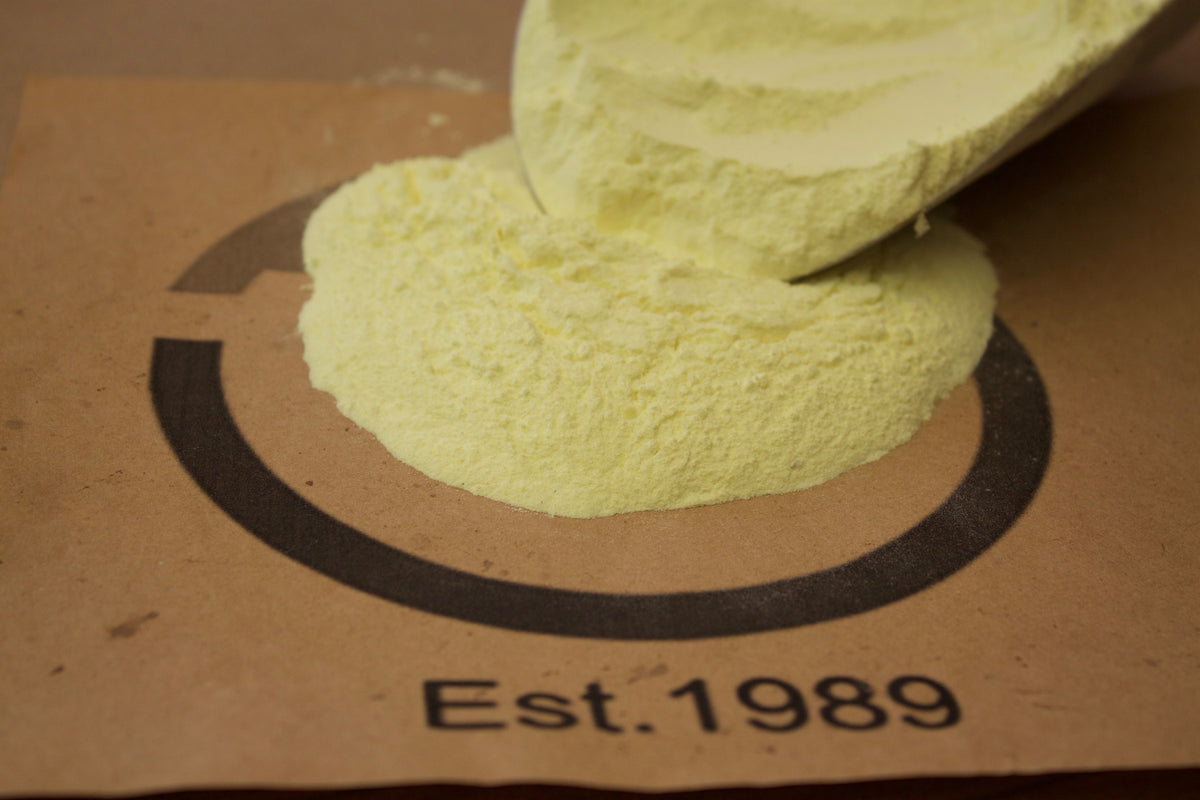
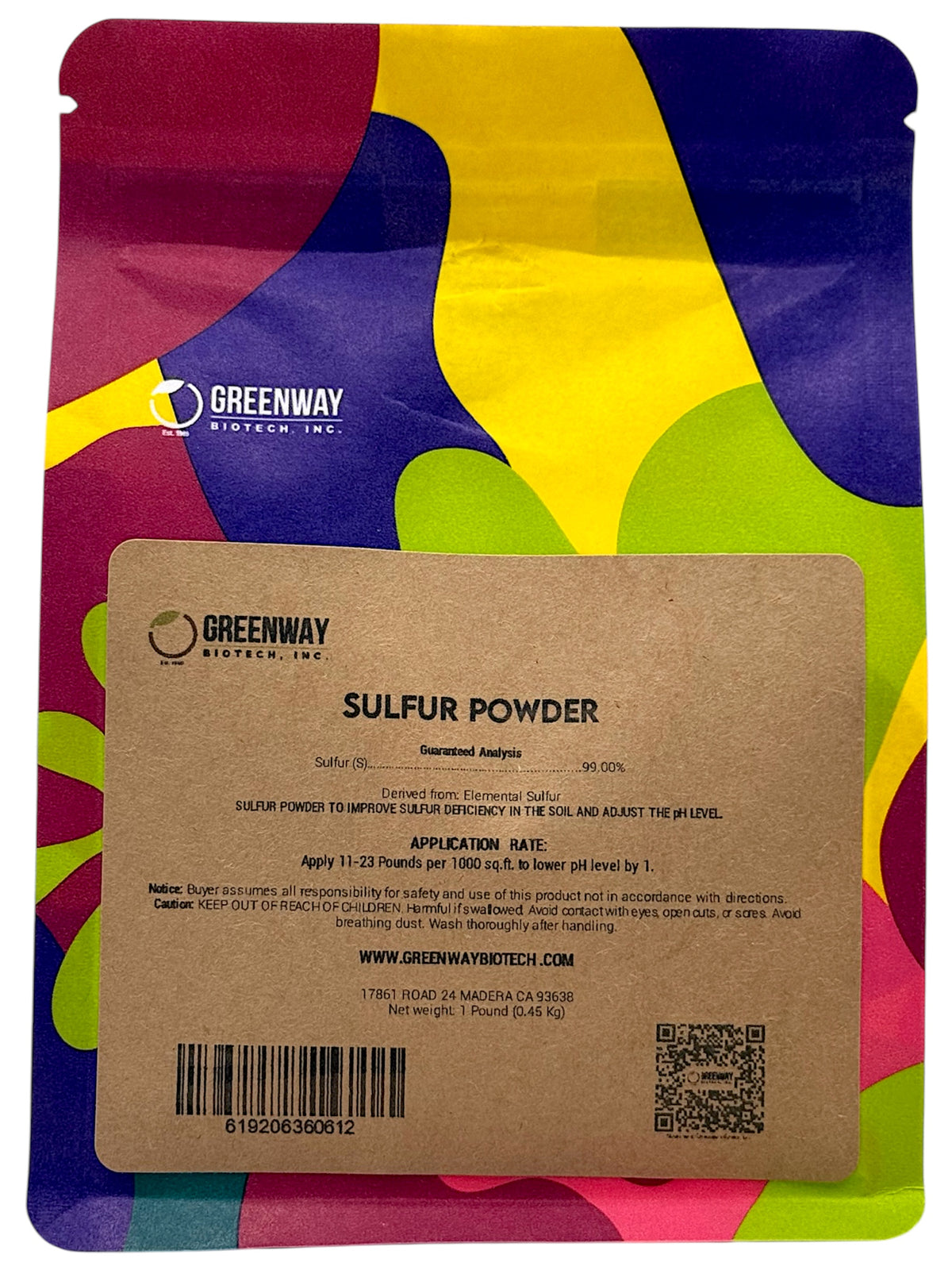
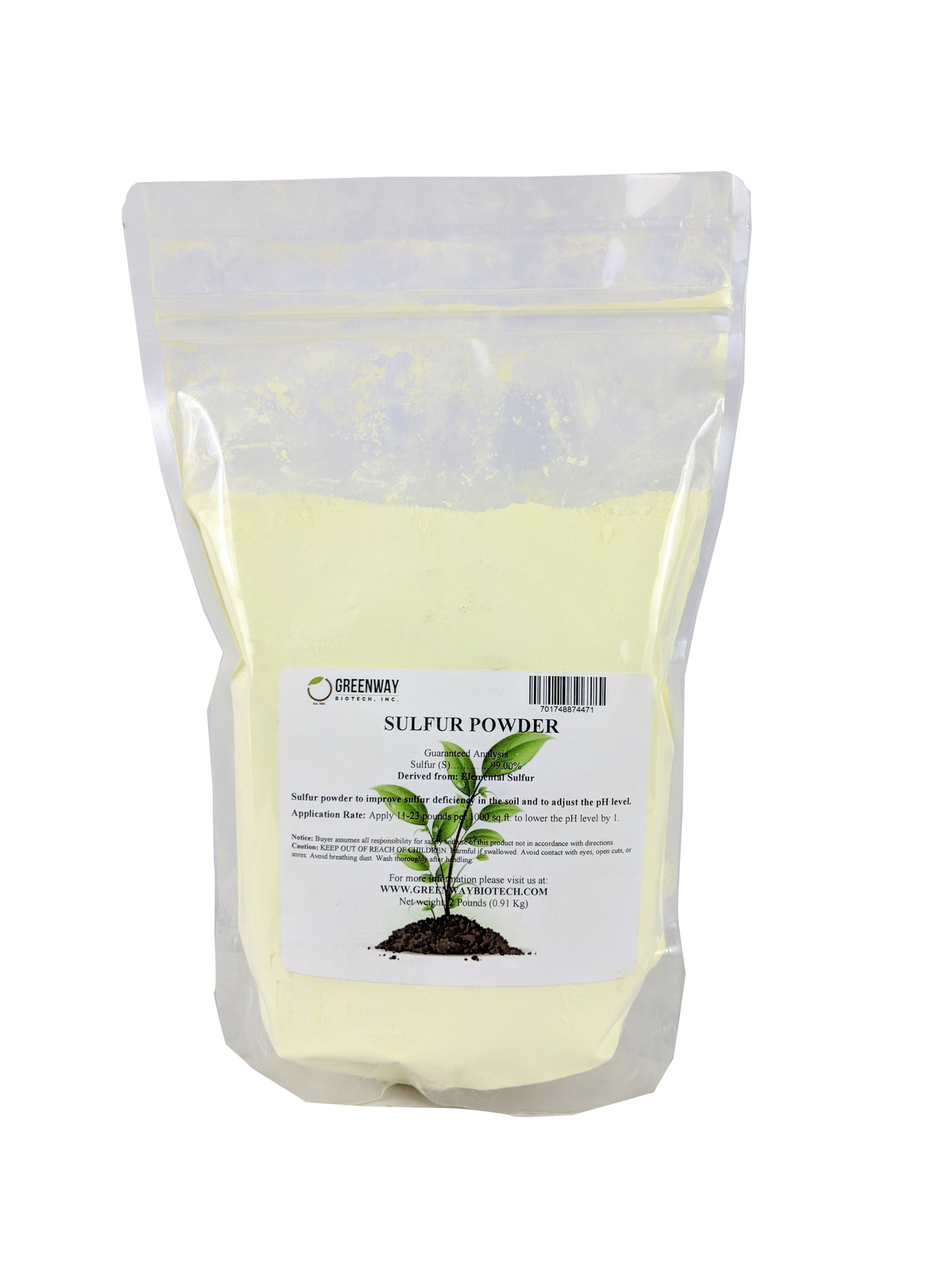
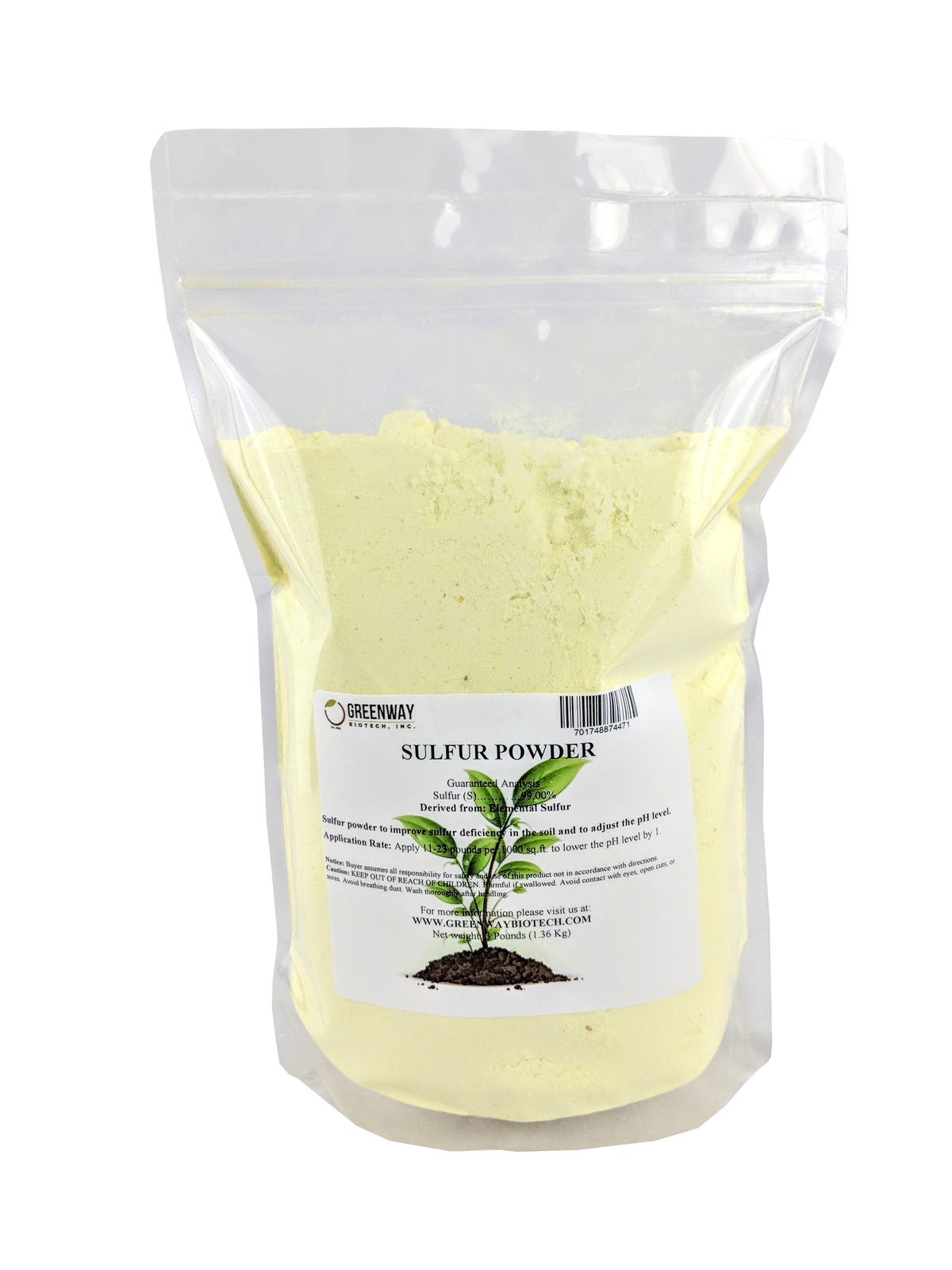
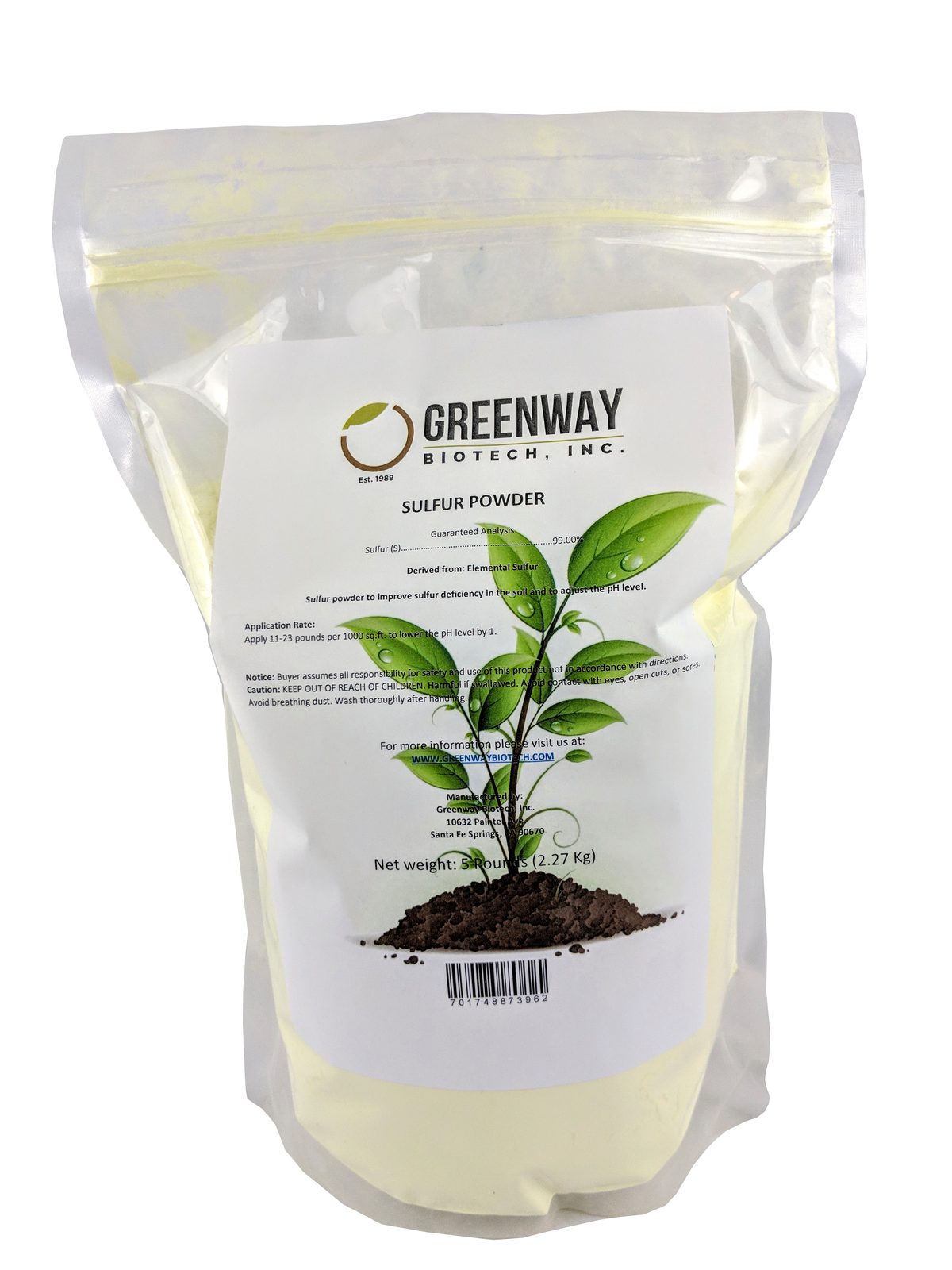
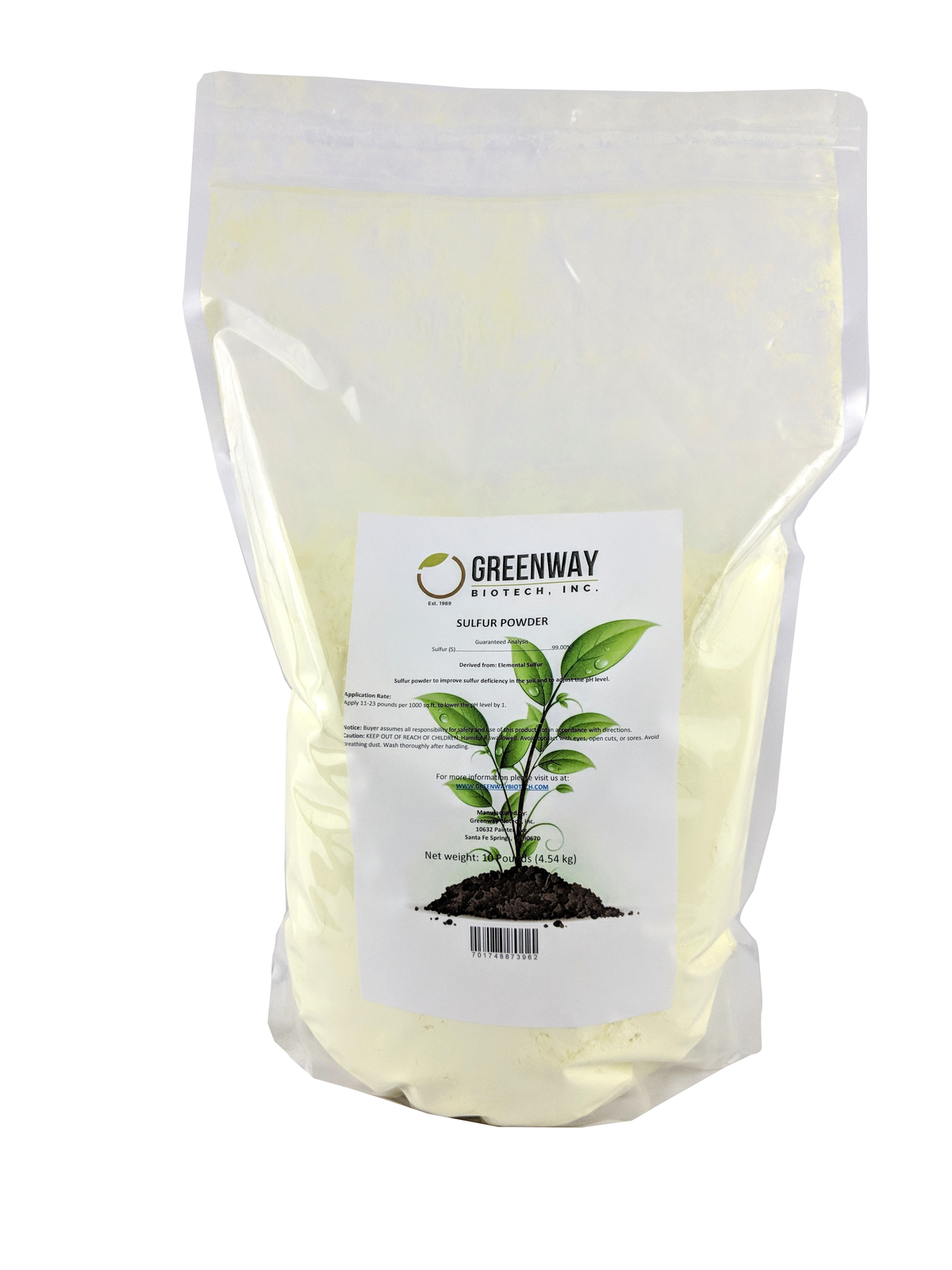
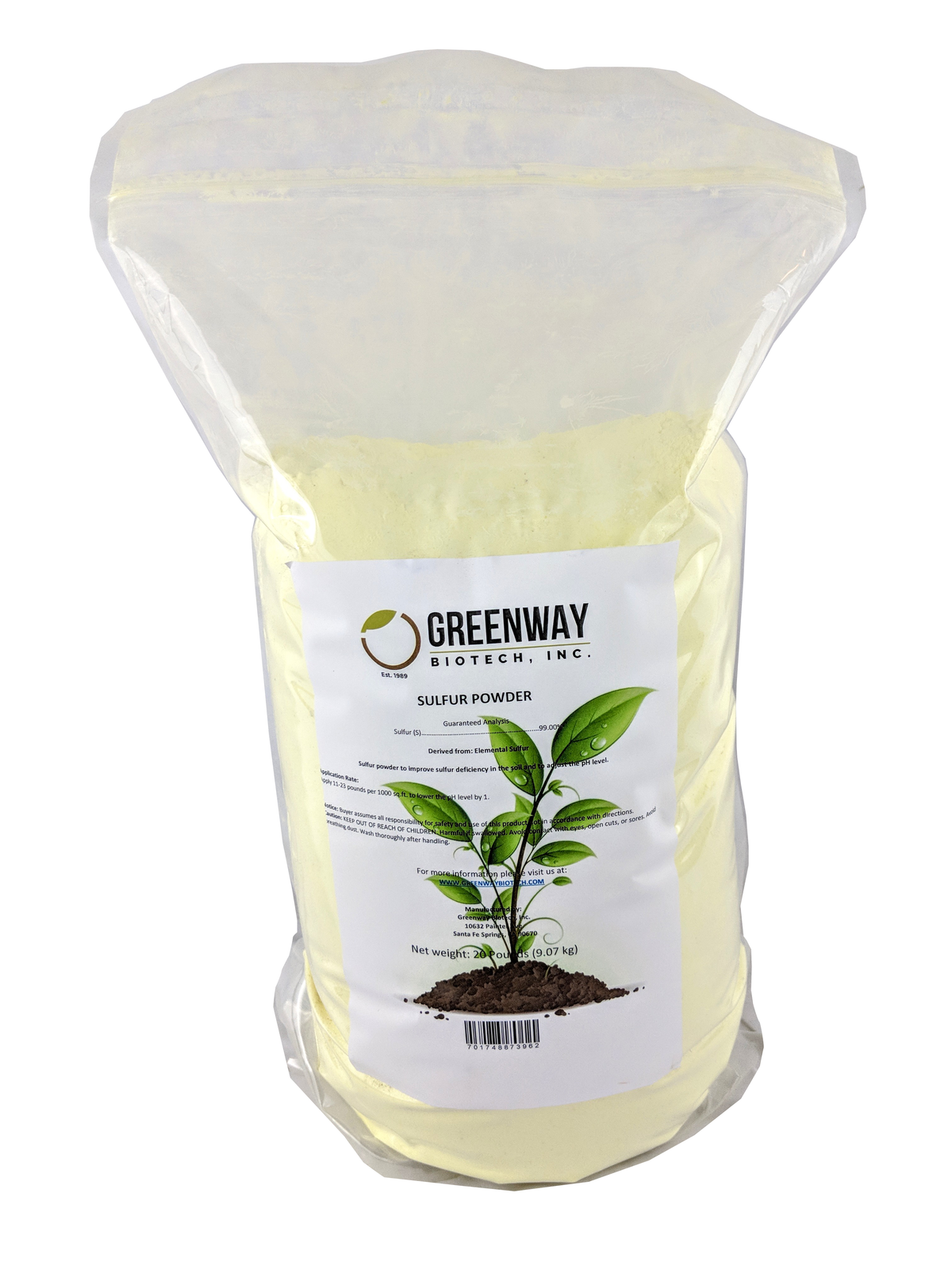
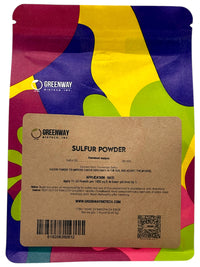
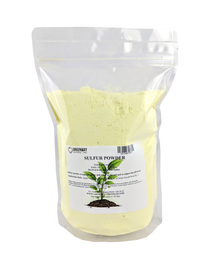
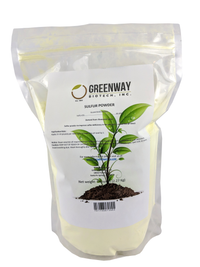
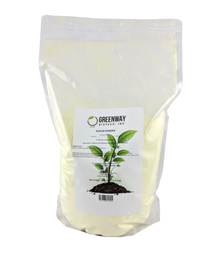
CDFA-registered, ≥98% pure elemental sulfur for lowering soil pH on acid-loving plants, supplying sulfur as a plant nutrient, and serving as a natural perimeter deterrent for snakes, chiggers, and other yard pests. Micronized for faster microbial conversion and independently lab tested for heavy metals.
Find your size → Calculate how much I need98%+
Elemental sulfur (S) by mass — CAS 7704-34-9
1pH unit
Achievable drop per application in most non-calcareous soils
4th
Most-needed plant nutrient after N, P, and K
35+yrs
Specialty fertilizer manufacturing in California
Coverage estimates below assume a 1-point pH drop on loam soil at approximately 6 lbs per 1,000 sq ft. Sandy soils need less; clay soils need more. Acid-loving plant beds and pest barriers may use higher rates — always check the calculator for your specific case.
| Bag Size | pH Correction (loam, 1 pt drop) | Blueberry Plants | Best For |
|---|---|---|---|
| 1 lb | ~165 sq ft | 2–4 plants | Trial size, small beds |
| 2 lb | ~330 sq ft | 4–8 plants | Container gardens |
| 3 lb | ~500 sq ft | 6–12 plants | Raised beds |
| 5 lb | ~830 sq ft | 10–20 plants | Most popular |
| 10 lb | ~1,650 sq ft | 20–40 plants | Backyard orchards |
| 20 lb | ~3,300 sq ft | 40–80 plants | Lawn acidification |
| 50 lb (2 × 25) | ~8,300 sq ft | 100+ plants | Best value |
Elemental sulfur wears three hats — soil acidifier, plant nutrient, and natural pest deterrent. Used at the right rate, all three can come from a single bag.
Lowers soil pH into the 4.5–5.5 range blueberries, cranberries, and lingonberries require. Plan 3–6 months ahead of planting for best results.
Maintains the slightly acidic pH (4.5–6.0) these ericaceous shrubs need for healthy iron uptake and chlorophyll production.
Acidifies soil to keep aluminum available, which is what shifts hydrangea blooms from pink toward blue. Apply in early spring.
Supplies sulfur for corn, canola, alfalfa, and small grains on sandy or low-organic-matter soils. Fall application allows time for microbial conversion.
Used for generations as a perimeter band around homes, gardens, and outdoor living areas. Many gardeners report fewer chiggers and ticks in treated yards.
Reduces alkalinity in soils above pH 7.0 where many turfgrasses struggle. Split heavy applications to avoid root injury.
The element that opens up acidic-soil gardening, fills a growing nutrient gap, and quietly handles yard pests — all in one bag.
Greenway Biotech sulfur is finely milled elemental sulfur (CAS 7704-34-9) at ≥98% active ingredient. The fine particle size gives soil bacteria more surface area to colonize, which can significantly improve the speed of conversion to plant-available sulfate compared with pelletized or granular grades.
After nitrogen, phosphorus, and potassium, sulfur is the next most-needed plant nutrient — required for protein synthesis, enzyme formation, and chlorophyll production. Atmospheric sulfur deposition has declined sharply over the past two decades, so deficiencies are now common where they were once rare. For background, see our article on the function of sulfur in plants.
Elemental sulfur isn’t directly acidic. Thiobacillus and related soil bacteria oxidize it into sulfuric acid, which then reacts with soil to lower pH and release sulfate (SO42−) — the form plants actually absorb. This is why results are gradual (2–6 months) and why warm, moist, well-aerated soil above 55°F is required for the process to run.
Because conversion is biological rather than chemical, the pH change happens gradually over weeks to months. That makes elemental sulfur safer for established plants than fast-acting acidifiers, and the corrected pH tends to persist longer than from quickly-soluble sources.
Registered with the California Department of Food and Agriculture as a fertilizing material, tested for heavy metals by independent labs (results consistently well below required limits), and packaged in our family-run Madera, California facility — the same one that’s been making specialty fertilizers since 1989.
55°F
The soil temperature threshold below which Thiobacillus activity slows sharply.
Plants don’t absorb elemental sulfur (S0) directly. The form they take up is sulfate (SO42−), and the conversion from one to the other is biological. Specifically, it’s carried out by chemoautotrophic soil bacteria — primarily Thiobacillus species — that oxidize sulfur for energy and release sulfuric acid as a byproduct. That sulfuric acid is what actually lowers soil pH, and the released sulfate is what feeds the plant.
Because the process is microbial, three soil conditions govern how quickly it runs: temperature above roughly 55°F, consistent moisture, and adequate aeration. Cold, waterlogged, or compacted soils slow the process to a crawl — which is why fall and early-spring applications in warm regions outperform mid-winter applications in cold ones. Particle size matters too: a finer powder gives bacteria more surface area to colonize, so conversion runs faster than with prilled or pelletized grades.
There is one important limitation. Calcareous soils — those containing free calcium carbonate (lime) — resist acidification because the lime continuously neutralizes the sulfuric acid being produced. On these soils, even very large sulfur applications may not durably move pH downward. A soil test that includes free-lime content tells you whether elemental sulfur is a realistic tool for your site or whether raised beds with imported mix are the better path.
For a broader treatment of how sulfur fits into a balanced fertility program, see our article on choosing the right sulfur fertilizer.
Rates below are compiled from university extension sources (Clemson, UF/IFAS, Purdue, NC State, OSU, Iowa State, University of Minnesota). For pH adjustment, always start with a soil test — particularly to confirm soils are non-calcareous before applying.
Quick answer: Approximately 4–8 lbs of elemental sulfur per 1,000 sq ft lowers pH by roughly 1 point — lower end for sandy soils, higher end for clay.
| Soil Texture | Rate (lbs / 1,000 sq ft) | Equivalent per Acre | Notes |
|---|---|---|---|
| Sandy | 3–5 lbs | ~130–220 lbs | Lowest buffering — fastest response, shorter persistence |
| Loam | 5–7 lbs | ~220–305 lbs | Most predictable response — best balance of speed and persistence |
| Clay / Clay-loam | 7–10+ lbs | ~305–435+ lbs | Highest buffering — slower response, longer-lasting |
Single-application ceiling: University extensions advise no more than 5–10 lbs of elemental sulfur per 1,000 sq ft (approximately 220–435 lbs per acre) in a single application. Split larger requirements over multiple applications 3–6 months apart to avoid root injury and protect soil biology.
📋 Calcareous soils: Soils with free calcium carbonate (commonly above pH 7.8 in arid regions) resist acidification because the lime continuously neutralizes the sulfuric acid being produced. Confirm free-lime status with a soil test before planning a sulfur program on alkaline soils — raised beds with imported mix may be a better path.
Quick answer: Approximately 0.5–1 cup of sulfur per established blueberry, azalea, or rhododendron, worked into the soil around the drip line in spring or fall.
| Plant | Target pH | Rate per Plant | Timing |
|---|---|---|---|
| Blueberries | 4.5–5.5 | ~½ cup, worked into root zone | Early spring — ideally 3–6 months before planting new beds |
| Azaleas & Rhododendrons | 4.5–6.0 | ~¼ cup around drip line | Spring and again in fall |
| Camellias | 5.5–6.5 | ~¼ cup around drip line | Spring |
| Hydrangeas (for blue blooms) | 5.0–5.5 | ~¼ cup, worked into soil | Early spring |
| Strawberries | 5.5–6.5 | 4–6 lbs per 1,000 sq ft pre-plant | Fall before spring planting |
For new blueberry plantings: Apply sulfur 3–6 months ahead of planting and re-test pH before transplanting. Working sulfur into alkaline soil at planting time often delivers transplant stress — the acidification needs time to happen first.
Quick answer: Typical rates range from 10–30 lbs of actual sulfur per acre, with sandy and low-organic-matter soils sitting at the higher end.
📋 Field & acreage rates: The per-acre figures below are general references for medium-testing soils at typical yield goals. Actual rates should be based on a current soil test, tissue test history, and local nutrient removal estimates. Consult your local extension service for site-specific recommendations.
| Crop | Actual S per Acre | Notes |
|---|---|---|
| Corn (fine-textured soils) | ~15 lbs | Iowa State; rates up to 25 lbs on coarse / sandy soils |
| Corn (sandy / low OM) | ~20–25 lbs | Purdue starting point; response above 25 lbs is rare |
| Soybean | 15–25 lbs | Responsive on sandy / low-OM sites |
| Wheat | 10–25 lbs | MSU: up to 25 lbs on responsive sites |
| Alfalfa (high-yield) | 10–25 lbs/yr | UMN: up to 25 lbs/yr in intensively managed stands |
| Canola (heavy soils) | 10–15 lbs | UMN; canola has higher S demand than small grains |
| Canola (sandy soils) | 20–30 lbs | UMN; KSU trials show ~13% yield gain at 30 lbs on deficient sites |
| Sugar beets, sorghum, sunflower | 15–25 lbs | UMN / SDSU on deficient soils |
Form matters in season: Elemental sulfur must oxidize to sulfate before plants can use it, so it’s best applied in fall or pre-plant. For in-season correction of confirmed deficiency, a sulfate-form source like Ammonium Sulfate 21-0-0 or Gypsum delivers plant-available sulfur immediately.
Quick answer: A continuous 2–3 inch wide perimeter band for snakes; broadcast at roughly 5 lbs per 1,000 sq ft for chiggers, fleas, and ticks. Reapply after rain.
| Target | Method | Rate | Frequency |
|---|---|---|---|
| Snakes | Continuous perimeter band | 2–3 inch wide band | Reapply after rain |
| Chiggers | Broadcast in yard / brush | ~5 lbs / 1,000 sq ft | Every 4–6 weeks in season |
| Fleas & Ticks (yard) | Broadcast across active areas | ~5 lbs / 1,000 sq ft | Every 4–6 weeks |
| Light garden dusting | Hand or duster on foliage | Light, even coat | As needed, not in heat |
Foliar safety check: Do not apply sulfur dust to foliage when temperatures exceed 85°F or within 14 days of a horticultural-oil spray — the combination can cause leaf burn. Sulfur-sensitive varieties (some apple cultivars, Concord and other Labrusca grapes, certain cucurbits and apricots) should be avoided entirely. Always test on a small area first.
Sulfur works on biology’s timeline, not yours — so the rhythm is always test soil first, apply at the right rate, then retest before deciding whether more is needed.
A home pH meter is fine for a starting read. For anything beyond a small garden bed, a lab soil test that reports both pH and free-lime content tells you whether elemental sulfur can realistically move pH on your site.
Use the calculator on the right (or the Application Rates section above). Sandy soils need less sulfur than clay; large pH drops should be split across multiple applications spaced 3–6 months apart.
Broadcast evenly with a spreader (or by hand for small beds), work into the top 6 inches of soil, then water thoroughly. Moisture and contact with the soil microbial population are what start the conversion.
Most of the pH change happens between weeks 4 and 12. Retest before deciding to apply more. Stacking applications too closely together can drop pH below your target and damage roots.
Sulfur fertilizers are not interchangeable. Elemental sulfur is the only form that durably lowers pH; sulfate forms are immediately plant-available but neutral. Pick the one that matches your goal.
| Product | Acidifies Soil? | Plant-Available? | Best For | Notes |
|---|---|---|---|---|
| Elemental Sulfur Powder (this product) | Yes — gradually | After microbial oxidation | Long-term pH reduction; sulfur nutrition on warm soils | Requires >55°F, moisture, aerobic soil |
| Ammonium Sulfate 21-0-0 | Yes — quickly | Immediate (sulfate + ammonium-N) | In-season N + S correction with acidifying effect | Provides 24% S plus 21% N |
| Gypsum (Calcium Sulfate) | No — pH neutral | Immediate (sulfate) | Sulfur + calcium without changing pH | Improves clay soil structure |
| Epsom Salt (Magnesium Sulfate) | No — pH neutral | Immediate (sulfate) | Sulfur + magnesium correction | Highly water-soluble; foliar or drench |
| Ferrous Sulfate | Yes — mildly, fast | Immediate (sulfate + iron) | Iron chlorosis correction with mild acidification | Less persistent pH effect than elemental S |
A few minutes deciding now saves months of waiting for an application to do something it was never going to do.
Acid-loving plants benefit from more than just lowered pH — iron availability, balanced macronutrients, and steady sulfur nutrition all matter.
Adds iron and a fast-acting acidifying sulfate. Excellent companion for blueberries, azaleas, and any acid-lover showing iron chlorosis.
Nitrogen + Sulfur21% N plus 24% S, with an acidifying effect from the ammonium ion. Two benefits in one source.
NPK for BerriesComplete nutrition for strawberries and other acid-tolerant fruiting plants. Pairs naturally with a sulfur-corrected pH.
Calcium + SulfurAdds calcium and sulfur without changing soil pH. Improves clay structure and drainage — useful background for any soil program.
Sulfur powder is a low-toxicity natural element, but it’s a flammable solid and a fine dust — basic precautions matter.
If your question isn’t here, contact our team at questions@greenwaybiotech.com or see the full Organic Elemental Sulfur FAQ page.
Most of the pH change happens between weeks 4 and 12 after application, with full effects typically visible by 3–6 months. The speed depends on soil temperature (above 55°F is required for active microbial conversion), moisture, particle size (finer is faster), and the soil’s microbial population. Spring or fall applications in warm regions outperform mid-winter applications.
The rate depends on soil texture: sandy soils need approximately 3–5 lbs per 1,000 sq ft, loam soils 5–7 lbs, and clay soils 7–10+ lbs per 1,000 sq ft to drop pH by 1 point. These figures come from Clemson, UF/IFAS, and Purdue extension publications. Use our calculator above for an exact amount based on your specific situation.
Generally not as a practical solution. Soils with free calcium carbonate (commonly above pH 7.8 in arid Western regions) resist acidification because the lime continuously neutralizes the sulfuric acid being produced. Research trials have shown that even 8,000–16,000 lbs per acre may not durably move pH on heavily calcareous soils. For these sites, raised beds with imported acidic mix are usually the more realistic path.
No. Sulfur lowers pH, lime raises it — applying them together (or within the same season) cancels their effects and wastes product. Always start with a soil test, decide which direction you need to move pH, and pick one tool.
Elemental sulfur applied to soil at recommended rates is safe for most plants. Two situations cause problems: applying excessive amounts (above 10 lbs per 1,000 sq ft in a single application) can drop pH too far and injure roots; and dusting sulfur directly on foliage in temperatures above 85°F or within 14 days of an oil spray can cause leaf burn. Some plant varieties are sulfur-sensitive — including certain apples, Concord and other Labrusca grapes, and some cucurbits — and should not be foliar-treated at all.
When used as directed, elemental sulfur has lower acute toxicity than many synthetic alternatives (oral LD50 in rats > 5,000 mg/kg). Keep pets away during application to prevent dust inhalation, water thoroughly after applying to settle the powder, and store in a secure location. Refer to the SDS for complete handling and toxicology information.
Pure elemental sulfur has a faint, mild sulfur odor — not the strong “rotten egg” smell of hydrogen sulfide (H2S). The odor dissipates quickly once the powder is worked into soil and watered in. If you ever notice a strong hydrogen-sulfide smell after application, that signals waterlogged anaerobic conditions — improve drainage before reapplying.
Sulfur powder has been used for generations as a natural deterrent, and many homeowners report fewer encounters when a continuous 2–3 inch wide barrier is laid around homes, gardens, and outdoor living areas. It is not a guaranteed exclusion, and it requires reapplication after rain. For yard-wide chigger, flea, and tick management, a broadcast rate of roughly 5 lbs per 1,000 sq ft is typical — reapply every 4–6 weeks during pest season. For more, see our guide on how to use organic sulfur powder.
This is high-purity elemental sulfur (≥98%) registered with the California Department of Food and Agriculture as a fertilizing material and tested for heavy metals by independent labs. Elemental sulfur is allowed under most organic programs as a soil amendment and as a fungicide / miticide, but certification programs differ — if your operation requires an OMRI-Listed input, verify the current status of the SKU you’re ordering with your certifier before applying.
No. This product is agricultural-grade elemental sulfur for soil and pest applications — not for human consumption. If you’re looking for a sulfur supplement, see our pharmaceutical-grade MSM Powder, which is OptiMSM®, third-party tested, and GRAS-designated for the specified food uses.
From a 1 lb trial bag to 50 lb commercial quantities, every order ships from our Madera, California facility. Free shipping on orders over $100, and a 90-day money-back guarantee on every product we make.
Choose your size →