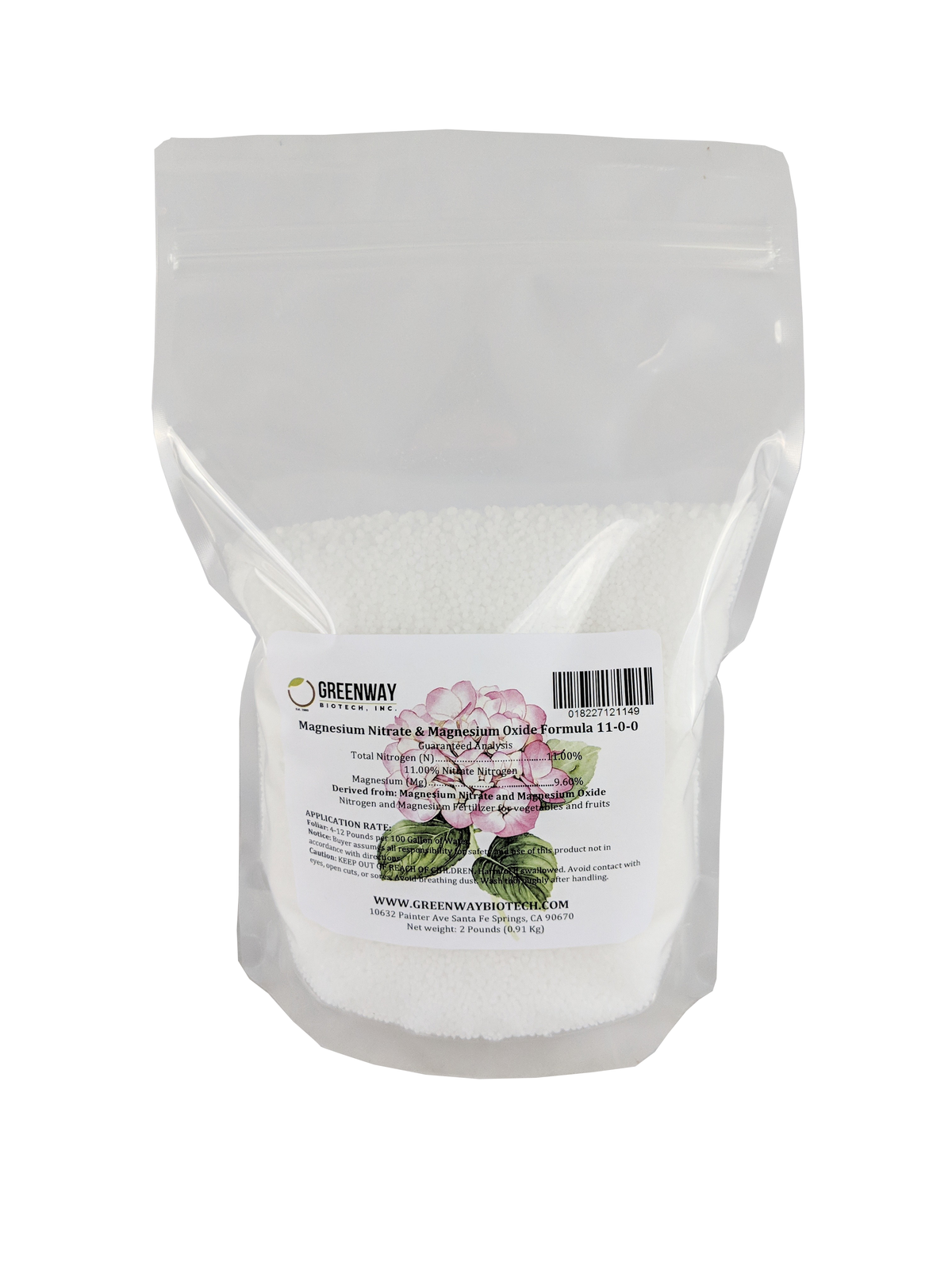
Magnesium Nitrate Fertilizer 11-0-0 with 9.6% Magnesium
- Regular Price
- $ 26.99
- Sale Price
- $ 26.99
- Regular Price
- $ 22.99
Sold Out
- Unit Price
- per
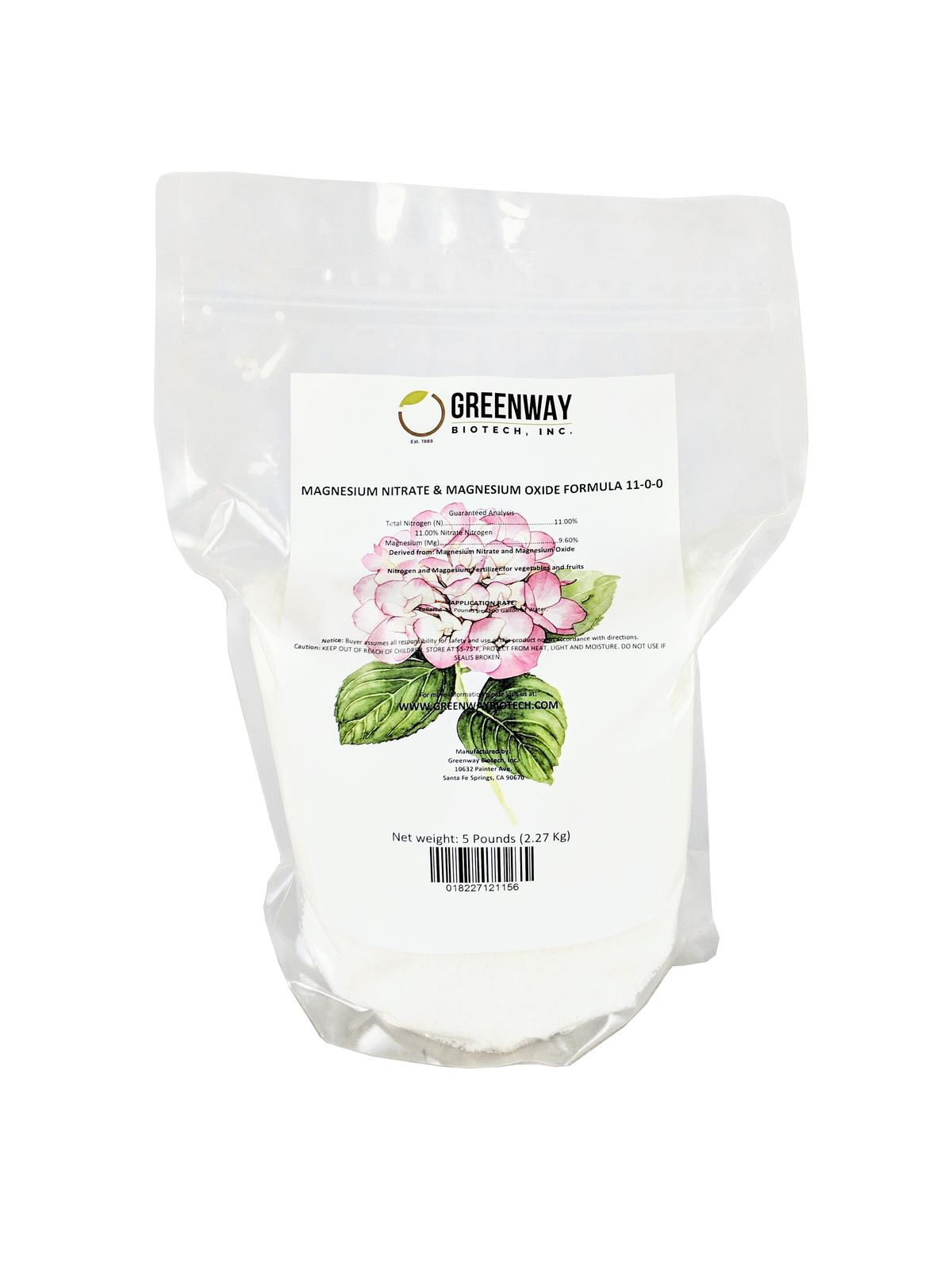
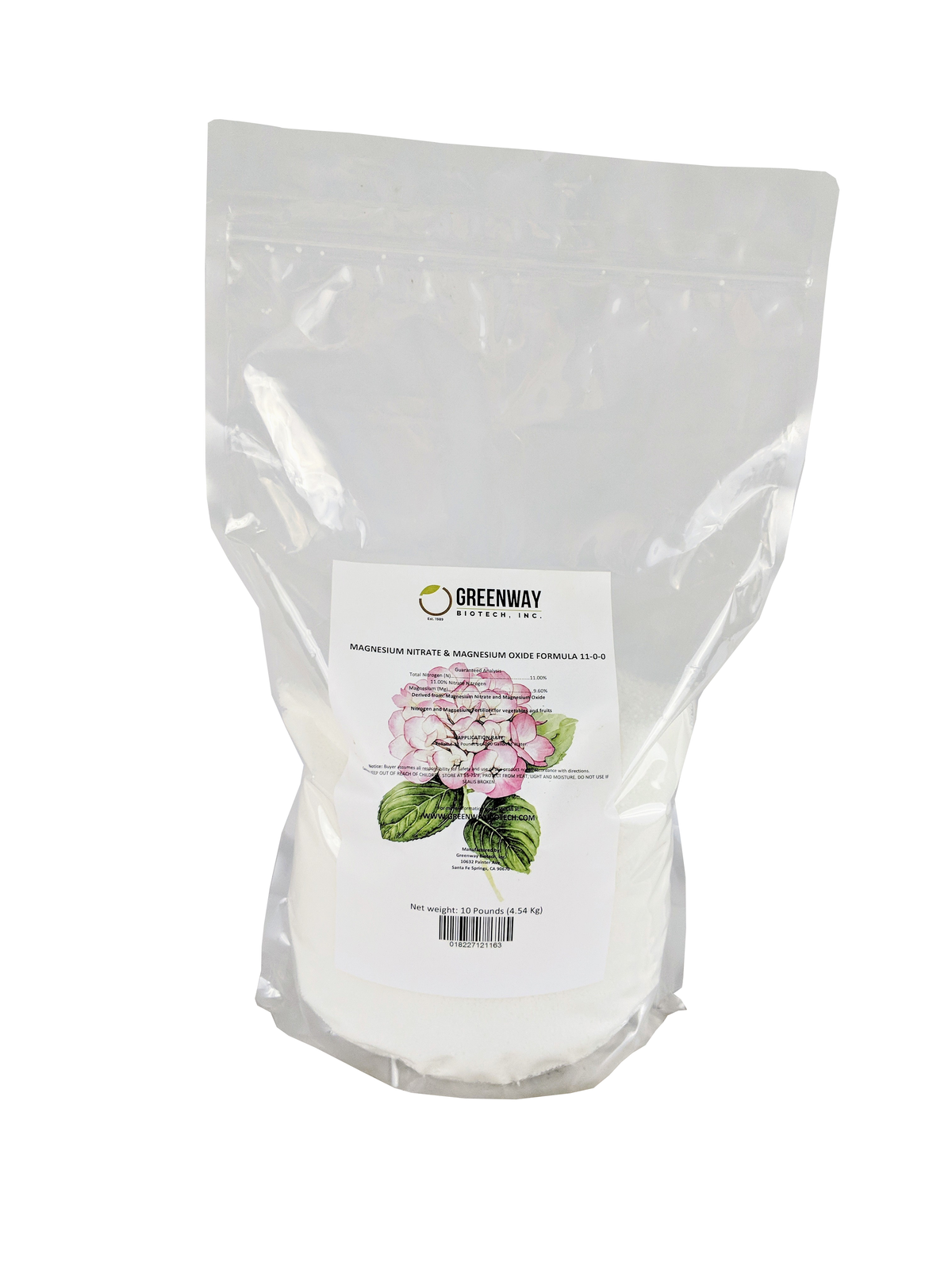
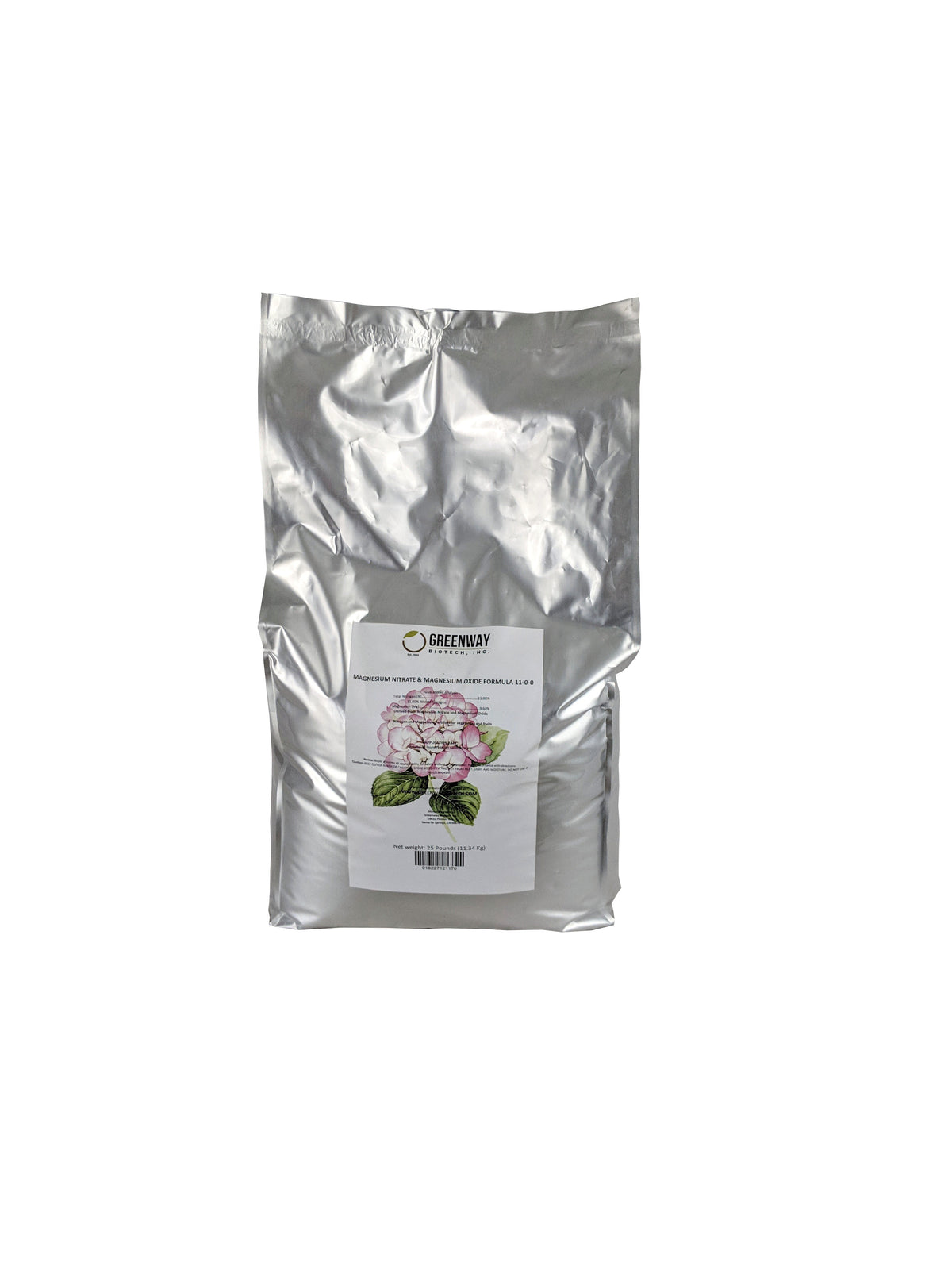
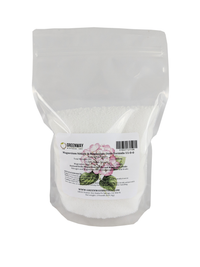
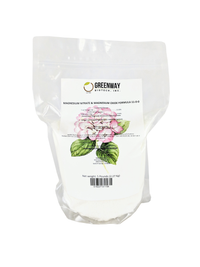
Water-soluble magnesium and nitrogen · 11-0-0 · 9.6% Mg
Magnesium Nitrate 11-0-0 is magnesium nitrate, a water-soluble salt that supplies 9.6% magnesium (Mg) and 11% nitrogen, all of it nitrate nitrogen. Growers use it as a foliar spray where magnesium runs short on crops such as citrus, fruit trees, grapes, tomatoes, and potatoes, and as the magnesium source in hydroponic, soilless, and fertigation solutions.
Every unit of magnesium comes with about 1.15 units of nitrate nitrogen, so choose it when the crop can use that nitrogen too. Unlike magnesium sulfate, it can share a concentrate tank with calcium nitrate, but keep it out of concentrated phosphate stocks. It is not a practical way to build up soil magnesium; for soil-grown crops, use it in irrigation water at the manufacturer’s fertigation rate. Weigh it: every amount on this page is a weight.
| Specification | Detail |
|---|---|
| Total nitrogen (N) | 11.00%, all nitrate nitrogen |
| Magnesium (Mg) | 9.60%, which is 16.0% expressed as magnesium oxide (MgO) |
| Available phosphate (P₂O₅), soluble potash (K₂O) | None guaranteed (the grade is 11-0-0) |
| Source of both nutrients | Magnesium nitrate. The Safety Data Sheet lists magnesium nitrate hexahydrate, Mg(NO₃)₂·6H₂O (CAS 13446-18-9), at about 100%. |
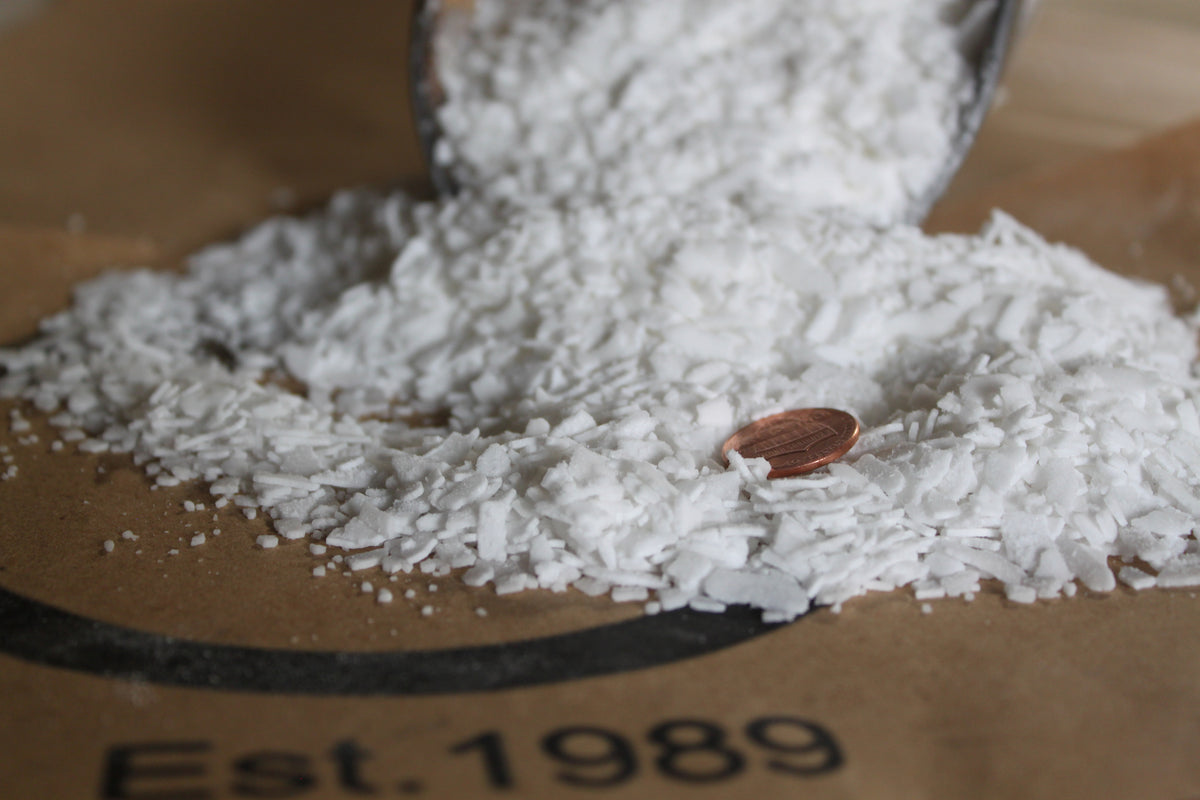
| Form | White or off-white crystalline flakes or granules, odorless. It absorbs moisture from the air. |
| Solubility | Highly soluble: about 125–225 g per 100 mL of water at 20 °C (68 °F), per the Safety Data Sheet. The manufacturer’s data lists insoluble matter at 200–300 ppm (0.02–0.03%). |
| Solution pH and electrical conductivity (EC) | Slightly acidic. The manufacturer’s data gives pH 5.6 and EC 0.88 mS/cm at 0.1% (1 g per liter), and pH 4.8 and EC 7.6 mS/cm at 1%. |
| In solution | 1 g per liter adds 96 ppm Mg and 110 ppm nitrate N. 1 g per US gallon adds 25.4 ppm Mg and 29.1 ppm N. |
| Hazards | Not classified as hazardous under the OSHA Hazard Communication Standard. Dust may cause mild, passing irritation. An oxidizer at high concentrations. See Handling, storage & limitations. |
| Package sizes | 2, 5, 10, 25, and 50 lb (the 50 lb size may ship as two 25 lb bags) |
Percentages are by weight of product. Magnesium is sometimes guaranteed as magnesium oxide: 9.6% Mg and 16% MgO describe the same amount of magnesium (Mg = MgO × 0.603), so convert before comparing products or recipes. The current package label’s derived-from line reads “magnesium nitrate and magnesium oxide”; the Safety Data Sheet lists magnesium nitrate hexahydrate at about 100%, and the 16% MgO figure is the oxide expression of its magnesium. Calculate from the guaranteed figures and weigh the product: this page assumes no weight for a spoonful.
Choose it when a crop needs magnesium and can use nitrate nitrogen along with it.
The manufacturer of this magnesium nitrate gives spray concentrations and timing for citrus, deciduous fruit trees, grapes, mango, olive, potato, tomato, cucumber, barley, and winter wheat. See the foliar table.
It supplies magnesium by weight, 96 ppm Mg for each gram per liter, with no sulfate. The manufacturer’s target for most crops in soilless media is 30–40 ppm Mg in the nutrient solution, counting the magnesium already in the water.
The manufacturer lists it as compatible with calcium fertilizers, where magnesium sulfate is not, so it can go in the same concentrate as calcium nitrate. It must stay out of concentrated phosphate stocks.
Where soil and water analyses show the crop needs more magnesium, the manufacturer’s rate is 0.1–0.3 g per liter of irrigation water per application.
The foliar, solution, and fertigation rates below are the directions published by the manufacturer of this magnesium nitrate. University sources add context under their own headings. Weigh the product, apply it where a soil, water, or leaf test or crop guidance shows magnesium is needed, start at the low end of any range, and test a small area before treating a whole planting.
Confirm the need first. University of Minnesota Extension advises analyzing the soil when the need for magnesium is in doubt, and using plant analysis together with soil testing rather than on its own. Magnesium moves within the plant, so a shortage shows first in the oldest leaves, but diseases, herbicide injury, and environmental stress can look similar.
| Crop | When to apply | Spray concentration | Pounds per 100 gal, as printed | Grams per gallon of spray (calculated) |
|---|---|---|---|---|
| Citrus | 1–4 applications, when the spring-flush leaves are about two-thirds of their final size and not yet hardened | 1–1.5% | 8–12 | 37.9–56.8 g |
| Deciduous fruit trees | 3–4 applications 14 days apart, starting at bloom | 0.5–1.5% | 4–12 | 18.9–56.8 g |
| Grapes, for dry stalk (bunch-stem necrosis) | 1–3 applications 10 days apart, starting after the bunches have formed | 0.5–1% | 4–8 | 18.9–37.9 g |
| Grapes, for magnesium chlorosis | 1–3 applications 10 days apart, starting after berry set | 0.5–1% | 4–8 | 18.9–37.9 g |
| Mango | 1–2 applications, when the young leaves are about two-thirds of their final size | 0.5–1% | 4–8 | 18.9–37.9 g |
| Olive | One week before flowering, and three weeks after bloom | 0.5% | 6–12* | 18.9 g |
| Potato | 3 applications, at 2, 3, and 4 weeks after emergence | 0.7–1.5% | 4–12* | 26.5–56.8 g |
| Tomato | At the beginning of fruiting | 0.5–1.5% | 4–12 | 18.9–56.8 g |
| Cucumber | At the beginning of fruiting | 0.5% | 4 | 18.9 g |
| Barley | At the beginning of shooting | 0.5–4% | 4–30* | 18.9–151 g* |
| Winter wheat | At the start of stem elongation, at node formation, when the flag-leaf sheath opens, and when flowering is complete | 0.5% | 4 | 18.9 g |
A 1% spray is 10 g of product per liter of water, 37.9 g per US gallon, or 8.35 lb per 100 gallons; the grams-per-gallon column is calculated from the concentration column. *For olive, potato, and barley, the two printed columns do not match: olive’s 6–12 lb per 100 gallons is 0.7–1.4%, not 0.5%; potato’s 4 lb is 0.5%, below its 0.7%; and barley’s 30 lb is 3.6%, not 4%. This table shows the percentage column as printed; until the directions are confirmed, the calculator starts each of these crops at the lower of the two printed figures (0.5%) and uses 3.6% as barley’s top figure. The directions give a concentration, not a spray volume per acre, so mix enough to wet the foliage of the plants you are treating.
Test a few plants first. The manufacturer advises spraying a few branches or plants and checking them for leaf scorch after 3–4 days before treating the whole crop, because conditions and varieties differ. Dissolve the product in a small amount of water, then add it to the spray tank, and test any tank mix in a small batch first. The manufacturer presents these rates as a general guide and advises following a local crop consultant for the exact program.
For most crops in soilless media, the manufacturer recommends 30–40 ppm magnesium (50–70 ppm as MgO) in the nutrient solution, counting the magnesium already in your water. In a two-tank system, dissolve it in the tank that contains no phosphorus.
Formula. Grams of product = (magnesium target in ppm − magnesium already in your water in ppm) × liters of final solution ÷ 96. Multiply US gallons by 3.785 for liters. If your recipe writes magnesium as MgO, multiply that figure by 0.603 first. Each ppm of magnesium from this product also adds 1.15 ppm of nitrate nitrogen.
| Magnesium target | Per 100 US gal of final solution | Per 1,000 L of final solution | Nitrate nitrogen it adds |
|---|---|---|---|
| 30 ppm Mg (50 ppm MgO) | 118 g | 313 g | 34.4 ppm |
| 40 ppm Mg (66 ppm MgO) | 158 g | 417 g | 45.8 ppm |
Subtract the magnesium in your water first: a water test showing 10 ppm Mg cuts the 30 ppm amount by a third. For an injector, dissolve the amount for the full volume of final solution in the stock tank: at 1:100, a 30-gallon stock tank treats 3,000 gallons.
Set the crop’s magnesium needs from soil and water analyses. Where more magnesium is needed, the manufacturer’s rate is 0.1–0.3 g of product per liter of irrigation water per application (1.3–4 oz per 100 gallons), which adds 9.6–28.8 ppm magnesium and 11–33 ppm nitrate nitrogen to that water. The directions state no frequency, so retest before repeating. The manufacturer also notes that in most irrigation practice the magnesium concentration of the water should fall between 20 and 60 ppm, so count the magnesium your water already carries.
UF/IFAS targets 40 ppm Mg for hydroponic tomatoes up to the third fruit cluster and 50 ppm after that, with nitrogen starting at 70 ppm, and notes that magnesium can vary with the magnesium in well water. It takes its magnesium from magnesium sulfate, in the same stock as its phosphate and sulfate fertilizers, and keeps its final solution at pH 5.8–6.2. Supplying 40 ppm Mg from this product instead would add 45.8 ppm nitrate nitrogen, about two-thirds of that first-stage nitrogen target, and would drop the sulfur the magnesium sulfate supplied, so a recipe built on magnesium sulfate needs its nitrogen and sulfur recalculated before you switch. In Cornell’s hydroponic recipe guide, the two recipes built from single salts, a modified Sonneveld lettuce recipe and the University of Arizona CEAC recipe at 48 ppm Mg, also take their magnesium from magnesium sulfate, in the tank without calcium.
University of Minnesota Extension sets magnesium rates by soil test. For fruit and vegetable crops it recommends 100 lb of magnesium per acre broadcast, or 20 lb banded, on soils testing 0–50 ppm Mg; 50 lb broadcast or 10 lb banded at 51–150 ppm; and none above 150 ppm. Those are pounds of magnesium, not of fertilizer. The table converts them to this product and shows the nitrate nitrogen that would come with it.
| Soil-test Mg and placement | Magnesium (lb per acre) | This product per acre | This product per 1,000 sq ft | Nitrate nitrogen it would add (lb per acre) |
|---|---|---|---|---|
| 0–50 ppm, broadcast | 100 | 1,042 lb | 23.9 lb | 115 |
| 0–50 ppm, banded | 20 | 208 lb | 4.8 lb | 23 |
| 51–150 ppm, broadcast | 50 | 521 lb | 12.0 lb | 57 |
| 51–150 ppm, banded | 10 | 104 lb | 2.4 lb | 11 |
| Above 150 ppm | 0 | None | None | None |
At the broadcast rates, the nitrogen that comes with the magnesium (57–115 lb per acre) would have to be counted against the crop’s whole nitrogen budget, which is why this page does not recommend this product for building soil magnesium. Minnesota names dolomitic limestone as the most cost-effective way to apply magnesium, notes that deficiency there has been seen only on very acid soils, below about pH 5.5, and lists potassium-magnesium sulfate as a source when raising soil pH is not wanted. It also notes that an ideal soil calcium-to-magnesium ratio has never been verified by research in the Corn Belt, so go by the soil-test magnesium level rather than a ratio. These are Minnesota recommendations; where your state’s soil lab gives a different magnesium recommendation, use it, and convert it with pounds of product = pounds of Mg ÷ 0.096.
The package label (see Product documents) describes the product as a nitrogen and magnesium fertilizer for vegetables and fruits and prints one application rate: 4–12 pounds per 100 gallons of water, with no method or timing. That is a 0.48–1.44% solution, the strength of the manufacturer’s foliar sprays above, so this page applies it as a foliar spray at the concentration and timing for your crop. The full 4–12 lb range matches deciduous fruit trees and tomatoes; for cucumber, olive, and winter wheat the manufacturer gives 0.5%, the label’s low end, and for grapes and mango no more than 1%. Hydroponic, soilless, and fertigation solutions use the much lower rates above: fed to roots at 4–12 lb per 100 gallons, a solution would carry 460–1,380 ppm magnesium, about 12 to 46 times the 30–40 ppm soilless target. If your package prints a rate other than 4–12 pounds per 100 gallons, email questions@greenwaybiotech.com before applying.
No rate is given here for lawns, houseplants, or foliar sprays on crops the table does not list, because none of the sources used on this page gives one for this product. For any of these, email questions@greenwaybiotech.com with your plant, growing method, and any soil, water, or leaf test.
Formulas. Foliar sprays: grams of product = spray concentration (%) × 10 × liters of spray, or × 37.85 × US gallons. Nutrient solutions: grams = (magnesium target − magnesium in your water, in ppm) × liters of final solution ÷ 96. Irrigation water for soil-grown crops: grams = 0.1 to 0.3 × liters of irrigation water. Divide grams by 453.6 for pounds.
Worked examples. One gallon of tomato spray at 0.5%: 18.9 g of product; a 2 lb bag covers it. A 100-gallon citrus spray at 1%: 3,785 g (8.35 lb); a 10 lb bag covers it. A 50-gallon fresh batch of nutrient solution at 30 ppm Mg, from water with 10 ppm: (30 − 10) × 189.3 L ÷ 96 = 39.4 g, adding 22.9 ppm nitrate nitrogen; a 2 lb bag covers it. A 30-gallon injector stock at 1:100 for 30 ppm Mg, from water with no magnesium: 7.82 lb (3,549 g) in the tank, treating 3,000 gallons; a 10 lb bag covers it. 500 gallons of irrigation water at 0.1 g per liter: 189.3 g; a 2 lb bag covers it.
The calculator below asks for your crop and spray volume, your solution volume and water test, or your irrigation volume. It applies the manufacturer’s rate for that use, starting at the low end of any range, states the magnesium and nitrogen supplied, and recommends the smallest single bag that covers one spray tank, batch, or application, plus a lower-price bag combination when one exists. Prices, tax, and shipping are confirmed at checkout, and availability is confirmed when you add to cart.
The calculator needs JavaScript. If it does not appear, use the rate tables and formulas above to choose a size.
Magnesium moves within the plant. When supply runs short, the plant shifts it from older leaves to new growth, so deficiency shows first in the oldest leaves (University of Minnesota Extension). Diseases, herbicide injury, and environmental stress can cause similar symptoms, which is why a soil test, or plant analysis alongside it, confirms the cause.
All of the nitrogen in this product is nitrate. As roots take up nitrate, they release hydroxide and bicarbonate, so a nitrate supply tends to make the root zone more basic, while ammonium makes it more acidic (Dickson and Fisher, HortScience, 2019). In the tank, the solution itself is slightly acidic: the manufacturer’s data gives pH 5.6 at 1 g per liter. The Safety Data Sheet notes that nitrate is highly mobile in soil and contributes to algae growth in water at high concentrations, so apply only what the crop needs.
Because it carries no sulfate, it can share a concentrate with calcium nitrate (see Related products & compatibility for which stocks stay apart). The manufacturer recommends foliar sprays where magnesium must be corrected quickly or where root uptake is impaired, and describes foliar spraying as a way to supplement plant nutrition.
This describes magnesium and nitrate nutrition in general; it is not a trial of this finished product.
Match the product to the need your soil, water, or leaf test shows. Analyses are each product’s guarantee as shown on its page.
| Option | Supplies | Choose it when | Limitation |
|---|---|---|---|
| Magnesium Nitrate 11-0-0, this product | 9.6% Mg, 11% nitrate N; water-soluble | A spray or nutrient solution needs magnesium and the crop can use nitrate nitrogen, or the magnesium must share the calcium nitrate tank | Adds 1.15 lb of nitrogen per pound of magnesium; not a practical soil magnesium source |
| Epsom Salt (Magnesium Sulfate) | Magnesium and sulfur; no nitrogen | The crop needs magnesium without more nitrogen, or needs sulfur too | Sulfate and calcium can precipitate in concentrate, so it stays out of the calcium nitrate tank |
| Sulfate of Potash Magnesia 0-0-22 | 22% K₂O, 11% Mg, 22% S | A soil test calls for potassium, magnesium, and sulfur together | Supplies potassium and sulfur whether or not you need them |
| Dolomite Lime | 22.7% Ca, 11.8% Mg | A soil test calls for lime, and magnesium is also low | Raises soil pH; not for sprays or nutrient solutions |
| Cal-Mag Plus 2-0-0 Concentrate | 3.2% Ca, 1.2% Mg, 0.1% EDTA-chelated Fe, 2% nitrate N | You want calcium and magnesium together in one product | Much less magnesium per pound; follow the directions on its page |
It supplies 9.6% magnesium, equal to 16% magnesium oxide (MgO), and 11% nitrogen, all of it nitrate nitrogen. It has no phosphate or potash. Each pound supplies 43.5 g of magnesium and 49.9 g of nitrogen, and 1 gram per liter of water adds 96 ppm magnesium and 110 ppm nitrate nitrogen. The Safety Data Sheet lists the contents as magnesium nitrate hexahydrate.
It depends on the crop. The manufacturer’s directions give 0.5–1.5% for tomatoes and deciduous fruit trees, 1–1.5% for citrus, 0.5–1% for grapes and mango, 0.7–1.5% for potatoes, 0.5–4% for barley, and 0.5% for cucumber, olive, and winter wheat, each with its own timing; for olive, potato, and barley the printed pound figures differ, and the calculator starts at the lower one. A 0.5% spray is 18.9 g per US gallon, and a 1% spray is 37.9 g. Start at the low end, spray a few plants first, and check them for leaf scorch after 3–4 days.
The manufacturer recommends 30–40 ppm magnesium in the nutrient solution for most crops in soilless media. Grams of product = (magnesium target minus the magnesium already in your water, in ppm) × liters of final solution ÷ 96. For 30 ppm in 100 US gallons of water with no magnesium, that is 118 g. Each ppm of magnesium also adds 1.15 ppm of nitrate nitrogen, so count it in your recipe.
Yes, in the same concentrate. The manufacturer lists magnesium nitrate as compatible with calcium fertilizers, where magnesium sulfate is not, and Cornell’s recipe guide explains that calcium can combine with sulfates and phosphates to form insoluble precipitates. Keep both out of the phosphate concentrate: the manufacturer excludes concentrated phosphate solutions, and the Safety Data Sheet warns that magnesium phosphate may precipitate in concentrated stocks. Jar-test new combinations at your own concentrations before filling a tank.
Both supply magnesium. Magnesium nitrate brings nitrate nitrogen with it, about 1.15 g for every gram of magnesium; Epsom salt (magnesium sulfate) brings sulfur instead and no nitrogen. Choose magnesium nitrate when the crop can use the nitrogen, when the water or recipe already carries plenty of sulfate, or when the magnesium must share the calcium nitrate tank. Choose Epsom salt when the crop needs magnesium without more nitrogen, or needs sulfur too, and keep it out of the calcium nitrate concentrate.
Slightly, in two different ways. In the tank, the manufacturer’s data gives pH 5.6 for a 1 g per liter solution and 4.8 at 10 g per liter, so check pH after mixing. In the root zone, roots taking up nitrate release hydroxide and bicarbonate, so a nitrate supply tends to make the root zone more basic over time, while ammonium makes it more acidic (Dickson and Fisher, HortScience, 2019).
It is not a practical choice. University of Minnesota Extension recommends 100 lb of magnesium per acre broadcast for fruit and vegetable crops on soils testing 0–50 ppm Mg. Supplying that from this product would take about 1,040 lb per acre, or 24 lb per 1,000 sq ft, and would add about 115 lb of nitrate nitrogen. Minnesota names dolomitic limestone as the most cost-effective way to apply magnesium on acid soils that need lime; potassium-magnesium sulfate supplies magnesium without nitrogen and without raising soil pH. Base the choice on a soil test.
It is a foliar spray strength. The label describes the product as a fertilizer for vegetables and fruits but gives no method or timing, and 4–12 lb per 100 gallons of water is a 0.48–1.44% solution, the strength of the manufacturer’s foliar directions. Apply it as a spray at the concentration and timing the foliar table gives for your crop: 0.5%, the label’s low end, for cucumber, olive, and winter wheat. Nutrient solutions and fertigation use much lower rates: fed to roots at that strength, a solution would carry 460–1,380 ppm magnesium. If your package prints a rate other than 4–12 pounds per 100 gallons, email questions@greenwaybiotech.com before applying.
Keep it in the original container, resealed after each use, in a cool, dry place out of direct sunlight; it absorbs moisture from the air and can cake. Store it at 55–75 °F as the package label directs (the Safety Data Sheet sets 95 °F as the maximum), away from strong acids, strong alkalis, and organic or combustible materials, and out of reach of children. Wear safety glasses and gloves and avoid breathing dust. If it gets in your eyes, flush them with clean water for at least 15 minutes.
Articles give background. For this product, use the weighed rates and documents on this page.
The foliar, solution, and fertigation rates come from the manufacturer’s directions listed first below; the university and research publications after it supply the context noted beside each, without evaluating or endorsing this product; and the composition, hazard, storage, and first-aid statements come from the label and Safety Data Sheet above.
Rates and sources reviewed October 16, 2026.
Not sure whether your crop needs magnesium, or how to fit this product into a spray program or nutrient recipe? Email your crop, growing method, and any soil, water, or leaf test to questions@greenwaybiotech.com, or call (562) 351-5168, Monday to Friday, 7 AM to 5 PM Pacific, and we will work through it with you.
Ready to buy? Calculate your amount & choose a bag
Every order carries a 90-day satisfaction guarantee, and we pack and ship from Madera, California. You can also choose a package weight from the size selector at the top of this page.
Greenway Biotech, Inc. is a family-owned California company that has blended and packaged specialty fertilizers and soil amendments since 1989, now based in Madera.